Replacing culvert at a crossing that's never dry

   / Replacing culvert at a crossing that's never dry #1  

Boondox

Elite Member
Joined
Apr 6, 2000
Messages
3,871
Location
Craftsbury Common, Vermont
Tractor
Deere 4044R cab, Kubota KX-121-3S
I've studied the threads on installing culverts, but none appear to have the same challenges I face. I have a 10 foot long 24 inch diameter culvert that is (a) a tad too small to handle the seasonal volume of water that flows in the stream, and (b) too short to permit a sufficient amount of fill to drive my tractor or excavator safely across. Unfortunately, my woodlot is on the other side of the stream.

I'm going to replace it with a 20 foot long 36 inch diameter double walled culvert that will allow me to build the crossing up with fill, which I have plenty of. I have two challenges:

1) With water constantly flowing (on a dry day it's two feet wide and a couple inches deep), will it be possible to spread and pack down a stone base?

2) The approach is very narrow. In a perfect world I would be able to use the tractor bucket to hold the new culvert in place while adding fill, but there's barely enough room for the excavator as it is. Is there another way of preventing the culvert from shifting as the fill is placed around it?

Advice welcomed.

Pete
 
   / Replacing culvert at a crossing that's never dry #2  
Pete, you might have to forgo the stone base. I know I did a 4" crusher base on mine, but that was because it was going to be inspected and that's what the highway department wants. I've seen many other culverts installed in the area with no base or bottom grading/prep done at all. The existing base under your culvert now might be OK as-is.

If you determine that you really need a base, crusher run is the best, but might be messy when dumping into water. So I'd maybe up the size to #78 or #8 gravel, which still have small pieces but are washed of all dust and won't become muddy. Could maybe even use #57 gravel if the pipe didn't have fine corrugations. I think the main goal of the base is to support and conform to the pipe. If the ground is really mucky, I'd start with #3 then the smaller stuff on top.

As far as holding in place, is the new pipe concrete or steel, or plastic? If it's heavy enough, you can use shovel-fulls or small piles of crusher run or fill on each side, at about 4 foot intervals, like "chocks" to wedge it into position and keep it from rolling (that would be the only major motion on a heavy pipe). You can tamp the little piles down side to side as needed to fine-tune centering the pipe. Build up those little piles as high as needed to make it fairly solid. Then start dumping fill over the top, aiming for the exact top of the pipe to keep the fill from pushing the pipe one way or another as it falls. Work the fill around the side and under the pipe with a shovel or stick/pipe, and then tamp that down once it's fairly uniform. Then add more fill, tamp more, etc... Do it in layers to get good compaction, which is critical to support the pipe and help it only see hoop loads.

That said, I have see a lot of construction culverts that are nothing more than a pipe dropped into a ditch with fill dumped on top and then driven over. The tend to look lumpy and lopsided eventually, but they do hold up just fine in most cases. So I think you don't have to be 100% by the book.

Good luck! It's a fun project.
 
   / Replacing culvert at a crossing that's never dry #3  
Maybe some sacrificial rebar stakes and cheap tie-down straps? Drive the stakes in beside the new culvert, run straps over the culvert from stake to stake and bury them in-place. Probably need to form a hook in the top of the stakes before pounding them in.
 
   / Replacing culvert at a crossing that's never dry #4  
If there is much water moving very fast where you need to work, you might run a spare trench along where you are working to temporarily divert the flow.
 
   / Replacing culvert at a crossing that's never dry #5  
A 20 foot long 36 inch diameter double walled culvert is some serious weight. I don't think the two inches of water will move it. Remember the culvert will be setting in the center of the stream and water will be flowing through it, not against it.
 
   / Replacing culvert at a crossing that's never dry #6  
I think his concern was more about having trouble getting the base material in place so the culvert has proper support across the bottom and lower sides rather than the culvert floating away... The depth and width do not matter as much as the rate of flow which wasn't mentioned. It would simply be more difficult and time consuming to work in the water if the water is moving fast enough to make placing the base material difficult.
 
   / Replacing culvert at a crossing that's never dry
  • Thread Starter
#7  
Some good advice, thanks. The flow is significant only after a rain as the entire cirque drains via that stream, but between storms it's just a low volume babbling brook. And Sysop is right; my concern is the fill displacing the plastic culvert. But I have a channel that's pretty deep, so if I go slow and tamp things down I should be fine. BTW a parallel trench is not an option due to granite boulders on either side that outweigh my excavator by several tons.

Thanks again.
 
   / Replacing culvert at a crossing that's never dry #8  
Is it possible to do this a different way?

For instance, I would strongly consider leaving the existing 10' x 24" culvert in place. Build small coffer dams on either end to keep the water flow through the culvert.

Then add a 20' x 24" plastic culvert next to the original one. Then re-arrange the coffer dams to send water flow through the new culvert and add a 5' section to each end of the existing culvert.

The final result is two parallel 24" culverts, which will carry ~88% of the water a 36" culvert will, and the advantage is that you never have to lay a culvert in running water. There is a second advantage of a lower profile with two 24" culverts than one 36" one.

I suspect 30' of 24" culvert will cost just about the same as 20' of 36" culvert.
 
   / Replacing culvert at a crossing that's never dry #9  
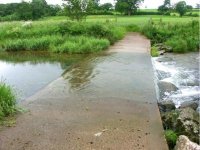
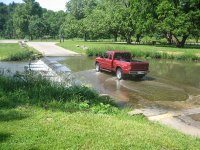
I like fords. A 14 foot wide ford 6 inches deep will be about the same volume of water as a 36 inch culvert. It doesn't get plugged, or wash away in a storm.

Small version:

Lyvennet_Crossrigg_Ford.jpg

Larger version:

297506d1358040636-bridge-questions-800px-ogle_county_il_white_pines_state_park_fords3.jpg

Bruce
 

Attachments

  • Lyvennet_Crossrigg_Ford_270612_02_309130190.jpg
    Lyvennet_Crossrigg_Ford_270612_02_309130190.jpg
    2.3 KB · Views: 980
Last edited:
   / Replacing culvert at a crossing that's never dry #10  
If the ground under the pipe is solid then you would be fine putting down something that will pack well that's stone with fines. If it's muddy then larger stone that will sink into the mud. It doesn't have to be perfect. Once you lay the stone put the culvert in place and then put more solid fill around the inlet to the new culvert. That will force the water through the pipe. You can give the muddy ground time to dry and you can pack fill solidly around the culvert. I would use something like 3/4 crusher run around the culvert.
 
   / Replacing culvert at a crossing that's never dry #11  
   / Replacing culvert at a crossing that's never dry #12  
You need a place for the water to flow while you are working. Dig out a channel about 4" deeper a couple feet beyond your proposed pipe run. Then back up and dig out your existing pipe, throwing the material up stream blocking your pipe, but allowing the water to flow threw the new channel. This way you can work in the dry, and make sure your pipe is set right, and compact in lifts instead if rushing to beat the water. Once the new pipe is in and back filled, refill the channel, in lifts of coarse. While I say you can take your time, I would make sure to get it done all in the same day to prevent an over night rain from washing your road away.
 
   / Replacing culvert at a crossing that's never dry #13  
The way the excavation guy did it at our camp for our 30 foot 24 inch he just put it in the flowing stream and it dint move the stream is 2 feet across and about a foot deep in the spring and 3 4 inches the rest of the year
 
   / Replacing culvert at a crossing that's never dry #14  
You do not want a stone base as it will allow an alternative path for the water and eventually float your culvert out of the ground. I would add another 24" alongside the existing for increased capacity. A perfect base will not occur but everything will be fine.
 
   / Replacing culvert at a crossing that's never dry #15  
A crossing like that may not be legal here.

Yeah, it's nice but the DEP would probably consider it a fish blocker. They are replacing culverts that don't allow the movement of spawning fish, or traps hatch-lings into a particular portion of a stream.

I don't know if it applies to the OP's case, but the DEP has been using big diameter "U" culverts and embedding the lower portion into the stream bed. The goal is to maintain an approximate natural stream channel bottom.

Most of the streams around me have very rocky bottoms, the water has cut down to the ledge (bedrock). Stowe, VT is probably similar. That does limit the choices.
 
   / Replacing culvert at a crossing that's never dry #16  
For holding I was thinking of a couple of screw eyes screwed into the top of the culvert and then you can put a piece of rebar through them to hold it in place.
 
   / Replacing culvert at a crossing that's never dry #17  
Hello Pete.

Pictures please!

Suggestions:
After original culvert removal build a smooth base, maybe just a tad higher in the middle, using the minimum crushed gravel. Then place the culvert and tie a rope?? Around the upstream end to a tree. Really not needed. Then start laying crushed gravel fill at the centre where you will be driving till the culvert is covered. Now you got a place to work from and backfill the rest keeping crushed gravel against the pipe. Try and place some bigger boulders around the inlet and outlet and on the stream bed.
Don't get hung up on compaction when first starting. Save that ill you get enough fill in to cover the pipe and got room to work.
When you're ready to go be adaptable.:D

Ready for PAINT SEASON!
 
   / Replacing culvert at a crossing that's never dry #18  
You may want the gravel fill if possible, I notice you're in stowe - if you use frost prone material (clay and plain dirt) your culvert may float to the surface after 10 winters or so if the ground over it is plowed or packed and it's above the frost line (4 feet or so around here). My driveway culverts did this and I replaced them and placed 3/4 stone 6" below, 6" beside, and 3' over the culvert and they haven't risen in 6 years.
 
   / Replacing culvert at a crossing that's never dry #19  
Many ways to go about it for sure. I like the adding a 2nd 24" beside the first personally as it can actually be slightly higher and on a dry side 2 feet away only flowing water when the first is half full. I been contemplating replacing my bridge with a 36' or so culvert with creek run on top. My bridge has a good frame still but the treated wood deck and poles are shot. Cost wise the treated wood is about 1/2 cost of a culvert and I can place it dead onto the bedrock and back-fill with the wash/gravel out of the creek to a pretty deep depth if I want and can drag logs across then without worry about damaging the decking on the bridge.

On your 36" if you pull out the 24" try to maintain the half round bottom and build out for the longer length. Stake some rebar into ground & cheap rope over top. Bend a U on one end to tie rope to the rebar & dont hammer it all way in until the ropes are on it. Hammer rest of way down to tighten the rope, (assuming you are not on bedrock now.) Back fill right on top of the culvert then going slow but dont pack it tight to the culvert. It will tend to PUSH UP trying to pack it too tight real fast can still push them up if you are too far off the side of the culvert. It will naturally pack and silt in as the creek flows thru & some will go around it silting it tightly in no time.

This is what my creek bottom looks like flows 90% of time only been damp holes/springs/dry 3 or 4 times in 13 years but been no "Top Flow over gravel" usually less than a week or two per year & still flowing THRU the gravel.


creek here is about 6'wide with level-ish bottom with maybe 1" water flowing. I can drive my 6' box blade up/down the creek in some areas when it is low flow.


In Winter during snow melting time w frozen ground.


What the "Bed Rock" sandstone/shale rocks look like, this is about 3sq feet of rock and I've built 3 Patios out of it by removing it when the wash is dry.


This is what it looks like when we get 2"/hr rain all day... :eek: I ended up having to move close to 80yards of gravel that washed into my park/picnic area after this flood, we ended up with 3 rains that have done this to me in 13 years now. Pic was taken from my Bridge I want to replace, there is a Granite Bolder where it is spreading left & right that is maybe 5'x4'x? I tried to move it once but just spun all 4 tires on my tractor. (busted a 5/16" chain then tried 3/8" chain when lost traction.

looking uphill same day as above pic.


Tried to find a pic of the bridge but it is not listed now, must have deleted it off PB... The above FLOOD is about 4' wide INSIDE the banks and maybe 16" deep on average at the center where it spread out was maybe 15' wide and turned left into the mowed grass picnic area. I had a gravel bank this time that was maybe 100' long by 4 or 5 feet wide and maybe 18" deep of wash/run gravel sand mix. It flooded that time and one more time the following week AFTER I cleaned it all up and re-seeded the picnic area ... Go figure it was just my luck lol.. My neighbor and I put it all into his drive using my tractor & dump trailer and he loaded the dump trailer. The last time it washed out I used larger rock to build up the bank in that area which I'm hoping will solve that.

Mark
 
   / Replacing culvert at a crossing that's never dry
  • Thread Starter
#20  
Okay, Egon's point about pix is well taken. I'll try to get some before the weekend if I can get home before dark.

Existing 24" culvert is on bedrock. There is a nine foot drop on the downhill end into a shallow pool, so no way for fish to get upstream. Not much stream upstream anyway, only about 100 yards before it disappears into the soggy forest it drains. The stream cuts thru a channel in the granite, so there is no way to run a parallel trench or to bury another culvert next to the existing one. Also not possible to pound rebar into solid granite. The stream runs thru a low point on the property and with a 20 foot length of culvert I could cover it with four feet of fill. Concrete footings are not an option because of the granite ledge and with minus 30F temps in winter I can't plant them deep enough.

And to Egon's other point, this is Vermont. Large stones I have! :)
 

Marketplace Items

5ft Pull-Behind Rotary Tiller Tractor Attachment (A59228)
5ft Pull-Behind...
2021 BMW 1200RT (A55853)
2021 BMW 1200RT...
2006 Acura RL Sedan (A59231)
2006 Acura RL...
2016 Ford F-150 Ext. Cab Pickup Truck (A59230)
2016 Ford F-150...
2019 KOMATSU PC490LC-11 EXCAVATOR (A60429)
2019 KOMATSU...
CATERPILLAR 72" HANG-ON WHEEL LOADER FORKS (A60429)
CATERPILLAR 72"...
 
Top