Running a Hydraulic Motor - Valve Question

   / Running a Hydraulic Motor - Valve Question #21  
I'm not too lazy to go to the Prince manual to look but I am seeking confirmation / support. I'll go back to trying to figure out what Prince says and if they have anything like that.

I need to run a motor Reverse, Neutral (ports blocked to hold), Forward and then Free Spool. Imagine this sequence in the order listed as you move the control handle. Pulling back would be reverse and pushing all the way forward would be Free Spool. Being free spooling in Neutral is unacceptable since I need to hold a load in that position and passing through the Neutral slot while not being able to hold the load would be a problem.

What type of valve should I use?????

No direct knowledge of the JD valves, but in general...

When running a hydraulic motor, you have to remember that it is really a pump in disguise. So, if there is a lot of rotational momentum (like a rough cut mower), the motor will keep turning from that momentum. You stop the flow of fluid to the motor it can't instantly stop. It will then start acting like a pump, but the lines will be deadheaded with no relief. If the momentum can provide enough instant engery, the pressure can get very high very fast and "bad things" may happen.

Motor spool valves allow for free wheeling in neutral. Standard spool valves don't. At a guess, the "deluxe" valves may have a relief built in? You may want to add a relief valve between the inlet and outlet of the motor for protection.
Fairly cheap and easy to do. Parts from surpluscenter.com.
 
   / Running a Hydraulic Motor - Valve Question #22  
A standard 4 way valve with a crossover relief in the work lines will do what you want.
 
   / Running a Hydraulic Motor - Valve Question #23  
It would appear from your statement that you need a single spool valve with float.

You could get a loader valve which will match the GPM or this one spool valve with float.

http://www.surpluscenter.com/Hydrau...INCE-RD512GG5A4B1-OC-VALVE-W-FLT-9-6701-F.axd
Relief valve.

http://www.surpluscenter.com/Hydrau...00-3000-PSI-HYD-CUSHION-VALVE-9-4019-50-H.axd

Reverse, hold in neutral, fwd, and float/free wheel. Allows motor to turn with a load, or force the motor to turn manually.

Hydraulics:
Type: open
Capacity: 10.3 gal [39.0 L] (9-speed)
11.5 gal [43.5 L] (12-speed)
12 gal [45.4 L] (24-speed)
Pressure: 2860 psi [197.2 bar]
Valves: 0 to 3
Pump flow: 18.7 gpm [70.8 lpm]
Total flow: 25.3 gpm [95.8 lpm]
 
   / Running a Hydraulic Motor - Valve Question #24  
The importance of a crossover relief or some component filling that role cannot be overstated.
 
   / Running a Hydraulic Motor - Valve Question #25  
Thanks and thanks as well to RickB. I was headed in that direction but wanted support and illumination. I plan on running this off of one of my three ways. Not much volume is needed since the motor application is SLOOOOW RPMs. The hydraulic cylinders will need a lot of speed either.
 
   / Running a Hydraulic Motor - Valve Question #26  
A related question.

I'd like to put hydraulic rotation on the snow blower chute on my sub compact Kubota. It already has a standard loader valve. 2 spools, one with float. The one with float raises and lowers the snow blower, one without float is not currently being used and I'd like to use this to power a hydraulic motor to turn the chute.

To me, that means a reversible motor, and a couple of hoses, or over $800 to buy the same from Kubota.

Odds are, the motor will run way too fast for the application, so I'll have to slow it down. Looking at flow control valves, I see there are ones that restrict one way, and full flow the other, as well as restrict in both directions. Which would be most appropriate? The single, both way valve would be a lot cheaper, but that would put the valve upstream of the motor in one direction, downstream of the motor in the other. I don't now if this would be harmful or not, or just less desirable or no difference whatsoever. The one way type valve would require one on each side of the motor.

I should be able to get parts required, except the mounting bracket I'd have to build, for about $200 from Surplus Center. A vast savings over Kubota's price, which I simply can't really afford.

Before you say use an electric motor, I have my reasons for wanting hydraulic. Everything from trying to waterproof everything, and frying it anyway, to no good location to put a switch. The joy stick on the loader valve is right there, in my hand, doing nothing. Logic would dictate using it.
 
   / Running a Hydraulic Motor - Valve Question #27  
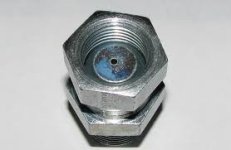
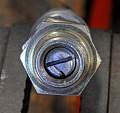
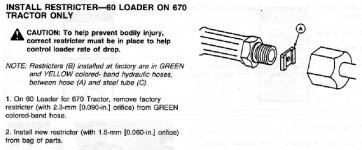
If you are trying to slow a hyd motor, find a washer restrictor or a fitting with a small orifice and insert it into one of the motor fittings.
 
   / Running a Hydraulic Motor - Valve Question #28  
I would install two one-way restrictors oriented so as to limit the flow TO the motor regardless of direction of rotation and allow free flow AWAY from the motor regardless of direction of rotation. Limiting flow or otherwise raising pressure in a motor return path can shorten the shaft seal life significantly.
 
   / Running a Hydraulic Motor - Valve Question #29  
The washers are cheaper and you only need one.

The fluid has to pass through the orifice coming and going.

Select the orifice for the speed.

Can also use a needle valve to adjust flow.
 

Attachments

  • hyd restrictor fitting.jpg
    hyd restrictor fitting.jpg
    6.2 KB · Views: 243
  • restrictor-06.JPG
    restrictor-06.JPG
    3.4 KB · Views: 531
  • restrictors12.jpg
    restrictors12.jpg
    115.4 KB · Views: 188
   / Running a Hydraulic Motor - Valve Question #30  
The washers are cheaper and you only need one.

The fluid has to pass through the orifice coming and going.

Select the orifice for the speed.

Can also use a needle valve to adjust flow.

Style is irrelevant, function isn't. I disagree on the quantity required for the reason I stated. Your mileage may vary, but I'm not going to risk an orbit motor for the price of a one way restrictor. You can choose to do so.
 
   / Running a Hydraulic Motor - Valve Question #31  
Thanks for the advice guys.

I can't heat the barn this time of year, and the old joints don't allow working in the cold, so............ I'm asking around.

I agree form follows function. What good is pretty if it doesn't work? That said, price always plays a bigger issue than I care to admit to.

SO, my current thought is... since I can't do the actual assembly work until spring, when I won't be needing the blower for a while, I'm going to plumb the motor in with small, (which also happens to be cheaper) but identical, fittings and hoses on both sides of the motor, plug it in, see how fast it goes. If it's too fast, I'll install some sort of restriction on both sides. The one way flow valves being the best, but also, the costliest way. But cheaper than a motor with blown seals. AAARRRRGGHHHH, I hate being poor!
 
   / Running a Hydraulic Motor - Valve Question #32  
GPM's and displacement determine the speed of the motor, and the control valve supply fluid to the motor.

Engine rpm also determines the pumps speed, and therefore the pumps GPM.
 
   / Running a Hydraulic Motor - Valve Question #33  
Correct.

Restrictive losses from hose/line length, diameter, size of fittings, number of fittings, etc. also come into play. The biggest pump and valve in the world won't flow any more than what the various lines and fittings allow.

Small lines and fittings will flow less than large ones. I'm certain large lines and fittings would spin the motor too fast. Smaller ones probably will too, but not to as big of a degree. Since I'm not made of money, I'm not buying flow restrictors until I know I need them.

Alternatively, I could do a mechanical speed reduction between the motor and rotor shaft. Cross that bridge when I come to it.
 
   / Running a Hydraulic Motor - Valve Question #34  
Another question guys. I'm just getting more and more confused. The motor I was looking at from Surplus Center says, "three-zone spool valve, integral check valves, high pressure shaft seal and a provision for a case drain to reduce pressure on internal seals to improve product life." The main part I'm beginning to wonder about is the "provision for a case drain". Ok, it improves life, but just how necessary is it? It's claiming a high pressure seal. Since this Kubota is new to me, I'm not sure where I'd plumb a drain line back into the transmission as it shares oil with the hydraulic system. It's rated for 2250 continuous, 3000 intermittent. The tractor maxes at 1850. Seems like a fairly good safety zone on the pressure.

The next size pump they have, (No, they are not the only source, just an easy and fairly inexpensive source) is 4.5 times as large. The ones in between don't have an adequate pressure rating, some weird manifold ports, or other undesirable traits.

The tractor hyrdaulic pump is rated at 6 GPM, but what's the actual flow through the valves? Darn good question, huh? I have to assume it's being shared with the hydrostatic drive and power steering, so there may not be all that much flow left. Hate to spend twice as much on a pump with no drain, only to have it barely move.
 
   / Running a Hydraulic Motor - Valve Question #35  
Case drain can go to any return hose. The fluid that flows from the case drain also lubricates the motor.

GPM determines the speed of the motor, so just reduce the speed of the motor by using a flow control or reduce the engine rpm.

You can also use belt and pulley, or chain/sprockets.
 
   / Running a Hydraulic Motor - Valve Question #36  
The integral check valves will connect the motor case to the motor work port that has the lowest presssure. If when the motor is operating the outflow from the motor flows through the directional control valve and ultimately to the tank, then the pressure at the motor out port (and also the motor case via the check valve) will be virtually that same as the tank. As a practical matter the integral check valves eliminate the need for a case drain line as long as the flow from the motor has an unobstructed path to the tank.

If there is an obstruction to the return flow from the motor, so that the pressure in the motor out port exceeds tank pressure, then the case pressure will increase to the out port pressure unless the case drain is connected to provide a low pressure, unobstructed path to tank. In some applications two motors may be connected in series; that is, out flow from one motor becomes in flow to the second motor; in that case out flow does not have an unobstructed path to tank and motor case pressure rises to the out flow pressure.

It seems to me that you plan to have the motor out flow pass back to the directional control valve and then to tank via the common return line. In that case, the integral check valves will work satisfactorily to keep motor cases pressures virtually that same as return line pressures.
 
   / Running a Hydraulic Motor - Valve Question #37  
You might also consider this.

Quote from Sauer Danfoss:

A case drain line must be connected to one of the case outlets to return internal leakage
to the system reservoir.
 
   / Running a Hydraulic Motor - Valve Question #38  
Not every orbit motor has a dedicated case drain. In fact most small displacement, low torque motors such as discussed here, do not. Certainly one sized to turn the chute on a small 3PT hitch snowblower would not have a separate case drain.
 

Marketplace Items

AEREATOR (A58214)
AEREATOR (A58214)
EZ-GO Utility Cart (A55851)
EZ-GO Utility Cart...
2019 KOMATSU PC490LC-11 EXCAVATOR (A60429)
2019 KOMATSU...
2021 CATERPILLAR GP30N STRAIGHT MAST FORKLIFT (A60429)
2021 CATERPILLAR...
1996 FORD F SERIES DUMP TRUCK (A60430)
1996 FORD F SERIES...
2016 KOMATSU PC240LC-11 EXCAVATOR (A60429)
2016 KOMATSU...
 
Top