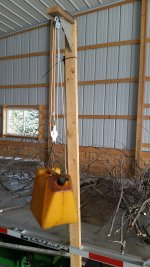
Sheave block mechanical advantage?

/ Sheave block mechanical advantage? #21  
Just a question that I can't get my head around.

For argument, let's say you are lifting a load. You have a block and tackle (hook) attached to the load.

One end of the line goes to your winch or vehicle frame.
The Other goes to your winch drum.

So in theory you have multiplied the pulling force of the winch many times.

But really you have the weight of the load divided by two on your frame and the other half on the drum.

So, how can it be easier to pull, when the Static weight is still there?

Clearly, I must be missing something.
 
/ Sheave block mechanical advantage? #22  
The pulley block attached to the load acts as a lever.

At any given moment, one side of rim is not moving (anchored line). For every inch the hub center moves (hook attached to load), the far side of the rim is moving two inches (winch drum side). And the real joy of the system is, every time it moves, you don't have to re-anchor the lever, it keeps being a "new" lever in the correct perfect position as it rolls.

Now if you really want to have fun, we can throw in parbuckling. This is where the line is anchored, goes out past the load (log) and returns on the other side back to the winch. The log itself becomes the pulley. Obviously, this works better with things like bucked logs or barrels on their side, and not so well with things like trees with tops still attached that will keep them from rolling.

Chambers_1908_Parbuckle.png
 
Last edited:
/ Sheave block mechanical advantage? #23  
I should also note that the total weight on all of the lines is still the same, so if you have one end attached to the bumper and the other to a winch, the total load on the vehicle is the same. Half the load is on each point. This gets important if your tow vehicle is about to slide. You can improve this by putting your anchored line on a rock or tree (if there is one) so then only half the load is pulling on the tow vehicle.
 
/ Sheave block mechanical advantage? #24  
Here is a pic of my 3 to 1 block & tackle. Notice one end of the rope is attached to the lower pulley with a single wheel. The top pulley has 2 wheels. I pull on the end of the rope you see beside the 2x4.


3 to 1.jpg
 
/ Sheave block mechanical advantage? #26  
So that is kind of my point.

The winch I just got is drum pull rated at 2000#

So, in some manner I rig up a block and tackle and lift a 6000 # load.

But, there is still only two attachments points to the drum and frame, which means there is 3000# on each.

So, how can the winch pull 3000 # which is the Static load?
 
/ Sheave block mechanical advantage? #27  
If your arrangement has only those two lines anchored, it will only pull 4000 lbs, not 6000 lbs. (minus friction losses, etc)

If you are pulling 6000 lbs, you have another line you are not telling us about. :D

Bruce
 
/ Sheave block mechanical advantage? #28  
Also, there is a difference between what the winch pulls, and what the tractor pulls. If your anchored line (or one of the pulley sets in a multiple pulley arrangement) is also on the tractor, then it is seeing more of the pull than just what is on the winch.
 
/ Sheave block mechanical advantage? #29  
Doesn't this make you wonder what conversations between Ancient Egyptians must have sounded like as they discussed how the Great Pyramid would be constructed?
 
/ Sheave block mechanical advantage? #30  
To get around the limiting factor of the winch (or vehicle) capacity, you'd have to anchor to a tree or some other sturdy object. Take Bigtiller's picture above, a 200 pound person could lift a 300 pound weight, because the line he's pulling (winch line) has only 100 pounds of force on it. That's how heavy recovery trucks snake big rigs up from an embankment they've went over.
 
/ Sheave block mechanical advantage? #31  
Yes, I was missing a line. So something has to carry the load. Like a crane where the jib or boom carries the load, but the hoist has mechanical advantage via a bunch of sheaves and never sees the full load.
 
Last edited:
/ Sheave block mechanical advantage? #32  
If your arrangement has only those two lines anchored, it will only pull 4000 lbs, not 6000 lbs. (minus friction losses, etc)

If you are pulling 6000 lbs, you have another line you are not telling us about. :D

Bruce

The "rated" pull is usually considerably on the conservative side. I can see a 2,000 lb rated pulling a 3,000 load. Possibly a bit on the extreme side but I wouldn't be surprised.
 
/ Sheave block mechanical advantage? #33  
It would be interesting to see some real world figures as to what these cheap winches can do. Most sound on the verge of death. That Keeper portable winch I got is rated at 2000# and cost all of $110.00 CDN. Comes with nice vinyl battery cables (which look chinsy) and a wired remote.
 
/ Sheave block mechanical advantage? #34  
[video]https://www.google.ca/search?q=pully+mechanical+advantage&ie=UTF-8&oe=UTF-8&hl=en-ca&client=safari#imgrc=RVwuteWB6TBmWM:[/video]
 
/ Sheave block mechanical advantage? #35  
To get around the limiting factor of the winch (or vehicle) capacity, you'd have to anchor to a tree or some other sturdy object. Take Bigtiller's picture above, a 200 pound person could lift a 300 pound weight, because the line he's pulling (winch line) has only 100 pounds of force on it. That's how heavy recovery trucks snake big rigs up from an embankment they've went over.

Oh,so that's how it works? Why didn't someone say so earlier? :duh:
 
/ Sheave block mechanical advantage? #36  
There is a way to multiply your force even more using vector force.
Stretch chain/cable from tree to solid anchor.
Place sheave in middle of chain.
Run winch line through sheave and back to fixed anchor.
A tremendous amount of force can be applied this way from a small winch.

https://www.ropebook.com/wp-content/uploads/2016/11/vector-chart.jpg
 
/ Sheave block mechanical advantage? #37  
I have different take on the issue. What you want to do has hidden dangers might not work as expected. Initially the tree will move in the direction of the force applied but when the rope gets slack the tree is free to fall sideway. So before you cut it make sure that the wind direction is right and the weight distribution of the tree will help you to drop it where you want it. If you tension it with your vehicle or tractor wind force in opposite direction might(unless the vehicle is really heavy) throw it like rag doll. Ask me how do I know it.
 
/ Sheave block mechanical advantage? #38  
There is a way to multiply your force even more using vector force.
Stretch chain/cable from tree to solid anchor.
Place sheave in middle of chain.
Run winch line through sheave and back to fixed anchor.
A tremendous amount of force can be applied this way from a small winch.

https://www.ropebook.com/wp-content/uploads/2016/11/vector-chart.jpg

I used that on a hazard tree. My F150 2x wouildn't pull any more, Tree ready to go but needed a bit more force. I grabbed the cable about 1/4 way out from the truck and swung my weight from it. Success.
 
/ Sheave block mechanical advantage? #39  
I have different take on the issue. What you want to do has hidden dangers might not work as expected. Initially the tree will move in the direction of the force applied but when the rope gets slack the tree is free to fall sideway. So before you cut it make sure that the wind direction is right and the weight distribution of the tree will help you to drop it where you want it. If you tension it with your vehicle or tractor wind force in opposite direction might(unless the vehicle is really heavy) throw it like rag doll. Ask me how do I know it.

I was going to mention that up thread aways. The tow vehicle only starts the tree moving, from then on it is in free fall. The tow vehickle or winch cannot take up slack fast enough to effect more than the first few seconds. I hung a coupld 5 gallong pails of water from the middle of the pulling cable once to maintain the pull for a few seconds longer.
 
/ Sheave block mechanical advantage? #40  
That's why I ALWAYS use a very long nylon rope with a good amount of stretch. The bad thing is, if there are rotten branches or tops, that jerking of the stretched rope can break that stuff off, falling on you.

When I had to cut a lot of foot or so pines and they had to fall where wanted, I used a steel cable, cut them mostly off in proper felling manner, and ripped them down with the backhoe in the direction I wanted. It worked perfectly and really took a lot of the anxiety out of the operation. Like, when's it gonna fall and where?
 
 
Top