Should Pharmaceutical Commercials be allowed on TV?

/ Should Pharmaceutical Commercials be allowed on TV? #64  
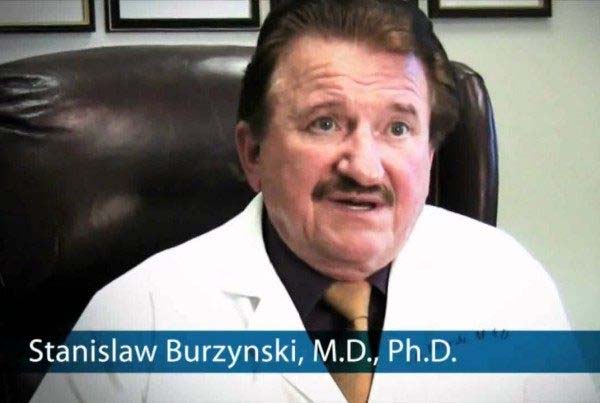
Dr. Bruzenski is a good example of how messed up (corrupt) the process is for getting successful treatments to patients. He had a 90% cure rate for brain tumor cancers.
Learned about him on a "60 minutes" (more than 20 years ago, don't recall the exact date) segment that showed how the g---------ent aided other busineses in trying to steal his patents and financially drain his business to stop his practice.

 
/ Should Pharmaceutical Commercials be allowed on TV? #65  
Dr. Bruzenski is a good example of how messed up (corrupt) the process is for getting successful treatments to patients. He had a 90% cure rate for brain tumor cancers.
Learned about him on a "60 minutes" (more than 20 years ago, don't recall the exact date) segment that showed how the g---------ent aided other busineses in trying to steal his patents and financially drain his business to stop his practice.

Other researchers tried to prove his method worked, and failed.
But a lot of Dr. have researched this as well as other cures like alkalinity.
Some of the Bruzenski research into diet has actually been integrated into modern cancer diet advice.
The Dr. that don't work with Bruzenski that wanted this "cure" to work spent a lot of their own money and time, one was related to my old boss and has been a leader in the trying new things approach and not sticking to mainstream influenced crap.
One of the reasons that immunotherapy is more involved in boosting your own immune system in todays cancer cures and why the percentage of cures has gone up so much.
My old boss had a brain tumor and has been healthy for over a decade.

I do agree most of this research is driven by people who want to keep employed forever, but not all of them and many did try Dr B approach with inconclusive results.

A little trip down google provides all of this information.
 
/ Should Pharmaceutical Commercials be allowed on TV? #66  
University in Fukuoka, Japan—where independently designed studies of Antineoplastons have been underway for 27 years—without Dr. Burzynski’s (the inventor’s) involvement or supervision. Learn how this team of Japanese pathologists, oncologists and surgeons have studied these anti-cancer compounds using their own methodologies—resulting in the first ever independently-run randomized controlled clinical trials.
“After twenty-seven years of independently testing Antineoplastons—including randomized clinical trials, we found that Dr. Burzynski was right. It’s obviously not anecdotal anymore.”
—Hideaki Tsuda, MD – 2013, Kurume Medical University, Fukuoka Prefecture, Japan


/ Should Pharmaceutical Commercials be allowed on TV? #67  

In your articles:
Never mentions that most of his cured patients went through traditional treatments.
Also never mentions what happens to most of his patients after taking this medicine.

The FDA gave him clear and precise instructions on testing etc. and even how to work with them on following the same guidelines others must follow.
They are always onerous, and as I said many Dr have tried to prove him right with no success. Over 30 years or so.
 
/ Should Pharmaceutical Commercials be allowed on TV? #71  
Agree on most points.
Potentially dangerous adverse reactions/effects are one of the reasons for the FDA designating a drug as prescription only; although another determination is that benefits must outweigh risks.

A "me-too" drug is another drug in the same class as an existing drug but changed enough to call it a new drug. Good examples here are with the original drug Prilosec(omeprazole), then all the me-toos in the same "proton pump inhibitor class" like Prevacid(lansoprazole), Protonix(pantoprazole), Nexium(esomeprazole), etc. They usually all have very similar efficacy and adverse reactions/effects. Me-toos are different enough that they don't require the patent on the original drug in the class (the "index" drug) to run out.

A "biosimilar" drug refers to another company replicating a large molecule protein brand name drug. Because of the size and complexity of these large molecule protein drugs, it is nearly impossible for a second company to reproduce the original company's process and produce exactly an identical large molecule drug. However, they can very closely reproduce it to have the same function and they are required to show the FDA that it is equivalent to the original drug. The concept is very similar to a "generic" drug which refers to small molecule drugs which can be chemically reproduced exactly and both generics and biosimilars require patent expiration before approval. To my knowledge all biosimilars currently require a prescription in the US.

I also consider biosimilars to be the same principal as a me-too drug. I do understand the differences but dont think it is relevant to this forum thread. Basically its a situation where a drug company is trying to milk as much money out of patients without needing to put in all of the work to create something new.
 
 
Top