Straight Fence Line? Long Distance...

   / Straight Fence Line? Long Distance... #1  

SanDucerro

Gold Member
Joined
Jan 5, 2013
Messages
335
Location
Yoakum, TX
Tractor
Kubota M7040 - L3130 - ZD326S
I have two posts 570 feet apart. I want to create a straight line between the two posts for a fence. I assume there is a "trick" to getting a straight fence line over a long distance, but so far the technique has escaped me. So, how do you do it?

I looked at buying a transit, but the instructions say 200 feet is the maximum distance. I don't think a string stretched tight will work as I'm in a rather windy area. To complicate matters, the line I need to "draw" is on flat ground until the 400 foot mark - at which point it gently slopes down so that the "end point" is about 4 foot lower than the start point.
 
   / Straight Fence Line? Long Distance... #2  
Sounds like you can see one post from the other. As long as you have someone to help you, have them locate a stake in the center by sighting down the post line. Then keep adding center stakes between the others until you have a short enough distance to stretch a line. You can do this by yourself by trial and error, but you may to a lot of walking to get the first center stake set perfectly.
 
   / Straight Fence Line? Long Distance... #3  
Run a string from one corner to the other.
 
   / Straight Fence Line? Long Distance... #4  
For hi tensile wire I just stretch the bottom wire after setting the end braces, then drive the posts against the wire.

For all other types of fence I use temporary fence wire (aka poly wire) or masons twine, stretched as tight as possible by hand. I have seen others use plastic square baler twine. Sometimes on a long run you have to put a post or two in the middle, just by eye balling it, to help keep the line where it needs to be. You can also "stake" the twine where it needs to be, then drive the posts or drill the holes tight against the twine.
 
   / Straight Fence Line? Long Distance... #5  
Besides suggestions above have also used good rifle scope mounted on wood. ;)

Boone
 
   / Straight Fence Line? Long Distance... #6  
   / Straight Fence Line? Long Distance... #7  
The rifle scope is a great idea and would work perfectly unless you are putting the fence posts up by yourself.
 
   / Straight Fence Line? Long Distance...
  • Thread Starter
#8  
The end post on the lower point of the property line is only 4 foot tall - and unfortunately, it's not visable from the other post due to the gentle slope. As such, stretching a line between the two posts is not possible. I can place a tall t-post in front (or behind) the low side post to get some extra height so I can "see" the post. With that in mind I had hopes that there was a tool or sighting method that would make the job easier - and it would be great if it could be done by a single person.

I think KennyG is on the right track.
Sounds like you can see one post from the other. As long as you have someone to help you, have them locate a stake in the center by sighting down the post line. Then keep adding center stakes between the others until you have a short enough distance to stretch a line. You can do this by yourself by trial and error, but you may to a lot of walking to get the first center stake set perfectly.

I found a website that documented a very similar idea - where you set a post about 200 feet using "eyesight", then move up to the 200 foot post and use it to sight in the next post. Then you go to the last post you set, turn around, and resight the line back to the original post. Then you repeat as necessary all the way down the line. The process makes sense and overcomes "issues" (or unsatisfactory results) we obtained today when we tried to "sight" in the posts. Of course I was hoping there was a super neato tool or gadget I could buy that did all of this for me. Once I finish the main fence line I need to repeat the process for 48 rows of trellis - so finding a quicker method would be very nice....
 
   / Straight Fence Line? Long Distance...
  • Thread Starter
#9  
Besides suggestions above have also used good rifle scope mounted on wood. ;)

Boone

I was thinking of using a spotting scope mounted to a tripod... But still looking for a "trick" that allowed me to do this single handed - of course that may simply be wishful thinking...
 
   / Straight Fence Line? Long Distance... #10  
The end post on the lower point of the property line is only 4 foot tall - and unfortunately, it's not visable from the other post due to the gentle slope.
I think KennyG is on the right track.


I found a website that documented a very similar idea - where you set a post about 200 feet using "eyesight", then move up to the 200 foot post and use it to sight in the next post. Then you go to the last post you set, turn around, and resight the line back to the original post. Then you repeat as necessary all the way down the line. The process makes sense and overcomes "issues" (or unsatisfactory results) we obtained today when we tried to "sight" in the posts. Of course I was hoping there was a super neato tool or gadget I could buy that did all of this for me. Once I finish the main fence line I need to repeat the process for 48 rows of trellis - so finding a quicker method would be very nice....

As far as short pole or slight hilly terrain you could use big tieraps or something simular and hold longer/taller pole behind it in place for visial line-up.

Boone
 
   / Straight Fence Line? Long Distance... #11  
I put up a little over 2,000 feet of new fence posts by myself about three years ago. One 900' run, one 600' run, and another 500'+ run. A post every 10'. Same as you I struggled with how to do this by myself and keep the posts straight. bullbreaker's suggestion for a rifle scope is the very best. But by doing this myself it wasn't practical. I did it all with a string. Not so handy on the windy days but it can be done. But it turned out straight as an arrow. After three years my neighbors are still complementing me on my fence.
 
   / Straight Fence Line? Long Distance...
  • Thread Starter
#12  
I put up a little over 2,000 feet of new fence posts by myself about three years ago. One 900' run, one 600' run, and another 500'+ run. A post every 10'. Same as you I struggled with how to do this by myself and keep the posts straight. bullbreaker's suggestion for a rifle scope is the very best. But by doing this myself it wasn't practical. I did it all with a string. Not so handy on the windy days but it can be done. But it turned out straight as an arrow. After three years my neighbors are still complementing me on my fence.
String was my original thought - even went and bought four rolls of twine today. But the wind was so strong I never even opened the packages. The property is about 95 miles from our house, so it becomes probmatic to find a non-windy day. If it's calm here at the house, it could still be a virtual wind tunnel out at the farm.
 
   / Straight Fence Line? Long Distance... #13  
Wind is a problem. For sure in the winter here. It's flat as a pancake here and I can see for over a mile from my front porch. If it's windy it will take some extra time. I would stretch a string from the corner posts and then push in a fiberglass pole in the ground in the middle when I thought the wind had settled. Then I would sight down the line. Sometimes it was straight. Sometimes I had to do it over again. It's a lot harder if you are doing it by yourself but I had to do it that way on the posts. When it came to the fence stretching I did have to call in some favors from my friends. I just can't stretch and nail fence by myself.
 
   / Straight Fence Line? Long Distance... #14  
I am doing long runs and using a fishing reel. Tie the line to post,string it out to other post.Get string tight, adjust the line to it looks straight and I keep it as close to ground as I can. Step off for my post and use "marking paint" to mark spots for post. Reel line up and start drilling my post holes. Found a bright green fishing line at a tackle shop and had that put my reel. Works good so far. I was using regular string, but the wind was a problem. The fishing line works alot better, plus alot easier to just reel it up :). Also use some 3" x 10' pvc pipe to slip over T-post when starting the initial fence line and use at each end of the run. When I set the posts I use them to help keep the post straight/in line as I put them in and tamp. Easiest way I have found for when I am doing it by myself
 
   / Straight Fence Line? Long Distance... #15  
When we did our fence, i set my corner tposts and then bought some 10-20' white pvc pipe and painted hazard orange stripes on it and slid it over the corner posts. I didnt have the gun sight available, but if you mounted that on a wooden corner post and pointed it towards the other white corner you might be able to see a 20'tall pipe in the air. Just have a buddy watch through the scope and look for another 20' white pvc pipe that you're carrying around. When you get in the crosshairs your in line.
 
   / Straight Fence Line? Long Distance... #16  
Wind is a problem. For sure in the winter here. It's flat as a pancake here and I can see for over a mile from my front porch. If it's windy it will take some extra time. I would stretch a string from the corner posts and then push in a fiberglass pole in the ground in the middle when I thought the wind had settled. Then I would sight down the line. Sometimes it was straight. Sometimes I had to do it over again. It's a lot harder if you are doing it by yourself but I had to do it that way on the posts. When it came to the fence stretching I did have to call in some favors from my friends. I just can't stretch and nail fence by myself.

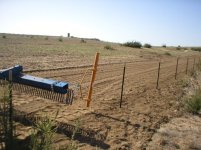
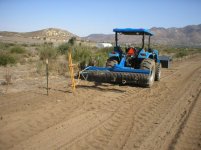
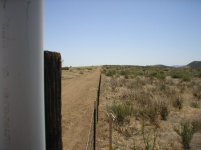
What type of fence did you put up? There are stretchers for barbed wire and for field fence. Both work very well. ;)
 

Attachments

  • P5200016.JPG
    P5200016.JPG
    129.7 KB · Views: 754
  • P5200018.JPG
    P5200018.JPG
    120.2 KB · Views: 609
  • P5200019.JPG
    P5200019.JPG
    101.7 KB · Views: 545
   / Straight Fence Line? Long Distance... #17  
What type of fence did you put up? There are stretchers for barbed wire and for field fence. Both work very well. ;)

I put up Red Brand No-Climb horse fence. I have used stretchers like you show in your pictures and they work very well. When it came to stringing the fence I bought a fence unroller/stretcher from TSC. Not all that expensive and a tremendous time saver.
 
   / Straight Fence Line? Long Distance... #18  
Many times I've done fence lines 1/4 mile or more. We do it by eye. Afterall, don't you look down the line to verify after using a string or wire? Most west coast fence companys won't hire a foreman that uses string to set posts.

Basically I start off with a post at each end, normally here in Texas I set the post three to four inches inside the property line unless the neighbor is sharing the cost. Then I set it on the line. These posts are a just stabbed into the ground because they are temporary sight posts.

If I have a clear line of sight end to end then I won't use a middle post unless there is grade change. then I will place posts just off line at the height I want to use at the high and low points. I shoot height and line at the same time btw.

Let's say I'm setting posts on 8' centers, my most common situation. I will use either a claw hammer as a pick and scratch a line perpendicular to the line every eight feet across the line. Sometimes I use upside down paint. If you use upside down paint try to use white. Utility locators can then distinguish your post marks from other utility marks. The worst color to use is orange because it is telco and cable marking color. If you are along the road then chances are most likely you will have a lot of those.

Once the post marks are in I come back with a sight post midway for line. I then sight down the line starting at one end using the mid post and the other end post for line. When I hit the mid post I have to turn around and sight backwards towards the other end post. At each post I use either the scratch mark or upside down paint to mark the line. At every post I should have a plus sign.

Next I dig my holes. I will center the auger over a post width over every plus sign, same side, doesn't matter which side. This is to keep the posts in the middle of the holes.

When the holes are dug I will set the two end posts. I will then set the third post followed by the second post. I do what is called back sighting because I usually work alone. If I have help I can wear two men out keeping me in concrete. Like I said, I set the posts for height and line. Most of my big jobs are pipe fence so all the posts are notched, coped, fish mouthed, fitted up, prior to use. Ends and corners I turn the cope down instead of having it up.

When you are setting pipe fence with a top rail you need a height mark 1/2 inch below the top rail diameter at each end or corner. You shoot your height to that mark instead of the top of the posts. Gate posts are shot to the top of the posts.

When sighting in the posts you always shoot to the same side. Let's say I'm doing line posts. I grab the post and center it into the hole, especially in line. Using a plumb level I hold the post plumb and look back at the last post set. I move my post plumb to where the end post disappears behind the next post. I put in concrete. I like my concrete stiff, not dry, but not watery. This allows me to pull the post up for height using the same technique of watching the next post disappear behind the post I'm setting for height. Once the post is set for height and line I go back to the last post and look down towards the other end to verify I'm keeping everything straight.

This takes minutes. In fact when I'm in the zone doing this the post just seems to jump in line and at height. When that happens like I said I can kill two helpers keeping me in concrete with one of them feeding a nine cubic foot mixer and the other shuffling concrete with two wheel barrows.

A couple of tips, one you always start work at the post furtherest away from where your materials are. As you wear down the distance to haul material is shorter. Two, NEVER EVER kick in dirt to cheat on concrete or fail to clean your post holes with post hole diggers even if you are using an auger to dig your holes. If you use concrete the top ten inches of your hole you have now created a very bad thing for the future. First you have created a fulcrum that allows your post to lean easily. The second you have done is the soil in your hole is less dense than the surrounding soil. Water is eventually going to seep down in that cavity and your soil will now compact. When the ground is wet your post will sink.

There's a lot of discussion about whether to use concrete or not. I like concrete for livestock fence. Here's the logic. If pressure is applied against a post without concrete the only resistance is the width of the post. If you have a proper concrete set post you have the diameter of the footer. That can be huge.

If you are working in clay soils there are a couple of other things to consider. One is you have to watch your augers for wear. If your auger is worn you will be making a taper hole. When the clay gets wet and expands that provides a surface for pushing the post up. The same happens when you over fill you hole and leave a mound above the hole. This can be a serious issue over time because the crown or mound will be above the grade when the clay dries and shrinks away from the post. You now have a hazard if you have a horse. Btw, it never falls back down when it dries, it always continues to rise each wet/dry cycle.

I hope this helps. I've only been doing this professionally since the early seventies.
 
   / Straight Fence Line? Long Distance... #20  
I clear the fence line, set the corner posts, use a tight string and try not to let it hit the ground, measure the distance using a large measuring wheel (tape measure on a wheel), and a mason's level to set my t-posts/wood posts vertical next to the string without touching it. Longer distances need posts in between to hold the string.
 

Marketplace Items

TEST YOUR BID BUTTON! (A60429)
TEST YOUR BID...
John Deere 6110M (A60462)
John Deere 6110M...
KBH Tank Trailer (A61307)
KBH Tank Trailer...
2016 Ford Explorer AWD SUV (A59231)
2016 Ford Explorer...
Kubota M4700 (A60462)
2018 Chevrolet Tahoe SUV (A59231)
2018 Chevrolet...
 
Top