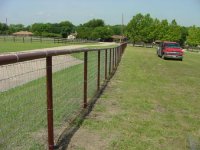
stretching farm fence

/ stretching farm fence #1  

wroughtn_harv

Super Member
Joined
May 12, 2002
Messages
6,092
Location
Denison, Texas
Tractor
2013 Volvo MC85C
This subject comes up often. I do a lot of it.

These observations are my own and this is only the way I do it. I have my reasons for just about every part of the process. Some of those reasons might or might not be important to anyone else.

From a professional's point of view I like the better quality fabrics. It's better to work with and when done properly it looks and works better, especially over time.

The problem I have with the fixed knot fabrics is they've got built in stretch kinks. What this means over time is it's going to deform. Fabrics like non climb and V Mesh don't come with built in stretch kinks. But they are harder'n heck to get to roll up and down grades. Their upside is if you've got some of the horizontals tighter'n Dick's hat band as they say around here, it's tight today. And it'll be tight tomorrow.

I've made some tools for making this easier on me. The old two boards, some bolts, and a chain work. But I'm lazy. I hate losing and or buggering the bolts and nuts.

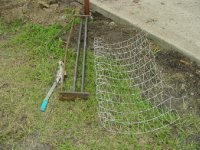
This is my friction stretcher. It's easy to make. And not hard at all to use once you get the right attitude.

The right attitude is, "if it was easy the women and kids would be doing it." We know it's going to be hard so we just buck up and do it.

If you look at the picture you will see the middle rod slides back and forth in a slot that's cut in the top and bottom plates.

Think about a belt buckle kinda sorta.

The fabric is fed in between the two verticals until it reaches approximately the end of the slots in the top and bottom plates.

The floater is pulled forward. Then comes the hard part. That's folding the fabric over the floater and pushing it down until it's flat with over the floater.

The floater is pulled back far enough where the end of the folded fabric can fit back through the verticals. Pulling on the frame will force the floater against the verticals locking in the fabric.

There is one downside of this friction stretcher. It's designed for pulling past the termination post. Then the horizontal wires are cut one at a time, staggered of course, and terminated around the post.

I will usually cut the fabric where when stretched it's foot and a half to two feet past the terminating post.
 

Attachments

  • 448204-Image012.jpg
    448204-Image012.jpg
    60.5 KB · Views: 864
/ stretching farm fence
  • Thread Starter
#2  
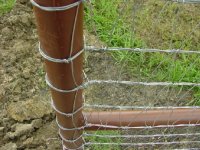
pulled tight and working right /forums/images/graemlins/grin.gif
 

Attachments

  • 448207-Image005.jpg
    448207-Image005.jpg
    63.1 KB · Views: 652
/ stretching farm fence
  • Thread Starter
#3  
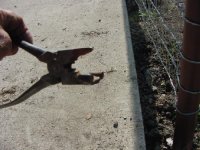
Terminating.

I use and old pair of ten inch Kleins. But if you visit a local fence supplier they might have some ten inch professional fence pliers.

There is a difference between what the pros use and what everyone else has to get by with.
 

Attachments

  • 448211-Image010.jpg
    448211-Image010.jpg
    58.7 KB · Views: 909
/ stretching farm fence
  • Thread Starter
#4  
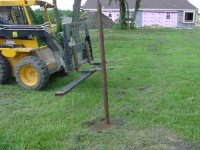
For dispensing the wire I use an idea I stole from one of our TBN'rs that's much smarter than me.

I use a skid steer and I have some forks for it.

The dispensed consists of three parts. A horizontal frame that fits on the forks. It has a piece of two and a half inch (2 7/8) welded in the end. I use this for either side of the framework because the female pipe in the framwork is far enough off to one side where I can drive along the fence line. I'll be on one side and the fabric will be on the other.

The next part consists of two inch (2 3/8) pipe welded to a piece of quater inch plate. I used twelve inch by twenty four inch plate. If I was to do it again I'd use a twenty four inch diameter piece of quater inch plate.

The reason is I have to be alert to slack in the fabric getting off the plate and getting damaged, not good, extra splice, lots and lots of bad words. /forums/images/graemlins/blush.gif

If you look a the top of the pipe you'll notice I have a loop sticking up.

The pipe and plate is placed inside of a roll of wire and the roll is stood vertical. Then the tractor is used to lower the pipe in the forks attachment over the pipe sticking out of the wire.

The third part is whatever's handy. On this job I used a large screwdriver. I prefer a piece of half inch round rod. But anything that will fit through the loop will work.
 

Attachments

  • 448215-Image001.jpg
    448215-Image001.jpg
    51 KB · Views: 587
/ stretching farm fence
  • Thread Starter
#5  
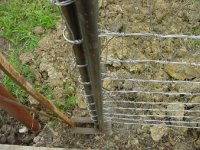
I forgot to mention stripping the verticals so the horizontals can be terminated. I like to use these nippers. You can cut either side. And with non climb or other fabrics where there's a tricky and tighter'n anything should be tie you can cut when nothing else will. Just make sure you're wearing eye protection.
 

Attachments

  • 448219-Image015.jpg
    448219-Image015.jpg
    52.9 KB · Views: 508
/ stretching farm fence
  • Thread Starter
#6  
This is the part that separates the men from the boys.

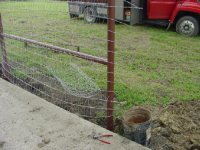
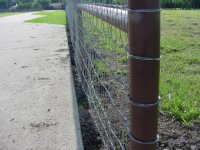
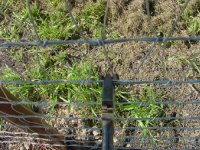
In this picture the wire has been stretched tight. But since there is a roll in the grade some of the horizontals aren't tight. Now with fixed knot you wouldn't see this because the kinks would have stretched out hopefully and the tight ones. But you'd have to walk the fence and make sure. Otherwise over time the ones you missed will slack up and the fence will too.
 

Attachments

  • 448227-Image001.jpg
    448227-Image001.jpg
    49.7 KB · Views: 578
/ stretching farm fence
  • Thread Starter
#7  
This is a pair of fence pliers that I've modified to take care of the slack.

I welded two short pieces of quarter inch round rod on the bottom jaw. The spacing generous for the corresponding rounding off of the upper jaw.

What I've after is the ability to put in the same kind of kink the fixed knot fabric has. And basically for the same reason, to pull slack.

I'm sorry for the poor picture.
 

Attachments

  • 448230-Image003.jpg
    448230-Image003.jpg
    47.2 KB · Views: 492
/ stretching farm fence
  • Thread Starter
#8  
removing slack

A couple of notes. First, the slack is over some distance. It can't be pulled out of just one crimp. Next, it's not just one horizontal that's got the slack.

So there's a lot of crimping to do sometimes. It's another of those things like doing homework with the kiddos to make sure they do it. No way of getting around just doing it. Sorry, used the last magic bullet on a dragon. /forums/images/graemlins/tongue.gif
 

Attachments

  • 448234-Image006.jpg
    448234-Image006.jpg
    81.4 KB · Views: 501
/ stretching farm fence
  • Thread Starter
#9  
Same view, but deslacked.
 

Attachments

  • 448236-Image005.jpg
    448236-Image005.jpg
    55.7 KB · Views: 568
/ stretching farm fence
  • Thread Starter
#10  
I like to stretch no more than four hundred foot pulls. But then for me it's not just a fence. It's my reputation.

Keep in mind the pliers will hurt you and then giggle when you cry.

Never ever ever pull with fence pliers. You always roll. If you're pulling and something slips they become deadly missles and you're the bombing range. My dad, fence man of fencemen, lost a couple of front teeth doing what he told me not ever to do.

I learned my lesson early. Twice in three or four posts I pulled instead of twisted tightenting some ties. Both times ten inch Cresent fence pliers landed square on the bridge of my nose. First time I saw bells and heard stars. Second time I lost all sense of pride and cried, big tears, loud boohoos too.

The will also pinch. In fact from someone who knows take it that they can do more damage with an accidental pinch than a framing hammer with a serated head can do on purpose.

Eye protection is important. Fence wire isn't the highest grade of steel. So occasionaly you'll hit a piece of hard stuff that might have been a backhoe tooth in a past life. When it cuts it's a bullet looking for a soft place to land.

The cut ends of the wire can be like petting a porcupine. In fact at the end of the first day you might remember that and think to yourself that you'd given said porcupine a full body massage with your body.

Never ever step across and or in front of the taught come a long. If at that moment something lets go your next job might be in a choir. If you're lucky it will be with one here on earth.

There are inherent dangers associated with doing fencing. And there isn't an audience to impress unless you screw up. That never happens when no one's around.

Good luck.

Welcome to my world.
 

Attachments

  • 448241-Image007.jpg
    448241-Image007.jpg
    43.9 KB · Views: 1,959
/ stretching farm fence #11  
</font><font color="blue" class="small">( Both times ten inch Cresent fence pliers landed square on the bridge of my nose. First time I saw bells and heard stars. Second time I lost all sense of pride and cried, big tears, loud boohoos too. )</font>

/forums/images/graemlins/laugh.gif /forums/images/graemlins/laugh.gifI can sure identify with that. /forums/images/graemlins/laugh.gif /forums/images/graemlins/laugh.gif
 
/ stretching farm fence #12  
</font><font color="blue" class="small">( For dispensing the wire I use an idea I stole from one of our TBN'rs that's much smarter than me. )</font>


Harv, glad you mentioned this, I did the same thing. I took this idea from you and made me one. Use it on pallet forks on my tractor. It works great. I did use a larger plate (little over 2ft across)on the bottom for wire to rest on. Did not get any hang ups on 200ft roll of 48in no climb wire.

Thanks for posting your projects. This one saved me a lot of time and energy.
 
/ stretching farm fence #13  
Harv, thanks for the pics and the stroll.

Spent last spring putting in my first and only fence. 1800 lineal feet. Wood posts ten feet on center. I drilled all the holes in a day with a rented skid-steer. Then spent three weeks placing, plumbing and back pounding each post. with a tamper bar. Three different guys came out to help at three different times. Each time they would help with a few posts, I would look at THEIR work on MY fence, suggest we had done enough for the day and feed them a few beers and my thanks. Some posts got tamped in twice.

Vividly remember tamping in post 189. She ended up being the end post of a 670 foot straight run, down and back up a swale. I am very proud of how you can stand at one end and not see any posts peeking around their neighbors, just a row of soldier heads going down and then climbing back up. Don't know if that makes sense. Guess a picture would help. As a Newbie to fencing, I though the hard part was over.

Then I went and bought seven, 330 foot rolls of thirty-nine inch field fence and a mile of barbless. I could have used only six rolls of the field fence but I loathed the idea of splicing. I did one, it's at the far end of the property, out of the way where only I and my neighbor might see it and I still spent an hour or so just making that look right. Must have worked cause I had to point it out to the neighbor and my Dad. The first day of pulling wire my hands hurt. The second day they bled. The third day my head bled from being tired and not watching out for how fast a roll of wire can re-wind itself. Apparently took a nap cause I woke up tangled in field fence. Don't know how I didn't loose an eye, I guess God must have wanted me to have both.

My longest pull was 220 feet. Did that on purpose cause I too knew it had to be tight to be right. Moved the rolls around with my daughters wagon since there wasn't a tractor then. Learned that unwinding a roll downhill is a thousand times easier than unwinding one up hill.

Anyway, I am still proud of that fence a year later and will take every complement that gets handed to it. I walk the length of it twice a day with the dog. Partly to appease the dog and partly to appease my own ego. Don't mean to equate my work with your art but just wanted you to know that I can appreciate yours for what it is.

Thanks again, Mike
 
/ stretching farm fence #14  
re: the tightening pliers. I saw a commercial one used by an old man. The fence was mostly lying on the ground, posts mostly held up by the wire. He just walked along doing 3-4 crimps between what posts there were. A fem minutes and he had a tight fence.

I went home, grabbed a pair of vice grips (why do they call them a pair when there is only one?), welded matched pieces of angle to the jars. Works great and I don't have a problem with pinched fingers. I have suggested this to other people but they don't seem to listen. I guess one demonstration is required before the light dawns.

Harry K
 
/ stretching farm fence #15  
Love the fence, Harv!

Mine has very little slack, but I will get to crimping...

How about the bottem of the vmesh. Can it contact the ground, or stay up off it?

Why did you place the fabric on the outside of the posts, are there not critters gonna be pushing on it?

I have a really cool saddle quide that i clamp to the post, and then trace round about it with my flame wrench. Sure makes fast work of those saddles...

Sure hope to get a post pounder someday. I don't like the FEL approach... Right now I do those by hand. Sure annoying to hit limestone that way...
 
/ stretching farm fence #16  
As always harv!!!!! beautiful work!!! /forums/images/graemlins/cool.gif /forums/images/graemlins/cool.gif /forums/images/graemlins/cool.gif /forums/images/graemlins/grin.gif
 
/ stretching farm fence
  • Thread Starter
#17  
Morning Mike,

I have about six or so different "Sure--Cuts". I use them for two and seven eighths only anymore. For the two and three eighths I have the Vogel notcher. I think it's in "build it yourself" or "projects" but I have a thread on all the techniques I use to notch pipe. A lot of the time I'll use a portaband and that works fine too. If you have to do a pipe that you don't have a template for I have a trick. I butt the pipe perpendicular. Measure the distance between contact points outside. I then go back that distance to start the notch.

I like to keep the fabric off the dirt. For horses it's generally recommended to keep it up six inches to a foot up. If given the opportunity I'll keep it four inches or so up. This makes trimming under it easier too.

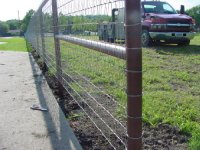
This fence isn't about livestock. It's about image. He went with the fabric over pipe frame because of cost. Then he went with the V Mesh because I gave him the option of it or non climb. But when I do livestock fence I try to put the fabric where the livestock are pushing against the framework and not just the fabric.

I think most folks would be surprised at how much abuse a fence gets from even pet farm stock. This was brought home to me by some white goats and a new non climb fence a bud put up. /forums/images/graemlins/grin.gif /forums/images/graemlins/grin.gif Fence fabric is a great brush--rub--massager.
 
/ stretching farm fence #18  
There is something to think about when stretching fence that I've never seen mentioned here. This only is a factor when you live in an area that sees close to zero degrees or below temperatures. You can stretch a fence too tight. You get out there on a 98 degree day and stretch that fence tight, pluck it like a guitar string tight. The first day the temperature bottoms out those strands snap and give themselves shrinkin' room. Then you get to go back and fix 'em in that nasty cold so that no livestock get the urge to warm themselves up by taking a little stroll. Or because the rancher you did the work for decides having you fix it at 10 below will be good positive reinforcement of a lesson he figures you should have known. Then you have to go back in the summer to stretch it again because wire doesn't stretch worth a durn at 10 below. Just a little lesson I learned about doing fencing after moving from Northern California where it gets down to 20 above at the most to Central Nevada where you can see 40 below on occasion.
 
/ stretching farm fence #19  
I get some of that weather related problem. Luckily, before I stretched my fence, my neighbor told me about hearing wire pop at 15 below. i thought she was a little crazy but this winter when we actually had two mornings at 15 below, that wire was like a bow string. Of course now that it is 85 above it feels like limp spaghetti and I have to tighten but not TOOOOO much.

Mike
 
/ stretching farm fence #20  
</font><font color="blue" class="small">(
The will also pinch. In fact from someone who knows take it that they can do more damage with an accidental pinch than a framing hammer with a serated head can do on purpose.
)</font>

I've seen what a 32 oz. Vaughn does to a thumb, full swing by a pro. I won't call you a liar, but he's in another line of work now.
 

Marketplace Items

72" ROCK BUCKET (A52706)
72" ROCK BUCKET...
Brock 48'x16' Flat Bottom Grain Storage Tank (A57148)
Brock 48'x16' Flat...
2019 Deere 550K (A53317)
2019 Deere 550K...
UNUSED IRANCH MINI EXCAVATOR RAKE (A60432)
UNUSED IRANCH MINI...
2016 Ford Transit 250 Passenger Van (A55852)
2016 Ford Transit...
2020 CATERPILLAR 289D3 SKID STEER (A60429)
2020 CATERPILLAR...
 
Top