Surveyors

/ Surveyors #21  
</font><font color="blue" class="small">( it was comical to see the antics that the surveyor was going through to 'find' the section line )</font>

There is a reason for this. The old section surveys were rife with errors, some worse than others. In its wisdom, the law was written that, to avoid future adjustments, the correct section corner was where it was actually monumented, even if it was tens of feet from its mathematical position. So when using a section corner as a reference, it is important to find the actual, physical corner, not calculate where it oughta be.

I've seen all kinds of errors in surveys, particularly historic ones. They were done with cruder instruments than we have today, and calculated by hand. One of the most common old errors is the dropped chain. The actual length would be a chain (66 feet) or more rarely a hundred feet longer than recorded. The chainman simply screwed up the count.

The computer has eliminated most of the math errors, and achieving a good closure is a check on the accuracy of a survey.

But beyond that, it becomes an issue of finding and accommodating the original errors. Depending on the situation, they must be corrected or incorporated into your survey. My former property had a bad corner. The length of the block did not equal the sum of the individual lots. The error had to be distributed between the various lots. It caused an off and on again four-inch argument with various neighbors, and resulted in a maze of cross-cuts in the sidewalk where various surveyors interpreted the corner location.
 
/ Surveyors #22  
Remember ruling pens? They are a tweezer like device that holds the ink between the blades with a mixture of surface tension and luck. On a long line, often the ink or the luck runs out.
 
/ Surveyors #23  
</font><font color="blue" class="small">( each lot, differs from the survey. )</font>

Perhaps the County has a Geographic Information System (GIS) that is used, among other things, to compute the taxes. In doing those, they start with a geometric base, often the State Plane Coordinate benchmark system, which is surveyed but was not ever designed for Land Surveys, and rubber sheet all the other mapping to that. Since nothing ever matches, there's a lot of pulling and tugging required to get the rubber sheet maps to line up. Hence the discrepancies in area.
 
/ Surveyors #24  
</font><font color="blue" class="small">( Deed descriptions go to the middle of the road and the county, state, etc. have an X foot right of way on either side. )</font>

It depends. I've seen it both ways, even with a single job.

The "ownership" of the road right of way varies from county to county and within various counties and even varies within municipalities. It depends on how the land was platted. You really need to look at your deed to tell.
 
/ Surveyors #25  
<font color="blue"> It depends. I've seen it both ways, even with a single job.</font>
You're right. I should have qualified what I said by adding that in all the jobs we (my FIL and I) worked on, the property lines went to the center line of the road. As you noted, it's best to check the deed.
 
/ Surveyors #26  
You bet. Think I can still find the old drafting set. Geting that ink under the plastic set square was real fun to clean up.

Lordy me; I just can't be old enought to have used that stuff.

Egon /forums/images/graemlins/grin.gif /forums/images/graemlins/grin.gif
 
/ Surveyors #27  
Ah-- the vagracies of old surveys is always interesting.

Dropped chain -- then theres the fellow who misscounted the number of times the buggy wheel went around.

Wonder what comments our future generations will make on what we think of as cutting edge tecknology.

Egon
 
/ Surveyors #28  
</font><font color="blue" class="small">( Dropped chain -- then theres the fellow who misscounted the number of times the buggy wheel went around. )</font>

That's 'cause he was taking a pull from the jug when the rag tied to the spoke went by.
 
/ Surveyors #29  
A little off the post but I have a queston.I have a irregular shaped lot of 14 arcres ,with 1500 feet of road frontage(road curves).Found rebar for rd frontage ,but cannot locate rear markings.Even with survey i just dont were the property ends,on paper it ends 500 ft out from the road.
Problem is the lot is slopping forrest,cant use wheel the terrains too rough,tried a long spolled tape measure but cant keep a strait line with the trees.A friend tried a magellan sporttrak gps(could not get a small enough scale)but we have no gps expierence.Any Ideas ?
 
/ Surveyors #30  
My property was originally sold as north of road x, west of road y. Therefore it doesn't go to the center of any road. /forums/images/graemlins/grin.gif
 
/ Surveyors #32  
Rmal,
The GPS unit is the way to go. You should be able to fing a setting where you can get the distance traveled and the direction taken. Get your survey and the gps and stand on the known pin. Walk until the GPS says you are X feet and Y degrees from your start. Once there start looking for a pin. You will NOT be right on top of it most likely. GPS has built in error for civilian purposes and the smaller the unit the more error you will get from it, but you will be close. Bring a metal detector if you have access to one and your survey says "iron pin"

If that doesnt work, call a surveyor to mark the corners.
 
/ Surveyors #33  
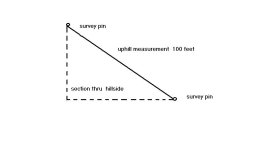
Question, When survey and plat/deed shows 100 feet and the line is up a slope, how is that land measured when the bulldozers finish leveling the area?

Without having the original elevation shown I can't understand how the new plat is calculated.

See attachment.
 

Attachments

  • 479457-survey.JPG
    479457-survey.JPG
    17.1 KB · Views: 128
/ Surveyors #34  
I can't answer the question as to how a surveyor would make the measurements, but you only have 100' in depth, and it doesn't matter if it is a hill or not. If you remove the hill, the measurements of the underlying surface are still going to be the same. Survey measurements are adjusted for hight and the map shows the ground as if there were no change of elevation. I can understand how they can do it with modern equipment, but how it was done with the old manual tools, is the question.
I had a piece of property in NH that I purchased in 1963, that the three of the boundaries descriptions were pretty much useless for surveying.... "from the big oak tree, to the stone pile to the snow pile, to the stream", or some kind of language such as that. I didn't pay much for it, and didn't get much for it when I sold it a few year later, but I always wondered how I would have had it surveyed. It contained about 50 acres, more or less. Probably, today, a attorney wouldn't even consider transferring a deed like that without having a better description worked out by a surveyor. When I purchased it, it was said that a lot of the deeds were like that and there was never a problem. 40 years later, I still wonder about this..... /forums/images/graemlins/frown.gif
 
/ Surveyors #35  
Good post, it has been very interesting. So if there is so much room for error, whether human or historical, how are discrepancies settled? If you have a parcel surveyed for fencing and find that the surveyor’s findings do not match what the neighbors markers say what do you do? I sure would not want to go through the expense to put up a fence and find it has to be moved. Also, does the surveyor have any liability if there is a discrepancy? It sounds like two surveyors can interpret a deed differently without either necessarily being wrong.

MarkV
 
/ Surveyors #36  
Around here (CT) if this arises, you go to the neighbor and discuss it. If you are both agreeable people, you enter into a boundary line agreement and both will quit claim any land on the other side of the boundary to the other. The deeds and the new boundary line survey are all filed with the town and it is then "set in stone". A 100 years ago, farmers would agree over the stone wall and a handshake. A couple of feet either way wasn't a big thing. Today, people will argue over inches. /forums/images/graemlins/frown.gif /forums/images/graemlins/frown.gif
 
/ Surveyors #37  
Junkman, that makes sense and sure would be the civil way to do it. It also brings up another question. I happen to own two separate properties where one boundary is a county line. I would suspect that the county would not think highly of my neighbor and I doing a quick claim deed that would change the county line. Does a county or state line supersede any deed description that would disagree with the county or states interpretation of the line?

Thanks,
MarkV
 
/ Surveyors #38  
<font color="blue"> I can understand how they can do it with modern equipment, but how it was done with the old manual tools, is the question. </font>
3-4-5 right triangle process is one way.

Measure the distance between 2 points along the slope, determine the elevation change (using the same telescoping measurment pole used to do a topographic survey) between the same 2 points. You now have the length of two sides of a right triangle so you can solve for the horizontal distance.

In the case of very steep slopes, it required several set ups with the transit to complete this process.
 
/ Surveyors #39  
Good old time surveying and accuracy. Equals a Wild T1 and interpolating six place log tables with recipies that distribute discrepencies over all the obsevation points.

Egon
 
/ Surveyors #40  
It's all about angles measured by theodalite, distances measured horizontally and calculations. Course I'm talking 40 year ago.

Egon
 

Marketplace Items

New/Unused Quick Attach Bale Spear (A57454)
New/Unused Quick...
1996 Great Dane 50' x 102" Reefer Trailer (A62613)
1996 Great Dane...
SKIDDED FRAC TANK (A58214)
SKIDDED FRAC TANK...
PJ  32 FLATBED GOOSENECK (A58214)
PJ 32 FLATBED...
2017 Ram 3500 4x4 Crew Cab Service Truck (A60352)
2017 Ram 3500 4x4...
2014 AMERITRAIL TUGGER TRAILER (A58214)
2014 AMERITRAIL...
 
Top