The Cattle Thread

/ The Cattle Thread #21  
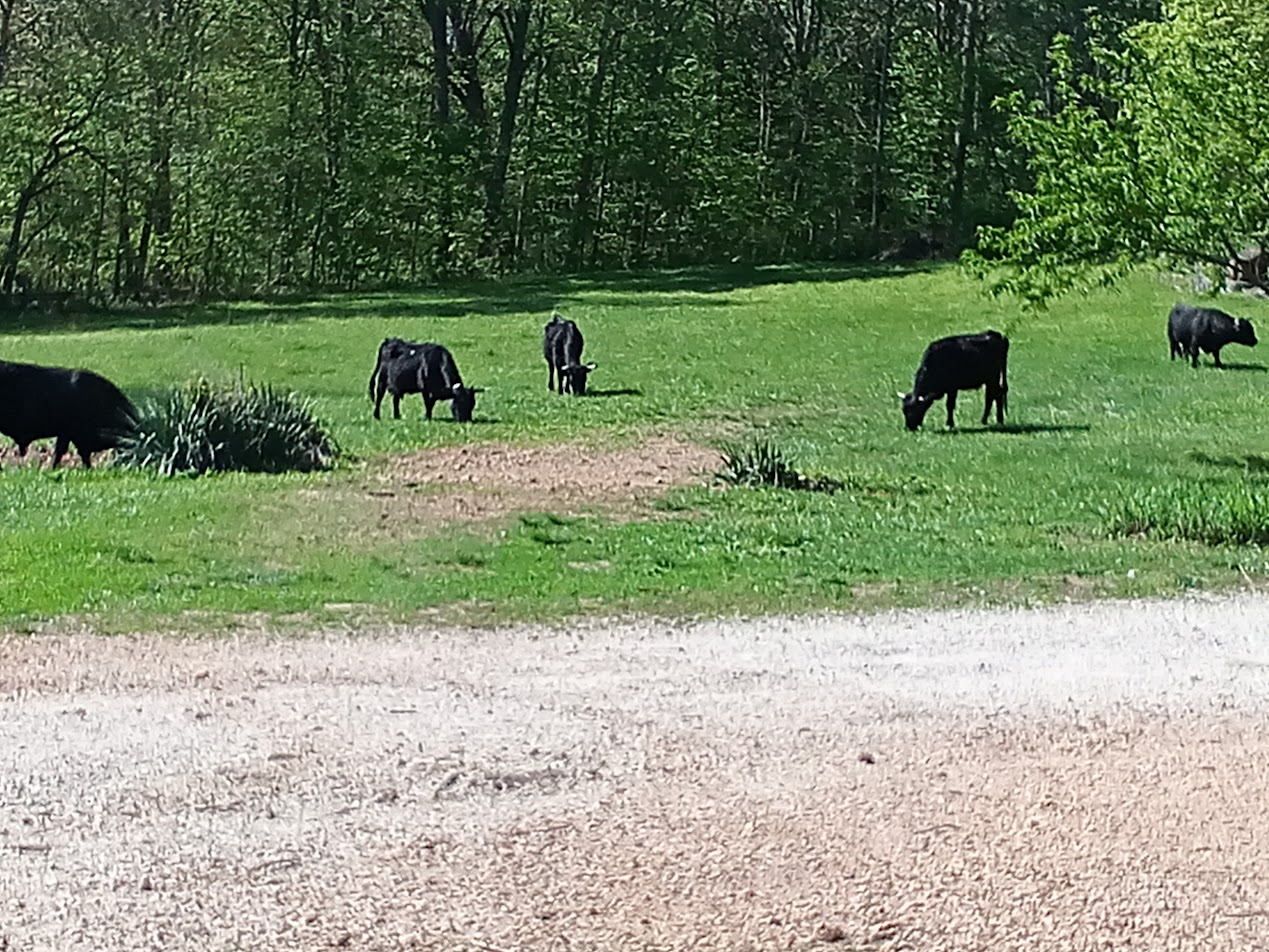
Running the cattle in the front yard today. Supervised field trip, see assistant supervisors at the end.
1776871580484.png


1776871598275.png


1776871760374.png


1776871789384.png
 
Last edited:
/ The Cattle Thread #22  
Did you buy a Charolais? The breed is hard to handle, they can be very spooky at times. Ya gotta move slow and easy when herding them. Great meat producers though.

We raised Herefords mostly when I was a youngun (which seem to be kind of a bit of a left behind breed but were pretty solid range cattle..) but our one neighbor had Charolais. It was always a bit rough if the Charolais bull got over onto our side of the range, the smaller Hereford heifers were not made for giving birth to a half Charolais calf.

We have Dexter's, Jersey's, and crosses of Dex/Jer. Got our first Dexters in 2018 and now have a herd of 40.

My dad has had a couple of Dexter/Dexter cross.. They seem pretty good for raising some home meat as the yield/acre was really decent. But I do wonder about marketing them if you're trying to sell any to the meat market having such smaller frames (add in the jersey and I guess my question still holds?), maybe it's less of a problem now than it was 20 or 30 years ago? Or are you mostly reselling them as breeding/milking stock?

I always liked the Jersey's we had for milk cows (we only had a couple at any time for house milk).. they seemed more even tempered than the Holsteins for whatever reason.
 
/ The Cattle Thread #23  
We haven't had any trouble selling 100% grass fed low line Belted Galloway beef locally. There's another large scale breeder hereabouts that has grown a sizable operation; his ground beef retails for $11/lb, tri-tip $27/lb, ribeye $40/lb. He has really worked at marketing his meat, so kudus to him.

Personally, I have always liked Jerseys, and they always seemed sweet and even tempered to me, unlike the Holsteins we had. We never had them, so I really can't comment.

All the best, Peter
 
/ The Cattle Thread #24  
We haven't had any trouble selling 100% grass fed low line Belted Galloway beef locally. There's another large scale breeder hereabouts that has grown a sizable operation; his ground beef retails for $11/lb, tri-tip $27/lb, ribeye $40/lb. He has really worked at marketing his meat, so kudus to him.

Thanks, interesting to get some direct feedback from the current realities :)

Ok interesting so you're selling direct to consumer then. The processing costs for that seem to continue getting more usurious unless you're real lucky with a local processor.

How happy your customers are with well north of $10/lb much less $20+/lb beef is another interesting note, seems wild to me.. but I've been out of touch on that for a while I guess. I would assume that's fairly regional as well.
 
/ The Cattle Thread #25  
Thanks, interesting to get some direct feedback from the current realities :)

Ok interesting so you're selling direct to consumer then. The processing costs for that seem to continue getting more usurious unless you're real lucky with a local processor.

How happy your customers are with well north of $10/lb much less $20+/lb beef is another interesting note, seems wild to me.. but I've been out of touch on that for a while I guess. I would assume that's fairly regional as well.
Just to be clear those are their prices, not ours. They have worked for twenty years to establish a local grass fed brand that extends today well beyond beef. We never targeted direct to consumer for a variety of reasons.

Yes processing is a local challenge, in terms of price, availability, and customization. It is hard to get local processors hang the beef for long, e.g. over a few days, and slaughter plus processing adds on the order of $1/lb, though it can be had for closer to $0.60, if the cattle are hauled 1-2 hours away.

All the best,

Peter
 
/ The Cattle Thread #26  
Brangus is my preference down here in the humid hot climate of Florida, a little brahma mixed in to any breed in these parts makes them fairly hardy, brahma's will eat leaves, gallberries and palmettos to survive when there is minimal forage while many other breeds will melt down to nothing.
 
/ The Cattle Thread #27  
Processing in my area is well past a buck a pound.
The last time I check a $1.10 was the least expensive, with one at $1.72/pound. Then add a $25 kill fee, and a $20-$35 waste disposal fee.

Current direct sale prices in this area;

1776901124018.png
 
/ The Cattle Thread #28  
Brangus is my preference down here in the humid hot climate of Florida, a little brahma mixed in to any breed in these parts makes them fairly hardy, brahma's will eat leaves, gallberries and palmettos to survive when there is minimal forage while many other breeds will melt down to nothing.
Animals being fed in that manner are going to be strong flavored and tougher to chew.
 
/ The Cattle Thread #29  
Animals being fed in that manner are going to be strong flavored and tougher to chew.
Most Florida animals are moved to Ok/Texas to feed out before slaughter, and not that many finished here.
 
/ The Cattle Thread #30  
Animals being fed in that manner are going to be strong flavored and tougher to chew.
They have to survive and that's what is most important, most of these momma cows ain't headed to a slaughterhouse. I'm feeding these 2 out right now, 1 is a steer the other is a registered Brangus heifer that is sterile, but I will guarantee you that they will taste good on anybody's plate.
20260422_111245.jpg
 
Last edited:
/ The Cattle Thread #31  
They have to survive and that's what is most important, most of these momma cows ain't headed to a slaughterhouse.
If you need to feed animals that poorly you shouldn't have them.
Besides which most this thread seems to be home/farm locally raised not feed lot stuff.
 
/ The Cattle Thread #32  
If you need to feed animals that poorly you shouldn't have them.
Besides which most this thread seems to be home/farm locally raised not feed lot stuff.
I didn't say that I needed to ,I try to keep pasture , hay, Rye during the winter etc, but we are in the middle of a drought since last September and trying to hold on, Florida is full of wood's cows, a little different than where you are, most cattlemen aren't trying to feed them poorly as you say, we are just trying to survive a rough patch ( drought ).
 
 
Top