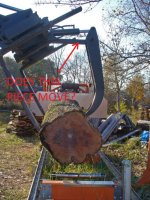
The "thumb"

   / The "thumb" #21  
I think you must have an error in your math. If we assume ID = 38 x 46" for the standard 40 x 48 inch totes, and you manage to cut your wood to fit without even 1/4" gaps (like Tetris-perfect), your best case 0.52 cords while keeping the total height at the 6 feet you had mentioned early. In reality, given your wood is probably not of a length that perfectly fills the tote, it's probably a bit under 0.50 cord.


Another indicator these are not 1.4 cords per bin. Check the cord weight of firewood, your 2700 lb. loader would get 1.4 cords of most species off the ground. Figure nearly 5000 lb. per cord for green oak, or 3600 lb. after drying. Your estimated 1.4 cords per bin would be 5000 to 7000 lb. per bin.

In any case, my tractor (JD 3033R) is too light to move that kind of weight on the loader, so not relevant to the design of this particular thumb. If I have to move something anywhere near that heavy, it'll be on the 3-point!
Yes...1.4 face cords. My bad.
 
   / The "thumb"
  • Thread Starter
#22  
Yes...1.4 face cords. My bad.
No worries. It's easiest to just talk cords, as everyone's face cord is a different volume of wood.

Cord = 128 cubic feet of wood, such as 4x4x8 feet

Face cord = 32 square feet cross-section of stacked wood, such as 4x8 feet, of any undetermined split length and volume

Some cut to 24" lengths, others to 16", with the former's face cord containing 50% more wood than the latter's.
 
   / The "thumb" #23  
I would want the clamp to be able to open flush with the pallet fork back frame to at least the height of a standard pallet. I had one of these and I quickly grew tired of it damaging pallets and took it off and used my regular grapple instead. View attachment 777208

That is the best one I have seen but you are right. It will still damage totes with those “teeth”.
 
   / The "thumb"
  • Thread Starter
#24  
So, I did a simple stress analysis of the rev.a thumb with the straight back, just to get a sense if 1.5 x 1.5 x 3/16" square tubing would be strong enough to withstand the pressure exerted by the cylinder. It appears it's more than sufficient, which was a surprise.

The steel is all better than 47 ksi yield, and I'm not seeing anything even approaching 1 ksi, other than the walls of the cylinder itself (purchased). The displacements are all less than .003" at 2500 psi hydraulic pressure:

1672592835388.png
(click thumbnail for full size)

Trying to figure out how to get the software to tell me what pressure the arm is exerting on the log at the interface, but its not cooperating. If there are any SolidWorks sim experts out there reading this, speak up!
 
   / The "thumb" #25  
I can't help but think that you are doing the same jobsthat can be done so much more nicely with a backhoe and thumb.
 
   / The "thumb"
  • Thread Starter
#26  
I can't help but think that you are doing the same jobsthat can be done so much more nicely with a backhoe and thumb.
You're suggesting I buy a backhoe for lifting logs out of a trailer and moving them across my wood splitting area, when I already own a tractor with a loader and forks?
 
   / The "thumb" #27  
Yes all rotating/pivoting joints must be grease-able or it’ll wear out in no time
That's not true. This is a slow speed minimal movement and prety minimal force pivot. If you can drill the pins or put grease fittings in the bosses do it but It wouldnt be a deal breaker.
 
   / The "thumb" #28  
Not sure I agree. Look at the cylinder he is spec'ing here, it is capable of a lot. When you go to clamp a log down, or snatch up a half ton boulder, you need to squeeze them HARD. A metal-on-metal joint full of sand doing grapple work all day long will eventually not be very fun to operate. Just my 2c.

Why do you think all commercial grapples come with grease-fitting joints?
 
   / The "thumb"
  • Thread Starter
#29  
Well, here's an interesting point, guys. If I recall (it's long gone), the 52 loader on my Deere 855 had grease zerks in the cross-tube ends of the pistons, but the pins simply slid into 1/4 inch'ish-thick gusset plates on either side of the loader arm. Thinking back, the pins may have had an arm welded to the head, that kept them from rotating in the gusset plates, and forcing all rotation to happen between the pin and the cross-tube on the cylinder, containing the zerk. I may be able to repeat this type of interface on my assembly.

I think the bigger problem with my design may be that I have a very small horizontal component in the distance between arm pivot and cylinder normal force. It means that, despite the cylinder exerting 7000 lpf the actual force between the thumb and log may be quite low. Need to find some time to look at that more, but due to a cross-member between the loader arms, I don't see a very good opportunity to lower the cylinder and create a better triangle between it and the primary thumb pivot.
 
   / The "thumb" #30  
Not sure I agree. Look at the cylinder he is spec'ing here, it is capable of a lot. When you go to clamp a log down, or snatch up a half ton boulder, you need to squeeze them HARD. A metal-on-metal joint full of sand doing grapple work all day long will eventually not be very fun to operate. Just my 2c.

Why do you think all commercial grapples come with grease-fitting joints?
The pivots are what looks like 2ft above the ground. If they constantly have dirt in them on a home brew tool that's built for moving logs I think you may have other problems.

Theres always a reason to overkill something..but some times theres really no need to. Will things wear, absolutely. But for this low speed, half turn and non precise tool I dont think a bit a slop will matter. It really sounds like it's just to keep logs from falling off a set of forks.

I had a Paulson loader that was on a 1950s tractor. I believe the loader was a 1980s vintage, the thing didnt have a single grease fitting on it but was just as tight as my 2002 new holland loader with a grease fitting at every joint.
 
   / The "thumb" #31  
It's not just dirt to worry about. Any tool which i used a lot is bound to get wet sometimes. Adding zerks during the build will allow him to grease and avoid them from rusting togther.
 
   / The "thumb" #32  
I'm not saying dont add grease fittings I'm saying it's not a deal killer and wont "wear out in short order".
 
   / The "thumb" #33  
In my mind if you need to load logs with any degree of fine control you will want something short. Working with forks DOWN IN a trailer or out 3 or 4 feet from your point of rotation is not easy. I realize you already have the forks but this may be a bigger trade-off than you think.

21_3_17-1.JPG


22_2_15-1.JPG


22_8_22-3.jpg


Just my two cents.

gg
 
   / The "thumb" #34  
   / The "thumb" #35  
In my mind, one of the advantages of pallet forks for working logs is that they are longer.

I don't consider myself some kind of a super operator, and I don't have any problem at all with the forks being long, as long as the grapple matches the forks that's the important part!

P1040195-S.jpg


I can dig the log out I want of the bottom of a pile of logs and all kinds of other things that use the advantage of longer forks.

Plus, the longer forks make the tool useful for many other operations like moving boxes of firewood or picking up piles of brush or picking up multiples of logs and letting them roll off into place one by one.

These are things I do all the time working with firewood and saw logs.

SR
 
   / The "thumb"
  • Thread Starter
#36  
First, on grease fittings, bushings, etc. Nothing is decided yet, as I see both sides of the argument. This is a homeowner (non-commercial) application, so wear will be limited by hours, and I don't think "in short order" is really applicable here. But, if I'm going to build it, I'd like it to last a good 20 years and be sellable when I'm done with it, so this is not a point I'm completely ignoring, either.

I will aim to use bushings drilled for zerks if possible, but even if not, simply pulling the pin out and greasing it before any long weekend of use might also be acceptable, in this application.

In my mind if you need to load logs with any degree of fine control you will want something short. Working with forks DOWN IN a trailer or out 3 or 4 feet from your point of rotation is not easy.
My thoughts exactly. In fact I think I mentioned this earlier, although the thread has gotten so long I won't go hunting for it. I'm thinking I might make a spare set of short forks to slide onto this frame, for this purpose. This will let me optimize them for holding logs, if that ends up being their only purpose, such as adding some curvature to the lower "short forks".

This project may have to go on hold for awhile, I just got notification that some new work is coming in that will have me working a lot of overtime the next few months. But as I continue to toy with the idea in my spare time, I'll be doing it with a mind toward making this thumb work on both the current forks (52") and potential future shorter forks.

edit: SR's last post came in simultaneously to this, while I was typing. Good advice to consider!
 
   / The "thumb"
  • Thread Starter
#37  
In my mind, one of the advantages of pallet forks for working logs is that they are longer...

SR
One thing that bothers me with my design posted above is the short distance between the thumb pivot and where the my piston attaches to the top link of the 3-point pins already present on the fork set. The effect is that the ~7000 lb. exerted from the piston translates to very low force out at the end of the thumb.

But I see now that your thumb pivot appears to be very close to the point where the piston attaches to the back of the thumb. Is that section of square tubing to which the thumb attaches fixed solid, or does it also pivot down at the fork frame?

I drew an arrow to the piece I'm talking about, in your photo:

P1040195-S.jpg
 
   / The "thumb" #38  
I'll share some pictures of similar style of thumb and forks setup we have here for brainstorming purposes.

When I'm doing DIY projects, I usually look at lots of pictures and absorb as much as possible.

59653565_2208108182618151_7262503352066375680_n.jpg
60203338_2229690767126559_1900743961597706240_n.jpg
66504713_2329974887098146_973200831488720896_o.jpg
 
   / The "thumb" #39  
It's solid and it has amazing amount of clamping force, obviously it has a very good cylinder on it.

BTW, it's not square tubing, it's heavy channel iron and super strong.

SR
 
   / The "thumb"
  • Thread Starter
#40  
Thanks, @ptsg and Rob! Those photos are super helpful @ptsg, as I never even considered mounting the cylinder that way. I will definitely play with that idea.

Thanks for the info on your setup too, @Sawyer Rob. It looks like a I have some time to play with ideas, a new project that came in is going to keep me away from doing much personal fab work the next few weeks.
 

Tractor & Equipment Auctions

Harlo HP6500 (A60462)
HYDRAULIC THUMB CLAMP FOR MINI EXCAVATOR (A58214)
HYDRAULIC THUMB...
Sakai SW354 (A60462)
2013 CATERPILLAR 950K WHEEL LOADER (A60429)
2013 CATERPILLAR...
Bobcat 863 High Flow Compact Wheel Loader Skid Steer (A59228)
Bobcat 863 High...
2002 Frieghtliner Pressure Digger Truck (A55973)
2002 Frieghtliner...
 
Top