TiltMeter question...

/ TiltMeter question... #1  

FN in MT

Bronze Member
Joined
Apr 30, 2009
Messages
70
Location
Craig, Montana
I've got some hilly areas I'd like to mow, with both the MMM and the bushhog. With safety my prime concern I've thought of buying a TiltMeter.

How MUCH "tilt" is allowed before your in trouble?? I know there are many other factors but on dry terrain, whats the guideline??

FN in MT
 
/ TiltMeter question... #2  
This is a re-post from a previous thread....

Depending on speed, turns, potholes, full raised fel, swinging rear implement, it can become quite easy to tip a tractor at 12 degrees. IMHO, when you're in the range of 10-20 degrees, the actual angle is not the most important variable. So if you measure a 12, 13, 14, 15, or more on your hill, it really doesn't matter. Don't waste your time with the protractor. You know its dangerous going out there and a 14 degree measurement shouldn't give you any more confidence than you already have. I admittedly pucker fast and that's a good thing I think. If you want to drive sideways on that hill, I suggest all the low ballast you can get and slow, deliberate driving with the seatbelt and rops in place to test her out. If you pucker, listen to it and back off. Then mow up and down and raise the mower so as not to scalp. That night, you'll be eating your wife's dinner instead of hospital jello.
 
/ TiltMeter question... #3  
I don't think anyone is going to commit to any particular amount of tilt because of the variables that can be involved. I've heard that tractors are designed to not turn over at 20 degrees, but that's the bare tractor with no implements. And of course if you assume 20 degrees is the maximum and you get there, then a wheel on the high side runs over a pebble, or something larger, or a wheel on the low side finds a tiny depression . . . well, you get the idea.

bx24d has given a good answer.

Now if you search back far enough, you'll find that I had 2 tiltmeters on my B2710; one for fore and aft and one for side to side, and I once parked sideways on an 18 degree slope, got off, and pushed on the high side without turning it over. But I can also tell you that 12 to 15 degrees was the steepest I wanted to get to and I moved very slowly and carefully at anything over 10 degrees.:)
 
/ TiltMeter question... #4  
Agree with others. And said it in a thread not 1 month ago. I would NEVER go by a tilt-meter. Just no point.

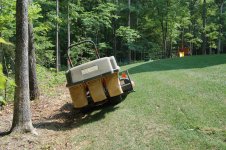
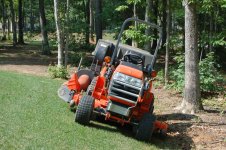
This is about the steepest thing I mow. I always slow down when I mow this and don't go the other way since the mass of the bagger would be downhill instead of uphill (see impeller offset in "front" picture). I think I'd make it, but as others have said, if I ran over a twig, hit a soft spot, found a chunk of dirt or a pine cone, I'd suddenly find myself at a very different "slope" and further risk a rollover.

I have tried this slope with FEL/BH and MMM/Bagger disconnected...couldn't do it. The COG was so much higher that I was simply too uncomfortable to continue.

I just measured the slope in AutoCAD off this picture...17 degrees. Doesn't look like much in the picture. But it feels steep enough on the tractor to prompt me to get off the tractor, take a picture, and share it with others.

Go with your gut. Look at what your doing. Don't stare at a tilt-meter and figure "you're good". Way too much can happen.
 

Attachments

  • BX on slope rear.jpg
    BX on slope rear.jpg
    709 KB · Views: 317
  • BX on slope front.jpg
    BX on slope front.jpg
    514.3 KB · Views: 396
/ TiltMeter question... #5  
I would NEVER go by a tilt-meter. Just no point.

As I've said on here many times, a tiltmeter won't keep you from turning over, just like a fuel gauge won't keep you from running out of fuel, so neither one is "necessary", but they both provide me a little information that I like to have.;)
 
/ TiltMeter question... #6  
Can you share pictures of those hills? If you can mow 'em up and down, do so. Side to side is risky with or without a tiltmeter. A bump or depression you'd hardly notice on flat ground can be really dangerous on a hill.

I have a lot of short but steep hills here due to raised septic field mostly and while I sometimes do go side to side I usually go up and down to feel more comfortable and safe. Either way when I'm mowing the hills, it is MMM only for me. FEL and BH sit in the garage to help lower center of gravity and remove awkward physics "moments" from having things hanging off the far reaches of the tractor.
 
/ TiltMeter question... #7  
You have to calibrate it. Jack up one side of the tractor while wathcing the tilt meter until the tractor tips over. Then mark that spot.

Now I hope you all know I'm KIDDING.

All good advice above.
 
/ TiltMeter question... #9  
You have to calibrate it. Jack up one side of the tractor while wathcing the tilt meter until the tractor tips over. Then mark that spot.

Now I hope you all know I'm KIDDING.

All good advice above.

I know you are kidding, but that is one idea. I have mine on a couple of really steep angles. And once I was able to get the seat out of my cheeks I decided not to do that again.

The tilt meter could make you a little over confident. I mow on some steep hills and usually never had a problem until onde day a pring decided to surface in a spot that never had one. The tractor slid down the hill sideways and when it stopped, it almost tipped over. I'm sure that that won't happen to probably anyone, but the point is that even in places that you have been across before can be dangerous.

When I first got my tractor it felt like it was going to flip over all the time. Made it really hard to use the tractor. So I decided that I would drive it onto a hill, get of (on the up hill side) and see if the tractor would tip over, if it didn't then I would get back on it and have my wife see if it would tip. I was playing on the theory that if it just needed a little to tip, just a little would keep it from tipping over. It helped to give me a little confidence in the tractors abilities.

In the really steep parts I go at an angle just enough to be safe, but enough that I don't have to keep doing the front to back up and down the hill all over the place.

Like others have said, a little bump on the up hill or a depression on the down hill will totally make the tilt meter worthless if you are solely looking at it. If you are going to look at anything, watch your front tires, especially the up hill side, that is going to give you a better indication that you are about to be in trouble.

One last final bit of advice, leave the BH and FEL off, it does raise the center of gravity even more and make it a whole lot more dangerous IMHO.
 
/ TiltMeter question... #10  
another point in favor of the tilt-meter...

I bought one just to validate that my own "pucker-meter" calibration was set correctly. I always wondered if I was being over-confident on the few slopes that I do mow.

It's nice to know that the meter on the seat pretty closely matched the meter attached to the tractor.

Now after validating those slopes I rarely look at my tilt-meter but it's nice to know it's there if I end up on any new slopes.

Rex
 
/ TiltMeter question... #11  
I've got some hilly areas I'd like to mow, with both the MMM and the bushhog. With safety my prime concern I've thought of buying a TiltMeter.

How MUCH "tilt" is allowed before your in trouble?? I know there are many other factors but on dry terrain, whats the guideline??

FN in MT
About 15 % Max
 
/ TiltMeter question... #12  
I hope in this kind of discussion that everyone keeps in mind the difference between "percent" and "degrees". I'd agree that 15 degrees is normally as far as I ever want to go, but I believe that would be about 33.33 percent.
 
/ TiltMeter question... #13  
<snip> I once parked sideways on an 18 degree slope, got off, and pushed on the high side without turning it over. But I can also tell you that 12 to 15 degrees was the steepest I wanted to get to and I moved very slowly and carefully at anything over 10 degrees.:)

This is the ONLY true test. Tires, wheel width, dirt on the frame vary, how high the FEL, how much fuel etc.

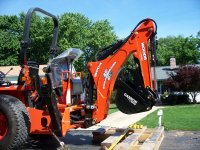
What you NEED to do, but probably won't, is put your tractor on some boards, jack the boards up on one end till your tractor tips over, buy a new tractor.

I already had my tractor lift it's left hind leg while slipping down a slope. The FEL went to the ground and I don't want to do it again. I did not have a strain gauge between my cheeks to accurately measure the pucker factor.

I'm thinking now of having a "tractor NOT tipping exercise" where' I'll get my tractor on a slope like Bird did and have my son's there with a rope to haul it back as soon as it starts to go.

It's good to have three strong son's.

Meanwhile I added about 800lbs of ballast, but it's partially top heavy :)
 

Attachments

  • bh70x8x6.JPG
    bh70x8x6.JPG
    482.5 KB · Views: 147
/ TiltMeter question... #14  
Incidentally, when I did that, I had the FEL off the tractor.
 
/ TiltMeter question... #15  
A guideline won't do. You will need to figure it out for your self. Even On dry ground, conditions can vary greatly and will be different with different equipment. As you probably know, here in Montana, dry ground can solid with excellent traction, or it can be loose and crumbly, or the vegetation or droppings can be a factor. Dry ground with a lot of pine needle on top can be like marbles.


With that said, I can comfortably go up and down 35 degree (not percent) dry grass slopes and up to 25 deg side slope on my X749. On a JD 110 TLB, a 15 deg side slope is uncomfortable, and is not doable in more slick conditions. I have tried a 15 degree slope on the 110 in slick conditions, it would just slide sideways upon entering the slope. Had to wait until it dried out before it could go there.

For maximum slope, I think a key to the condition is to watch the front tires. If you try to steer up hill and if they slip and go straight or slip downhill, it is definitely too steep. The problem with getting to this point is at that slope and traction condition, you have lost full steering control. To recover requires some serious thought or else the situation can be made worse. Sometimes it feels like playing chess. You make a move, nature counters, you re-assess and make a different move, etc... To be on top of it, you really need to think several moves ahead and consider your risk each step of the way, and know the lay of the land. If you can't stand much risk, keep off slopes greater than the tractor manufacturer recomends. Oh, well maybe that is the guideline.:)
 
/ TiltMeter question... #16  
I was discussing tilt meters with one of my engineers yesterday and he said a rule of thumb is not to drive on anything that would spill your beer.
 
/ TiltMeter question... #17  
Even a static absolute number is hard to define.
Even if you did a bump on the high side or pot hole on the down side could still upset you.
Staring at a protractor distracts you from watching for bumps, rocks, potholes, gopher holes.
Up/Down mowing is safest.
If you HAVE TO cross mow (& I would argue that you don't HAVE TO).
An offset mower has a slight advantage as long as you mow with it on the up side.
You might be able to work out a pattern whereby you make the return runs on flat(flatter) areas.
Also not what you want to hear, but loaded tires add stability, both by adding weight and by reducing bounce (less air cushion).

Maybe against instinct, but turn DOWN the hill if/when things get weird.
 
/ TiltMeter question... #19  
I have two slope meters because it is interesting to see what angle you are at, not for safety. So today I know i was using the minihoe on my PT1850 slope mower sideways on a slope a little over 20 degrees. Neat to know but not important.

Ken
 
/ TiltMeter question... #20  
I look at the Tilt-meter as a speedometer. You don't need the latter to tell if you are travelling at a dangerous speed. But, a speedomter will provide a scale as to how a particular vehicle handles at certain speeds under specific conditions, and, of course, based on the driver's skill. There is no hard, safe speed, for any given vehicle in any given scenario - it comes from experience. Think back to when you were 15 and you finally got to leave the drivers ed parking lot and were doing 60 on the hwy - bet the pucker factor was kinda high then huh? That 318 in my folk's Volare seemed like a rocket....

I like the tilt-meter because it provides a similar frame of reference. I can now look at slopes and assign a number to them. I glance at it from time to time, to associate my pucker factor to a number, but don't rely on it to determine if I am safe or not...
 

Marketplace Items

2013 Ford Taurus AWD Sedan (A64194)
2013 Ford Taurus...
2017 Ford Fusion Sedan (A64557)
2017 Ford Fusion...
PALLET OF TRACTOR WEIGHTS (A64278)
PALLET OF TRACTOR...
2016 Ford Explorer SUV (A64557)
2016 Ford Explorer...
2016 Ford Explorer SUV (A64557)
2016 Ford Explorer...
2001 THOMAS-INTERNATIONAL 3800 SCHOOL BUS (A65054)
2001...
 
Top