Total hypothetical question

/ Total hypothetical question #1  

SI2305

Gold Member
Joined
May 5, 2006
Messages
320
Hi all, I have totally hypothetical question if anyone should wish to share their thoughts.

I recently ran across this Navy Asked to Donate Ex. USS Nassau to Support Humanitarian Relief Worldwide | Defense Update: and I think that this is an absolutely fantastic idea for old military equipment.

With this in mind, I was wondering what equipment would one want/need at high altitude, extremely remote disaster sites. I was thinking especially about the recent earthquake in Nepal. All of the pictures I saw showed a bunch of collapsed buildings, bricks and other ruble under which people were very possibly buried. What equipment would anyone think would be the best for moving/excavating debris with the limitation that it had to be airlifted due to the remoteness of the location. A marine V-22 can carry about 15K Lbs in a slung load and this vehicle might serve as a basis for setting limitations on what you could get to the area (also, that 15k load will almost certainly go down as the altitude goes up). I had two thoughts: First, just a plain old bobcat w/ tracks. Second would be something like a JD 3038e (other brands of course perfectly reasonable) with a loader and a backhoe with a thumb (thinking the Wallenstein 620) Neither is a huge machine but that is the point. Also, what other attachments would be desirable in this disaster scenario? A grapple on the loader in place of the bucket? A grapple in addition to the bucket that could be switched out as needed? Some type of accessory to a backhoe? Any other type of attachment I overlooked?

Obviously this is just a hypothetical, but as disasters do happen, I was wondering what "heavy" equipment is light enough, powerful enough and flexible enough to be airlifted (really helicopter lifted) and still actually be useful in the field.

Thanks in advance for insight into my rather eccentric thought,

SI2305
 
/ Total hypothetical question #2  
Never send equipment to an area that the area cannot support logistically. Wonder how much logistical support Nepal could offer to your recommended equipment.

Here's an acronym. If someone gave you 1000 acres of land with the stipulation that you had to maintain it and not sell it. Would that be a financial blessing?? Or financial burden?? :confused3:
 
/ Total hypothetical question #3  
The Army transports CAT D7 dozers under the belly of a UH1(heuy). Their heavy lift helicopter can move 20 tons in a lift but not to 10,000ft. Maybe 6000.
Smaller units can be moved quickly but the support system has to be in place to keep them operating. The Army Corp of Engineer and the Navy's SeaBees can do most anything anywhere but the other governments have to allow it and rescue operations must be completed before the heavy stuff moves in.
Rescue can go brick by brick to keep further collapse from happening and crushing the survivors. .
 
/ Total hypothetical question
  • Thread Starter
#4  
Overszd,

Actually I was thinking partly with support in mind--part of the reason for relatively light equipment. I figure that they have to operate by themselves for at least several days--maybe dropped off w/50 gallons of fuel and a few other items. I am assuming that in any disaster scenario that there is no native support and any support must come in from outside. When I saw the images from Nepal, I was thinking about how many people were either buried alive, trapped by ruble or otherwise needed to just clear paths for very basic transportation. Also, especially for those buried alive, they have a very narrow window to be recovered alive and seeing people trying to dig through tons of rubble, many would die for want of even a little equipment--even small equipment beats digging out by hand which is exactly how most all of the recovery operation was going. Again, this is mostly a hypothetical, but I wonder what even a little support from outside could have done to help some of those very poor-off people who had their world collapse around on them
 
/ Total hypothetical question #5  
The Army transports CAT D7 dozers under the belly of a UH1(heuy). Their heavy lift helicopter can move 20 tons in a lift but not to 10,000ft. Maybe 6000. Smaller units can be moved quickly but the support system has to be in place to keep them operating. The Army Corp of Engineer and the Navy's SeaBees can do most anything anywhere but the other governments have to allow it and rescue operations must be completed before the heavy stuff moves in. Rescue can go brick by brick to keep further collapse from happening and crushing the survivors. .

I believe that only the big transport planes (c-17) can haul something the size of a D7.
 
/ Total hypothetical question #6  
The Army transports CAT D7 dozers under the belly of a UH1(heuy). Their heavy lift helicopter can move 20 tons in a lift but not to 10,000ft. Maybe 6000.
Smaller units can be moved quickly but the support system has to be in place to keep them operating. The Army Corp of Engineer and the Navy's SeaBees can do most anything anywhere but the other governments have to allow it and rescue operations must be completed before the heavy stuff moves in.
Rescue can go brick by brick to keep further collapse from happening and crushing the survivors. .

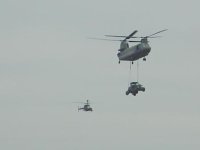
I've flown in a LOT of Hueys, but never with a D7 strapped to the bottom. I'd like to see that. A Chinook maybe, but even then I doubt it. :)

Grader lift 2.jpg

I agree, our logistical teams can do anything. But, I am not in favor of doing that. These countries need to dig themselves out with minimal medical and logistical support from us.

If you supply crack to a crack-head, you only increase the need for more crack.
 
/ Total hypothetical question
  • Thread Starter
#7  
Daves1708,

I was using Nepal specifically because it represents just about the worst sort of conditions for transportation--remote, isolated and very high up. I am not certain how far the airlift component would have to travel, but most helicopters would be severely challenged to travel with a burden so high and in any case they would not be able to travel terribly far. They Huey is an excellent general purpose helicopter that certainly proved its worth in Vietnam. But getting up high in the Himalayas is the real challenge. Sad truth is that even if it could get that D-7 up to 6000 ft, it may as well be on the other side of the moon as it will likely never get to the 10000 ft village. I was thinking around the lines of the v-22 due to its excellent range and impressive operating altitude (25k ft). Obviously, it won't operate at 25k ft with a heavy load, but this was the purpose of the challenge--how much help could be transported quickly to remote and high altitude areas. I agree that Army Corps of Engineers and SeaBees can perform some pretty spectacular feats, but moving say 20 tons of bricks by hand is certainly slower than with even a small amount of power equipment. Thanks for the input though.
 
/ Total hypothetical question #8  
Overszd,

Actually I was thinking partly with support in mind--part of the reason for relatively light equipment. I figure that they have to operate by themselves for at least several days--maybe dropped off w/50 gallons of fuel and a few other items. I am assuming that in any disaster scenario that there is no native support and any support must come in from outside. When I saw the images from Nepal, I was thinking about how many people were either buried alive, trapped by ruble or otherwise needed to just clear paths for very basic transportation. Also, especially for those buried alive, they have a very narrow window to be recovered alive and seeing people trying to dig through tons of rubble, many would die for want of even a little equipment--even small equipment beats digging out by hand which is exactly how most all of the recovery operation was going. Again, this is mostly a hypothetical, but I wonder what even a little support from outside could have done to help some of those very poor-off people who had their world collapse around on them

I totally understand your compassion.

When dealing with Mother Nature, compassion rarely is relevant.

Drop off 50 gallons of fuel and the thugs will steal it and use it to power the vehicles they are using to pillage the community.

When dealing with these situations compassion and emotion MUST be removed. Only logistical decisions based on logistical facts should be considered. There is going to be death. You can't escaped that.

Where the U.S. fails most is in our belief that we can save everyone. Korea. Vietnam, Iraq (Desert Storm), Haiti, Bosnia, Kosovo, Afghanistan, Iraq (again), and now the list has grown beyond belief. We spend hundreds of millions of dollars (actually trillions) a year trying to save the World. It ain't working.

Offer these countries minimal medical and logistical support and require that they rise above it all before giving more. You can't wean a calf by offering a tit.
 
/ Total hypothetical question #9  
Daves1708,

I was using Nepal specifically because it represents just about the worst sort of conditions for transportation--remote, isolated and very high up. I am not certain how far the airlift component would have to travel, but most helicopters would be severely challenged to travel with a burden so high and in any case they would not be able to travel terribly far. They Huey is an excellent general purpose helicopter that certainly proved its worth in Vietnam. But getting up high in the Himalayas is the real challenge. Sad truth is that even if it could get that D-7 up to 6000 ft, it may as well be on the other side of the moon as it will likely never get to the 10000 ft village. I was thinking around the lines of the v-22 due to its excellent range and impressive operating altitude (25k ft). Obviously, it won't operate at 25k ft with a heavy load, but this was the purpose of the challenge--how much help could be transported quickly to remote and high altitude areas. I agree that Army Corps of Engineers and SeaBees can perform some pretty spectacular feats, but moving say 20 tons of bricks by hand is certainly slower than with even a small amount of power equipment. Thanks for the input though.

How many support personnel would you recommend be sent in to support this lift you are talking about?? Think about that considerably before answering.
 
/ Total hypothetical question
  • Thread Starter
#10  
overszd,

This is actually an integral part of the question and part of the reason I am asking. The Nassau sort of comes as a more-or-less complete package. It has most of the support items it will need in its own hull. It will need additional fuel, but this is likely to arrive in a timely fashion, in large part because it is at sea. In the scenario I am proposing, I just don't know the total answer as to support personnel. I am pretty certain that one operator for the single piece of equipment is hardly a complete answer. I was thinking partly about disaster agencies that are semi or non-governmental. For instance, I don't know what the manpower requirements are for a doctors-without-borders operation. In any case, you are correct in that additional personnel are needed. However, transporting people to these areas is the relatively easy part. I was thinking about how difficult it is to move equipment. Therefore, I was thinking about the type of equipment that could be moved easily, effectively, that would provide genuine assistance once on the ground (I was assuming that moving debris would likely be the main purpose tasked for such equipment) and operate in an environment where the next re-supply drop is probably a week off.

I am not trying to make this sound as simple as loaning your mower to your neighbor who needs his lawn mowed while his own mower is getting serviced, but there was a fairly large international contingent of relief workers on the ground shortly after the Nepal quake. For this I am happy. My main motivating thought was those crush victims who had perhaps 72 hours on the outside for effective rescue, how quickly the debris could be removed to free them and how important the first few hours after such a disaster can make such a big difference for survival.
 
/ Total hypothetical question #11  
UH1's Lifting D7 Caterpillar dozers?... are you kidding?... a UH1, would not be able to lift 1/10 of a D7 cat.. A UH1 might be able to pull 4000 lbs off of the ground on a good day. Maybe I misunderstood what you were saying?
 
/ Total hypothetical question
  • Thread Starter
#12  
k0ua,

My original point was what type of equipment could be put to use in this particular type of disaster scenario. I know that foreign aide is not always a popular topic, but we do have people on the ground in these emergencies on a regular basis. Simply put, I was wondering what type of equipment could be effectively transported to these areas and what would that equipment be?

SI2305
 
/ Total hypothetical question #13  
I think a forestry skid loader would be the biggest bang for the buck per pound. They are tough, stable, and being a skid loader you can put all kinds of stuff in front of them...
Grapples, jack hammers, trenchers, etc.
It would be waaaaaaaaaaaaaaaaaaay better than any CUT, which would be destroyed in a matter of hours.
 
/ Total hypothetical question #14  
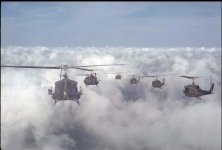
UH1's Lifting D7 Caterpillar dozers?... are you kidding?... a UH1, would not be able to lift 1/10 of a D7 cat.. A UH1 might be able to pull 4000 lbs off of the ground on a good day. Maybe I misunderstood what you were saying?

The Huey is an old friend of mine. But a heavy lift Chopper she is not.

Formation over Vinh Long.JPG

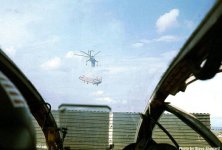
Can't remember the nomenclature of this Chopped but we called them a Hook. It was very capable but still would doubt lifting a D7.

Hooked Hook2.2.jpg
 
/ Total hypothetical question #15  
Back to the original point.

The U.S. loves to help others in need. We jump at the chance. All over the World. Our extension of aid is led by some very experienced and intelligent Logisticians. They've had plenty of practice in every scenario imaginable. I believe in regards to Nepal. We analyzed the situation and sent the most effective aid. I think individual attempts with little planning would ultimately do more harm than good.
 
/ Total hypothetical question
  • Thread Starter
#16  
Arlen4720,

The idea of a forestry skid steer is just along the idea of my main question. Most effective per unit weight, assuming it can be lifted in the first place. I had not thought of that idea (obviously) but I like your line of thinking. Thanks for the input.

overszd,

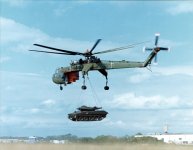
I think the "hook" you were thinking about is the CH-54, also known as the sky-crane. Some brilliant unorthodox thinking in the design--just get rid of the "fuselage"--not certain if that is the correct term for a helicopter--to save weight and increase lifting capacity. Although the Army no longer uses them, they have a number of commercial niches for them today. I sometimes think the army would do well to have a modernized version of that sky-crane, but I know that the army has budgets too and a chopper that can perform both heavy lift and carry troops is going to win out over a chopper that only carries objects. Still, a unique design.


CH54B_and_M551_Sheridan.jpg

I like this picture as we have a helicopter lifting a tank. Granted, it was considered a light tank, but it was a tank nonetheless and I imagine quite a load to carry.

SI2305
 
Last edited:
/ Total hypothetical question #17  
I totally understand your compassion.

When dealing with Mother Nature, compassion rarely is relevant.

Drop off 50 gallons of fuel and the thugs will steal it and use it to power the vehicles they are using to pillage the community.

When dealing with these situations compassion and emotion MUST be removed. Only logistical decisions based on logistical facts should be considered. There is going to be death. You can't escaped that.

Where the U.S. fails most is in our belief that we can save everyone. Korea. Vietnam, Iraq (Desert Storm), Haiti, Bosnia, Kosovo, Afghanistan, Iraq (again), and now the list has grown beyond belief. We spend hundreds of millions of dollars (actually trillions) a year trying to save the World. It ain't working.

Offer these countries minimal medical and logistical support and require that they rise above it all before giving more. You can't wean a calf by offering a tit.

I agree. Can't save those that do not want saved. The middle east is a good example. They have been fighting for over 2000 years.
I support helping other help themselves but some will not step up and help themselves.
In Jimmy Carter's term we sent over a billion dollars worth of farm equipment to African nations only to see the equipment rot in the fields.
 
/ Total hypothetical question #18  
Arlen4720,

The idea of a forestry skid steer is just along the idea of my main question. Most effective per unit weight, assuming it can be lifted in the first place. I had not thought of that idea (obviously) but I like your line of thinking. Thanks for the input.

overszd,

I think the "hook" you were thinking about is the CH-54, also known as the sky-crane. Some brilliant unorthodox thinking in the design--just get rid of the "fuselage"--not certain if that is the correct term for a helicopter--to save weight and increase lifting capacity. Although the Army no longer uses them, they have a number of commercial niches for them today. I sometimes think the army would do well to have a modernized version of that sky-crane, but I know that the army has budgets too and a chopper that can perform both heavy lift and carry troops is going to win out over a chopper that only carries objects. Still, a unique design.


View attachment 429689

I like this picture as we have a helicopter lifting a tank. Granted, it was considered a light tank, but it was a tank nonetheless and I imagine quite a load to carry.

SI2305

When first developed and used the sky-crane had a detachable body similar looking to a conex box with windows in the sides. It was used to haul troops. Can't remember how many could get it in but it was considerably more than a Chinook.
 
/ Total hypothetical question
  • Thread Starter
#19  
I had heard that configuration was a part of its design, but I did not know that any of the troop compartments were ever acquired. Sounds more and more like a good idea for today, but I bet the same budget forces still apply.
 
/ Total hypothetical question #20  
I had heard that configuration was a part of its design, but I did not know that any of the troop compartments were ever acquired. Sounds more and more like a good idea for today, but I bet the same budget forces still apply.

I'm afraid it's obsolete for today's market. A Blackhawk is wayyyyy quieter and more capable than a Huey. And I love the Huey. I've rode hundreds, if not thousands of miles in both. The Blackhawk, hands down, is a better ride. I have a love affair with the Chinook as well. But always hated boarding from the rear thru the heat and wash of the turbines. :)
 

Marketplace Items

2017 Hino 155 16ft. Box Truck (A61568)
2017 Hino 155...
2015 Chrysler Town & Country Van (A61569)
2015 Chrysler Town...
New/Unused Two Wheeled Electric Bike (A61166)
New/Unused Two...
Mini Skid Steer (A60352)
Mini Skid Steer...
2016 Ford F-150 4x4 Crew Cab Pickup Truck (A61567)
2016 Ford F-150...
Kubota KX057-4 Excavator (A61166)
Kubota KX057-4...
 
Top