Tractor drawn grader

   / Tractor drawn grader #1  

maxxum5140

New member
Joined
Nov 8, 2013
Messages
2
Location
orkney
Tractor
mccormick xtx 200, xtx 185, case 5140, 956xl, 1056xl, ford 6610, david brown 1390, mf 135, case cx330 and 130 excavators
Hello i am hoping to build a tractor pulled grader much like this one Landoll Corporation Icon Industries I have never seen one of these machines here in the UK, no one seems to build them here so im going to have do do it myself. I have seen them in the US and Australia a few years ago when i worked on combine crews ( i should have wrote down some dimensions back then!). I was hoping someone here has built or owns a similar machine and could give me a hand with the measurements / ideas.

I'm not sure on what length of blade yet. My largest tractor is 200hp weighing 10.5 tons inc front weights so should pull a fair bit. I would also use the blade to level rough ground after ploughing / harrowing by running at 90 degrees with plates on the ends of the blade to create a sort of box to pull the soil from the high bits into the low bits.

For the blade i plan to use a half of a piece of 3' pipe cut lengths ways with a heavy H beam welded o the back of it and i already have plenty wheels and axles. The rest of the steel and the hydraulics will all have to be bought in. I was thinking an old wreck of an excavator might be a good start - use the slew ring for the blade pivot and the arm for the back bone of the grader and you'd already be more than half way there with the hydraulics, pivot pins and bushes. If i happened to own one it would be fine but the price even for a wreck these days is a lot of money. Might just be better to go out and buy new steel and hydraulic rams?
 
   / Tractor drawn grader #3  
:welcome: TBN. Good luck with your project. :thumbsup:
 
   / Tractor drawn grader #4  
Welcome to the forum Maxxum,
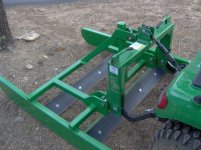
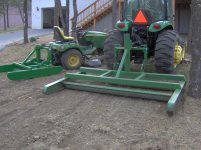
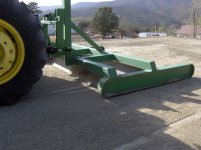
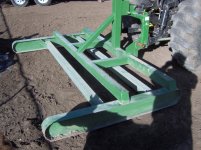
Just a suggestion but a large landplane would be easier and cheaper to build and would yield good results. Not familiar with standard implements in the UK but here in the US I would consider a landplane grader blade for your 200 hp McCormick to be 14' wide with 10' skids. With large grader blades and stout frame it should weigh in about 1 1/2 to 2 tons. With a 10 foot running surface and 14 foot width this would give you a very smooth surface.

Several members here have built their own landplane grader blades with great success and the designs vary a little but all seem to work. You might wan't to look at some of the threads on the forum as there are many. Here are two that I built, one 4' and one 8'.
 

Attachments

  • Butch W  new lawn work 003.jpg
    Butch W new lawn work 003.jpg
    342.1 KB · Views: 1,018
  • Butch W  new lawn work 002.jpg
    Butch W new lawn work 002.jpg
    379.8 KB · Views: 598
  • Butch W  new lawn work 001.jpg
    Butch W new lawn work 001.jpg
    379.7 KB · Views: 1,180
  • shop pad landplane 006.jpg
    shop pad landplane 006.jpg
    360.5 KB · Views: 410
  • landplane 001.jpg
    landplane 001.jpg
    409.3 KB · Views: 746
  • landplane 002 triple weights.jpg
    landplane 002 triple weights.jpg
    435.2 KB · Views: 571
   / Tractor drawn grader #6  
Welcome to the forum Maxxum,
Just a suggestion but a large landplane would be easier and cheaper to build and would yield good results. Not familiar with standard implements in the UK but here in the US I would consider a landplane grader blade for your 200 hp McCormick to be 14' wide with 10' skids. With large grader blades and stout frame it should weigh in about 1 1/2 to 2 tons. With a 10 foot running surface and 14 foot width this would give you a very smooth surface.

Several members here have built their own landplane grader blades with great success and the designs vary a little but all seem to work. You might wan't to look at some of the threads on the forum as there are many. Here are two that I built, one 4' and one 8'.
Nice builds, what wall tube did you use on the smaller one?
I wonder if adding some longer runners to my box blade would be of benefit.
 
   / Tractor drawn grader #7  
Nice builds, what wall tube did you use on the smaller one?
I wonder if adding some longer runners to my box blade would be of benefit.


Don't remember the exact thickness, but heavy wall 3/16" or better. More to add weight than strength or rigidity, total weight is about 420lbs. These were drops purchased from my steel supplier. When I built the skids I used 3/8" flatbar welded to the running surface and wrapped this around the open ends to close the tubing.

About adding skids to a box blade, I suspect it would help quite a lot with finish smoothing. If I were to add skids I would have a pivot point located directly over the blades and set the depth flush. Stops in the front to allow some limited tilt or oscillation yet provide alignment for the front of the skids. You could have three sets of holes in the rear to allow for depth adjustment and a vertical slot in the front to allow tilt and oscillation. I should mention that I suggest using bushings welded in place to allow an inch of clearance and prevent wallowing the holes.

This way you can weld nuts on the box blade sides and use bolts of the proper length making it easily removed or installed depending on the box blade use. When not used you would only have the four nuts sticking out on the sides about four inches above the ground. I haven't done it yet but do have the plans on the back burner now.
 
   / Tractor drawn grader
  • Thread Starter
#8  
Thanks for all the replies folks :). yea if i could find an old self-propelled grader it would be ideal but they are like hens teeth up here. Would need to go down into england to get one be, looking at a few thousand for the machine and another 」800 or so to get it here.
The main reasoning behind the pull type grader was the ability to put a camber on the road to get the water to run off. Our roads on the farm are full of low flat bits where the water lies and end up full of pot-holes. How well do them landplane graders work on very compacted gravel? If i went in and ripped it up with the digger then used the landplane i guess it would make a decent finish. Also how well do they work in soft soil, do the skids sink in too much and leave ridges? I have seen and used simple types of 'land levelers' which are just bits of channel iron in a zig-zag shape welded to a frame much like your box grader but without the skids on the side. They seem to work ok in soil but don't do a lot to a road, jut skip over the top mostly.
 
   / Tractor drawn grader #9  
maxxum5140 said:
The main reasoning behind the pull type grader was the ability to put a camber on the road to get the water to run off. Our roads on the farm are full of low flat bits where the water lies and end up full of pot-holes.
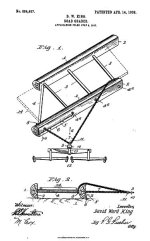
The easiest way to do it would be a drag. Google arround for "King road drag" or "split log drag".
I made one to put crown on a dirt(not gravel) road. Will try to get a pic of it tommorow. I also built a pull type grader, but without any turntable or tilt ability. See my first post for pics of that one.
 
Last edited:
   / Tractor drawn grader #10  
My primary use for both of my landplane grader blades is lawn and field smoothing so my blades are set straight for minimal drift of the material. Most of these landplane graders have the blades angled slightly. Some have a row of front ripper teeth similar to a box blade as an option. I would use a rear blade to build a crown and cut ditches then use a landplane to maintain the road.

When I saw this was your first post I suspected you would doubt the usefulness of a landplane grader blade. I am not here to convince you just offer suggestions, a little research might help you decide.
 
   / Tractor drawn grader #11  
Back in the woods behind my parents lives a couple that have to maintain their dirt road in order to get to the house at winter, or they get hopelessly stuck in the hollow forest roads. He has dug slots through the berms on both sides to let the water run into the bush, but because the road is lower than the surrounding due to wear and decades of mud splatting up into the bush next to the road, he has to keep crowning it to let the water run to the sides and then channeled through the berms into the bush.

Anyways, this guy has only a small 15hp Kubota or so, but he made a fixed angle grader blade, no joints, no cylinders. To slope the sides, he shortens the toplink to the shortest so the tip of the blade goes down. Once he has cut the sides enough, he levels the grader and smooths out the material he ploughed up. You cant get it simpler than that, though his little Kubby would have no chance to cut hard packed gravel, just not enough weight on both the tractor and implement.

The local municipality has a fixed angle plough to crown roads, and the ridge of dirt in the middle is leveled and smoothed with a standard 3pt hitch field drag which is also the weapon of choice to level fields for farmers around here. I'm not sure but i think the front angle blade doubles in the winter as a snow plough..
 
   / Tractor drawn grader #12  
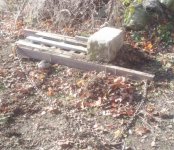
I forgot to take a pic while I was using it, so you can't see the hardened cutting edge on the bottom edge of the leading 18"-20" of the front blade. It is welded on about 1/2" below the bottom of the front blade. That cutting edge goes on the ditch side of the road and scrapes up a little dirt. The dirt flows to the middle of the road, but without a hard cutting edge on the rest of the blade, the dirt goes under the blade and is pushed into the road surface.


2013-11-10 11.54.07-1.jpg
 
   / Tractor drawn grader #13  
My Dad made one of these, many years ago, out of an old horse drawn grader. He took the front wheels off and welded on a pintle hitch ring and hooked it to a draw bar on the 3 point arms. That allowed him to adjust overall height with the 3 point. He never got creative enough to convert the other adjustments (blade angle & side to side slope) to hydraulics because he didn't use it that often and had 3 sons, he could usually get 1 of us to set on the back seat and run the controls for him.
 
   / Tractor drawn grader #14  
I forgot to take a pic while I was using it, so you can't see the hardened cutting edge on the bottom edge of the leading 18"-20" of the front blade. It is welded on about 1/2" below the bottom of the front blade. That cutting edge goes on the ditch side of the road and scrapes up a little dirt. The dirt flows to the middle of the road, but without a hard cutting edge on the rest of the blade, the dirt goes under the blade and is pushed into the road surface.


View attachment 345288

That's almost an exact copy of the King Road Drag.

King road drag - Wikipedia, the free encyclopedia

374px-King_Road_Drag_Patent_Diagram.jpg

Bruce
 

Tractor & Equipment Auctions

2000 Bobcat 763 (A60462)
2000 Bobcat 763...
2022 FORD F-250 STX CREW CAB TRUCK (A59823)
2022 FORD F-250...
2007 FORD F-150 XL TRITON (A58214)
2007 FORD F-150 XL...
MASSEY FERGUSON 4710 TRACTOR (A59823)
MASSEY FERGUSON...
2014 Magnum 7696BLA Light Tower (A59213)
2014 Magnum...
2019 CHEVROLET SILVERADO 1500 CREW CAB TRUCK (A59823)
2019 CHEVROLET...
 
Top