Hybrid Rotary Cutter Proof of Concept

/ Hybrid Rotary Cutter Proof of Concept
  • Thread Starter
#61  
Every deck seems to require a different type of blade. I worked for a blade manufacturer. There were a couple of tests we did that simulated running across a stake, like a surveyor stake, or a fence post in the case of a forage harvester, yet the blades afterward needed to still function, and without breaking.
Yes, the 'stake test'. Part of the ANSI battery of tests. A solid (1"?) steel stake is fired up into each blade at a specified location. To pass, NOTHING can fall on the floor... including ANY deck part. Sometimes, adjacent blade(s) will unscrew themselves and fall on the ground: fail! Redesign blade joint! Big decks can cut the stake right off! The Euro version of the test fires a hollow tube. Some say a tougher test because the 'stake' bends over and contacts the blade continuously. Other ANSI mowers tests are: stop time, imbalance, and thrown objects (200 ball bearings, each launched into a chamber, fired out hitting a target, if ONE goes high: fail) Typically, stake test is done last because the deck is toast after that!

I was going to say welding on them sounds like a quick r&d thing to get it done, but then you went out and had some made.
Exactly.
 
/ Hybrid Rotary Cutter Proof of Concept
  • Thread Starter
#62  
Would you recommend adding the baffle first or increasing the blade fin/wing?
Oh yeah: if deck cant shift... shift the LH rear tractor tire inward. See if the stripe disappears/improves.
 
/ Hybrid Rotary Cutter Proof of Concept #63  
Oh yeah: if deck cant shift... shift the LH rear tractor tire inward. See if the stripe disappears/improves.
My tires are not adjustable per the ownership’s manual, so the baffle first?
 
/ Hybrid Rotary Cutter Proof of Concept
  • Thread Starter
#64  
I'd shift the mower... if mower tongue is fixed, could you prepare a crossbar and bolt it to the tractor hitch? Hook up the mower shifted left? It will be the most impactful thing to do.
 
Last edited:
/ Hybrid Rotary Cutter Proof of Concept #65  
I would think tow-behind mowers would be much harder on the U-joints than three point mounted models. For that reason alone, I would stick with the three point model, unless I really needed tow-behind because of the size.
Hey Runner, I would think just the opposite--the u-joints would stay more in a straight position instead of having to flex up and down when the 3-point is raised/lowered. There are definite advantages with being able to raise the 3-point, but I was able to raise the trail type I had with hydraulics to clear rocks, stumps, etc. There was a lot more vibration transferred to the tractor with the lift models; that can't be good on bearings, bushings, etc., and over time has to take its toll.
 
/ Hybrid Rotary Cutter Proof of Concept #66  
Cost. Pull-type mowers require at least 2 rear wheels and external hydraulics to operate the lift. Since their driveshafts operate in 3d space, expensive CV joints must replace the cheaper cardan joints found in 3pt mounted mower driveshafts.
Thanks for the reply. From my perspective, the additional strains on the much more expensive tractor, especially lighter SCUT and CUT tractors, would eventually lead to greater costs than one additional wheel and better CV joints for the mower. But I'm not privy to info that I'm sure you are. Just from personal experience, when I was actually 'farming' with larger equipment (and it was a mountainside farm, not nice smooth fields), I always felt the trail type transferred a lot less vibration onto the tractor itself, thereby reducing the stress on the tractor and its' many parts. I currently have a 3-point but would trade it for a trail type in a heartbeat; "brush hogs" are made to withstand beating and banging, tractors not so much...
On a side note, the areas I've seen flail mowers used on here look more like the material had been knocked down more than cut but, then again, this isn't on nice smooth fields.
 
/ Hybrid Rotary Cutter Proof of Concept #67  
Hey Runner, I would think just the opposite--the u-joints would stay more in a straight position instead of having to flex up and down when the 3-point is raised/lowered. There are definite advantages with being able to raise the 3-point, but I was able to raise the trail type I had with hydraulics to clear rocks, stumps, etc. There was a lot more vibration transferred to the tractor with the lift models; that can't be good on bearings, bushings, etc., and over time has to take its toll.
Maybe depends on the property being mowed. When I mow my pasture, I set the height once and don't touch the rockshaft lever again until I'm done mowing.
 
/ Hybrid Rotary Cutter Proof of Concept #68  
I'd shift the mower... if mower tongue is fixed, could you prepare a crossbar and bolt it to the tractor hitch? Hook up the mower shifted left? It will be the most impactful thing to do.
I was thinking about that very thing making a temporary extension to shift the hitch position to the left.

The term you used is back sweeping which I think means the blade is moving forward (ex., as the tractor is mowing) which is the same direction that the tires push the grass down.

Which leads me to this question is clock wise rotation is it as viewed from the top of the deck or when looking up from underneath the deck?

I think it would be best to just hook up and the mower with it raised up and observe the blade rotation.
 
/ Hybrid Rotary Cutter Proof of Concept
  • Thread Starter
#69  
I was thinking about that very thing making a temporary extension to shift the hitch position to the left.

The term you used is back sweeping which I think means the blade is moving forward (ex., as the tractor is mowing) which is the same direction that the tires push the grass down.

Which leads me to this question is clock wise rotation is it as viewed from the top of the deck or when looking up from underneath the deck?

I think it would be best to just hook up and the mower with it raised up and observe the blade rotation.
"Back-sweep" is the portion of the blade going backward as the deck moves forward. This is typically the best cutting region on each blade. The deck (and tractor) is pushing the material forward as the deck moves through it. Easy for the blade to then "go against the grain" and cut cleanly. Blade pass frequency on my new cutter is 1.1"/cut @ 3mph... so each grass tuff gets appr 3 wacks. That's it.

Forward sweep is the weakest part of the cut! Grass bent forward, mower blade also going forward = grass NOT lifted. Note: most zero-turn mowers out there have one (at least) caster wheel out front that is repositioned farther to the side. Why? They are moving a tire track OUT of the forward-sweep region and into the back-sweep.

r4e028192_642x462.jpg


When a tire track aligns with forward sweep... the result is almost always "striping". It appears that is what your mower is doing (you didnt reply to my question about the tractor tire aligning to the stripe). I looked up your C114-1 and it detailed CW turning blades. From the images I saw on YouTube, their tractor tire was at the 11:00 position to the LH blade.... that's the forward sweep region. ITs GOING TO STRIPE! I dont think baffles or blades will fix it. I'd put my energies toward shifting the mower (or overlapping the passes to re-mow the stripes). Hope this helps! Randy
 
/ Hybrid Rotary Cutter Proof of Concept #70  
"Back-sweep" is the portion of the blade going backward as the deck moves forward. This is typically the best cutting region on each blade. The deck (and tractor) is pushing the material forward as the deck moves through it. Easy for the blade to then "go against the grain" and cut cleanly. Blade pass frequency on my new cutter is 1.1"/cut @ 3mph... so each grass tuff gets appr 3 wacks. That's it.

Forward sweep is the weakest part of the cut! Grass bent forward, mower blade also going forward = grass NOT lifted. Note: most zero-turn mowers out there have one (at least) caster wheel out front that is repositioned farther to the side. Why? They are moving a tire track OUT of the forward-sweep region and into the back-sweep.

View attachment 3774346

When a tire track aligns with forward sweep... the result is almost always "striping". It appears that is what your mower is doing (you didnt reply to my question about the tractor tire aligning to the stripe). I looked up your C114-1 and it detailed CW turning blades. From the images I saw on YouTube, their tractor tire was at the 11:00 position to the LH blade.... that's the forward sweep region. It’s GOING TO STRIPE! I dont think baffles or blades will fix it. I'd put my energies toward shifting the mower (or overlapping the passes to re-mow the stripes). Hope this helps! Randy
Sorry hadn’t had time to hook it back up and measure it.

It is a 114” wide mower 57” to center. On my TC45DA the left tire measured from the center of the drawbar is 18” to inside and 34” roughly to the outside edge.

The streak seems be from almost the outside edge of the left tire to say 30” to most of the way to the outside edge of the cut, but not the whole way.

Next week I will hook it up again and see the actual measurement of the streak.
 
/ Hybrid Rotary Cutter Proof of Concept #71  
Maybe depends on the property being mowed. When I mow my pasture, I set the height once and don't touch the rockshaft lever again until I'm done mowing.
I'm jealous of your terrain! Rotary mowers, which most refer to as bush or brush hogs, are primarily used for clipping/clearing ground that is very undulating, with saplings, rocks, etc. For fields that are smooth and clean enough to set once and go, we usually cut for hay or use a finish mower to clip it, using the rough areas for pasture--those areas where if the cattle didn't travel both ways on the hillsides, they would have shorter legs on one side. LOL Another advantage to the trail type mower is weight doesn't quickly shift to the rear of the tractor, which is pretty important on our hillsides.
 
/ Hybrid Rotary Cutter Proof of Concept #72  
Very interesting thread. A lot of R&D went into this project and it's nice to read a complete explanation of what is happening when the wheel row fails to stand up and get cut. I have 50 hp so I primarily use an offset flail. Higher blade speed and slower ground speed allows time for more lifting of the single tire track. For rough stuff I found an old 5' BH and fitted it with chains. For very tall stuff I use a 5' BH on the front of the SS.
Keep up the good work (y)
 
/ Hybrid Rotary Cutter Proof of Concept #73  
Sorry hadn’t had time to hook it back up and measure it.

It is a 114” wide mower 57” to center. On my TC45DA the left tire measured from the center of the drawbar is 18” to inside and 34” roughly to the outside edge.

The streak seems be from almost the outside edge of the left tire to say 30” to most of the way to the outside edge of the cut, but not the whole way.

Next week I will hook it up again and see the actual measurement of the streak.
I haven’t hooked it up yet, but had time to measure it and the mower.

From center of PTO it is 18” to the inside tread lug/bar of the left rear tire.

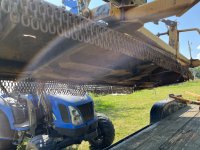
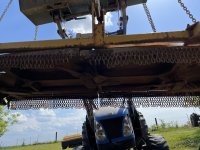
Attached are some pictures of the mower with black tick marks from center of gearbox to 18”, 34” and the center of the outside spindle on that side.
 

Attachments

  • IMG_1805.jpeg
    15.7 MB · Views: 104
  • IMG_1803.jpeg
    13.3 MB · Views: 103
  • IMG_1806.jpeg
    IMG_1806.jpeg
    789.1 KB · Views: 69
  • IMG_1807.jpeg
    13.6 MB · Views: 98
/ Hybrid Rotary Cutter Proof of Concept
  • Thread Starter
#74  
From center of PTO it is 18” to the inside tread lug/bar of the left rear tire.
I'm sorry, I don't know what "it" is. I also dont see the "black tick marks" and what they represent.

Here's all we'll need:
  • A pic (or your visual description) of the tractor/mower (shot from the rear) with a stripe coming out.
  • How stripe aligns with LH tractor tire (full width? Starts at tire center and goes out beyond tire to edge of mower? etc)
  • How it aligns with LH mower spindle (10:00, 11:00, 12:00, 10-11:00 position maybe???) Best guess or pic (stop tractor, snap pic with stripe from rear)
  • Confirm spin direction of LH spindle (CW, CCW?)
We'll get to the bottom of this!
 
/ Hybrid Rotary Cutter Proof of Concept #75  
I haven’t hooked it up yet, but had time to measure it and the mower.

From center of PTO it is 18” to the inside tread lug/bar of the left rear tire.

Attached are some pictures of the mower with black tick marks from center of gearbox to 18”, 34” and the center of the outside spindle on that side.
Sorry it was not clear.

From center of the PTO stub shaft on my tractor it measured 18” to inside of the left tire lug and then from the PTO center it’s 34” to the outside of the tire lug (lugs are the parts of a R1 tire that grip and press the grass down).

Also it is 37” from the center line of the PTO shaft out to the far left spindle (about inline with the Woods decal).

If you expand the last picture I wrote those measurements in black marker on the belt cover/guard.
 
Last edited:
/ Hybrid Rotary Cutter Proof of Concept #76  
Here are some more pictures and the last one has measurements written on it with black marker.

- the tire path from center of mower/ PTO shaft 18” out to 34”

- streak is in the tire track and out to the center of that spindle

In the last picture the blade rotation at the front of the mower is going to the right side of the picture (outside edge of the mower deck).

Hopefully I am making sense.
 

Attachments

  • IMG_1841.jpeg
    IMG_1841.jpeg
    1.4 MB · Views: 68
  • IMG_1818.jpeg
    IMG_1818.jpeg
    9.7 MB · Views: 91
  • IMG_1819.jpeg
    IMG_1819.jpeg
    8.7 MB · Views: 107
/ Hybrid Rotary Cutter Proof of Concept #77  
I just realized shifting to the left will be easier than I thought. I forgot that my center drawbar can be moved left or right until I scrolling through some TC45 photos I had saved see attachment. I will try that next mowing.

Hopefully the u-joints won’t scream too much.
 

Attachments

  • IMG_0178.jpeg
    IMG_0178.jpeg
    257.8 KB · Views: 66
Last edited:
/ Hybrid Rotary Cutter Proof of Concept #78  
I tried mowing with my drawbar shifted to the left. It shifts the mower to the left 4” 5” and I noticed my PTO shield rubbed the yoke on shaft yoke so it can’t move farther than that.

The left tire track shifted to the right of the deck by about 4”.

It didn’t make a real difference on the streaking left by it.

If I go slow like when I outline the field next to the fence cutting as close as possible to posts (every 8’ is a post on perimeter) it cuts with no streaking say less than 1.5 mph, but I mow at 3.5 mph typically.
 

Attachments

  • IMG_1928.jpeg
    9 MB · Views: 83
  • IMG_1927.jpeg
    15.4 MB · Views: 83
  • IMG_1922.jpeg
    12.4 MB · Views: 85
  • IMG_1930.jpeg
    IMG_1930.jpeg
    1.5 MB · Views: 61
Last edited:
/ Hybrid Rotary Cutter Proof of Concept #79  
I also used my IR temperature gun on the u-joints. The back one which was running the straightest was about 5 degrees cooler than the middle u-joint at 114 degrees which had the most amount angle with the mower shifted.
 
/ Hybrid Rotary Cutter Proof of Concept #80  
"Back-sweep" is the portion of the blade going backward as the deck moves forward. This is typically the best cutting region on each blade.
Backsweep is the concept that the creators of the 80s TV series Airwolf missed: Turbo boost (booster rocket) on a helicopter sounds cool to the kids watching it, but it would mean that the blade backsweeping with the travel direction would loose its lift and the forward sweeping section would gain too much lift, putting the helicopter in a corkscrew... 🫣😅
 

Marketplace Items

2018 Peterbilt 220 Elgin Crosswind Series J Sweeper Truck (A61568)
2018 Peterbilt 220...
2023 John Deere 8R 280 Tractor (A63109)
2023 John Deere 8R...
500 BBL FRAC TANK (A58214)
500 BBL FRAC TANK...
BUNDLE OF 4"X RANDOM LENGTHS RED OAK FLOORING (A62131)
BUNDLE OF 4"X...
3PT. PTO DRIVEN SPRAYER (A62131)
3PT. PTO DRIVEN...
2017 Unverferth 1245R-35 Rolling Harrow (A63116)
2017 Unverferth...
 
Top