Tractor Stability on Hills

   / Tractor Stability on Hills #1  

NorthernboyinKY

New member
Joined
Sep 16, 2013
Messages
2
Location
Tyner, KY
Tractor
Sears Lawn Tractor
I'm looking to buy a sub-compact tractor, and I'd like to purchase one more stable on hills. My question is, why is it impossible to find out which models are more tip-resistant than others? I've read countless threads about stability on hills, but the manufacturers make no mention of center-of-gravity or tipping moment or anything else that would help me make my decision. I know the info varies greatly depending on implements, but I can't find any information at all.
 
   / Tractor Stability on Hills #2  
No manufacturer can state (with absolute authority) that one tractor is more "tip resistant" then another.
These machines are used in a great variety of situations as far as type of property, severity of slopes, implements to be used (which can change the center of gravity) and much more.
It's up to the operator (YOU) to determine safe usage of the machine and make appropriate adjustments (wheel spacers, filled tires to name two) to enhance it's safety. It's also up to the operator (YOU) to use the equipment in a safe manner.
 
   / Tractor Stability on Hills #3  
No Scut is going to give a specific rating other than perhaps some generic "do not operate on grater than 15* slopes"

If you want something specific (or less general) you really need to look at machines made special for slopes.

As Roy said, its going to come down to experience. I regularly operate on about 20-22* slopes, some guys do more, some do less. Things like spacers and filled tires can help on slopes.
 
Last edited:
   / Tractor Stability on Hills #4  
There are tractors made for hills

I've seen steiners on some amazing slopes.
 
   / Tractor Stability on Hills #5  
There are Tilt-O-Meters. Formulas for percentage of slope. And opinions. It differs. A loader on with bucket raised is less stable on hills. An implement raised on side hills is less stable. A hidden hole or rock missed the previous time will cause instability on hills. It is what you are doing at the time and what you are doing it with. You are the ultimate judge of slopes. If you feel that it is unsafe then it is certainly is unsafe. Don't push it to the edge on hills. Take a little more time to do it in a way that you are comfortable with.
 
   / Tractor Stability on Hills #6  
I'm in WV and we have a couple hills here and there. :D Pretty much any tractor can be setup for hills, I put 35 gallons of windshield washer fluid in my Craftsman tires and use it on some astonishing slopes. Others I know have setup dual wheel setups on their lawn tractors. My Mahindra weighs over 6000# with the empty loader and nothing on the three point and I have the rear wheels set to the middle width setting; it goes really well on slopes as it is, but a few I slide sideways down the hill due to a lack of traction. I'm considering dual wheels or more weight to counter the problem. I know of a few folk that have added dual wheel setups to their tractors of this size as well. All types and brands manage all sorts of terrain here. Your main consideration should be the size you need for the tasks you have and don't buy too small. You can set it up for hills through use of ballast, spacers and width settings, and in the extreme; dual wheel kits.
 
   / Tractor Stability on Hills #7  
"If you feel that it is unsafe then it is certainly is unsafe." ..so it comes down to feelings? A center of gravity height to width ratio also might also be a useful basis for comparing different tractors.
 
   / Tractor Stability on Hills #8  
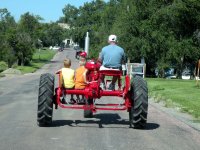
"Grandpa's tractor" would be have stability on hills. :)

Grandpa’s tractor – TRUE DAKOTAN

car-show-tractor-kids.jpg
 
   / Tractor Stability on Hills #9  
"If you feel that it is unsafe then it is certainly is unsafe." ..so it comes down to feelings? A center of gravity height to width ratio also might also be a useful basis for comparing different tractors.

It comes down to experience. I.E feelings. If you want to go the gravity height to width ratio give 'er a go. I'll watch your height to width ratio and see how that works. But I won't be on the tractor with you.
 
   / Tractor Stability on Hills #10  
Here's a picture...

3.jpg
 
   / Tractor Stability on Hills #11  
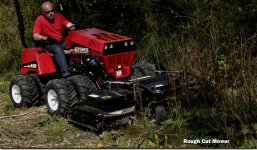
Try a Power Trac 425 or 1430. 30 degree slopes sideways (that is VERY steep)

This is a Ventrac video. As you notice they are going up and down which is just what a normal tractor would do. Why they didn't go sideways is a mystery, maybe the machine they say can, can't. But it gives you and idea of what 30 is. How Steep is 30 Degrees? - YouTube

I have a Power-Trac 1850 that is rated at 45 degrees sideways. Frankly I got off a 40 degree slope and pretty much tumbled down. Nearly had a heart attack getting back to the tractor. and getting in was no fun. 45 is really really really steep.

There are two other tractors (Ferrari and one other) that are true slope tractors but bring your gold card.

Widening the stance and adding fluid might get you 20 degrees sideways with a normal tractor. We looked very hard at "normal" tractors before we got the PT. Don't regret it but don't fault people keeping conventional machines either, quite jealous on occassion.

Versatile Tractors,Compact Tractors,Trailer Packages,Landscaping,Utility Vehicle Rentals,Mowers-Power Trac
 
   / Tractor Stability on Hills #12  
State road here uses Massey Ferguson 5450 2WD with Tiger mowers connected to special heavy weight subframes for roadside mowing and get up on some slopes a billygoat would balk at. They fill the rears halfway and have both fronts and rears set as wide as they can go without extensions.
 
   / Tractor Stability on Hills #13  
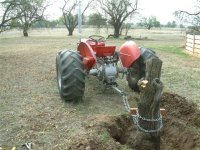
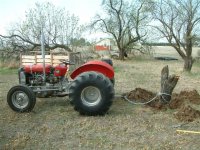
Some modern orchard tractors generally have a low center of gravity since they have to squat low to avoid damaging the trees. And standard field tractors can be modified fairly easily to lower the CG. My 1964 MF135 diesel is a case in point.

MF135 stump1 (1).JPGMF135 stump2.JPG

The normal tall rear wheels have been replaced by BF Goodrich 6-ply 18.4-16A tires (18" wide, 16" dia rim, 40" tall overall) and the front axle spindles have been replaced with shorter ones to keep the tractor level. The previous owner made these modifications to work in his olive orchard.

Good luck.
 
   / Tractor Stability on Hills #14  
"If you feel that it is unsafe then it is certainly is unsafe." ..so it comes down to feelings? A center of gravity height to width ratio also might also be a useful basis for comparing different tractors.

Well, if one thinks an area is unsafe, it probably is. Although, as mentioned before....it's also a matter of developing a comfort level with the equipment.

As far as this:
A center of gravity height to width ratio also might also be a useful basis for comparing different tractors.
As I'd written in my original response, the manufacturer has no control how operators equip or use their tractors. A comparison such as you suggest would be for the tractor alone and could give buyers a false sense of security.
 
   / Tractor Stability on Hills
  • Thread Starter
#15  
Thank you all for your info and advice. I'll probably end up with a JD 1-series, or maybe even one of the X-700's. My hills probably aren't as steep as I may have led you to believe, but my "pucker" factor is high due to my inexperience in operating a tractor. I really just wondered why more of the safety info isn't more readily available. For autos, they do skid pad tests, braking tests, and any number of other safety-related tests, and I look at them not because I plan on seeing how fast I can take the curves, but as one factor among many criteria to be used in choosing the right vehicle for me. Believe me, I understand that safe operation is my own responsibility, as it is when I drive a car, or operate my table saw for that matter. Thanks again for taking the time to post responses.
 
   / Tractor Stability on Hills #16  
Nothing wrong with being cautious...

For most of us having a tractor is having the pleasure of doing our own projects on our timeline...
 
   / Tractor Stability on Hills #17  
Thank you all for your info and advice. I'll probably end up with a JD 1-series, or maybe even one of the X-700's. My hills probably aren't as steep as I may have led you to believe, but my "pucker" factor is high due to my inexperience in operating a tractor. I really just wondered why more of the safety info isn't more readily available. For autos, they do skid pad tests, braking tests, and any number of other safety-related tests, and I look at them not because I plan on seeing how fast I can take the curves, but as one factor among many criteria to be used in choosing the right vehicle for me. Believe me, I understand that safe operation is my own responsibility, as it is when I drive a car, or operate my table saw for that matter. Thanks again for taking the time to post responses.

The largest variable for a car in such tests is the passenger load and the difference between a full tank of fuel or an empty tank of fuel. Perhaps a thousand pounds and it stays centered between all the wheels. The variables for tractors are much harder to predict. There are times a tractor can be moving it's own weight doubled or even tripled and that weight is never distributed the same.

Any testing they would do on a tractor would be insufficient to be applied to real world uses due to the inability to recreate all the real world variables, so why bother wasting the money and driving the cost of the machines up?

Best of luck with your choices!
 
   / Tractor Stability on Hills #18  
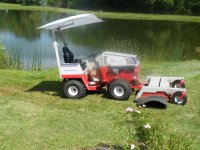
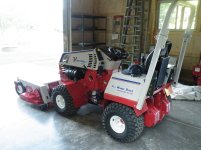
One of the most stable looking tractors for slopes that I've seen around here is a Ventrac. Think its smallest engine size is 30 hp; so, a bit large for a SCUT.

I'd hoped that my new 1025 would be a little more stable on hills because it's a tad lower to the ground than my 4010 was. However, it doesn't FEEL any more stable. As with any tractor, you need to have it well balanced with weight in both front and rear that offsets working weight in front or rear that you're carrying. Most stable condition for my 4010 seemed to be with carryall loaded about 1/2 way and a full load in the FEL of the same material. Gotta still go very slowly up and down and particularly sideways on slopes.

Ralph
 
   / Tractor Stability on Hills #19  
Once heard an old farmer I was working for tell a guy if he felt uneasy, stop and climb off the uphill side, then put a good effort into lifting on the high side and watch the sidewalls of the tires on the high side as you do. He said if you are far enough over there's much risk, you can move it at least enough to take some weight off the high side tires and you can see it in the sidewalls. Definitely not scientific and doesn't take into consideration any sort of terrain changes and the amount of give is going to vary by tractor and tire, but if you think you're feeling too uneasy at certain angles, such a thing might make you feel more at ease. Seat time will as well, work slowly and progress into the steep stuff as your pucker factor allows. Don't rush learning the machine and you can find it's limits slowly and safely without exceeding those limits and hurting yourself or your machine.
 
   / Tractor Stability on Hills #20  
I use a Ventrac on slopes, Good for the Pucker factor.
 

Attachments

  • 2013_0825ventractop0019.jpg
    2013_0825ventractop0019.jpg
    1 MB · Views: 232
  • 2013_0718Ventrac0005.jpg
    2013_0718Ventrac0005.jpg
    721.6 KB · Views: 207

Tractor & Equipment Auctions

2016 John Deere 35G Mini Excavator (A55973)
2016 John Deere...
2018 CATERPILLAR 336F L (A58214)
2018 CATERPILLAR...
NIPPON HYD THUMB (A52706)
NIPPON HYD THUMB...
2019 Krause 8005-30 Excelerator - High Speed Vertical Tillage - 30 FT Working Width (A56438)
2019 Krause...
UNUSED FUTURE FT90 PLATE COMPACTOR (A52706)
UNUSED FUTURE FT90...
HUSQVARNA RIDING MOWER 42IN DECK (A56859)
HUSQVARNA RIDING...
 
Top