trailer lights

/ trailer lights #1  

ugabulldog

Silver Member
Joined
Jun 22, 2010
Messages
125
Location
GA
Tractor
'04 MF 451 diesel shuttle shift w/ MF 1040 loader
I am really trying to figure this out, hate trailer lights not working like most people, don't want to rewire entire trailer, but I am close..... It is the trailer as my other trailer works fine hooked to same vehicle.... only 1/2 the lights work, it is not the bulbs... the front running lights work when hooked to truck, but the rest of running lights do not work at all.... but when I troubleshoot and jump trailer pins with alligator clips off of a known good battery, I can't get lights to come on? And I know I am touching the right pins on plug, In fact when I hook up volt meter to leads, it reads 12v but as soon as l I touch leads to plug pins, voltage goes away...... Also, when hooked to truck and front running lights are on, the voltage on wire right before going into front running lights is 20 volts?
 
Last edited:
/ trailer lights #2  
does this trailer have electric brakes and a break away switch with its own battery?
Has it been activated and does it go to some of the lights?
That's the only way I could see that you could have 20 volts is 2 batteries in series.
 
/ trailer lights #3  
90% of the time with trailer light problems.. there is a bad ground somewhere.
 
/ trailer lights #4  
90% of the time with trailer light problems.. there is a bad ground somewhere.

Yup. When I rewired my trailer I pipe to the entire thing in plastic electrical conduit. I also ran a ground wire instead of using the frame. Everything soldered no crimp connectors. Silicone Dielectric grease is also an important element. In all the bulb sockets and any connectors
 
/ trailer lights #5  
Most trailer wiring depends on the frame for the ground return.
One secret is to use a wire loom that includes its own ground wire, forget about using the frame.
Also do not use easy crimp connections, solder each joint and then shrink a waterproof sleeve over that joint.
Corrosion (rust) is your enemy!
 
/ trailer lights #6  
It is usually the ground on my trailers that cause issues. My smaller Big Tex stop, tail, and marker lights on the rear did not work on the last pre-trip inspection. The front markers and license plate lights worked. Pulled the left taillight out of the rubber housing and found that all the grounds were connected to a bolt through the frame behind it. Tightened the nut and everything worked great. Just lucky I pulled the correct light first.
 
/ trailer lights #7  
Probably be time ahead to rewire the trailer. Quite a while ago I bought a 250 ft spool of 16/3 flexible power cord like is used on power tools. Among other things I've used it to rewire two trailers. Not a time consuming job at all. Provides a separate ground wire like Piloon says. Soldering and shrink sleeves also real good advice.
 
/ trailer lights #8  
Read someplace that you are not suppose to solder and shrink tube the connections because the solder will move up inside the insulation and the vibration and bouncing causes the wires to break. I have never had it happen, and I have rewired my last two trailers by solder and shrink tubing and running a separate ground to each light.
 
/ trailer lights
  • Thread Starter
#9  
does this trailer have electric brakes and a break away switch with its own battery?
Has it been activated and does it go to some of the lights?
That's the only way I could see that you could have 20 volts is 2 batteries in series.

Yes, it has a battery for breakaway brakes, it has not been activated as far as I know, not activated now anyways...I will check to see if it goes to any lights tomorrow

Read someplace that you are not suppose to solder and shrink tube the connections because the solder will move up inside the insulation and the vibration and bouncing causes the wires to break. I have never had it happen, and I have rewired my last two trailers by solder and shrink tubing and running a separate ground to each light.

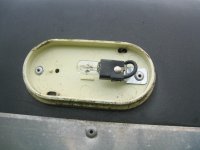
A couple of questions on rewiring, where do you ground all the wires to, trailer frame? Also, on lights like these, where the rivet is the ground, where do you attach the ground wire to light?
 

Attachments

  • 001.JPG
    001.JPG
    2.6 MB · Views: 275
/ trailer lights #10  
Does that fixture have a bare metal back where the ground contacts the frame, how does it ground normally? Maybe a ring terminal trapped between the backing and the trailer frame? As I understand it, the most common way of running separate ground wires is not wire OR ground through frame, but wire AND ground through frame, in other words don't take any extra steps to isolate the light grounds from the frame, just provide a better dedicated electrical path in addition so as not to rely on the frame ground.

Here's another troubleshooting thought, regarding battery vs vehicle: Are you actually getting any ground contact through your connector at all? Maybe it only partially works when hooked to the tow vehicle because the ground is happening though the hitch ball (or pintle). Have you tried leaving the wiring hooked up, but unhitching so the hitch is not providing a 2nd ground, then seeing what happens with just the connector ground? The matching battery test would be to add a jumper wire from the battery ground to the frame to bypass the connector.
 
/ trailer lights #11  
It's not clear what people mean when they say use a ground wire instead of frame. Seems there are 2 possibilities:
1) Run a separate ground wire from each light instead of relying on the light contacting the frame as part of its mounting. Relying only on frame path requires paint be scraped where light mounts.
2) Other possibility is run a separate ground from the frame (trailer tongue) to the trailer's connector plug, and the vehicle's receptacle also has this terminal grounded to its frame, instead of relying on the connection through the ball (and the hitch /receiver)

I've only had to do the later.

Don't overlook that often there's a lot of paint and warning stickers on the removable draw bar (ball mount) that prevents a good conductive contact with the vehicles receiver when relying on the frame as a path. I've had to ground this off to get lights working.

Getting 20 volts is weird. Either something is going on with the trailer's battery somehow being in series the vehicle's (seems unlikely); or because of bad/missing connection (path), probably a ground, you're not really measuring across the battery.

(That is: If the battery negative terminal isn't connected to this reference (frame) that you measure from, the reading you get is meaningless; because you're only measuring voltage from the positive to the frame, but not the unknown voltage from frame to negative. This unknown voltage exists because the two are not connected.)
 
Last edited:
/ trailer lights #12  
One guy I know never bothers to wire turn indicators and uses standard extension cord (110 VAC 3 wire) to do so.
He claims the LEO's really don't care nor see that the turns don't work and actually the only 'give away' is non working brake lights or at night the markers.

On my trailer every lite works! and I use LEDs since potholes and filaments don't go well together.
Mind U with LEDs you need very good ground returns as the current is so low.
 
/ trailer lights #13  
There are a lot of unknowns in the situation. If it was my problem to troubleshoot, I would start with the tow vehicle wiring. Make sure there is a continuous ground from battery negative terminal to the connector on the hitch. If the hitch was added on, it is almost certain that the ground wire just goes to the frame and can be compromised by rust or undercoating. If it is OEM it is continuous unless a previous owner made a modification, you never know, so everything has to be checked. Make sure all the connectors are wired properly and working at that point. Once the vehicle side of the connector is known to be functioning properly, then start the trailer troubleshooting.
 
/ trailer lights
  • Thread Starter
#14  
suprise suprise, it was the ground where rivet acts as ground to frame, or maybe it was the butt splices as I replaced a few also, (not sure where to 20v came from) Anyways, thank for all the help. I am going to run a ground wire from light base to inside of livestock trailer and ground to a tap screw into frame, .....rather than tie wires from all lights together into a common ground.
 
/ trailer lights #15  
It's not clear what people mean when they say use a ground wire instead of frame. Seems there are 2 possibilities:
1) Run a separate ground wire from each light instead of relying on the light contacting the frame as part of its mounting. Relying only on frame path requires paint be scraped where light mounts.
2) Other possibility is run a separate ground from the frame (trailer tongue) to the trailer's connector plug, and the vehicle's receptacle also has this terminal grounded to its frame, instead of relying on the connection through the ball (and the hitch /receiver)

I've only had to do the later.

Don't overlook that often there's a lot of paint and warning stickers on the removable draw bar (ball mount) that prevents a good conductive contact with the vehicles receiver when relying on the frame as a path. I've had to ground this off to get lights working.

Getting 20 volts is weird. Either something is going on with the trailer's battery somehow being in series the vehicle's (seems unlikely); or because of bad/missing connection (path), probably a ground, you're not really measuring across the battery.

(That is: If the battery negative terminal isn't connected to this reference (frame) that you measure from, the reading you get is meaningless; because you're only measuring voltage from the positive to the frame, but not the unknown voltage from frame to negative. This unknown voltage exists because the two are not connected.)

What is meant by separate ground wire is you run a wire from the vehicle plug ground terminal wire to each individual light. Either solder a loop connector to the end of the wire and attach it to one of the light mounting bolts which is normally the light ground, or if using LED, which normally have a separate white ground wire that is normally connected to the trailer frame or around one of the light mounting bolts, you connect your ground wire to it. That way you are not even using the trailer frame for the ground.

I have seen a bad ground on a trailer light actually backfeed through another light to find ground. Bad ground backfeeding the ABS system on the vehicle blowing the fuse. A bulb that was overturned and jumped the pin on a right rear turn signal activate all the running light on the trailer and the tow vehicle. Looked like you turned on the flashers but the sign marker lights on the trailer also flashed.
 
/ trailer lights #16  
I have a buddy that owns a storage facility and rents/loans trailers to help the clients move in. (he maintains 5) Nice perk!.
90% of his trailer lighting problems are from grounds!
The other 10% corroded connections.
We now solder all joints and run separate ground lines. 95% of the problems have disappeared.

On an aside most users are too lazy to crank up the hitch leg enough so many get damaged when they cross a curb.
 
/ trailer lights #17  
It's not clear what people mean when they say use a ground wire instead of frame. Seems there are 2 possibilities:
1) Run a separate ground wire from each light instead of relying on the light contacting the frame as part of its mounting. Relying only on frame path requires paint be scraped where light mounts.
2) Other possibility is run a separate ground from the frame (trailer tongue) to the trailer's connector plug, and the vehicle's receptacle also has this terminal grounded to its frame, instead of relying on the connection through the ball (and the hitch /receiver)

I've only had to do the later.

Don't overlook that often there's a lot of paint and warning stickers on the removable draw bar (ball mount) that prevents a good conductive contact with the vehicles receiver when relying on the frame as a path. I've had to ground this off to get lights working.

3) Wire it like you're supposed to with a proper ground from the vehicle frame to vehicle side connector and a proper ground from the trailer side connector to the trailer frame.

In this thread, I am seeing people working way too hard to fix a problem that is only a problem due to shoddy work. When properly wired and terminated, these problems don't exist. Adding solder and multiple terminations/splices due to running separate grounds to all the lights introduces more points of failure. You're doing more work while introducing more opportunity for faults.
 
/ trailer lights #18  
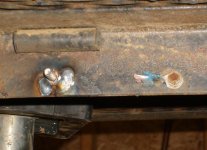
Do you have a small mig/ wire feed welder? Do yourself a favor and get some 1/4 stainless steel bolts and weld them to the frame near each light and near each axle (if you have brakes). Then run the ground from each light to the bolt. It'll never loose ground again. Counting on a metal contact touching the steel frame on a trailer will sooner or later fail as the bare metal needed for contact will rust. A number of trailer lights use the mounting studs as a ground as well. If possible I replace the steel bolt they use with a stainless bolt and then make up a short wire to connect the ground stud to the bolt I welded on the frame. While it's more work that running a ground wire to each light it's often easier on larger trailers.
ground.jpg
 
/ trailer lights #19  
Do you have a small mig/ wire feed welder? Do yourself a favor and get some 1/4 stainless steel bolts and weld them to the frame near each light and near each axle (if you have brakes). Then run the ground from each light to the bolt. It'll never loose ground again. Counting on a metal contact touching the steel frame on a trailer will sooner or later fail as the bare metal needed for contact will rust. A number of trailer lights use the mounting studs as a ground as well. If possible I replace the steel bolt they use with a stainless bolt and then make up a short wire to connect the ground stud to the bolt I welded on the frame. While it's more work that running a ground wire to each light it's often easier on larger trailers.
View attachment 551087

Interesting solution, to say the least! I am wondering why you stipulated a mig/wire feed welder? Any welder capable of welding stainless should work fine to weld the bolts, I would think.
David from jax
 
/ trailer lights #20  
Interesting solution, to say the least! I am wondering why you stipulated a mig/wire feed welder? Any welder capable of welding stainless should work fine to weld the bolts, I would think.
David from jax

I think it would be difficult to weld with a stick, being such small bolts. A TIG would work just fine but less people have them where as wire fed welders are pretty common now. As long as you paint it you don't even need to use stainless wire.
 

Marketplace Items

USC Series 2000 Conveyor (A61307)
USC Series 2000...
2019 CUSHMAN HAULER PRO ELECTRIC GOLF CART (A58375)
2019 CUSHMAN...
2023 VOLVO VNL760 6X4 T/A  SLEEPER TRUCK TRACTOR (A59908)
2023 VOLVO VNL760...
2012 HYUNDAI  HL740-9 WHEEL LOADER (A58214)
2012 HYUNDAI...
36"x12' Stacks of Sheet Metal (A60463)
36"x12' Stacks of...
Toro hr:2213.5 (A56859)
Toro hr:2213.5...
 
Top