Treated or regular lumber?

   / Treated or regular lumber? #1  

Richard

Super Member
Joined
Apr 6, 2000
Messages
5,057
Location
Knoxville, TN
Tractor
International 1066 Full sized JCB Loader/Backhoe and a John Deere 430 to mow with
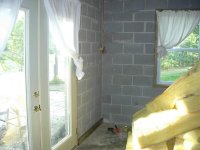
Starting to finish the main room in the basement (walkout). One full side of it is under grade and not visible in the photo. The side under grade is the whole right side of the room and the photo is of the left corner which as you see, is fully exposed to air & sunlight.

If it matters to know, when storms come in, they seem to come in blowing towards this side of the house.

My question is, I've always thought/understood that when ever you have wood to concrete contact, you really should use treated lumber. Once you have a treated plate down, you can then use regular lumber.

On the side of the house that is under grade, I've used treated on the floor and as firring strips up the walls (I used treated 2x4's)

Now on this wall I'm wondering if I really NEED to use treated since it's so open air?

Frankly, I kind of hate using treated because of how freaking wet it is from the store and if you don't use it immediately, how it turns into a pretzle as it dries out.

So, I'd PREFER to use regular lumber (again 2x4's) up the wall as my firring strips. I keep falling back to the "always use treated against concrete or blocks" logic so I'm in a quandry.

Thought I'd ask for opinions?
 

Attachments

  • wall.JPG
    wall.JPG
    60.7 KB · Views: 280
   / Treated or regular lumber? #2  
i wouldn't want to use treated lumber inside my house.
 
   / Treated or regular lumber? #3  
It is my understanding that if the wood is in contact with masonry or concrete, or exposed to the elements, you must use treated wood.

Bob
 
   / Treated or regular lumber? #4  
For the walls in your picture, I'd use a PT plate, I'd even use a sill seal between the plate and the concrete floor and use regular 2 x 4s as wall studs. There's noting wrong with using PT inside a house.
 
   / Treated or regular lumber? #5  
I'm with the other guys.. PT on anything wet, or in contact with ground/concrete/elements.. otherwise #2 white wood is ok.. etc.

Soundguy
 
   / Treated or regular lumber? #6  
I would use PT as well. Just make sure that your fasteners are rated for the PT chemicals used in the wood.

Later,
Dan
 
   / Treated or regular lumber? #7  
Funny enough.. doubledip galv is more $$ than stainless in my area... go figure..

Soundguy
 
   / Treated or regular lumber? #8  
Keep PT on the floor in all cases. For the wall furrings, you should be okay without PT. My last house had a similar basement - concrete floor/block wall. The wall furrings were not PT and everything was good after 15 years of use before I sold it. But I couldn't vouch for the code...
 
   / Treated or regular lumber? #9  
Richard said:
I keep falling back to the "always use treated against concrete or blocks" logic so I'm in a quandry.
The issue is block and concrete can absorb moisture, particularly concrete floors. This moisture can then seep into the lumber and cause rot if it's not PT.

With block walls, they should have been treated with sealer (below grade) or paint (above grade) so they won't transmit moisture to the studs. A 'pants and suspenders' kinda solution would be;

1. 2 x 6 PT sole plate with sill sealer beneath it.
2. 2 x 6 top plate
3. 2 x 4 wall placed flush with the interior edges of the sole and top plates

This will keep the 2 x 4s 2 inches away from the block wall.
 
   / Treated or regular lumber? #11  
TBDonnelly said:
In my area I've seen many basement where steel studs were used.

Don

Bingo! Do like the commercial builders do and use metal studs, or a smaller metal furring channel fastened directly to the block wall.

Also, if you have a concern about moisture, address that rather than building to accomodate the water. You would be much better off sealing the space from water [liquid or vapor] than planning for wet building materials.
 
   / Treated or regular lumber? #12  
Whether someone has moisture problems or not, direct contact with concrete requires PT wood.
 
   / Treated or regular lumber?
  • Thread Starter
#13  
MikePA said:
Whether someone has moisture problems or not, direct contact with concrete requires PT wood.

That's always been my understanding too... I've decided I'll just go with the treated & not worry about it.
 
   / Treated or regular lumber? #14  
From what I remember around here, vapor barrier is required between masonry and wood no matter what type of wood.

Steve
 

Tractor & Equipment Auctions

CATERPILLAR 305CR EXCAVATOR (A60429)
CATERPILLAR 305CR...
John Deere TX Gator (A60462)
John Deere TX...
DEUTZ MARATHON 60KW GENERATOR (A55745)
DEUTZ MARATHON...
Crown RM6025-45 4,500 LB Stand-On Electric Forklift (A59228)
Crown RM6025-45...
2021 HYUNDAI ROBEX 35Z-9A EXCAVATOR (A60429)
2021 HYUNDAI ROBEX...
2021 CATERPILLAR D3 LGP CRAWLER DOZER (A60429)
2021 CATERPILLAR...
 
Top