Wallenstein BX62 Comments

/ Wallenstein BX62 Comments #1  

nopost

New member
Joined
Sep 13, 2011
Messages
6
Tractor
Ls R4041ez
In case someone desires to know my experience w/ the BX62, here are some thoughts (and questions for those who have a BX62). If this thread gets good comments, it may help others who are shopping for a chipper. I read all the old threads about chippers and found I still was not well informed. I'm familiar with a Vemeer 12" chipper and now have a BX62s; its well made, but I think hydraulic feed would be more practical.

Many ppl ask whether to get a 42 or 62; the most common answer is get a BX62 due to it's larger throat (allows crooked limbs to pass easier). I agree, but take note that you still have insert the limb carefully to get it to feed. Generally I have to force small ones in and stay clear of large ones. I just chipped pine and pin oak limbs that were cut about three months ago. If I had it to do over, I would definitely buy a hydraulic feed 62. It may cost more, but over time it would be worth it. Any comments from other BX62 owners?

I kept breaking the 'shear bolts' that the previous owner gave me. OEM? Doubt it. They were 3/8" grade 8 and had free play between the 3/8 bolt and the metric hole in the Binacchi pto. I tried M10 Class 8.8 from Lowe's and they broke, too. I ordered M10x1.5x50 Class 10.9 (Grainger part number 6AU16) and haven't broken any yet. Grainger's website says Class 10.9 is equivalent to Grade 8 and Class 8.8 is ~ Grade 5. M10's fill the hole better than the 3/8 bolts. (btw, the furnished Binacchi pto's plastic housing is better quality than those on pto's of my other attachments.)

Some folks on this forum said if a chipper feeds too fast then the blades are set too far from the anvil (big stuff feeds too fast, stick it in and get outta the way). My chipper is used (thus I don't know if it's common); there is over 1/16" variance in how close the blades come to the anvil blade. i.e. If my closest blade is <1/32, the farthest blade is over 1/16, about 5/64, maybe more. I made shims out of sheet metal but so far have not gotten all four blades the same distance because I only had two different thicknesses. Any comments from other owners? Do you see a variance on your unit and does a large gap feed too quickly?

Some folks asked whether a tractor w/ less than a 30hp pto will work. Some answers to those questions suggest the 62's 200 lb flywheel overcomes a lower pto hp. I disagree; large limbs feed fast enough to stall an LS 4041 w/ 35 pto hp (basically this is the same tractor as a NH Boomer w/ 41 bhp). Maybe its the blade to anvil spacing but I think 35 hp is not enough for large stuff (not everyone holds everything over 3" for firewood and I don't burn pine). Large limbs slow the flywheel with every blade impact; the longer the limb, the more likely a stall. It slows considerably with 3 month old 5" yellow pine and killed the tractor on 6" stuff if I didn't keep it about 3' long. (It ran short lengths of 3~4" pin oak well. And you can run 3" pine all day long.) It helps to set the pto faster than 540. Sharp blades help also.

Please comment if you actually have experience w/ a BX62 or 62 hydraulic; I'd like to see others' experience. Some old threads had comments from recent purchasers. I was impressed at first too, but now I wish I had hydraulic feed to slow down the large stuff and pull in the small. Maybe it's Vemeer's fault.

 
/ Wallenstein BX62 Comments #2  
I own a bx60 which has 3 blades and i set the blades at 1/16 for top of blade and 1/8 for the bottom of blade . I run exactly at 540 and have NEVER had a jam or slowdown running up to 6 inch oak or pine ect. My tractor is kioto ck35 with 34 hp. Have no experience with a bx62 with the 4 blade set. Mine is NOT hyd and works, chips, an shreds flawlessly. However, I follow leafy tree tops with butt end of next tree faith
fullly thus elimanating any clogs. Hope it helps
 
/ Wallenstein BX62 Comments #3  
<snip>

Some folks on this forum said if a chipper feeds too fast then the blades are set too far from the anvil (big stuff feeds too fast, stick it in and get outta the way). My chipper is used (thus I don't know if it's common); there is over 1/16" variance in how close the blades come to the anvil blade. i.e. If my closest blade is <1/32, the farthest blade is over 1/16, about 5/64, maybe more. I made shims out of sheet metal but so far have not gotten all four blades the same distance because I only had two different thicknesses. Any comments from other owners? Do you see a variance on your unit and does a large gap feed too quickly?

<snip>

Welcome to TBN!

I think you have identified a good part of the problem. The blades should be evenly gapped to the anvil so each blade takes an equal cut from the wood. If one blade is set with a larger gap, it will take a bigger bite, requiring more torque from the drive system to execute. This will result in a large, alternating torque being transmitted thru your PTO shaft at about 540 RPM/32400 Hertz. This is generally not good for machinery and may be why you are shearing bolts.
 
/ Wallenstein BX62 Comments #4  
do they really use grade 8 bolts for a shear bolt?
 
/ Wallenstein BX62 Comments #5  
Everything you describe sounds like it's feeding too fast. I'd investigate why the blades are so non-uniform in terms of spacing, and see if that can be corrected. You really want to get them much closer in terms of spacing.

I still have the stock shear bolts that came with my unit, and will look and see what the grade is next time I am out back.

One thing that jumped out at me is that you said you are chipping hardwood limbs that were cut 3 months ago. Those will be tougher than chipping fresh-cut, and I think they mention this in the manual (they suggest alternating green wood in with dry wood).

Finally, when is the last time the blades were sharpened? That has a big effect. If the answer is "I don't know" or "I did them myself" then you probably need to send the blades out to get professionally sharpened.

There's no doubt that blade spacing and blade sharpness will help you dial in the machine to an optimal operating envelope where it feeds and cuts well, and I think you're outside of that envelope right now. My Wallenstein sucks limbs in like spagetti and chips them smoothly and evenly.
 
/ Wallenstein BX62 Comments #6  
If the blade gap is different blade to blade the blades are not sharpened to the same length. The blades are mounted at an angle to the anvil so the length from the mounting holes to the edge must be the same. They must also be sharpened square or the gap will vary top to bottom.
 
/ Wallenstein BX62 Comments #7  
let me add another note to my reply on the bx60. I only have 3 blades and manual says to set different thickness so it has a taper to bottom thus making it self feed. !/16 0n top and 1/8 on bottom for the bx60 with 3 blades. Not in your case that I'm adhere of. Honestly don't know on yours
Diaedy
 
/ Wallenstein BX62 Comments #8  
The shear bolts that came with my Wallenstein are JDF 10.9, which has similar strength specs to a Grade 8 bolt.
 
/ Wallenstein BX62 Comments
  • Thread Starter
#9  
Thank you guys for your posts, I knew I would learn from you. The previous owner said the blades were never sharpened and he had never turned them around. Compared to units that I see for sell now, this unit looks worn; however it does not seem abused nor does the flywheel appear to wobble. I may set up a micrometer on it to see if it has been slightly bent.

Baby Grand: I concur. The blade 'pops' when the 62 is empty is faster than the 'chunking' of large wood when it's hit. I think the close blade is slicing and the farthest blade is grabbing. I'll call EMB this coming week to see what they suggest.

Lwalsh: As far as the blades being sharpened wrong, probably not. When I took them off to install the shims I saw the previous owner truly had never reversed them. These appear to be factory blades/edges (I have a spare set to compare). The used edge of the blades still felt sharp, but the fresh edges definitely cut better. Typing this reminded me that I did not turn the anvil blade over, nor check it's condition. That may be causing some of the problem. I agree that improper sharpening would cause a major problem.

s219: I probably need to read the manual again, I've slept since then. Let me tell you one big thing. I've ONLY used this chipper for deadwood and the three month old pine, sweet gum and oak. It was three months of drought, which must have made a difference. (I was at the mercy of the guy who came when he wanted to climb, top and drop the trees. I had other work to finish when he showed up.) No doubt it would be better chipping green limbs. Further these trees were cut at full sap. Today I went and chipped some dead trees (planted too high and the burlap had not been removed, they had no chance). They decided to take out some of the trees that weren't as dead yet. Here's the big thing; the green wood chipped great. It was about 4~5" max. The almost dead maple was really hard, but 3~4 limbs that still had leaves fed so smooth I put them aside to empty the chute with. I can see why people are so thrilled with their unit. As stated in the original post, this is a well built unit, I respect EMB Mfg for their quality.

murphy: "do they really use grade 8 bolts for a shear bolt?" Don't know, but I haven't broken the grade 8 (10.9) M10 with partially unthreaded shanks whereas I broke a number of 3/8 unthreaded shank Grade 8 and M10 full thread Grade 5 (8.8)

s219:As you suggested, I agree the different spacings seem to be causing overspeed feeding, whacking and grabbing the wood rather than pulling it in.

diaedy: I'll look at the manual again about having greater spacing at the bottom.

s219: I understand 10.9 but what do you mean JDF? Brand name?

Thanks for your responses.
 
/ Wallenstein BX62 Comments #10  
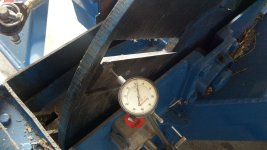
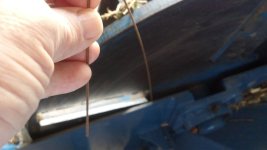
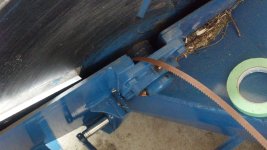
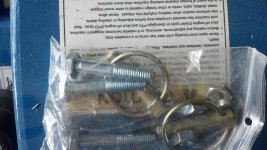
I have BX62 that I usually use with my 45HP Case DX45. I have never broken a shear bolt. The shear bolts are M8.8. I have been impressed with how well it self feeds but I did run out of power on stuff about 4 inch diameter and above and have stalled the tractor several times. I suspected that it was feeding too fast. I just recently adjusted my chipper blades for the first time. The manual states the gap should be 1/32 inch. I found it hard to measuring looking in the in feed so I opened the chipper and went from the top down. I first used a dial indicator as shown in the picture to check the relative height of the blades to one another. There were all within about 0.010 inches which I thought was pretty good. I checked at both ends and the middle of the blades. I marked the high blade and used that to check the gap. I found a 1/16 inch welding rod fit snug along the whole blade edge. Then I need a long gage that was 1/32 inch thick. I found an old broken band saw blade that was 0.030 thick to use as a gage to adjust the anvil (my wife wonders why I keep all that old junk :laughing:). I have not used the chipper since adjusting the gap, but I will be the week after next and will report back.
 

Attachments

  • Blade height.jpg
    Blade height.jpg
    216.1 KB · Views: 847
  • Wrie gage.jpg
    Wrie gage.jpg
    156.8 KB · Views: 613
  • SawBlade gage.jpg
    SawBlade gage.jpg
    232.2 KB · Views: 624
  • ShearBolts.jpg
    ShearBolts.jpg
    252.6 KB · Views: 560
/ Wallenstein BX62 Comments
  • Thread Starter
#11  
Stonehaller: Running out of power is one of the reasons I would like to have a hydraulic feed. Seems like I could dial back the speed for the big stuff. I would rather have mulch than firewood. Mix it with glass clippings and you get some quick compost if you keep it stirred up.

I'm going to have to get a magnetic base for the dial indicator I have. I miss a lot not having that option. I'm wondering how much variance there is in the flywheel. Broken bandsaw blade, now why didn't I think of that? I wondered why I was saving them. Can't wait to run in and tell the wife I found a use. Of course, I do that nearly every time so she is underwhelmed.

Originally I tried to adjust the farthest blade to 1/32, but the closest hit the anvil blade. So I tried adjusting out a little and saw little improvement in feed rate. Then I tried making shims out of two different thicknesses of sheet metal. It helped, but I need more sizes. I'll probably look for a shim pack or better yet, find out why there is so much variance and go from there. I think when all the blades are at 1/32 it will feed very well. As I stated in my previous post, the 62 feeds and chips small green limbs well. Even the 12" Vemeer would overload sometimes and have to be emergency stopped; the guy (in my opinion) had the feed rate set too high. Everything over 8" was kept for firewood and it was green wood.

If it isn't raining tomorrow I am going to take the anvil blade off and check it. And I'm going to call EMB. And I'm going shopping for a base for the dial indicator. And shims. There's my list and I'm sticking to it. Unless it rains, I'm made of sugar.
 
/ Wallenstein BX62 Comments #12  
I have never taken the blades out (I am impressed with the blade life) so I do not know if there is much slop in the holes that would allow you to individually adjust each blade. When I first put the indicator on, I checked the runout of the face of the flywheel just above the blades and it was 0.050. Made me wonder how I would get the blade gap at 0.031 for all four blades. When I saw the blades where within 0.010 I figured either they qualify the blade mounting surface or there is enough gap in the bolt holes for some adjustment. With yours being so far out makes you wonder if the previous owner somehow bent the flywheel.

If you do not have mag base, do you have something that allows you to mechanically clamp the indicator?

The other thing to keep in mind is that EMB does state that you need 60-70 HP for full capacity. We may be just expecting too much.
 
/ Wallenstein BX62 Comments
  • Thread Starter
#13  
Stonehaller: I'll use the info you gave me when I check mine. I ordered a new dial indicator w/ mag base; they are cheap enough now that I got a set. I've seen need for a mag base since I got the dial indicator. Thank you for pointing out using one. Since I only had the indicator, I didn't think about it. That will tell me if the flywheel is bent though I saw no wobble (Don't tell anybody, but I opened it up and turned it on; couldn't see any wobble.)

I agree 35hp pto is on the low end; it isn't enough power imo. 50hp pto seems like a good minimum for 6". That's one of the things I wanted potential buyers to note. When I read old posts here, I saw some claim the heavy flywheel keeps the momentum; it doesn't. One person said he owned a 29hp tractor and asked how well a 62 would work. I think he was misinformed by people who gave an opinion (though they may not had actual experience) saying the flywheel would do the work for the underpowered tractor. It is true for small limbs, but I wanted people to realize they needed a larger tractor if they were going to try full capacity like I have. I can do 3" very easily when it is green. Larger and drier both progressively need more power.

I also read in old posts that it would help to have all the blades at 1/32. That appears correct; having uniform blade gap should allow each blade to chip a little rather than one whacking, kicking the wood out a little and then whacking again when the wood slides back down. I have seen some chips that are one inch thick. Part of this has to do with lack of hp to keep momentum but I may have loose bearings (I can't 'feel' any freeplay). After I get the dial indicator, I'll check and then I'll call EMB to see what they suggest.

There is no slop in the bolt holes in my 62. I tried to slide the blades forward or back and they don't move. I agree the blades seem to stay sharp; I turned them over to see how much better it would do with factory sharp edges and there is a noticeable improvement at first. Since the wood had been on the ground for three months, some wood had dirt on it and I'm sure that dulled the new edges.

I really like having the chipper and look forward to grinding small green stuff. The blue monster gobbles it up. But for larger stuff I wish I had hydraulic feed to slow the feed rate.
 
/ Wallenstein BX62 Comments
  • Thread Starter
#14  
I've almost finished cleaning up what the tree climber cut for me. For those who are considering getting a chipper, here's what I've seen regarding how the BX62 does various wood. That which is noted as three month old had been healthy and in full leaf. It was cut by a man who climbed and topped the trees first because they were near the house. I had other work to do when he showed up and so the wood laid on the ground for about three months during which time we had a drought. Take note I bought this BX62 used; see the other topics discussed above because it all plays a part.

Today I chipped an Eastern White Pine which began dying prob three years ago. It ground and fed very well. I was able to split the top of the tree and grind it. That was the only thing that lugged the 31hp pto. I had to force the large end into the 6x10 opening (because it apparently was 6") so it lugged the tractor; by the time the trunk was at the smaller end (4") the flywheel was speeding back up. 3~4" limbs fed smoothly from big end to small end without breaking up.

I chipped limbs of an 80' Southern Yellow Pine (SYP). It had been cut due to it being alone/too near the house. (This was one of the 3 month old trees.) 5~6" limbs considerably lugged the tractor and sometimes killed it or broke shear bolts. It fed way too fast and caused enough vibration to break a lot of small limbs as it fed. They fell in front of the chute creating a nuisance/hazard. The tree had a lot of crooked limbs and 90 degree offshoots so I often I had to force feed. My 41bhp tractor w/ 35hp pto did not have enough power for the large stuff. Probably due to dried sap, this stuff was too hard to split by hand which prob explains why the 5~6" was so hard to chip. Surely this SYP would have chipped better if it had been chipped as soon as it was dropped.

I also chipped a SYP that I had done some excavation near - it died early last year. It (of course) chipped better than the SYP that had been alive. 5~6" was still too much for the 35hp pto. It fed too fast and vibration caused many twigs to break off the limbs. It was rotten enough that it broke up when we dropped it so it seems like the 5~6 should have chipped easier.

I chipped some 'pin oak' (that's what they call it here. I checked in a photo book of trees and it had a different name. It has narrow 3~4" leaves w/ no lobes). It was easier to chip than sweet gum. (It had been cut three months ago.) 4" stuff slowed the tractor, but not appreciably. I ran some 5~6 because it seemed to chip fair. I saved most of the large stuff. I had to force most of the twiggy limbs since they are so crooked. I've chipped these trees before with a 12" hydraulic feed Vemeer as soon as they were dropped and they may not have chipped any easier (of course we sent larger limbs into it).

The limbs from two sweet gum trees were the hardest to chip. (They were three month old.) They had very crooked limbs and many had to be forced into the chute due to stiffness and crooks. For these and the live SYP I kept a limb as a push stick because so much had to be forced in. Both these and the live SYP should have been chipped when they were green. Many of the twigs would break due to vibration and fall in front of the chute. 5~6" limbs were too large and bogged the tractor, killed it or broke shear bolts. Large limbs caused a lot of vibration.

Dead ornamental maples caused vibration and therefore dropped a lot of twigs. I threw 4~5" trunks aside because even 3~4" was hard to chip. Limbs of maples that were beginning to die fed perfectly (these still had green leaves). Did not try to chip the trunks. All these maples died because they were planted with burlap still on (root bound) and too high (1/2 the root ball out of the ground).

Dead and fallen willows often break up because they are weak and rotten, but the 62 will grind everything you can get through the opening. Generally deadwood pin oak chips well but breaks up and falls in front of the chute.

If you are considering getting a chipper, I hope this helps you make a better choice. As stated in the beginning of this thread, I've used a 12" Vemeer hydraulic feed chipper. It is very common and considered a small professional unit. I really considered buying a used one, but what I might buy costs $7000 and up and to me that would warrant doing this work for pay. I paid $2600 for this BX62 and got an extra set of knives. When I look for used stuff, it is never available. So when I found this one advertized, I committed to buy it based on a photo. When I got there it looked more worn than many photos of used ones that I've seen (and may have some abuse issues). I wouldn't have bought it for 2600 had I not asked the guy to hold it for me. From my experience with the variety of wood I chipped recently, I wish I had bought a hydraulic feed BX62. The quality and simplicity of these chippers is exceptional. But if you can afford it, you may want to get one with hydraulic feed so you can slow the feed rate for larger limbs. Part of that decision depends on how much you will be using it. For what I just did, I would like to have had hydraulic, but for infrequent cleanup of deadwood, that would not matter.
 
/ Wallenstein BX62 Comments #15  
My post hole digger uses grade 8 bolts for the sheer bolts. I was also very surprised, but I guess they are made from a softer metal.
do they really use grade 8 bolts for a shear bolt?


Marketplace Items

Jack Daniels Mini Decorative Truck (A61574)
Jack Daniels Mini...
2019 KENWORTH T880 6X4 T/A SLEEPER TRUCK TRACTOR (A59912)
2019 KENWORTH T880...
Caterpillar 814/815/816F Landfill Compactor Service and Parts Manuals (A63117)
Caterpillar...
2015 IC Corporation PB105 School Bus (A61568)
2015 IC...
Caterpillar 950F Wheel Loader Parts and Service Manuals (A63117)
Caterpillar 950F...
2020 JOHN DEERE 770G MOTORGRADER (A63276)
2020 JOHN DEERE...
 
Top