Wasted heat

   / Wasted heat #21  
DSC01961.JPG

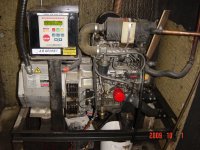
This actually is the companion to that BIG NG set, used for night time service. Keeps computers in the Office, Laser cutters and so forth powered up during the night. Waste heat also put into the various slabs.
 
   / Wasted heat #22  
Aaa the grand dreams of free power....
 
   / Wasted heat
  • Thread Starter
#23  
If you use genset all Winter, go ahead and add suitable heat-exchanger to you heating loop and shunt the coolant into it just to see what's up. Electric load/output will likely vary more than heat output and fuel use/hr. (frictional losses, other real inefficiencies)

I suggest that the general idea is more sensible than silly. What to do with excess Kw, or on the coldest days? Run electric heaters at the cost you'd get the grid to pay you to feed back. When you don't need the heat, grid power saves gen fuel/oil, allows service.

Cold days, run the genset and coast thru the night (heat, as said) on-grid for clocks, office UPS, etc. KISS by switching elec source by human decision when firing up the gen, say vs ever expecting automatic stuff to know when you'd like to bump the thermostat on a dreary day or whatever.

I say don't overthink the complexity. Three separate but SxS controls, I imagine. 1) Switch power from grid to gen. (have it anyway?) 2) Switch/valve to shunt 'spit' loop 3) Switch to start gen. Build separately, and instruct to operate separately-but-in-unison. Your youngest could switch 'em with a holler from the other room. (If it looks like a good long-term plan, add sophistication/automation as time and budget allow tech tweaks.) btw, such a project/prototype sounds easy for a guy like BT. :)

That is kind of how I see it too. Start small, keep it simple, and then add in stages as you go.

I am not sure if the power company would take the power or not because it is not alternative power, but rather fossil fuel derived. But net-metering is a sweet deal. They basically "buy" your power at retail rates.

It is not actually money that changes hands, but "credits". My Uncle has a windmill on net metering, and saves about 50% of his power. When he is over-producing power, every KW he produces for the grid, gets a "credit." When his windmill does not produce enough power, he has to trade those credits in. If all his credits are used up, then he obviously has to pay the electric company the extra kw's he uses.

This is a sweet deal for net-metering people like my uncle because they are getting retail prices (in the form of credits) for their wholesale power. So here in Maine, that price is 16 cents per KW, which is pretty high. But who knows how long that would last. We had net-metering, got a new governor and so it reverted back to wholesale-metering, then when he got replaced, it swapped back to net-metering again. That is because regular consumers, and the power company hate-net metering, but small scale power producers love it.
 
   / Wasted heat
  • Thread Starter
#24  
It's all doable, I would try to avoid back feeding the utility.
Mainly because of the synchronizing issues, I'm not sure how the solar units do this but I would
assume that the utility is controlling the inverter that is changing the solar DC to utility AC,
this has to be the same frequency and a slightly higher voltage to backfeed the utility.
A home generator or commercial unit will not have these abilities.
As far as recovering the engine heat that is quite doable and would be dollar sensible,
I'd be tempted to place a controlled 3 port valve that in one position would feed the floor
the other would go thru a radiator to control the engine heat.
Would this be less expensive then utility power I seriously doubt it.

I was curious about synchronizing as well. When I was working for the railroad, that was always tricky, getting the multiple unit to sync just right. A few times I got the frequency off...but this was AC Drives and not DC. The DC Locomotives were much simpler, but wheel slip was a lot more of a problem then with the AC ones. Those AC Loc's would often break the couplers before they would wheel slip or drop out.

Fun times, but that is going back a few years. But neither AC or DC would wheel slip like this bad boy! (LOL)

Wheel Slip.jpg
 
   / Wasted heat #25  
You can not hook a diesel powered generator to the grid. You have no means of keeping it synchronized. In any case , it would not be allowed as not legal due to RICE stationary ICE laws which are extremely tight the last years. Lastly it would surely cost more than just buying the electricity.
 
   / Wasted heat #26  
Your gen set only produces as much power as is consumed. And the prime mover supplies all of it, plus some more to accommodate loss.

If that is true then the diesel engine would consume no fuel when idling.

The past 10-20 years of innovation in small gensets has focused on the use of inverters. Allows the engine to run at slower speeds when less electrical power is needed so as to save fuel.
 
   / Wasted heat #27  
You can not hook a diesel powered generator to the grid. You have no means of keeping it synchronized. In any case , it would not be allowed as not legal due to RICE stationary ICE laws which are extremely tight the last years. Lastly it would surely cost more than just buying the electricity.

Well, it is difficult and the tools to do the job are not commonly sold over the counter.

EPA has regulations on emissions for equipment generating grid power requiring fewer emissions than any diesel, no matter DPF or SCR/DEF. Decades ago the Nuclear Regulatory Commission ordered backup generators be exercised every month under load. EPA would not allow the power to be placed on the grid due to the emissions but couldn't prevent the generator from being run. Typical government SNAFU: one agency said you must run the generator, the other said you can't use the generated power. So with no other option the local TVA nuclear plant had to build cooling ponds and huge load resistors to dissipate the electrical power their two stationary locomotive engines generated during monthly tests. This is one of many things the Reagan EPA corrected. Was only common sense that no one would run the diesel locomotives to sell power to the grid, the cost of running the engines was greater than the value of the electricity produced.
 
   / Wasted heat #28  
This is a sweet deal for net-metering people like my uncle because they are getting retail prices (in the form of credits) for their wholesale power. So here in Maine, that price is 16 cents per KW, which is pretty high. But who knows how long that would last. We had net-metering, got a new governor and so it reverted back to wholesale-metering, then when he got replaced, it swapped back to net-metering again. That is because regular consumers, and the power company hate-net metering, but small scale power producers love it.

It is a sweet deal. Too sweet. Federal law only requires the utility pay the audited incremental cost of generating a kWh. For TVA that is $0.015. A penny and a half. Effects of Obama's Save The Earth Greenies are fading and come January 1, 2020 the TVA Green Power Provider rate will go from $0.090 (for under 10kW systems) to $0.015 for new systems.

If the utility can generate a kWh (not kW, but a kW for an hour) for only 1.5¢ then why should it pay someone else more than that? Under TVA systems TVA runs the electric production and local "utilities" buy power from TVA and maintain the local power grid. The locals have to get paid for their wires somehow, so that is the difference between the price TVA gets paid the the utility charges end users.
 
   / Wasted heat
  • Thread Starter
#29  
The utilities are all in a deep death spiral now as far as I can tell.

The whole problem is that they get paid on a consumed scale. As technology moves forward, and things become more and more economical, that means the average consumer is using less electricity for their home. However their cost of getting electricity to the homes keeps going up: labor, fuel, material costs, etc. So they have no choice but to ask for a rate hike. When they get it, the consumers have more drive to buy even more things that will save them on electrical consumption to get their electric bill down. When enough people do that, the electric company has no choice but to ask for another rate hike...and on and on it goes.

People producing electricity for themselves, no matter how that looks, only makes the matter worse.

Maine has had two rate hikes in the last two years. There is talk now about going to a flat fee, where consumers are not charged by the kilowatt consumed. That certainly has its own concern for sure. I have always wondered how that will work for the people that are 100% off-grid, or people like my Uncle who produce about half his power for the grid. Will it be like some water districts where if they go past your home, you are required to hook up to it, like in the power line case, if the grid goes by your home, you must pay the fee whether you use the power or not? I am not sure.

But if anyone has been watching (and very few people have) the utilities are in a horrible death spiral, and have been for awhile. The cost of maintaining the powerlines HAS to keep going up, and with more and more electrical production going homeowner sized, and more efficient lightbulbs and electrical appliances, the consumption per home is going down. The wide spread use of heat pumps has helped take the edge off for utilities, but it is inevitable that another technology will come along. As is, we are on the verge of having whole-house battery technology that will make the grid obsolete.
 
   / Wasted heat
  • Thread Starter
#30  
The thing with these situations (co-generation) is that it is not IF the idea will work, but on whether or not that is the best way to get the the result.

I remember a few years ago talking to the Maine Dept of Planning, and discussing Compost Heat, and whether it would work to heat my house. Again, all I need is 100-150 degree water in my main boiler loop. Compost heat is great because it is 140 degrees, for months on end.

Anyway I had that man, and quite a few more tell me, "If it could be done, everyone would be doing it."

Well they were wrong, Jean Pain of France was a forester that had been heating his house from the 1970's using compost heat.

I did a lot of research on that, and concluded that while it would be 100% possible for me to use compost heat to heat my home all winter, in the same amount of time that it would take me to form the pile, running the pipes through the pile, etc, I could just cut my firewood, or cut firewood for someone else tree length, and buy my propane. Now that I am using wood pellets, the same thing applies.
 
   / Wasted heat
  • Thread Starter
#31  
I think the best thing for me to do is, install the gen-set out in an old insulated building I have out back, and hook it up to my pto generator. I have 220 right there so I can back-feed my home.

But I also have a wood/coal boiler kicking around not doing anything. I put it up for sale, but I did not get many people that were interested in it. I could put that in that same building, then plumb the diesel engine's cooling system to the boiler. Then I could run lines from that back building and wood/coal boiler to my main boiler loop.

That would enable me to do a lot of things.

It would give me a home that could be heated by propane/diesel/coal/wood pellets or firewood. When you live in Maine, having multiple sources of heat is always good.
It would give me backup power.
It would keep my engine at optimum temperature no matter what ambient air temperature was providing for instance starting.

This is that boiler that I got. It is in really good shape for a 40 year old boiler, which may apply to my wife as well! Just do not tell Katie I told you she is 40! (LOL).

DSCN1713.JPG
 
   / Wasted heat #34  
Hubba hubba :shocked:
 
   / Wasted heat #35  
It sounds like you are looking for an excuse to go off grid. It is very possible and can be fairly low effort on a daily basis, meaning fairly automatic. I think it was on this forum where someone built off grid. I’m going by memory but I seem to remember $20,000 being thrown around if you should go off grid. Meaning if it costs 20k to hook up to the grid, going off grid can pay. I seem to remember this individual spent big money on a high tech battery system. I think he went solar and with a good battery system, a generator for cloudy days can be small, like 7hp small.

Lots of ways to go off grid, it’s a matter of what’s easy, cost effective and practical.
 
   / Wasted heat
  • Thread Starter
#36  
Hubba hubba :shocked:

Yeah for a product of the 1970's, that is a decent looking boiler! I always thought a boiler with red trim looks nice! It even has red "heels", or all joking aside, I put that boiler up on blocks and then boxed around it with tin work so that I did not have to stoop over quite so far while putting wood or coal into it.

As for Katie, I think that picture was taken when she was 38 years old. She has managed to watch what she eats, and works out despite her age, and having three children. On the last one, I thought she would pork up, so I teased her, and she made a point to prove me wrong. She had to watch how she exercised because she just gave birth, but in 22 days she was back down to her pre-pregnancy weight.

Unfortunately I have to have "The talk" with her. I have been putting it off, but she is chubbing up on me, and every once and awhile, like all husbands, I have to remind her to put the ice cream down. I dread it though because she will get cranky for a week after I tell her.
 
   / Wasted heat #37  
I think Dave dodge man is right. Get the equivalent of a solar power agreement from your utility and read it. It probably says that if you're a "generator" that's, in effect, putting the same amount of power that you normally draw on average, they will not pay you back for it. With solar panels, I can put power back as long as I don't become a "generator". Think their term for it is actually different.

Our average consumption is between 2 and 2.5 kw, whole house for everything including heating. That's only about 3.5 hp. So, almost any water cooled engine would likely way overheat your house. Our 12.5 kw diesel generator runs our whole total electric house, including upstairs and basement heating and one electric hot water heater and the clothes drier. Just won't power the main heat pump, the electric stove, 2nd hot water heater, etc. It's only about 20 hp.

One of the ways, though, in getting power generation efficiencies up from fossil fueled ones is to locate them close to towns or cities and have a circulating hot loop to heat homes with low level waste heat that would normally go to air or cooling tower.

Ralph
 
   / Wasted heat #38  
Like anything thing else. I would prefer stories, facts and figures five years in, on off-grid living. What someone is going to install, or has just installed really means very little.
 
   / Wasted heat #39  
Solar and wind users have battery banks. If BT had the battery stuff, he'd have (only) the gen vs panels (not for everyone) or windmill generators (not for everyone) to mess with. Wouldn't need the biggest generator either, then would he??

How about adding a ground coupled heat pump to run HVAC with electricity that wouldn't need to be sold for peanuts, then? Ever seeking ways to keep the generator small, when needing less electricity the boiler can make more/all of the heat. (colder nights) Btw, batteries not required, just a trickle from the grid after 'lights out'.

Another :2cents:.
 
   / Wasted heat
  • Thread Starter
#40  
My uncle has a windmill and no battery bank, but granted it is grid-tied, and as he has told everyone, there is no way it would ever pay for itself.

I am situated well for wind here as the big windmill companies were going to put up (3) of those big wind mills on my farm, but the town passed ordnances against it. I can have a smaller wind mill like my Uncle, but as he has said, it just does not make fiscal sense.

My house is somewhat split. The main house is primarily all propane operated for the heavy loads, like the dryer, heat, cooking range, and whatnot, but the Inlaw Suite has mostly electrical appliances.

It really is a no-win situation because if you make all of it propane-derived, then it all comes out of one tank, and the propane truck is backing up to it every week. You cannot rightly have a two tank system because they charge an annual fee for every tank you have. And with four daughters, you know at least one of them is never going to leave the nest so you have to at least try and separate things so her and her husband will help with the utility bills. (Is that wishful thinking?) Katie did not want to put appliances in the Inlaw Suite at first, and I insisted because as I asked her, "Do you really want to be doing your daughters laundry too?" Kids just do not leave the nest like they used too, so you minds well plan for it.
 

Tractor & Equipment Auctions

MARATHON 76KW GENERATOR (A58214)
MARATHON 76KW...
2015 CATERPILLAR 308E2 CR EXCAVATOR (A60429)
2015 CATERPILLAR...
(APPROX. 20) 4' X 8' X 3/8" SHEETING (A52706)
(APPROX. 20) 4' X...
2002 Ford E-450 Enclosed Service Van (A59230)
2002 Ford E-450...
Year: 2014 Make: Acura Model: MDX Vehicle Type: Multipurpose Vehicle (MPV) Mileage: 183,948 Plate: (A59231)
Year: 2014 Make...
2012 DOOSAN G25KW GENERATOR (A58214)
2012 DOOSAN G25KW...
 
Top