Weight Distribution Hitch Question

/ Weight Distribution Hitch Question
  • Thread Starter
#21  
I will definitely go with a wd hitch. This may be a dumb question so go easy on me. Can you not take the fold up ramps off? I have never inspected any up close. I know they are a lot more heavy duty than the mesh gates and all which I can take off.
 
/ Weight Distribution Hitch Question #22  
Mine will come off. It might take a few minutes, but pulling a couple of pins will let them slide off. The only downside to that is that they have legs welded on, which means they won't store easy. I was thinking of making a set of holders for mine on the tongue of the trailer to hold them.
 
/ Weight Distribution Hitch Question #23  
I apologize if this is a stupid question, but does anyone make a dovetail trailer with slide-in ramps? It would seem you could engineer a slot in the dove where the ramps could slide in.

I would think that the ramps up in the air could create quite an additional drag at interstate speeds, especially when the trailer is empty.
 
/ Weight Distribution Hitch Question #24  
Yes. My PJ car hauler has a dovetail and slide in ramps and they work great.
 

Attachments

  • smalltruck.JPG
    smalltruck.JPG
    97.1 KB · Views: 281
/ Weight Distribution Hitch Question #25  
Ditto, a WD hitch lets a vehicle tow properly not just hide the poor weight distribution. The reason I don't frequently use my WD hitch is when towing in the field it has poor ground clearance and doesn't do well crossing deep ditches.

I feel this way about overload springs and air bags but not a WD hitch. If you understand the physics behind them you would see there is more benefit than just keeping the rear end from sagging. It really helps in the stability of the truck, steering, and braking.

Chris
 
/ Weight Distribution Hitch Question #26  
Ditto, a WD hitch lets a vehicle tow properly not just hide the poor weight distribution. The reason I don't frequently use my WD hitch is when towing in the field it has poor ground clearance and doesn't do well crossing deep ditches.
Ditto X2.

I have seen bad advice given where someone will say you don't need WD if you can balance the load properly. This is just not true.

Generally you want around 10% tongue weight for conventionl tow. If you try to balance the load on a heavy trailer so that the truck doesn't squat too much, or the hitch capacity isn't exceeded, then you may be well under 10% and swaying/handling problems will start. On the other hand, if you balance the load to get 10% tongue weight and don't use WD then you most likely will exceed the hitch rating or the truck's tow rating , or the truck tail may be dragging. Extra springs or air bags cannot correct the weight distribution, the hitch or truck will still be overloaded.

The factory hitch on my 2008 truck says it's only rated to tow 7,500# without WD, but with WD it is rated at 13,000#. Also the tongue weight is limited to 1,000# without the WD but is 1,500# with WD hitch. Since the truck itself is rated to tow 13,000 lbs when using a WD hitch the only way I can use it to its capacity is to have the WD hitch. Balancing the load different will not cut it if I'm pulling a loaded 12-14K trailer.
 
/ Weight Distribution Hitch Question #27  
As far as wd hitches, I've always thought of them as a way to stretch a trailer/tow vehicle slightly beyond their design limits. If you NEED one, you should have bought/borrowed a bigger trailer/truck or found a better way to position your load.

Pat, with all due respect, you couldn't be more wrong here. WD hitches don't "stretch" your vehicle's capacity. They allow your vehicle to achieve its full capacity. The limiting factor on most bumper-pull vehicles' towing capacity is the hitch's rating. Most hitches have a significantly higher rating when used with a WD system than without. Without a WD system, you'll typically see a rated tongue weight as low as 350 lbs; more typically around 500-1000 lbs; and very, very rarely up to 1500 lbs. With a WD system, the rated tongue weight usually goes up into the 1-1.5k range. The reasons for this are myriad, but one of them that is commonly overlooked is how the weight of the trailer is distributed across the bolts holding the hitch onto the vehicle's frame. Without a WD system, all of the weight is on the rear-most bolts, which are acting as a fulcrum. The front-most bolts are actually being pushed upwards. Once you add the torsion of a WD system, the weight of the trailer is more evenly distributed across the bolts holding the hitch on.

There are exceptions to these statements. For example, some factory hitches are welded onto the frame (Toyota Tundra does this) and achieve full rated capacity without a WD system. Some aftermarket hitches are just engineered to work without a WD system, and achieve full rated capacity without one. Also, some vehicles, like cars and small SUVs, don't have much capacity either with or without a WD system, so it might make sense to say that the WD system "stretches" the capacity.

But it's never true to say that a WD system is stretching a vehicle beyond its design limits. The WD system is part of the design limits of the towing system. If you NEED one, it simply means you want to tow more than your vehicle is rated to tow without a WD system, but less than your vehicle is rated to tow with a WD system.

It's true that a WD system can save you some hassle in positioning your load. If your hitch is rated 500 lbs tongue weight (TW) without a WD system and 1000 lbs TW with a WD system, you can afford to be 500 lbs more careless in front-loading your trailer if you have a WD system. Woo hoo! But you still must always have at least 10% of the trailer's weight on the tongue, or you're likely to have problems keeping the trailer behind the vehicle. You can get away with a tail-heavy trailer if your tow vehicle is sufficiently heavy relative to your trailer, but it doesn't take much to get the "tail wagging the dog," so to speak.
 
/ Weight Distribution Hitch Question #28  
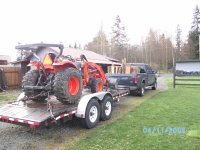
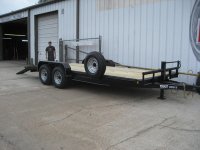
Sonewtrailerpics004[1].jpgnewtrailerpics003.jpgme photos of my 20 foot with 2 foot dove tail and slide in ramps. Also like the heavy duty tongue jack with spring loaded foot that raises/lowers by pulling a pin to allow the foot to drop to ground level rather than cranking it all the way up or down. Without the dove tail, it would make it have to load my backhoe with the short ramps that came with it as the angle is steep enough that the hoe drags the ground a bit when loading on driveway or level ground. Another foot would help but as long as I have a bit of slope, it works fine and I have loaded tractor and FEL without the ramps just use the FEL to tip the trailer and drive it on just like a tilt bed(trailer not hooked to truck)
 
/ Weight Distribution Hitch Question #29  
I apologize if this is a stupid question, but does anyone make a dovetail trailer with slide-in ramps? It would seem you could engineer a slot in the dove where the ramps could slide in.
I would think that the ramps up in the air could create quite an additional drag at interstate speeds, especially when the trailer is empty.
Yes, they slide in from the side.

Aaron Z
 
/ Weight Distribution Hitch Question #30  
...As far as wd hitches, I've always thought of them as a way to stretch a trailer/tow vehicle slightly beyond their design limits. If you NEED one, you should have bought/borrowed a bigger trailer/truck or found a better way to position your load.

I am not so sure about this.

When I look at the manual for my 2008 F 250 diesel, the max tow rating is 12,500 lb with a WD hitch, and only 5000 lb without a WD hitch. I suspect all the major brands of truck have the same type of rating system.

Do you really want to give up 7500 lb of tow capacity just because you don't like WD hitches?
 
/ Weight Distribution Hitch Question #31  
Because of the lousy receiver ratings requiring a WDH to tow even a tiny trailer I replaced my MY2000 Ford OEM receiver with a new curt receiver that can tow 15000lbs without a WDH and 16000 with WDH.

I still use a WDH for the big RV but I like the safety factor of not being required to use the WDH.
 
/ Weight Distribution Hitch Question #32  
Because of the lousy receiver ratings requiring a WDH to tow even a tiny trailer I replaced my MY2000 Ford OEM receiver with a new curt receiver that can tow 15000lbs without a WDH and 16000 with WDH.

Frankly, this is even cost-effective. When I was looking for a WD system for my truck, I found used ones in the $150-200 range. That brings my tow rating up to 10k GTW / 1k TW (due to the weight rating on the WD hitch--truck is rated for more). For $225 plus shipping, I could buy a brand new hitch that is rated for 15k/1.5k. I went with the WD hitch because 1) it provides advantages other than the increased tow capacity--level ride, and so forth, and 2) I didn't feel like fiddling around under my truck taking off bolts and stuff for a couple hours. All said and done, if I had bought the new hitch, replaced my factory hitch, and then sold the factory hitch, it probably would have come out even with the used WD system. I may still do it someday, because, frankly, the WD system is a bit of a PITA to fiddle with. The head and shank probably weigh 70 lbs or more, and the torsion bars scrape on the ground if I go over a hill or a curb. I'd like the option to just use a regular hitch and ball, and see if I notice the difference in the ride. Maybe if I towed my trailer without the WD system, I'd decide it was worth it. I just don't have much of a basis for comparison.
 
/ Weight Distribution Hitch Question #33  
Frankly, this is even cost-effective. When I was looking for a WD system for my truck, I found used ones in the $150-200 range. That brings my tow rating up to 10k GTW / 1k TW (due to the weight rating on the WD hitch--truck is rated for more). For $225 plus shipping, I could buy a brand new hitch that is rated for 15k/1.5k. I went with the WD hitch because 1) it provides advantages other than the increased tow capacity--level ride, and so forth, and 2) I didn't feel like fiddling around under my truck taking off bolts and stuff for a couple hours. All said and done, if I had bought the new hitch, replaced my factory hitch, and then sold the factory hitch, it probably would have come out even with the used WD system. I may still do it someday, because, frankly, the WD system is a bit of a PITA to fiddle with. The head and shank probably weigh 70 lbs or more, and the torsion bars scrape on the ground if I go over a hill or a curb. I'd like the option to just use a regular hitch and ball, and see if I notice the difference in the ride. Maybe if I towed my trailer without the WD system, I'd decide it was worth it. I just don't have much of a basis for comparison.
Like you say, you would have to compare how everything handles without the WD. Keep in mind though that it's not just the capacity of the receiver that matters. Like Highbeam's 2000 Ford truck, although he doesn't say what model it is you would have to look in the owner's manual to see what the tow capacity is with and without the WD. This has nothing at all to do with the hitch rating. It is more to do with the truck suspension, axle loads, rear overhang, etc. I have a feeling on a 2000 model year there could be a big difference between what you can tow with versus w/o WD.

Look at what CurlyDave said a few posts up, he would loose 7,500 lbs of tow capacity without the WD. It wouldn't matter if he installed a hitch rated at 25K, he would still loose the 7,500 lbs and only be rated to tow 5,000, and that is on a 2008 F250 diesel.
CurlyDAVE said:
When I look at the manual for my 2008 F 250 diesel, the max tow rating is 12,500 lb with a WD hitch, and only 5000 lb without a WD hitch. I suspect all the major brands of truck have the same type of rating system.

Do you really want to give up 7500 lb of tow capacity just because you don't like WD hitches?
 
/ Weight Distribution Hitch Question #34  
Look at what CurlyDave said a few posts up, he would loose 7,500 lbs of tow capacity without the WD. It wouldn't matter if he installed a hitch rated at 25K, he would still loose the 7,500 lbs and only be rated to tow 5,000, and that is on a 2008 F250 diesel.
Not quite. That is the rating of the OEM receiver hitch. If you read the "Towing" section of the Diesel supplement for the 2008 Superduty line (4th edition) or the owners manual (Owners manual for the 2008 Superduty line (4th edition) (pages 243-246) you will find the following:

http://www.motorcraftservice.com/?link=002&urlfile=/pubs/content/~WO8F23/~MUS~LEN/34/0860l6d4e.pdf page 20 said:
Trailer towing tables - F-Super Duty F250/F350 Single Rear Wheel (SRW)
Engine | Rear axle ratio | Manual transmission | Automatic transmission | Maximum GCWR - lb (kg.)
6.4L | 3.55 | | 23000 (10433)
6.4L | 3.73 | 23000 (10433) | 23000 (10433)
(note, it says nothing about WD vs non-WD permissible weights)

The next section is labeled Integrated hitch rating and it says that:
http://www.motorcraftservice.com/?link=002&urlfile=/pubs/content/~WO8F23/~MUS~LEN/34/0860l6d4e.pdf page 21 said:
Integrated hitch rating
The standard integrated hitch has two ratings depending on mode of
operation:
  • Weight carrying - requires a draw bar and hitch ball. The draw bar
    supports all the vertical tongue load of the trailer.
  • Weight distributing - requires an aftermarket weight distributing
    system which includes draw bar, hitch ball, spring bars and snap-up
    brackets. The vertical tongue load of the trailer is distributed between
    the truck and the trailer by this system.

As such, if you upgrade the bumper hitch (as Diamondpilot did on his truck IIRC) you can change the weight limits to whatever your hitch says IF you are still within the maximum axle loads.

Aaron Z
 
/ Weight Distribution Hitch Question #35  
Not quite. That is the rating of the OEM receiver hitch. If you read the "Towing" section of the Diesel supplement for the 2008 Superduty line (4th edition) or the owners manual (Owners manual for the 2008 Superduty line (4th edition) (pages 243-246) you will find the following:


(note, it says nothing about WD vs non-WD permissible weights)

The next section is labeled Integrated hitch rating and it says that:


As such, if you upgrade the bumper hitch (as Diamondpilot did on his truck IIRC) you can change the weight limits to whatever your hitch says IF you are still within the maximum axle loads.

Aaron Z
I see what you're saying about the Ford factory installed hitch. I'm not familiar with the Ford manuals and didn't realize that CurlyDave was talking just about the factory receiver specs.

In my 2008 GM owners manual it says on page 4-73:
If you will be pulling a trailer that, when loaded, will weigh more than 5,000 lbs (2 270 kg) be sure to use a properly mounted weight-distributing hitch and sway control of the proper size. This equipment is very important for proper vehicle loading and good handling when driving. Always use a sway control if the trailer will weigh more than these limits. http://www.extendedgmwarranty.com/owners-manual/chevrolet/2008-Chevrolet-Silverado.pdf

All of this aside, what do you think would be the rear axle load on a 3/4 ton pickup if you hooked up a 1,400 lb tongue weight trailer without WD? Would most trucks be OK as far as rear axle rating or would you need the WD to keep it in spec?
 
/ Weight Distribution Hitch Question #36  
All of this aside, what do you think would be the rear axle load on a 3/4 ton pickup if you hooked up a 1,400 lb tongue weight trailer without WD? Would most trucks be OK as far as rear axle rating or would you need the WD to keep it in spec?

I have a 2005 Ram 2500. It's rear axle weight is 2940 lbs unloaded. Its rear GAWR is 6010 lbs. That leaves 3,070 lbs remaining in rear axle capacity. It will tow up to 13,050 lbs. With a bumper-pull trailer, that would put as much as 1,957 lbs tongue weight on the rear axle (15% trailer weight). With a gooseneck, that would put as much as 3,262 lbs tongue weight on the rear axle (25% trailer weight).

Bottom line, it looks like the rear axle is specced to take almost any tongue weight that would be encountered when towing under the rated towing capacity--which, if you think about it, is really how it should be.
 
/ Weight Distribution Hitch Question #37  
joshuabardwell said:
I have a 2005 Ram 2500. It's rear axle weight is 2940 lbs unloaded. Its rear GAWR is 6010 lbs. That leaves 3,070 lbs remaining in rear axle capacity. It will tow up to 13,050 lbs. With a bumper-pull trailer, that would put as much as 1,957 lbs tongue weight on the rear axle (15% trailer weight). With a gooseneck, that would put as much as 3,262 lbs tongue weight on the rear axle (25% trailer weight).

Bottom line, it looks like the rear axle is specced to take almost any tongue weight that would be encountered when towing under the rated towing capacity--which, if you think about it, is really how it should be.

But the hitch from the factory is rated no where near that and more than likely you will exceed the GVWR or tires before you exceed the rear axle rating.

Chris
 
/ Weight Distribution Hitch Question #38  
But the hitch from the factory is rated no where near that and more than likely you will exceed the GVWR or tires before you exceed the rear axle rating.

Well, that's more or less my point: that the rear axle's weight rating is probably not the limiting factor in the vehicle's towing capacity. But just hypothetically, my vehicle's GVWR is 9000 lbs. It's curb weight is 6813 lbs. That leaves 2187 lbs of capacity before GVWR is exceeded. If we assume 100% of that is tongue weight from a trailer, that's an 8748-14,580 lb gooseneck trailer (25%-15% trailer weight on the tongue) or a 21,870-14,580 lb bumper pull trailer (15%-10% trailer weight on the tongue). So we can see that GVWR is not the sole limitation on trailer size. GCWR kicks in before GVWR is exceeded in some cases. But GAWR is never even approached.
 
/ Weight Distribution Hitch Question #39  
Often times, the limiting factor on a hitch that's bolt-in is how it attaches to the vehicle. The bolts that are used are likely not up to bearing the heavier weight. My truck has an integrated hitch from the factory. The cross bar of the hitch is round, and it actually inserts into the frame rails. Then, it's bolted to the frame. The end result is that the weight is borne by the frame rails and is transferred there directly by the crossbar of the hitch. The bolts are there more to "hold the hitch in place" than bear weight.
 
/ Weight Distribution Hitch Question #40  
All of this aside, what do you think would be the rear axle load on a 3/4 ton pickup if you hooked up a 1,400 lb tongue weight trailer without WD?
At least 1400#. It depends on the distance between the axle and the hitch.
Would most trucks be OK as far as rear axle rating or would you need the WD to keep it in spec?
Too many variables to say. How much weight is in the bed? How many people are in the cab? Which spring package?
It could be ok, or it could be a problem.

Aaron Z
 

Marketplace Items

1998 POLAR TANK (A60736)
1998 POLAR TANK...
LOAD OUT AND SHIPPING (A61166)
LOAD OUT AND...
2021 CATERPILLAR 300.9D MINI EXCAVATOR (A62129)
2021 CATERPILLAR...
Club Car Carryall 2 Electric Utility Cart (A55851)
Club Car Carryall...
JLG 20MVL MANLIFT (A58214)
JLG 20MVL MANLIFT...
LOT LOCATIONS (A59908)
 
Top