Welder settings

   / Welder settings #1  

Locoweed

Veteran Member
Joined
Nov 3, 2011
Messages
1,500
Location
West Tx.
Tractor
Kubota B2620
First off, let me preface this by saying that I am not picking on Miller. I have a Lincoln & the recommended settings in the book & what the welder it's self recommend are similar to what the manual for the Miller. Miller just happens to have a online calculator that I can use for comparison.

So, my question is about comparing what is the book setting vs the online Miller Calculator recommend. MIG Flux-Cored Weld Setting Calculator

Let's compare the settings for 1/8" metal & using .035" wire. No shielding gas. Here is part of a screen shot from the pdf manual.
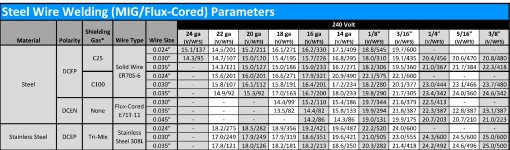

Manual.jpg

Here is a screen shot from the online calculator.
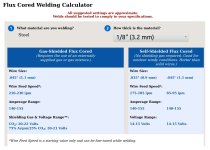
calculator.jpg

I have a lot better luck with the settings from the calculator. Why is there such a difference?
 
Last edited:
   / Welder settings #2  
I usually use door chart on my Hobart to get a ball park setting, then dial in according to what my test beads show me....

Dale
 
   / Welder settings #3  
Numbers are just there to get a welder-person close, but it really depends on so many factors, that in all practicality, you just set your welder for how you weld.

The best setting indicator I have found, is a black Sharpie pen. Once you reach a setting that you like, mark it with a black line so that you can return to that spot. I do this with my junk AC stick welder because I found a setting where I can weld in all positions. Sometimes my father will use the welder and adjust the settings, so I have the little black line to return too.
 
   / Welder settings
  • Thread Starter
#4  
The root of my question lies in the fact that the "book settings" are not very close. In this instance the book says 19.9V & 294IPS. The calculator says 14-15V & 175-185IPS. That is a lot of difference IMHO & both sets of numbers are from the same company. One of the attractions of buying a new welder for me was that it would automatically get you in the ball park after setting the wire size, type of wire & thickness of the metal. That turned out to be a bunch of advertising dross. At least Miller does give access to the calculator. Lincoln doesn't provide anything comparable.
 
   / Welder settings #5  
Keep in mind, a lot of how you weld (handle gun and stick out) has a lot of difference in what voltage and IPM for wire and wire size is.... Again charts are ballpark for starting point, the skill of the weldor (person who welds, not the machine) is how successful the welds are.....

As years go by and as I weld more its easier to look work to be done, make voltage setting (amperage) and sort of dial in wire speed, if weld does no seem correct I change setting as to what the feed back is from experience...

It's like driving a tractor, we all know how the manual explains how we should dive it, yet we all fudge (adjust) things a bit to suit our needs....

The real problem here is did the engineer that gave the information to graphics dept get it right for the particular welder... Or the did the person who wrote the calculator bases on theatricals get it right...Only the actual application (test) of both specification/theories will derive correct settings because end result will lie with weldor doing the "work".... Neither source is Absolute...Correct answer is probably somewhere in middle of both "information" sources....

Another issue here may also be is welder a stepped voltage machine or a infinite voltage machine.... IF I have stepped voltage and calculator give me a value for infinite machine that is somewhere in between my stepped voltages do I go up or sown.... Only experience can answer that....

Dale
 
Last edited:
   / Welder settings #6  
I'd guess it's a material thickness typo on Millers part. The longer you have the welder the less you will need the chart.
 
   / Welder settings #7  
What MIG welders show the voltage and/or the inches per minute wire speed. My Lincolns have always had the 1-10 dial or 1-4 click settings.
 
   / Welder settings #8  
What MIG welders show the voltage and/or the inches per minute wire speed. My Lincolns have always had the 1-10 dial or 1-4 click settings.
That is my only gripe with my Miller 211. I wish I could read voltage and ipm. I think that would be much more informative and maybe allow you to pick up another machine you never used and get going.
 
   / Welder settings #11  
I think most newer Migs have Volts and IPM readout. All the way down to the HF Titanium 115v 140 machine and most others. I'm not so sure it's that big of a deal. I tune by bead shape and sound mostly when not running in Synergic.
 
   / Welder settings #12  
The root of my question lies in the fact that the "book settings" are not very close. In this instance the book says 19.9V & 294IPS. The calculator says 14-15V & 175-185IPS. That is a lot of difference IMHO & both sets of numbers are from the same company. One of the attractions of buying a new welder for me was that it would automatically get you in the ball park after setting the wire size, type of wire & thickness of the metal. That turned out to be a bunch of advertising dross. At least Miller does give access to the calculator. Lincoln doesn't provide anything comparable.

Welding is great because it is a high-demand job, and is a high-paying job, but unfortunately, it is also a HIGHLY-SKILLED job. Everyone today wants to take that last part out of the equation, but it will never happen. There are no short-cuts. Just as a machinist cannot make a decimal equivalent chart make their CNC machine make the perfect part, welder settings in a book cannot make a welder form perfect welds.

There are too many variables. That is fortunate for welders because it keeps us in jobs; highly sought after, and high paying jobs.
 
   / Welder settings #13  
The root of my question lies in the fact that the "book settings" are not very close. In this instance the book says 19.9V & 294IPS. The calculator says 14-15V & 175-185IPS. That is a lot of difference IMHO & both sets of numbers are from the same company.

Not really, because you have to look at the percentage of change.

I normally run with a wire stick-out of 3/4 of an inch, but lets say another welder operates at 1/2 an inch of stick out. That is a 33% difference between me and them.

Yet in the numbers you cite, they equate to a 26% difference on voltage which accounts for the single variable of stick-out. In other words, that one small preference between welder-people makes the same percentage of difference on voltage. So imagine if only ONE preference is changed, imagine how all the other variations also come into play.

This is why welders are not scared of robotic welders. They need us to run them still because computer programmers and general laborer's do not know when the problem is with the robot movement, or the welding process itself. Robots are great because they take the redundant welding applications out of my job, but I am still needed because I can listen to a robot welding and tell if it has a plugged tip making it screw up, the voltage, or amperage is too low, or if the robot is not fully articulating. That is just from listening to it weld, but it takes some time to get to that skill-level.
 

Tractor & Equipment Auctions

2018 MQ POWER WHISPERWATT DCA-25 GENERATOR (A58214)
2018 MQ POWER...
2008 TEXAS BRAGG GOOSENECK FLATBED (A58214)
2008 TEXAS BRAGG...
22FT Roadway Dry Van Pup Trailer (A56438)
22FT Roadway Dry...
2019 MACK GRANITE (A58214)
2019 MACK GRANITE...
excavator trenching bucket- one bucket per lot (A56438)
excavator...
Greenworks Commercial 82V CZ60R Zero-Turn Mower- DEMO UNIT (A56438)
Greenworks...
 
Top