Welding advice, please

/ Welding advice, please #1  

Perplexed

Silver Member
Joined
Feb 28, 2011
Messages
147
Location
NE Oklahoma
Recently, I bought a Hot Max 135 amp MIG welder kit, and it came with a spool of 0.030 flux core wire, so I decided to start practicing with that wire. I got two pieces of 3/16" mild steel - one was a sheet about a foot square, the other was a rectangular piece about four inches wide and eight inches long. I wire-brushed the two pieces until they were relatively clean, then I used a 90-degree clamp to set the smaller piece perpendicular to the bigger piece. I set the welder's amperage and feed rates according to the diagram on the lid, and started welding. After several attempts where I consulted a welding guide (too much stick out, and too fast a feed, at first), knocking the smaller piece off and cleaning it up before setting it back in place, I am now at a point where I can produce somewhat smooth welds with a convex surface. However, I noticed there's not much penetration being made into the two pieces of steel; according to the guide, the amperage setting on the welder is too low. I bumped it up one notch (from "C" to "D" on a range from "A" to "J"), but still got minimal penetration into the steel. The welder is rated for up to 5/16 steel; I was wondering if I should keep bumping the amperage knob until I get satisfactory penetration? Right now, there's at most about 1 mm of penetration in some parts of the weld, while in other parts there's just surface discoloration. No discoloration at all on the other side of each piece of metal. Parts of the weld also seem to be sitting on the surface of the metal pieces. What can happen if I go too high with the amperage - will the welder shut down, or will there be burn-through in the steel or something worse? Any suggestions or advice would be welcome!
 
/ Welding advice, please #2  
I think you need more amps. What you call the amperage setting is really the heat control. Amps are controlled by wire speed. You may be moving the gun too fast along the seam, too much stick out. The worst that could happen is you burn through the stock. You may also want to try 0.035 wire that will carry more current without such a high wire speed. There are lots of online sites to go to.

For 100 amps with 0.030 wire you need 250 inches/min or 25 inches in 10 seconds.
With 0.035 wire for the same 100 amps you need 200 inches/min or 20 inches in 10 seconds.

Of course the ground clamp is on a clean spot and close to the weld line?
 
/ Welding advice, please
  • Thread Starter
#3  
Transit, the owner's manual describes the one knob as the "output voltage control" that "adjusts to any setting from 25 to 135 amps." The speed control knob "controls the wire feed speed" but the manual does not say anything anywhere about the WFS controlling the amperage - it seems the first knob does that. At the initial setting, I had the wire kicking back at the gun, so I figured my feed speed was too fast, and I dialed back on the WFS. That cured the kickback, but the penetration was still minimal. I tried upping the output voltage control two settings, and that seemed to help a bit with penetration, but I was concerned about going too high with that setting. Visions of a fire were dancing through my head, while I ran around screaming and retrieving the fire extinguisher :p

Oh, and the ground was on clean metal no more than 8-10" from the weld, and sometimes as close as 3-4".

About how much of each piece of metal should be penetrated at the weld? 10%, 25%, 50%? My last attempt was to weld the smaller piece on both sides while it was perpendicular to the larger piece, and it took several good solid whacks with a hammer to break the smaller piece loose. Should the weld be so strong it takes a grinder to break the weld?
 
/ Welding advice, please #4  
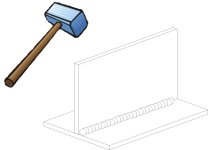
A good way to check penetration of a weld. Make a fillet weld on two plates, then beat on the upper plate, and force it over the weld.
 

Attachments

  • BFH test.jpg
    BFH test.jpg
    75.7 KB · Views: 412
/ Welding advice, please
  • Thread Starter
#5  
A good way to check penetration of a weld. Make a fillet weld on two plates, then beat on the upper plate, and force it over the weld.

That's how I was checking for penetration - in fact, your diagram is exactly how I was welding the two pieces of steel. Hammering on the vertical piece usually didn't do anything (no gradual bending over) until the piece broke loose. The welds weren't quite that neat, though :D
 
/ Welding advice, please #6  
Here's the only picture I could find of penetration. I made this weld with Tig.
Remember joint prep plays a big part in the amount of penetration you'll get.
 

Attachments

  • 1 CJ root.jpg
    1 CJ root.jpg
    56.9 KB · Views: 2,150
/ Welding advice, please #7  
I think you need to read the basics of how mig works. Mig is a constant voltage process which is set by the heat control [voltage], amps are related to the wire speed. The process that your unit uses is called Short Circuit. First the wire comes into contact with the work and a large current flows in the wire heating it to the melting point, the part that sticks out from the tip. Next that wire deposits a small drop on the work and be cause a gap forms between the droplet and wire in the gun a arc is formed that heats the droplet and work to form a puddle. Next the wire over takes the cooling puddle and everything starts over again. Once the heat is selected, there is a range of wire speed to match that condition that will not burn back the wire to fuse with the tip or push back the gun. The faster the on-off cycling the more amps, the deeper the penetration.

Just another thought, is this a mig or a wire feed welder? A mig will have a large capacitor in the gun circuit about the size of s beer can. If not you have stick welder that happens to use flux core wire in place of a welding rod and what you say about the step current control would be correct.

Hot Max 135WFG 135 Amp Gas Ready MIG Welder, Gas Welders, Welding Supplies
 
/ Welding advice, please
  • Thread Starter
#8  
Transit, I'm a bit confused with your last response. The welder I have is exactly what's featured at the link you provided; it's a MIG welder using flux core wire fed through the gun, so no shielding gas is needed. It can use CO2 though with regular wire, if I want. The setup I'm using now is the flux core and no gas.

But I wondered if vigorous wire brushing of the metal surfaces to be welded was enough; so I borrowed my neighbor's angle grinder to clean the surface of the larger piece of steel. I also cut off a bit of the smaller piece to provide a freshly cut surface for the weld. Then I clamped the pieces together as before, fired up the welder, and went to work.

This time - with only about 1/3 of the seam welded on both sides - I can't budge the vertical piece, even with healthy whacks with a hammer. Looks like surface prep is indeed the key, and an angle grinder is on my shopping list this weekend :D
 
/ Welding advice, please #9  
i've had an older century 120v wire feed welder and my experience is that when you get into the upper 1/2 of its capability range you're going to have to run up close to the high end in the heat setting. i'd try setting f or higher, and then tune your wire speed until it isn't "popping" (too slow) or trying to push the gun away from the metal (too fast). i'm sure your welder is more advanced that mine, seeing that it's 15 years newer and about 25a higher in the rating, but i found that trying to handle 1/4" and thicker i had to run at the max heat setting.

another thing to try is leaving a gap. what i will often do is use a couple left over stubs from stick welding to position the pieces with an 1/8" gap between them. it will give you a chance to learn a good technique for weaving the bead to fill the gap. it also will allow you more penetration for the same heat setting.
 
/ Welding advice, please #10  
Your machine is at its limits. Dont care what the manual says. China welders and their ratings are wishfull at best.

Proper beveling is essential, especially when your near the limits of your machine. Sure you could blow through that weld with a 300 amper without beveling, but you dont have that.

What transit said about Mig process is correct. Id suggest reading up on the process and which "knob" adjusts "what". Its essential to get the correct weld profile.
 
/ Welding advice, please #11  
On my Hobart Handler 140 I have to change polarity if I try to use flux core wire. Solid wire with shielding gas makes for prettier welds on clean material. Wire feed can stutter if I have extreme twists in cable/liner assembly. Clean material with a nice grinder makes a big difference. I do some pretty ugly wekds sometimes but other times they look good. May not pass an xray but usually they hold for the intended purpose. My machine I thought was rated at 3/16" but the current web site shows 1/4".
 
/ Welding advice, please #12  
i've had an older century 120v wire feed welder and my experience is that when you get into the upper 1/2 of its capability range you're going to have to run up close to the high end in the heat setting. i'd try setting f or higher, and then tune your wire speed until it isn't "popping" (too slow) or trying to push the gun away from the metal (too fast). i'm sure your welder is more advanced that mine, seeing that it's 15 years newer and about 25a higher in the rating, but i found that trying to handle 1/4" and thicker i had to run at the max heat setting.

another thing to try is leaving a gap. what i will often do is use a couple left over stubs from stick welding to position the pieces with an 1/8" gap between them. it will give you a chance to learn a good technique for weaving the bead to fill the gap. it also will allow you more penetration for the same heat setting.

You may also use scrap 0.030, 0.035 wire to set the gap and tack weld every 3 to 4 inches to keep the heat from changing the gap. all in the videos.
 
/ Welding advice, please
  • Thread Starter
#13  
An update after a weekend of practice. I spent most of the day Friday welding a vertical piece of steel to a horizontal piece (much like I was doing before), trying different amperage and WF settings. Finally I hit on a combination of settings where the edges on both pieces were subsumed in a satisfactory manner into the weld along with the flux core wire. The results aren't pretty - I still get a lot of spatter - but the welds are strong enough that hitting the vertical piece with a 4-lb sledgehammer doesn't do anything.

By the time I finished, my back and legs were so sore from welding on the concrete floor, I had trouble getting up and walking around :p So I decided to try my hand at welding up a work table the next day.

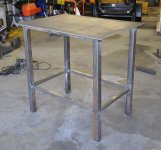
Saturday morning, bright and early, I went back to the shop and started. First, I flipped the 28" x 40" x 3/16" sheet of steel upside down, and welded a section of 3/16" angle iron along the front and back edges, 2" in from each edge. I used a newly-purchased angle grinder to clean the surfaces being welded, and that really helped compared to wire brushing. After hitting the two pieces of angle iron with the sledgehammer and getting nowhere, I started with the legs, which were made out of 2" square steel tubing, also 3/16" thick. I used long pipe clamps to clamp each leg to the table top, and welded them to the top and to the ends of the angle iron. Then I cut pieces of 1" square steel tube, also 3/16" thick, and clamped them in between each pair of legs (front-back and side-side) and welded them in place, 1' off the ground.

I did most of the work Saturday morning, but I quit around noon with the temps rising over 80 outside. Wearing a t-shirt, a long-sleeved shirt, a leather apron, a helmet, and thick leather gloves... not very pleasant when it gets warm out, even with a 42" shop fan blowing fresh air through the open door. Kudos to you professionals who weld outside for a living at the height of the summer! :thumbsup:

Sunday I went back to work, and finished up all the welding. Then I righted the table...... hey, not too shabby, if I may say so ;) I'll probably find some sheet steel to weld to the bottom of the cross-braces to create a lower shelf with a raised lip (the braces) to keep stuff from rolling off the shelf.

If anyone is interested, I'll post pics. Really, just a basic table - no fancy scroll work or flying buttresses or any such :D

To all of you who offered helpful advice without sneering about "cheap Chinese" equipment, many thanks!
 
/ Welding advice, please
  • Thread Starter
#15  
Can't say I didn't warn you :p
 

Attachments

  • table01s.jpg
    table01s.jpg
    220.3 KB · Views: 210
/ Welding advice, please #16  
You might consider welding and angle to one side that will provide a place to put a pipe in that will not roll off. It is also nice to put a chain vice on one end of the angle to hold round or irregular shapes in place.
 
/ Welding advice, please
  • Thread Starter
#18  
Thanks for the compliments and the tips! It's a work in progress - I like the idea of a "stop" to keep round stock from rolling off the table, and I also plan to weld a bolt to the underside of the lip at both ends of the table. Then I can use either bolt for the ground clamp.

I admit, I had to google "chain vise" but that looks like it'd be handy for clamping down round stock. Thanks for mentioning yet another gadget to buy :p
 
/ Welding advice, please #19  
Can't say I didn't warn you :p

There sure isn't anything to be ashamed of with that table. Great job! If you have any doubts as to how well it turned out, then just ship it my way and I'll keep it out of sight for you.:D
 
/ Welding advice, please
  • Thread Starter
#20  
Thanks, but if you saw the table up close, you'd see why I consider it a "decent" first attempt. Two of the legs aren't exactly square to the top, so if you look closely, you can see the legs aren't all parallel :ashamed: I tried hammering the worst back into line, but the welds weren't giving up anything! How do you folks position - and hold - a table leg so it's perpendicular to the top in both axes, before welding it in place?

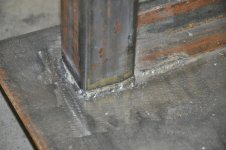
Here's a shot of the best welds on this table. Trust me, the other welds aren't as neat-looking :D I did notice a lot of splatter up to 2-3" away from each weld, plus a lot of tan-colored "soot" (for lack of a better word). The splatter can only be scraped or ground off, but the "soot" comes off with a paper towel. From what I've read, a certain amount of splatter is to be expected with flux core welding, but is there a way to minimize the splatter? I tried different wire feed speeds, holding the gun at different angles and distances from the work, fast/slow welding, etc. But nothing seemed to help reduce the splatter. Also, what's with the "soot" ? Is that normal?
 

Attachments

  • DSC_0419.jpg
    DSC_0419.jpg
    133.9 KB · Views: 181

Marketplace Items

UNUSED FUTURE FT-RT57 - 57" HYD ROTARY TILLER (A52706)
UNUSED FUTURE...
2019 Chevrolet Silverado 6500HD 4x4 ETI ETC37IH 37FT Insulated Bucket Truck (A59230)
2019 Chevrolet...
2017 Case CX145D (A60462)
2017 Case CX145D...
2015 CATERPILLAR 953D CRAWLER LOADER (A60429)
2015 CATERPILLAR...
Tank Only (A59076)
Tank Only (A59076)
CASE ROOT PLOW (A58214)
CASE ROOT PLOW...
 
Top