Welding thin to thick

   / Welding thin to thick #1  

Haywire

Veteran Member
Joined
Nov 20, 2010
Messages
1,047
Location
Central Kentucky
Tractor
Tractorless :(
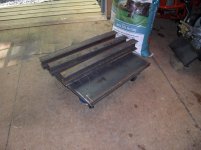
I've asked this question before, but can't find it now. I'm welding those sheet metal legs to the 1/2" plate. I don't want to blow through the leg material, so I thought about using 1/16 7014. Any penetration in the plate thicker than the sheet metal is a waste anyway. what do ya think? Sorry about the bad low-light cell phone pic...

table-1.jpg
 
   / Welding thin to thick #2  
You could do it that way. Lay a filet weld up tight to the sheet metal to get good bite. Then lay another one next to it overlap a bit with a biger hotter rod. Or. Just run bigger rod and just let the puddle flow over onto the sheet metal and keep the arc on the plate. Either would work I would use option 2. Good luck. I would like to have that table.
 
Last edited:
   / Welding thin to thick #3  
Well if it was me..I would choose some 3/32 7018 at about 75 to 80 amps and start in by pointing the stick more at the 1/2 and hit the edge of the thin stuff on the edge of my movement. More time and direction of stick on the thick material and less time and less direction on the thin. You might take scrap 1/2 and the sheet metal and practice first before you start in on the nicely cut out project. Haywire you know my experience level so please take my advice with the caveat that I am not a lot more experienced than you.

James K0UA
 
   / Welding thin to thick #4  
Those legs look far too weak for a welding table. No matter how well you weld that sheet metal to the top, the slightest push from the end of the table could result in the legs folding sideways and the whole thing collapsing.
Bite the bullet, buy some square tubing, heavy angle, etc. Build a complete table frame with stringers in both directions. Stitch the plate to the table frame
Just my opinion. We've built a few.
 
   / Welding thin to thick #5  
I am with KOUA, 3/32 -7018 would weld that fine if you concentrate the arc on the heavy side and just flow it into the thin stuff. Just remove the paint and rust first so the weld metal will flow without having to burn thru the rust and paint. Dirty metal is hard to weld on thin material due to the arc blow.

Also add some boxed braces near the bottom to steady the legs and some vertical cross braces to strengthen the legs from folding up. That thin sheet metal wont take much to bend and your table to collapse
 
   / Welding thin to thick #6  
I am with KOUA, 3/32 -7018 would weld that fine if you concentrate the arc on the heavy side and just flow it into the thin stuff. Just remove the paint and rust first so the weld metal will flow without having to burn thru the rust and paint. Dirty metal is hard to weld on thin material due to the arc blow.

Also add some boxed braces near the bottom to steady the legs and some vertical cross braces to strengthen the legs from folding up. That thin sheet metal wont take much to bend and your table to collapse

Agreed! I too would use this method and gusset the legs for lateral stability... should be a fine table!! :thumbsup:
 
   / Welding thin to thick
  • Thread Starter
#7  
Those legs look far too weak for a welding table.

Yes, that is a concern. I was wondering how I was going to cross brace them. I've got the 2" pipe that were originally legs on that table before I cut the plate up to rearrange it. I guess I could use them. Those pre-made leg sets take the guesswork out of getting them straight though.

Ian
 
   / Welding thin to thick #8  
I am going to finish my welding table today, I will post some pictures so you can see how I made the frame.
 
   / Welding thin to thick #9  
Well if it was me..I would choose some 3/32 7018 at about 75 to 80 amps and start in by pointing the stick more at the 1/2 and hit the edge of the thin stuff on the edge of my movement. More time and direction of stick on the thick material and less time and less direction on the thin. You might take scrap 1/2 and the sheet metal and practice first before you start in on the nicely cut out project. Haywire you know my experience level so please take my advice with the caveat that I am not a lot more experienced than you.

James K0UA

I am with KOUA, 3/32 -7018 would weld that fine if you concentrate the arc on the heavy side and just flow it into the thin stuff. Just remove the paint and rust first so the weld metal will flow without having to burn thru the rust and paint. Dirty metal is hard to weld on thin material due to the arc blow.

Also add some boxed braces near the bottom to steady the legs and some vertical cross braces to strengthen the legs from folding up. That thin sheet metal wont take much to bend and your table to collapse

Agreed! I too would use this method and gusset the legs for lateral stability... should be a fine table!! :thumbsup:
Yep, I call it "favor the heavy piece".
 
   / Welding thin to thick #10  
7018 is a good choice here, I'd run a J-motion, keeping the long side of the J on the 1/2 inch material, and just bounce up onto the 1/16 inch material.
 
   / Welding thin to thick
  • Thread Starter
#11  
I've decided to go a different route. Not going to use those legs after all. The need to rig some cross bracing convinced me to go with pipe legs.
 
   / Welding thin to thick #12  
Iv'e seen some nice tables where they welded threaded flanges on the table top and then used 3" threaded pipe. Add as many legs as you like.
 
   / Welding thin to thick #13  
7018 is a good choice here, I'd run a J-motion, keeping the long side of the J on the 1/2 inch material, and just bounce up onto the 1/16 inch material.

I agree. Use j motion to too push the weld up to the lighter metal but hold the puddle on the thicker metal. You really need a lower support going the other way though.:thumbsup:
 
   / Welding thin to thick #14  
I've asked this question before, but can't find it now. I'm welding those sheet metal legs to the 1/2" plate. I don't want to blow through the leg material, so I thought about using 1/16 7014. Any penetration in the plate thicker than the sheet metal is a waste anyway. what do ya think? Sorry about the bad low-light cell phone pic...

table-1.jpg

Get some 3/16" or 1/4" wall square tubing and channel and fab a new pair of legs.
 
   / Welding thin to thick
  • Thread Starter
#15  
Wow... 4 30 inch pieces of 3x1/4 square tube was $94. Not willing to spend that much. I'll reuse the old rusty round pipe legs.
 
   / Welding thin to thick #16  
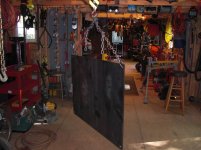
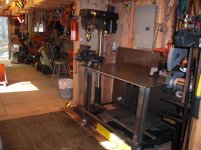
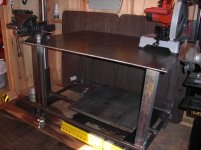
Not wanting to chance having the legs fold over on me, I used 3 inch i-beam for legs when I built my table......28 inch lengths....the "i" shape made for a lot of contact length for welding them to the underside of the table.......but first I welded small 1/4" square plate on bottom of each leg, pre-drilled with holes in the plates for casters, and then bolted on 4" wheel casters. Legs are really strong.....square tube cross-bracing near bottom to add rigidity.

Top is 3/8", 36x48.....I had 1" holes drilled in each corner for hoisting, handling, etc. My welding isn't pretty for sure, but it all holds nice & tight.

Built it for welding, but have only used it as a work table so far. Wheels make it easy to roll where I need it, and the casters lock to hold table in place, although if I really needed it to stay firmly put, I'd have to anchor it better.

If nothing else, the thing will help keep the floor from blowing away on a windy day......it's heavy, for its size.
 

Attachments

  • CIMG1916.jpg
    CIMG1916.jpg
    494.2 KB · Views: 170
  • CIMG1917.jpg
    CIMG1917.jpg
    460.3 KB · Views: 149
  • CIMG1920.jpg
    CIMG1920.jpg
    555.4 KB · Views: 148
  • CIMG1921.jpg
    CIMG1921.jpg
    439.1 KB · Views: 152
   / Welding thin to thick
  • Thread Starter
#17  
You must have either some good scrounging skills or a thick wallet... LOL
 
   / Welding thin to thick #18  
I worked at Freightliner and a cement truck came in needing the plates above the suspension replaced, they were about 5 ft x 2.5 ft X 3/4 thick. I welded them together and made a great bench.
I would spend the money on the strongest legs you can afford, you do not want to be welding, or banging on the bench with tin legs and it folds and hurts you.
Mine has 4 legs, of 2.5 X 1/4 square tubing with 4 pieces of 1/4 X 2 angle iron about a ft off the floor I put bases on the legs with 4 inch channel iron and 2X4 to the floor. Wood to the floor cuts away down on noise, and damage to the floor.
 

Tractor & Equipment Auctions

2011 NORAM POWER SYSTEMS 100KW GENERATOR (A58216)
2011 NORAM POWER...
UNKNOWN  500BBL WHEELED FRAC TANK (A58214)
UNKNOWN 500BBL...
2006 CATERPILLAR 320CL EXCAVATOR (A59823)
2006 CATERPILLAR...
UNUSED FUTURE XLA59 - 59" DRUM SPIKE LAWN AERATOR (A52706)
UNUSED FUTURE...
2022 John Deere R4023 (A60462)
2022 John Deere...
NIPPON HYD THUMB (A52706)
NIPPON HYD THUMB...
 
Top