Why four binders?

   / Why four binders? #1  

n8586m

Member
Joined
Jan 17, 2008
Messages
45
Location
Stanwood Mi
Tractor
Kubota B2620 w/FEL
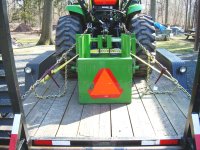
This is a question for all you trailer experts. Why do you use a binder on all four corners? I don't care what a law might say, I want to know the actual reason behind it. I put my tractor on the trailer where it needs to be for balance. Then I hook the two front chains as tight as I can by hand. Then I put one chain on the back and with the tractor in neutral and brake off, I use a ratchet binder on the back chain to tighten the front chains until the rear tire starts to flatten. I then use a flip over binder on the second rear chain. So what would binders on the front do except provide at failure point? The front chains are tighter than Dick's hat and there is no way they can ever come loose as opposed to flip over binder that can and have opened.
 
   / Why four binders? #2  
the reasoning I have heard is so that you can retighten any given corner with out moving the load. Say if the front tire went flat you could not retighten it the way you have it. also I can secure a tractor that is not in the same place on the trailer every time. The length of attachments, other stuff on trailer ect. I am not arguing for or against, but the only time a binder has come undone on me was when the chain was too slack.
 
   / Why four binders? #3  
n8586m

I do it the way you do. Put 2 chains on one end of the tractor. Adjust them properly and then move the tractor slightly to tighten them. I tighten them so they are about equal in tension.Then set parking brake. I then use 2 chains on the other end with a binder on each chain to keep everything tight. For the "purists" 4 binders are recommended but I never quite see the logic. If I use 4 binders, enevitably, some of very tight and others not so tight. (The exception is the screw type binders which can be tightened equally.)
 
   / Why four binders? #5  
"If you only have one chain and on binder and some thing breaks then nothing is holding the tractor on that end."

LBrown59, I think you replied to the wrong post.
 
   / Why four binders?
  • Thread Starter
#6  
LB, that don't make sense. I'm asking about four binders, not one. Duh, if you only have one chain and it fails you got a problem. My question is: Why four?
 
   / Why four binders? #7  
...... I don't care what a law might say, I want to know the actual reason behind it. ...
LOL....

For crying outloud, stop the madness... :D :D
 
   / Why four binders? #8  
LB, that don't make sense. I'm asking about four binders, not one. Duh, if you only have one chain and it fails you got a problem. My question is: Why four?
Have you ever seen a load shift, break loose, or completely come loose in a traffic accident? Or considered the safety of others? I have to respectfully wonder what you are thinking here of anything less than what the law requires and other people's safety. :eek:
 
   / Why four binders? #9  
I use one high test chain on the front and one on the back.

I run my chain from one side of the trailer...to the other side.
 
   / Why four binders? #10  
OOOUUCCCHHH To keep this guy happy you better have a haz mat kit along also. Never know when some diesel will spill.

The 4 binders I beleive assumes 4 seperate attachments point as in 4 seperate chains. A little overkill. Ideas being one fails the other three will hold.
Have you ever seen a load shift, break loose, or completely come loose in a traffic accident? Or considered the safety of others? I have to respectfully wonder what you are thinking here of anything less than what the law requires and other people's safety. :eek:
 
   / Why four binders? #11  
It's a DOT law for a reason, safety. Having been on a couple of accident recovery's over the years that involved loaded flatbed trailers I feel safe in saying that ones secured with less than 4 usually don't stay on the trailer. Don't think about it as securing with 4 chains, think of it as securing each end with 2 chains. If you put 2 chains on the front and only 1 on the rear if you get in a front end type accident the majority of the load is placed on the single chain securing the rear. Now if your trailer swings around and strikes rear first that's great, it has two chains to distribute the shock load over. Something else to consider is that winch cables do not count. On tow trucks even if the winch cable and V-bridle is still attached to the vehicle on the bed it still has to have 4 corner point securement, either with chains at each corner or wheel strap bridles on each wheel. Do yourself and the motoring public a favor and do the proper 4 point tiedown as required by law. How are you going to feel if you get in a accident and your tractor falls on a car and kills someone.
 
   / Why four binders? #12  
This is a question for all you trailer experts. Why do you use a binder on all four corners? I don't care what a law might say, I want to know the actual reason behind it. I put my tractor on the trailer where it needs to be for balance. Then I hook the two front chains as tight as I can by hand. Then I put one chain on the back and with the tractor in neutral and brake off, I use a ratchet binder on the back chain to tighten the front chains until the rear tire starts to flatten. I then use a flip over binder on the second rear chain. So what would binders on the front do except provide at failure point? The front chains are tighter than Dick's hat and there is no way they can ever come loose as opposed to flip over binder that can and have opened.

OK, with no regard to the law,
Because it's easier than doing it your way, A rated ratcheting binder is not any more a failure point than any single link in the chain.

Doing it easier puts less stress on the individual components, instead of demanding all the work out of, and pulling on just the one side, trying to square everything up. Your pulling all 4 corners down and opposing the opposite corners equally. Sucking all 4 corners down is better than just squashing down the rear and pulling on the front. You mentioned the rear tires flattening out, you probably don't see the fronts doing the same.

Not saying your way is not safe, guys have been doing it that way forever, it's just that with the 4 binders it's easier, faster and at minimum at least as safe, but probably a bit more secure.

I'm no pro here, just got my first equipment trailer a month ago but realized pretty quick that the 1 binder per corner is the way to go.

Less stress on the operator goes a long way also.

JB.
 

Attachments

  • DSCN3439.JPG
    DSCN3439.JPG
    883.5 KB · Views: 428
  • DSCN3446.JPG
    DSCN3446.JPG
    996.2 KB · Views: 422
   / Why four binders? #13  
This is a question for all you trailer experts. Why do you use a binder on all four corners? I don't care what a law might say, I want to know the actual reason behind it. I put my tractor on the trailer where it needs to be for balance. Then I hook the two front chains as tight as I can by hand. Then I put one chain on the back and with the tractor in neutral and brake off, I use a ratchet binder on the back chain to tighten the front chains until the rear tire starts to flatten. I then use a flip over binder on the second rear chain. So what would binders on the front do except provide at failure point? The front chains are tighter than Dick's hat and there is no way they can ever come loose as opposed to flip over binder that can and have opened.

It's a DOT law for a reason, safety. Having been on a couple of accident recovery's over the years that involved loaded flatbed trailers I feel safe in saying that ones secured with less than 4 usually don't stay on the trailer. Don't think about it as securing with 4 chains, think of it as securing each end with 2 chains. If you put 2 chains on the front and only 1 on the rear if you get in a front end type accident the majority of the load is placed on the single chain securing the rear. Now if your trailer swings around and strikes rear first that's great, it has two chains to distribute the shock load over. Something else to consider is that winch cables do not count. On tow trucks even if the winch cable and V-bridle is still attached to the vehicle on the bed it still has to have 4 corner point securement, either with chains at each corner or wheel strap bridles on each wheel. Do yourself and the motoring public a favor and do the proper 4 point tiedown as required by law. How are you going to feel if you get in a accident and your tractor falls on a car and kills someone.
Hes using 4 chains -- 2 on each end.
larry
 
   / Why four binders? #14  
Are you required to tie down the attatchments also FEL and BH ??
 
   / Why four binders? #15  
   / Why four binders? #16  
Something else to consider is that winch cables do not count. On tow trucks even if the winch cable and V-bridle is still attached to the vehicle on the bed it still has to have 4 corner point securement, either with chains at each corner or wheel strap bridles on each wheel.
I see roll backs everyday hauling cars with 2 chains in the bed in the back and nothing more that the bridle and cable pulling to the front. Then there are the others I see with the wheel straps (which I hate) somewhat loose and the vehicle rocking back and forth as it goes down the highway. And these are supposed to be the pros!
 
   / Why four binders? #17  
my boss said the 4 chains 4 binder law is simple, four points and all 4 tight. The four binders are overkill if the chain is tight, like you point out. overkill but the law.

seeing the pictures posted, i always try to tighten the chain as much a possible before binding, so if the binder fails the load is secure, loose but not free. does any one else do this?
 
   / Why four binders? #18  
Are you required to tie down the attatchments also FEL and BH ??

That's the way I understand it from all I've been learning about this subject.


seeing the pictures posted, i always try to tighten the chain as much a possible before binding, so if the binder fails the load is secure, loose but not free. does any one else do this?

I'm curious about the answer to this question, the way it's done in my pics is fast and easy but I see what your getting at. I never really gave it much thought.

JB.
 
   / Why four binders? #19  
I agree. I believe the original poster wasn't saying the law was wrong ,stupid or anything . He was simply telling us to consider that regardless what the law says, WHY is it this way . It has NOTHING at all to do with the person being negligent to safety or more specific the law..
I think people have touched on the why part. at least to my understanding.
 
   / Why four binders?
  • Thread Starter
#20  
I guess i have to restate what it is I am doing. I use four chains attached to four 10,000 lb rated tie down points on the trailer. The front two grade 70 5/16" chains are pulled tight, just as tight as ones with binders, and if a tire goes flat it will be just a loose as the one with a binder. At the rear I use two more grade 70 5/16" chains both with binders attached to two separate tie down points on the trailer. I am not asking the merits of the various DOT laws. I am looking for information that binders on the front have any extra value in holding the load. Using the one rear ratchet binder to tighten both the one rear chain and the two front chains takes less than one minute. The second rear chain it a flip over binder. On much heavier loads I have had the flip over binders style release but have never had a tight chain release. I believe that tight chains are far better than a chain tightened with a binder.
 

Tractor & Equipment Auctions

Bulk Lot of NEW Motorcycle Control Cables - Motion Pro & Biker's Choice (A56438)
Bulk Lot of NEW...
Pace American MW8516TA2 T/A Enclosed Concession Trailer (A56857)
Pace American...
2022 BOBCAT MT100 STAND-ON SKID STEER (A60429)
2022 BOBCAT MT100...
Dvorak Model 3072A Hydraulic Ironworker S/A Towable Trailer (A59228)
Dvorak Model 3072A...
2019 KOMATSU PC490LC-11 EXCAVATOR (A60429)
2019 KOMATSU...
Groundsmaster 3500-D madel 30839 (A56859)
Groundsmaster...
 
Top