Why four binders?

   / Why four binders? #41  
The intent of the law is that the chains, or straps, have to be able to be tightened by the operator. It does not say that they must be able to be tightened individually. Binders front or rear does not matter. If the fail, they fail. Since they are rated as grade 70 then they should have the same strength. No law that I have been able to find says each chain or whatever, has to have a binder, just that they have to be able to be tightened. I don't want the tractor to fall off the trailer backwards. That will probably kill some one. If it moves forward, it is going to come up to the bulkhead of the trailer or the back of the truck. Not a great situation but better than falling off the back of the trailer. And, that will only happen in the case of a stop. It seems clear to me that having binders on all four chains is just a myth that cannot be substantiated by any reference to law, just opinion. I am going to load up the tractor on the trailer and haul it down nearest DOT enforcement office and show it to them. I will report their findings pro or con.

Maybe their "findings" will be in writing. You should have done that to begin with, rather than argue with a bunch of lay people here. Fact of the matter is, if you get a professional opinion this week, and another next week, they probably will differ within the same jurisdiction. That's why reasonable and prudent folks try to err on the side of caution rather than nitpick the guys with the badges and gavels.
 
   / Why four binders? #42  
Maybe their "findings" will be in writing. You should have done that to begin with, rather than argue with a bunch of lay people here. Fact of the matter is, if you get a professional opinion this week, and another next week, they probably will differ within the same jurisdiction. That's why reasonable and prudent folks try to err on the side of caution rather than nitpick the guys with the badges and gavels.

We have a BINGO!
 
   / Why four binders? #43  
The intent of the law is that the chains, or straps, have to be able to be tightened by the operator. It does not say that they must be able to be tightened individually. Binders front or rear does not matter. If the fail, they fail. Since they are rated as grade 70 then they should have the same strength. No law that I have been able to find says each chain or whatever, has to have a binder, just that they have to be able to be tightened. I don't want the tractor to fall off the trailer backwards. That will probably kill some one. If it moves forward, it is going to come up to the bulkhead of the trailer or the back of the truck. Not a great situation but better than falling off the back of the trailer. And, that will only happen in the case of a stop. It seems clear to me that having binders on all four chains is just a myth that cannot be substantiated by any reference to law, just opinion. I am going to load up the tractor on the trailer and haul it down nearest DOT enforcement office and show it to them. I will report their findings pro or con.

Maybe their "findings" will be in writing. You should have done that to begin with, rather than argue with a bunch of lay people here. Fact of the matter is, if you get a professional opinion this week, and another next week, they probably will differ within the same jurisdiction. That's why reasonable and prudent folks try to err on the side of caution rather than nitpick the guys with the badges and gavels.

We have a BINGO!
n8586m, its fruitless to talk sense here. You get labled as unreasonable and imprudent and then piled on.:( Makes you wonder what the world has gone to.
larry
 
   / Why four binders? #44  
n8586m, its fruitless to talk sense here. You get labled as unreasonable and imprudent and then piled on.:( Makes you wonder what the world has gone to.
larry


Yeah, you're no doubt right. It's PROBABLY best to argue with the cops, disagree with the judge, and probe the limits of state and federal law whenever possible. No sense in trying to comply with the law AND get along with those who enforce them. Heck! It may even be more "prudent and reasonable" to just leave the load completely untied!
 
   / Why four binders? #45  
Does anybody know the law on size of chain needed my tractor weighs close to #3500 total would 5/16 grd.70 chain be fine or would 3/8 need to be used they say #4700 on the 5/16 nad #6600 on the 3/8?? I will be useing 4 ,1 on each corner and 1 over the BH and 1 over the FEL...:confused:
 
   / Why four binders? #46  
Does anybody know the law on size of chain needed my tractor weighs close to #3500 total would 5/16 grd.70 chain be fine or would 3/8 need to be used they say #4700 on the 5/16 nad #6600 on the 3/8?? I will be useing 4 ,1 on each corner and 1 over the BH and 1 over the FEL...:confused:

6 chains would be 28,000# so they are good for a 14,000# load in round numbers.
 
   / Why four binders? #47  
I put my tractor on the trailer where it needs to be for balance. Then I hook the two front chains as tight as I can by hand. Then I put one chain on the back and with the tractor in neutral and brake off, I use a ratchet binder on the back chain to tighten the front chains until the rear tire starts to flatten. I then use a flip over binder on the second rear chain. So what would binders on the front do except provide at failure point?
Two things:

FIRST:

My loading procedure is nearly identical to yours except for I DO us a binder on the front. Depending on what I have on my trailer (which was front-loaded with 1,000# of landscaping along with my tractor this weekend, for example), I have no assurance that proper balance can be had with ONLY the front chain tight and no binder. I use an over-center binder in the front and a ratchet in the back. As it turns out with my layout, the FEL bucket rests on top of the over-center binder so the handle can't come free.

Thusly, the binder in the front serves a purpose. As the binder is rated for 3/8 chain, it bests the strength of my G70 5/16 chain used elsewhere.

SECOND:

Only when the load exceeds 10,000# do the "4 chain" rules come into effect. I figure that to be in no small part due to the fact that the load begins to exceed the working strength of most chain/binders and you're going for "control" instead of "restraint".

Remember that if you use a single 5/16 G70 chain, the rating is 4,700#. If you use FOUR 5/16 G70 chains, the rating is STILL 4,700#. All you are doing is ensuring that failure of one tie-down point doesn't, by definition, ensure failure of ALL tie-down points.

I transported my 3,000# tractor twice this week using two 5/16 G70 chains, one on each end, both with binders, on a 10,000# trailer. Given that either one of the chains could CLEAN JERK my tractor with a Factor of Safety of 1.5 times, I figured myself to be OK.

As it so happened, I had to perform an emergency stop yesterday. Somebody cut someone else off who swerved unexpetedly into my lane under heavy braking. Truck performed great and all was well with my load (which included the afore mentioned landscape material).

Bless all that use 4 binders on 4,000# tractors, but it does NOT increase the overall "tie-down" weight rating. I concede that it does increase the potential of a better controlled load SHOULD a chain break, but the likelyhood of that happening is in lottery territory.
 
   / Why four binders? #48  
I have not transported tractors, but have hauled heavy implements and boats behind and on the roof of my wagon. I have hauled boats on my wagon roof and on trailers for decades. I have only had one come loose on a busy highway and was relieved that no one was killed. Ever since I have added a bit of redundancy because thinks can go wrong. Actually, eventually they will go wrong.
Two chains , one on the front and one on the back, looped through, or not looped through does not seem to make sense to me. What happens if a chain, [ I know yours never have, but it will] comes loose, breaks, what ever? Your tractor is not secured at that end, period. Four separate chains, two in the rear, and two in the front would seem to be the ONLY reasonable option.
I am not going to jump into the binder, no binder debate.:eek:
Oh what the heck. I will.
Being able to tighten all four attachment points seems like the only reasonable way to go.
 
   / Why four binders? #49  
Only difference: We're not talking about keeping balloons on the ground, here. The thing isn't exactly going to fly off the trailer without chains. I'm CONSTANTLY looking in the rear view mirror looking for any shift in the load. I hit a big bump just yesterday and had the truck pulled over within 1/10 mile to make sure everything was OK (it was).

A bit of perspective: You could suspend my tractor AND trailer from one of these chains. You could suspend my tractor AND trailer AND TRUCK from two of these chains. And of those two very chains I'm only asking to keep my tractor latched to my trailer. Pretty small task, considering what they're capable of doing.

I COMPLETELY CONCEDE that tying down using 4 chains instead of 2 is better and safer. So is using 3/8" chain. So is using 1/2" chain. So is driving 35 vs. 65. So is driving a F550 instead of a Smart. So is eating lettuce instead of porterhouse. So is drinking water instead of beer. Countless examples. The question is when safe is safe and you don't need to go any further.
 
   / Why four binders? #50  
Having transported Construction equipment [D-8 Cat dozer, 225 Cat Excavator, etc] on a Rogers 'croucher' low bed in the 70's I have to say I was suprised when the DOT made their 'Securement' rules. For the most part I think them to be overkill but that may be from all the years where we 'got away with' doing less. I'm glad I was never stopped!

For each trip I made w/ the D-8, I made a few dozen moving the D-4. Both were chained w/ one chain at each end. Both dozers were driven onto the trailer w/ the goosneck detatched so the blade was facing the rear and angled so the leading edge was on the curb side and the machine angled so about 6" hung off the curb side, the only real diference was the D-8 sat on oak planks on the outriggers.

That positioned the roadside cutting edge pointing away from any wayward vehicles as I didn't want to see what that edge would do to a car.

After hooking up the gooseneck, the bigger machnes were all backed up against it b/4 chaining.

We hooked the chain onto the web of the cross I-beams that ran under the deck from the main beam out to the side [edge] beam from near the midpoint of where the body of the machine sat on the deck & behind the arms connecting the blade to the machine and over the top of the front edge of the treads, across the front of the grill and back toward the center & tightended up w/ a rachet binder. The other went around the back in the same fashion and thru the drawbar.

Both chains were tightened so they pulled the ends toward the middle. You can move a track machine a few inches w/ a rachet binder!

Their theory was that the counter tension helped keep the chains in place. I never had a tracked machine move & the Main beams sat lower so they would ground before the edges so the chain hooks were protected. I once took the 955 up the terraced face off a quarry w/ the beams hitting as I topped each level without damaging the chains...

The only machine that gave me trouble was an articulated 920 Cat loader on tall high flotation tires. Chain it up w/ one binder on each chain & after driving a block the chains were loose enough that I had to stop and add another binder to each. That's after I had pulled the first rachet binder in all the way and there would be enough slack to add another & draw it all the way in!

The idea of having to deal w/ 4 of those 20' chains, one on each corner of a small backhoe [the machine I moved the most] with 4 binders plus one across the bucket and another across the backhoe is serious overkill and all the slack excess chain, in my mind, presents a greater danger w/ more opportunity of leaving the deck.
 
   / Why four binders?
  • Thread Starter
#51  
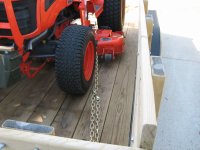
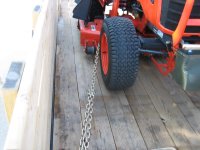
So, as I said I would, I loaded up the tractor and headed off to the nearest State Police post as a starter. Once there, I told what I want them to look at. They defered saying that they aren't versed in the motor carrier laws. The desk Sargent then called the nearest Motor Carrier Officer to get his location. We agreed to meet at an off ramp where he would inspect the load. When I met up with the Motor Carrier Officer, I asked him to look at the way the tractor was tied down. He said, " It is secured front and rear, it has an adjustable binder on the rear, it weights less than 10,000 lbs, it meets the requirement of the law." I told him to hold on, the experts at TBN claim that four adjustable binders are required. He repeated " It is secured front and rear, it has an adjustable binder on the rear, it weights less than 10,000 lbs, it meets the requirement of the law. If it was over 10,000 lbs then four binders would indeed be required."

So now we have a quandary, TBNers say four binders and the lowly Motor Carrier Officer ( the person who will be the one to issue any citations for violations) says that what I have is correct. What to do, what to do? I'm going to make a choice but I will let you guess whom I'm going with on this.

Photos showing what was inspected.
 

Attachments

  • IMG_0468.JPG
    IMG_0468.JPG
    471.3 KB · Views: 227
  • IMG_0469.JPG
    IMG_0469.JPG
    464 KB · Views: 220
  • IMG_0470.JPG
    IMG_0470.JPG
    651.8 KB · Views: 237
   / Why four binders?
  • Thread Starter
#52  
One more thing, as Steve McQueen said in his portrayal of Tom Horn, this is my final word on the matter.
 
   / Why four binders? #53  
So, as I said I would, I loaded up the tractor and headed off to the nearest State Police post as a starter. Once there, I told what I want them to look at. They defered saying that they aren't versed in the motor carrier laws. The desk Sargent then called the nearest Motor Carrier Officer to get his location. We agreed to meet at an off ramp where he would inspect the load. When I met up with the Motor Carrier Officer, I asked him to look at the way the tractor was tied down. He said, " It is secured front and rear, it has an adjustable binder on the rear, it weights less than 10,000 lbs, it meets the requirement of the law." I told him to hold on, the experts at TBN claim that four adjustable binders are required. He repeated " It is secured front and rear, it has an adjustable binder on the rear, it weights less than 10,000 lbs, it meets the requirement of the law. If it was over 10,000 lbs then four binders would indeed be required."

So now we have a quandary, TBNers say four binders and the lowly Motor Carrier Officer ( the person who will be the one to issue any citations for violations) says that what I have is correct. What to do, what to do? I'm going to make a choice but I will let you guess whom I'm going with on this.

Photos showing what was inspected.

Seems like the only one with a quandary is you :) I believe it was mentioned earlier that these regulations vary by state so all that really matters is what is required where you live and where you will be using your trailer. Four tie down points w/separate chains are required in PA not sure about the binder portion of your concern but for the record I use four. Happy towing! :)
 
   / Why four binders? #54  
well heck, if I had known we were talking about a riding lawn mower, it would have been different. I just put them in the back of mt Super duty and put a ratchet strap on them!
 
   / Why four binders? #55  
So, as I said I would, I loaded up the tractor and headed off to the nearest State Police post as a starter. Once there, I told what I want them to look at. They defered saying that they aren't versed in the motor carrier laws. The desk Sargent then called the nearest Motor Carrier Officer to get his location. We agreed to meet at an off ramp where he would inspect the load. When I met up with the Motor Carrier Officer, I asked him to look at the way the tractor was tied down. He said, " It is secured front and rear, it has an adjustable binder on the rear, it weights less than 10,000 lbs, it meets the requirement of the law." I told him to hold on, the experts at TBN claim that four adjustable binders are required. He repeated " It is secured front and rear, it has an adjustable binder on the rear, it weights less than 10,000 lbs, it meets the requirement of the law. If it was over 10,000 lbs then four binders would indeed be required."

So now we have a quandary, TBNers say four binders and the lowly Motor Carrier Officer ( the person who will be the one to issue any citations for violations) says that what I have is correct. What to do, what to do? I'm going to make a choice but I will let you guess whom I'm going with on this.

Photos showing what was inspected.

The Motor Carrier Officer is correct in what he told you. If under 10K it meets the requirement. I think most TBNers who use 4 chains and binders (like myself) do so as an added measure of safety. Don't forget that any added attachments need to be secured in addition to the tractor. Here is the Federal Motor Carrier link verifying what he told you is true.

Cargo Securement Rules - Federal Motor Carrier Safety Administration
 
   / Why four binders? #56  
Not attaching the load with any redundancy can only mean that you are unable to believe that you could just one time, sometime down the road, make a mistake or have some piece of equipment break. That would include the chain, the hooks, the attachment point on the trailer or the tractor[ or lawnmower], or the binders that started this thread.
I have never meet a piece of equipment that couldn't break, nor for that matter a human who couldn't make a mistake.
I never figured out why that boat went flying from the wagon. I missed something at the last inspection. The boat had been fine from Mass. to Arizona, and we were heading back east through Texas when it let loose. Redundancy would have solved the missed loose or frayed attachment.
Why is this so hard?:confused:
 
   / Why four binders? #57  
Not so here. California requires four independant ties, one on each corner, adjustable. I have posted it here before. I contacted CHP directly for an answer; got one by phone, and one by email. They do not care if it is a chain/binder, or a ratchet strap. They do, however, want each corner secured independantly, and adjustable(binder on a chain, rachet strap). The chain or strap does need to meet strength requirements.

Ca DOT regs are more stringent than US DOT rules.

So... if you traveled cross country(Interstate) the rules may change when you cross state lines.

So, as I said I would, I loaded up the tractor and headed off to the nearest State Police post as a starter. Once there, I told what I want them to look at. They defered saying that they aren't versed in the motor carrier laws. The desk Sargent then called the nearest Motor Carrier Officer to get his location. We agreed to meet at an off ramp where he would inspect the load. When I met up with the Motor Carrier Officer, I asked him to look at the way the tractor was tied down. He said, " It is secured front and rear, it has an adjustable binder on the rear, it weights less than 10,000 lbs, it meets the requirement of the law." I told him to hold on, the experts at TBN claim that four adjustable binders are required. He repeated " It is secured front and rear, it has an adjustable binder on the rear, it weights less than 10,000 lbs, it meets the requirement of the law. If it was over 10,000 lbs then four binders would indeed be required."

So now we have a quandary, TBNers say four binders and the lowly Motor Carrier Officer ( the person who will be the one to issue any citations for violations) says that what I have is correct. What to do, what to do? I'm going to make a choice but I will let you guess whom I'm going with on this.

Photos showing what was inspected.
 
   / Why four binders? #58  
..unable to believe that you could just one time, sometime down the road, make a mistake or have some piece of equipment break.
Well, ya!

Kidding.
Why is this so hard?:confused:
For me (remember...3,000# Kubota BX TLB) it isn't a matter of it being HARD, it is just a real PITA to have long enough chains (or short enough binders in my case) on all 4 corners for the widely varying conditions under which I tow my tractor. Just yesterday, I moved my tractor rearward on my trailer 4 feet to offset 1,000# of landscaping material I picked up.

With a 2 chain 2 binder system, it was slick as snot to move everything back a notch. Didn't miss a beat.

Just curious: If I was hauling 2 tons of stone (heavier than my tractor), why aren't we having a discussion about the overwhelming need to "bind" that load?

Just trying to keep it real.
 
   / Why four binders? #59  
OMG!!! I was in so much shock that I didn't get my cell phone camera out in time to get the picture. On the way back from my other property I was following a guy with a new looking JD110 TLB on what appeared to be a 7k utility (had the side rails as part of the strength - i.e. a lawn mower trailer) and it looked like it was moving on the trailer. As we were stopping for a light on Highway 41S I saw for sure that the tractor was moving a bit. I hit the power window on my passenger side to tell the guy that his load was loose but the light turned green and he took off. That is when I noticed that the only thing he had keeping the tractor on the trailer was one of the 1" wide, pull to tighten - like for a dirtbike, strap on the rear and one on the front. :eek:

At the next stop light I again tried to get his attention and let him know his new looking tractor appeared to be moving even more on his trailer. Of course, when I got his attention, he flipped me off. :rolleyes: That was when I noticed that he had a new temp tag on both his 2009 F150 and his trailer. Based on that, I assume that he had just bought the whole shooting match and was completely new to everything. I just went ahead and powered by him just in case he lost his new tractor off his new trailer.

I mention this because it's for guys like that that I think these laws are in place. I don't know what a JD110 weighs, but I'd venture to guess that it's too heavy for a 7k trailer. I'd bet his straps were rated for about 300 pounds max. He likely figured that with the front bucket down and the brake set that he didn't need to secure his new tractor. It's people like that guy why scare me. Heck, I wonder what towing rating his F150 has for that matter. I was pulling about 15k and I was able to easily drive away from him with my slightly juiced F350 6.0.
 
   / Why four binders? #60  
It all boils down to how the law is interpreted and enforced by the man with the badge and the gun. As with so many laws, you can argue extenuating circumstances, other viable options, and just "my opinion" until you're blue in the face. When "Smokey" has you sitting along side the road, and he's writing a citation that's longer than the GREAT AMERICAN NOVEL, MY opinion, YOUR opinion, and the next guys opinion matter little......only one that counts? SMOKEY's.

It's the law. Doesn't have to make sense.........Just has to be done that way.

My commercial liability insurance has a provision where certain claims can (and will be) voided if applicable laws are violated. ie.....4 chains, 4 binders, no matter if I think I can do it a better way or not.

Sit down...don't get too shocked, but I agree with you completely. I'm not even crossing my fingers behind my back. :) There are several things that are 'law' that I may not necessarily agree with, but I abide by them because I don't make a habit of breaking the law; especially when the consequences could be quite severe. Besides, dealing with a law enforcement officer with an attitude is never fun. I just have a suspicion that if someone were to start telling an officer what is and what isn't the law, you'd most likely end up on the losing end. I'm not trying to imply that the original poster has any intentions of breaking the law, but over the years I've seen many here on TBN say that they aren't going to abide by particular laws because they don't make sense to them.
 

Tractor & Equipment Auctions

KUBOTA M125X TRACTOR (A60430)
KUBOTA M125X...
Sakai SV505 (A60462)
UNUSED PAIR OF MINI RUBBER TRACKS (A52706)
UNUSED PAIR OF...
2017 Toyota Camry Hybrid Sedan (A59231)
2017 Toyota Camry...
2016 INTERNATIONAL PROSTAR TANDEM AXLE DAY CAB (A59904)
2016 INTERNATIONAL...
2002 AMERITRAIL 32FT GOOSENECK TRAILER (A58214)
2002 AMERITRAIL...
 
Top