Wiring 220V compressor

   / Wiring 220V compressor #1  

Volksfolks

New member
Joined
Jan 9, 2004
Messages
1
I recently purchased a 11/220V compressor and converted the motor to 220V.

My problem arises with the pig tail I need. My house is wired with a 4 prong 220V receptacle in the garage so I purchased a "dryer" cord with 4 prongs.

My compressor only has places for 3 wires. I was told by the "expert" at Home Depot to wire the green and white wires together and put them on the green spade.

That would leave me with the black wire on the black spade, the red wire on the white spade, and the green and white wires on the green spade.

Does this seem reasonable or am I about to ruin my compressor?

TIA.
Bill
 
   / Wiring 220V compressor #2  
The reason for the dryer to have 4 wires is that it needs a separate neutral because it uses 120 volt controls. Your compressor does not use 120 volts to control it, so it only requires the ground wire. The person at H. D. told you correctly. You could also leave the white wire disconnected and still be OK.
 
   / Wiring 220V compressor #3  
</font><font color="blue" class="small">( The reason for the dryer to have 4 wires is that it needs a separate neutral because it uses 120 volt controls. Your compressor does not use 120 volts to control it, so it only requires the ground wire. The person at H. D. told you correctly. You could also leave the white wire disconnected and still be OK. )</font>

That's correct. Except the neutral in the 4-wire feed should never be
connected to the grounded conductor. In general doing so is only
allowable where the separate system ground/neutral originates in the
service entrance equipment.
 
   / Wiring 220V compressor #4  
All you need is the two hots and a ground for the compressor, there is no nuetral wire.

If you take a voltmeter and measure from either hot to the nuetral it will read 120v. If you measure across the two hots it will read 220v, those are the ones you want to use. The ground connects to the to ground.
 
   / Wiring 220V compressor #5  
Using a dryer plug could be a hazardous route, if not for yourself then for the person you sell your house to, a kid, renter, or whatever.

A plug/socket is matched to the application/load. So if your compressor is rated for sub 15 amps at 220 (most likely if its convertabe to/from 110), then you should use a receptical for a 15 amp/220 volt circuit, which kind of looks like a regular 110 volt 15 amp receptical, except both prongs are turned 90 degrees. This should be connected to a 15 amp tandem (220 volt) breaker/fuse pair via a 14, or better yet 12, guage 2 conductor plus ground wire.

If you use a dryer recepticle, with is rated at something like 30 amps at 220, there is a risk you are essentailly saying 'its ok to plug a 30 amp/220 volt load like a dryer here. Lets say you strung a 30 amp circuit with proper (I think it 10 guage) wire and you fused it for 15 amps. Thats safe, but somebody could plug something in (like a dryer) and keep blowing fuses. Still safe, but a pain in the butt. If you don't hook up the neutal, you (or more likely the next occupant) could fry the dryer and maybe start a fire. Remember, somebidy sees a dryer receptical and they think its for plugging a dryer into.

Lets say you fuse your dryer receptical for 30 amps with 10 gage wire and your compressor starts seizing. This could cause a fire at the compressor.

There are all kinds of scenarios like this. (Wrong wire/breaker/plug combinations) which could kill somebody. So, use a dryer receptical/wire/breaker for dryer, not a compressor or anything else. The next guy who walks into that room may not know the story behind that receptical and somebody could die as a result.

The right thing to do is run a 20 gage 2 conductor plus ground with a tandem (poles tied together) 15 amp breaker. Get a 15 amp/220 plug/receptical (its written on the box). Join the copper wire to the ground terminal, black wire to one hot and red to the other (or white if there is no red).

If you see the Home Depot guy again, smack him and tell him his advice could have killed somebody.

Sorry for being a little sharp. Electricity done properly is safe to do and safe to use. Done wrong it can and does kill.

If you happen to be in Ontario, you can buy a little book called the 'Ontario Electrical Code Simplified' for, like $12 at Home Depot. Its a great book and put together for the DIYer.
 
   / Wiring 220V compressor #6  
This is interesting because I'm an electrical ignoramus. I have a 110/220 volt, full power recepticle on my generator but no rocker switch to move from one to the other. Are you telling me that whether I get 110 or 220 from the recepticle depends on how I wire up the plug???? If I use a 4-prong plug but a 3-wire cord connected to one hot spade, it'll put out 110 volts or if I connect up all 4-wires it'll put out 220 volts? This has always puzzled me because all my electrical piddling was done in the UK where everything is 220v and we never have this problem.
 
   / Wiring 220V compressor #7  
If the box is wired correctly and he hook the compressor with two hots and one ground on the compressor side of the box it should pose no theat to future use of the dryer plug. The only problem is the breaker may be to big for the compressor. I have made a pigtail that has a dryer plug and goes to 20 amp plug for mine. I use it when ever I am asked to work on sombodies house as most places do not have 20 amp 220 and I like my air tools. I have done this for years with no problem. Make sure that the ground is wired to the proper post on the plug.


Dane
 
   / Wiring 220V compressor #8  
</font><font color="blue" class="small">( ..........
The right thing to do is run a 20 gage 2 conductor plus ground with a tandem (poles tied together) 15 amp breaker. Get a 15 amp/220 plug/receptical (its written on the box). Join the copper wire to the ground terminal, black wire to one hot and red to the other (or white if there is no red). )</font>

Did you mean to write 12 gauge and write 20 gauge by mistake /forums/images/graemlins/confused.gif?
 
   / Wiring 220V compressor #9  
</font><font color="blue" class="small">( you telling me that whether I get 110 or 220 from the recepticle depends on how I wire up the plug???? )</font>

On the 220v dryer plug yes. On a standard two prong 110v outlet no. See my first post.


fyi...
Minimum sizes:
14 ga - 15 amps
12 ga - 20 amps
10 ga - 30 amps
 
   / Wiring 220V compressor #10  
Yes. 220 volts across both 'hots', 120 each across a hot and neutral.

As for the safety of using a dryer receptical, here is the acid test. Ask an electrical inspector or your utility if wiring a compressor into an dryer receptical/or non-standard wiring of a dryer receptical or hanging a dryer plug on a compressor meets code.

Then ask your insurance company if you are covered against doing your own wiring if you do commit a code violation.

I know some people make arc welder adaptors so they can temporarily power a buzz box (most houses don't have a 50 amp welder receptical handy). Thats a temporary solution, but ya takes yor chances.

I guess the question is, why do it wrong, when doing it right is safer, cheaper, and easier? :eek: :eek: :eek: :eek:

Better safe than sorry.

And, JUNKMAN, yes, I meant 12 gage. In fact I coulda sworn I corrected before I posted (but then again I RETYPED 20 gage again in this paragraph, so I must have my mind in the gutter again). Oooopps
 
   / Wiring 220V compressor #11  
What is typically done for a temp solution needing 220v at a work site is that you have a portable a breaker box. The box would be plugged into the dryer outlet via the appropriate sized cord and plug. The box will have 110v and 220v outlets with the appropriate plugs and breaker sizes. This way you can run a compressor, work light, batt chargers etc.. safely.
Same thing for power off of temp power poles building houses with 220v 50amp source. Diff plug of course.
 
   / Wiring 220V compressor #12  
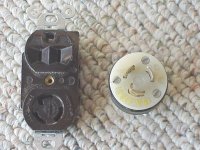
I have to agree with you 110% on the problems that you will have if you don't follow code when doing any wiring. There are some things that insurance companies will ignore as homeowner error, but electrical errors are not one of them. I have often said that the insurance companies should list the things that homeowners cannot do unless their work meets code...... electrical and plumbing are the two at the top of the list. I have planned an assortment of different outlets to be placed at the bottom of my sub panel in my shop. That way, there will always be the correct outlet for the appliance. I have even changed the plugs on some of my tools to twist lock types, because that will stop people from wanting to borrow them. If they can't plug them in, they won't want to borrow them. I have adapters for my own convenience when I take them off site.
 

Attachments

  • 361979-MVC-002S.JPG
    361979-MVC-002S.JPG
    50.6 KB · Views: 501
   / Wiring 220V compressor #13  
</font><font color="blue" class="small">( I have even changed the plugs on some of my tools to twist lock types, because that will stop people from wanting to borrow them. )</font>

That will work!!

LOL!!!
 
   / Wiring 220V compressor #14  
All of this is great advice and one should always be compliance with code.

When I read the post and the fact he was looking for a pig tail I assumed this was for temporary installation while working. If this is for final installation proper to code wiring is the only way I would go.
 
   / Wiring 220V compressor #15  
WARNING: READING THIS POST MAY OFFEND CERTAIN PEOPLE!

Junkman, boustany and the others who are promoting safety, doing the job correctly, using the proper equipment and code compliance. THANK YOU!

To the others who are slapping something together electrically and calling it good, find another topic to upon which to share your lack of knowledge. You are dealing with lives and property here.

Wiring a dryer outlet to take a compressor is just wrong. The electrical device manufacturer's make 220 volt 15, 20 and 30 amp plugs and receptacles for a reason, they are REQUIRED by the adopted codes. Please read LAW here for code because once legally adopted, they are law.

As for insurance coverage, I cannot count the number of times I have seen insurance investigators deny a claim because 'someone' did not follow code for electrical work.

If I have offended anyone, I am not sorry. Giving someone the wrong advice about motor oil or buying an attachment or even a tractor can only cost them money. Electrically, it could kill them and others.

Don
 
   / Wiring 220V compressor #16  
Gulp!

Thanks, I'm glad you wrote that.

Of course, I totally agree.

I am not an electrician, but I designed computers for about 12 years, so I know a bit about this sort of stuff. There is a tendancy to think 'codes are for losers' or something. When you look into it in most cases there is a very good reason the code is the way it is, whether you are talking about building, plumbing, or electrical. And, electricity can kill through burning or electric shock, and it usually happens without warning. Its not always to the person who did the work, however.

So, I bought the books and read 'em and I consult them whenever I have to do something new. I built, plumbed and wired my own house (us stock analysts have to make sure we've got a backup job). In Ontario, a private individual can get an electrical permitt and do his own wiring, and they send an inspector around to check it out.

My inspector looked at my preliminary wiring and told me to care only for the final - he didn't have to see any more because I did everything by the book.

Then we had a 1/2 hour conversation on the things he saw: people using extension cords for internal wiring, masking tape for connections, and on and on, and on. An those are people who get the permit. Think of the stuff he hasn't seen!
 
   / Wiring 220V compressor #17  
I surely hope you are not refering to me I assure you there is no lack of knowledge on this subject.

He asked a simple quesiton on how it was wired. A certain amount of knowledge is assumed otherwise your telling people to tie thier shoe laces before working on something.

So take your soap box elsewhere.
 
   / Wiring 220V compressor #18  
</font><font color="blue" class="small">( I surely hope you are not refering to me )</font>

Don't know that I was.

</font><font color="blue" class="small">( He asked a simple quesiton on how it was wired. )</font>

He most certainly did. The simple answer would be to use the proper receptacle / plug combination as required by the NEC, local codes and/or the manufacturer of the compressor. Then advise the him to ignore the obviously bad information received from the gentleman at Home Depot.

</font><font color="blue" class="small">( telling people to tie thier shoes )</font>

With all respect to, and no malice towards the original poster, if he is asking a question like this, he most definitely needs to learn how to tie his shoes, electrically speaking that is.

</font><font color="blue" class="small">( So take your soap box elsewhere. )</font>

Just a bit touchy, are we? /forums/images/graemlins/ooo.gif

When it comes to human life, making sure the basics are understood is not something we can </font><font color="blue" class="small">( assume)</font>
 
   / Wiring 220V compressor #19  
If they were truly "experts" they'd be working for me.

DO NOT wire the green(ground) and white(neutral) together. Run a circuit dedicated to the compressor or convert the dryer outlet to one that the compressor would be compatible to. Everytime someone "cobbs" something together to "make it work", I get involved in the investigation of the origin of the fire.
 
   / Wiring 220V compressor #20  
Ill just add that using a dryer plug and outlet is a half ^&% way to do this but could be safe if:
1) You used a breaker for which the compressor was rated. Not the 30 amp breaker the dryer is designed for.
2) You select a propery wire size and pull the two hots neutral and ground to the dryer outlet.
3) You do not use the white wire on the compressor side. Just cut the wire off of the cord you plug into the dryer outlet.

Its an ugly dumb solution that will be very confusing for anyone who someday trys to plug a dryer in at this location, but its not unsafe.

You have no potential for overcurrent on the compressor and a dryer plugged in at this location just will not work, pop the breaker. Also your using a 30 amp plug at what 15-20 amps? Thats not going to hurt a thing.

If you have a dryer plug and cord and are determined to go this route, and I am not advocating that, then you could at least put a label on the oulet "Fused at 15 amps not for a dryer".....

Fred
 

Tractor & Equipment Auctions

(2) UNUSED 31" X 8 MM EXCAVATOR TRACKS W/ PINS (A60432)
(2) UNUSED 31" X 8...
500 BBL FRAC TANK (A58214)
500 BBL FRAC TANK...
YANMAR VIO35-6A EXCAVATOR (A59823)
YANMAR VIO35-6A...
2009 Skeeter SL190 19ft Boat with 21ft Boat Trailer (A59231)
2009 Skeeter SL190...
HYDRAULIC TILTING BUCKET FOR MINI EXCAVATOR (A58214)
HYDRAULIC TILTING...
JMR STUMP/ TRENCHING BUCKET (A56857)
JMR STUMP/...
 
Top