Wood Retaining Walls

   / Wood Retaining Walls #1  

kiphorn

Silver Member
Joined
Nov 9, 2001
Messages
112
Location
Central PA
Tractor
TC 24D
I read the posts on the Retaining Walls using Allen Block or similar products. I don't think my budget is going to allow for one of these systems on my new house.

What about treated 6x6 or railroad ties? Has anyone installed a retaining wall using these materials with good success?

Whats the best way to secure them together and how do you anchor the wall so that it doesn't fall over once the fill is placed behind the wall?

I'm only planning on a 4'-6' wall. Any good websites or other references for constructing this type of wall?

Thanks for the help.


Kip
 
   / Wood Retaining Walls #2  
I have never built a retaining wall that size out of timbers. I have built several stone retaining walls, one is about 6 feet high on average by about 50 feet long. Another is about 8 feet high at the highest point and around 75 feet long, and then there are two retaining walls that flank the walk out basement door which are over 6 feet high.

I would imagine that you want to drive some lengths of reinforcing rod through the timbers into the ground to hold them in place, may require drilling a pilot hole.

I would spike the timbers together with 12 inch nails, staggering the joints. Every 3 or 4 courses high I would lay a timber every 6 to 8 feet perpendicular to the wall into the bank on top of a row and nail it to the wall. A few pieces of re-rod in these pieces wouldn't hurt either.
This will help hold the wall against the push of the bank.

Angling the wall a little bit backwards towards the top is always a good idea.

Good luck

Randy
 
   / Wood Retaining Walls #3  
kiphorn,

I don't know much about the stability of these types of walls. I have seen them built by others and they seem sturdy enough. A concern I've heard from several individuals though are the creasote or wood preservatives in these types of timbers that may contaminate and leach into localized soil thereby presenting a danger to nearby flower beds, shubbery, trees, etc. There may also be a danger of this type of contamination if the wall is near a dug, shallow well you may use for drinking purposes...especially if the soil is sandy and porous in nature.

Just a couple things you may want to keep in mind...
 
   / Wood Retaining Walls #4  
I would support your method 100%, and have experience helping build a 150' long retaining wall that on one end was just a couple of ties high, whereas in the middle there were 16 ties high. Start with a good solid row on the bottom on solid ground (undisturbed dirt, or a good tamped gravel base. Stagger the joints as you suggest, and put in the perpendicular tie back into the bank and anchored well every third course and at the ends of each tie in that row. Fill behind the wall as you go with tamped dirt or gravel. Gravel helps if there is moisture coming out of the bank. Agree to lean the wall back into the bank about 10 degrees, and leave a step on each tie of about 1 1/2 to 2". This retaining wall has held up to midwest freezing winters in clay soil (lots of frost heaving). This is where a boom pole on the FEL can come in real handy, with a log tong to grab each tie near the middle to swing them into place. Flowers grew all over this wall, and the creosote didn't have any apparent affect on them.
 
   / Wood Retaining Walls #5  
i agree with the previous methods that include stone for drainage, tie backs called dead men, and leaning the wall back toward the hill. In fact i built some at my previous house to get a walk out basement. however, any wood, even pressure treated will not last in ground contact. I used two different products both pressure treated 6x6. the pine ones were junk after 10 years though the black birch lasted over 15. think stone or concrete.
 
   / Wood Retaining Walls #6  
Others have pretty much covered the way I have built my walls. Remember that water pressure is a retaining walls biggest enemy. Drain tile and gravel fill will keep your wall standing for a good long time. When you say 6’ high you are getting to the high end for a wood wall. If you can terrace it---build up 3’ then step back 3’ for the last 3’ high section---your wall will be considerably stronger.

MarkV
 
   / Wood Retaining Walls #7  
Add emphasis to the stone or concrete idea. Exactly right about long term with wood. With a budget concern, use concrete blocks then paint to match. Overall price shouldn't be much more than wood. Then when money is a little more accessible, go back and brick or stone face your block work.
 
   / Wood Retaining Walls #8  
These posts have a lot of good advice. I had a 3'-4' PT wood wall built designed to last 40 years holding back a very "wet" hillside. We stepped back the courses ans used dead men. Most important we installed a perforated drain pipe on the inside, did all the backfill with gravel, and put fabric over the gravel to prevent fabric from filtering down into it. The area the wall is in gets plenty of sun, otherwise I would not have gone with wood. The wall is now 5 years old and in perfect condition.
 
   / Wood Retaining Walls #9  
When we lived in Wisconsin I built steps leading down to the lake out of old railroad ties. The steps are still in place over thirty years later without signs of deterioration. To fasten them together, I used huge galvanized nails that I purchased at the local lumber yard; each nail was approximately 9 inches long and 1/4 inch in diameter. I had to drill through the top tie in order to hammer in each nail. In Texas where we live now we have a low retaining wall built out of landscape timbers (round on two sides). The wall was built in the early 1980's and the timbers seem to be in perfect condition. They are fastened together with 3/8 inch rebar. Holes were drilled through the timbers and pieces of rebar were pounded through all of the timbers and into the ground (caliche) below to further anchor the timbers. Please bear in mind that we are in a semi-arid area so the timbers aren't exposed to a great deal of water. Treated lumber, whether ties or landscape timbers, seems to last indefinately, goes together more rapidly than stone, and is a heck of a lot easier on the back (landscape timbers aren't that heavy and you can use your tractor and crane to move ties around).
 
   / Wood Retaining Walls #10  
Kip

I helped salvage and haul the rail road ties for a couple of retaining walls, and I've been working on my own out of stone and concrete. Stone and concrete is lighter. You start hauling 14' railroad ties and they get a might heavy. Big rocks get heavy too, but for some reason you don't think about it as much.

For rail road ties, support is going to depend on the height of the wall. The traditional method is to notch in a T shaped dead man that runs back into the bank and works like an anchor.

SHF
 
   / Wood Retaining Walls #11  
I built a wall 4 ft high and 20 ft long about 15 years ago to make a level spot to build my shop/garage. I started with two vertical posts sunk it the ground and built the wall up against them, staggering the joints and spiking them together. It hasn't budged in 15 years. I can snap a photo of it if you are interested.
 
   / Wood Retaining Walls #12  
Kip,

I can't really add to the excellent advice the other guys have given you already. But I can offer you another source for information. If you go to <A target="_blank" HREF=http://www.lawnsite.com/>http://www.lawnsite.com/</A>, you'll find a discussion forum by landscapers. They have a discussion forum for homeowners to ask the professionals questions and advice. It's a lot like TBN, 'cept these guys get excited over lawnmowers and edgers and things /w3tcompact/icons/hmm.gif.
 
   / Wood Retaining Walls #13  
You might want to consider hiring local engineering help for your project. In my area you can't build a retaining wall over 4 feet high without a Professional Engineer's stamp on the print. I have used the Town Engineer from the next town over for a project; very friendly and reasonable cost.
 
   / Wood Retaining Walls
  • Thread Starter
#14  
Tony,

Please post a picture when you have time.

Thanks,

Kip
 
   / Wood Retaining Walls #15  
All excellent advice here. Wished I had found this discussion earlier instead of having to search and ask around for a lot of advice and sounding dumb. The only thing I have to contribute is that I would definitely go with landscape timbers over railroad ties. I think after looking at the wall for a few years, you will probably regret using railroad ties and I think the pressure-treating process is a little kinder type of leaching over cresote. As to integrity and resistance to decay and weakening of timbers, I think there is a slight difference among the pressure treating process used in manufacturing. Seems in my area at least, most timber (and other lumber materials) that come from a lumber and building company seems to be of better quality than the mass market places like Home Depot or Lowes. just an opinion here.
I have built 4 of these type walls, one 5 feet, two 3 feet, and one 4 feet. I believe anytime you go over 4 feet, you need a permit, but in my area it's very slack on permits for outside projects. Just make sure you use dead men in staggered rows for every 3 feet, for example if you go four feet, the one row of dead men will be fine, but if you go over 4 i would advise another row with longer angled dead mean staggered. Most of time if you go over 4 feet, you need professional engineering help.

just some tips......make sure you have a good heavy duty 1/2 drill with Irwin Speedbore auger or spade bits to start your holes for reinforcing rods.
I used a recripicating saw with metal blades to cut desired length of rods
as someone suggested, tie together with 10-12" spikes
ground contact rebar should extend down at least 24"
landscape fabric or burlap placed on top of gravel before backfilling adds years to projects life
a handy little item that helped me in laying out courses is a Sight Level purchased at any hardware store. cost about $10..about 4 inches long and you just look through it until the bubble crosses the line inside. Line level works good too, just not as quickly to use.
a spade that is about 8 inches wide called a landscaper's spade helps with leveling ground for bottom course.
The oldest wall i've built is 7 years old in a very shady and wet area with a red clay bank. Looks just like the day it was built even though i forgot the drain holes or weep holes until two years later.
one note.....if you use a tractor in the project, just make sure when you're using the rear blade for leveling or scraping loose fill down for pre-installation of timbers, that you don't forget to get the darn thing out of the way when you go back and forward! I tore a wall down just by being in too big a hurry.
 
   / Wood Retaining Walls #16  
kiphorn,

I'm going to ditto someone elses advice. Think about an engineer
if you have a lot of hight to cover. I know after a certain distance
you need the engineer. It might not be as expensive as you think either.
A coworker need an engineer to look into a problem he had with a house
he had a contract to purchase. To study the problem and design a
solution I think only cost him a couple of hundred dollars. You are going
to spend quite a bit of money on whatever material you use plus your
time. Might as well get it right the first time.

Beside code may require the engineer's design.

In case you dont know, pressure treated wood comes in different flavors.
There is a .20 and a .40 pressure treatment. I thinks there is a .60 or
there abouts as well. I think the .40 is .40 pounds of CCA per cubic foot
of wood. CCA is Chromate something or other Arsenic. I put a reference
on TBN, likely in the Rural discussion area, about the EPA banning CCA PT
wood in a few years for residential use.

You will want to use the .40 or better PT wood. I think the .60 was for use
in water applications like docks and such. I am lucky in that I have a local
PT company. He provides a much better product than the big box home
retailers.

I have read studies, they are all over the net if you look, that does not
have me that concerned about CCA leaching into the soil. It does but
it does not appear to migrate more than an inch or so. EPA is banning
CCA PT for no good reason for what I could see in their published paper.
A lot of ifs, maybe, could be, might type of language.

Hope this helps...
Dan
 
   / Wood Retaining Walls #17  
I would not recommend the landscape timber product for a structural application. I am involved with the pressure treatment industry and know the production practices and standards. Although the landscape timbers are treated with CCA this particular commodity is not treated to any standard and is not inspected unlike most other treated wood products. Landscape timbers are peeler core left over from plywood veneer production. They contain a large percentage of untreatable heartwood and generally are not properly dried before treatment. This was a market that they were able to get some value out of the wood. Landscape timbers would be acceptable as a border around a garden or flowerbed but not much more. Use treated 4x4’s, 4x6’s, etc. treated to 0.4 pcf CCA.
 
   / Wood Retaining Walls #18  
Sorry, my mistake and you're correct. When i used the term 'landscape timber' I was referring to pressure treated 6x6's...I didn't mean the thin rounded edge type used mostly for flower garden borders, etc. Thanks for clearing up.
 
   / Wood Retaining Walls #19  
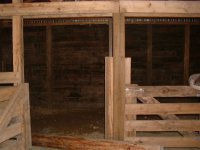
The retaining wall I built for my barn is made with Railroad ties for the wall and 6X6 treated poles for the support. The wall is 30 long and 10 high. Here is a pic of it from inside the barn.
Steve
 

Attachments

  • 33-127721-barn2.jpg
    33-127721-barn2.jpg
    58.6 KB · Views: 858
   / Wood Retaining Walls #20  
Here is another pic. They are not the greatest because I still don't have electric for lights.
Steve
 

Attachments

  • 33-127724-barn1.jpg
    33-127724-barn1.jpg
    58.3 KB · Views: 490

Tractor & Equipment Auctions

2023 CASE 580 SUPER N BACKHOE (A60429)
2023 CASE 580...
2019 Chevrolet Silverado 1500 Pickup Truck (A55973)
2019 Chevrolet...
3015 (A56857)
3015 (A56857)
Deere 35P (A53317)
Deere 35P (A53317)
2017 Toyota Hybrid Camry Sedan (A59231)
2017 Toyota Hybrid...
2019 GALYEAN EQUIPMENT CO. 150BBL STEEL (A58214)
2019 GALYEAN...
 
Top