Workshop Insulation

/ Workshop Insulation #1  

jadefox

Bronze Member
Joined
Nov 22, 2013
Messages
89
Location
Rockland, Maine
Tractor
Kubota BX25D, Case 448
We're enclosing a section of our 150+ year old barn to be a workshop, and we're thinking through insulation. There are two exterior walls to the new workshop that are sheathed in horizontal boards and then sided with shingles. In places there is old (very) tar paper between the sheathing and the shingles. We plan to replace the shingles and may add a WRB at that point, but that won't until next summer at the earliest. We want to insulate now from the inside, and we have access to some reclaimed 4x8 sheets of 1-inch thick rigid yellow polyiso insulation. We plan to panel the interior of the shop with boards.

Thoughts on the installation of the polyiso or other insulation? The interior two walls will also need to be insulated, but those are new walls built between the beams.

Thanks in advance!
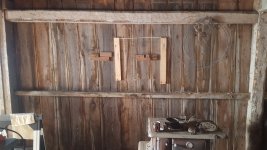
 

Attachments

  • 20161026_143540.jpg
    20161026_143540.jpg
    2 MB · Views: 296
/ Workshop Insulation #2  
WRB :confused3:
 
/ Workshop Insulation #4  
Well, Tyvek is for the outside, but yes I would not go without these days. It's more than just a water barrier. It's an air barrier.

You don't have any wall framing for traditional roll insulation. That leaves only rigid Styrofoam (which has a pretty low R value unless you really increase the thickness) or spray foam. The spray foam would be the best and you could forgo the Tyvek, but all that pretty barn wood would forever be damaged.

I would spray foam it and not worry about it.
 
/ Workshop Insulation #5  
We're enclosing a section of our 150+ year old barn to be a workshop, and we're thinking through insulation. There are two exterior walls to the new workshop that are sheathed in horizontal boards and then sided with shingles. In places there is old (very) tar paper between the sheathing and the shingles. We plan to replace the shingles and may add a WRB at that point, but that won't until next summer at the earliest. We want to insulate now from the inside, and we have access to some reclaimed 4x8 sheets of 1-inch thick rigid yellow polyiso insulation. We plan to panel the interior of the shop with boards.

Thoughts on the installation of the polyiso or other insulation? The interior two walls will also need to be insulated, but those are new walls built between the beams.

Thanks in advance!
If your horizontal exterior backer boards are in good shape and will remain as you update the exterior siding, I guess the trend would be to use sprayed foam...not cheap but the cost is coming down as more people are getting in the business. From what I have read heat loss from a side-wall is not that much if you can eliminate drafts/air infiltration and foam will do that. Biggest heat loss comes from your ceiling I think. There are a lot of people on this site that know a lot more about it than I do so stay tuned for more advice. Interior partition walls...my shop is partitioned between hot and cold with 2x6 framing. I used steel for the interior so my "nailers" run horizontally so as to secure the steel. I spaced the "nailers" 24" OC and used Kraft faced fiberglass on the heated side (readily available in that width). Back side I put up OSB.
 
/ Workshop Insulation
  • Thread Starter
#6  
Well, Tyvek is for the outside, but yes I would not go without these days. It's more than just a water barrier. It's an air barrier.

You don't have any wall framing for traditional roll insulation. That leaves only rigid Styrofoam (which has a pretty low R value unless you really increase the thickness) or spray foam. The spray foam would be the best and you could forgo the Tyvek, but all that pretty barn wood would forever be damaged.

I would spray foam it and not worry about it.

Thanks. The VRB will likely be added (on the outside) when we re-shingle the barn next summer (hopefully). For now, I'm really thinking of going with the rigid, as I can get it cheap and double up. If I do that, I'm thinking I should use spacers to create an air gap between the sheathing and the insulation. Thoughts? I have not totally ruled out spray foam (we did that in the attached barn, and it's toasty!), but I'd like to do as little to the barn that compromises any of its historic integrity (we're suckers for that kind of thing).
 
/ Workshop Insulation
  • Thread Starter
#7  
If your horizontal exterior backer boards are in good shape and will remain as you update the exterior siding, I guess the trend would be to use sprayed foam...not cheap but the cost is coming down as more people are getting in the business. From what I have read heat loss from a side-wall is not that much if you can eliminate drafts/air infiltration and foam will do that. Biggest heat loss comes from your ceiling I think. There are a lot of people on this site that know a lot more about it than I do so stay tuned for more advice.

We used spray foam in the attached barn, and it's awesome. We did ceilings and floor too. It's a pain to then go in and redo and plumbing/electrical though, which is really the only down side (besides the cost and ruining the historic integrity of the structure).
 
/ Workshop Insulation #8  
It would pain me to cover that historic structure with anything. Much less something that couldn't be removed easily. I think I would put on an extra jacket and build a double drum wood heater to keep warm.
 
/ Workshop Insulation
  • Thread Starter
#9  
It would pain me to cover that historic structure with anything. Much less something that couldn't be removed easily. I think I would put on an extra jacket and build a double drum wood heater to keep warm.

Insulation of some sort is going to be necessary. Our business has grown much more quickly than expected, and we need the space. At present, snow blows in during the winter, so we need to button up this section (it's about two-thirds of one side of the first floor). Having said that, we are committed to maintaining as much of the historic integrity of the structure as possible. That's one reason we were thinking that rigid foam may be the way to go. Today I ripped out walls that were built over the years (last 25 years, I'm guessing) and uncovered more beautiful beams. It is our goal to leave as many of these exposed as possible.
 
/ Workshop Insulation #10  
We used spray foam in the attached barn, and it's awesome. We did ceilings and floor too. It's a pain to then go in and redo and plumbing/electrical though, which is really the only down side (besides the cost and ruining the historic integrity of the structure).
Cutting through that foam for pipe/wiring upgrades might be a bit messy but certainly is easier than cutting through 150 year old lumber. Go find a cheap "oscillating multi-tool"...or find a cheap fillet knife! As for historic integrity, costs more but there are ways to preserve your wood from foam if you want to bother but IMHO you will most likely lose some of the benefits of foam in terms of energy efficiency (probably not much)...thinking...
 
/ Workshop Insulation
  • Thread Starter
#11  
Cutting through that foam for pipe/wiring upgrades might be a bit messy but certainly is easier than cutting through 150 year old lumber. Go find a cheap "oscillating multi-tool"...or find a cheap fillet knife! As for historic integrity, costs more but there are ways to preserve your wood from foam if you want to bother but IMHO you will most likely lose some of the benefits of foam in terms of energy efficiency (probably not much)...thinking...

I hear ya...and it is a barn after all. We're not expecting it to be warm like a residence, but we also don't want our employees filing workman's comp for frost bite! The challenge in the attached barn was actually finding the pex inside the foam and tracing runs. I would do it differently next time.
 
/ Workshop Insulation #12  
I insulated my pole barn with reclaimed polyiso panels (1.5" and 2" thick). I fitted two layers between the posts, filling gaps/holes with spray foam. Then I put horizontal 2x4 nailers and fitted a final layer. Over that I put 6 mil poly as a vapor barrier and finished the inside with wood paneling and OSB sheets. When I replaced the exterior metal siding, I added tyvek under the metal to finish it off. Seems to be working well. Probably the most significant was adding the metal ceiling (under vapor barrier on the bottom of the trusses with blown in cellulose.

The one thing I would do differently is the electrical. I ran it in the walls and above the ceiling. Now I would run everything in surface mount conduit.
 
/ Workshop Insulation #13  
I hear ya...and it is a barn after all. We're not expecting it to be warm like a residence, but we also don't want our employees filing workman's comp for frost bite! The challenge in the attached barn was actually finding the pex inside the foam and tracing runs. I would do it differently next time.
I think code (or any reputable plumber/electrician) would tell you that you that you should not bury any connection where you can't get at it if you need to (e.g. my plumber refuses to use shark-bites where I might hide them behind drywall...electrical code is the same...no hidden junction boxes). Access panels are a no brainer and easy to build into any building. I see you live in Maine so your climate might be similar to ours. You can minimize the "frost-bite" somewhat by sealing the side-walls but as far as I know your problem will require you to "look up" (i.e. ceiling). If you have the potential for a thriving business, a totally enclosed space where you could insulate all walls and ceiling might cost a few thousand $$$ and you wouldn't harm that historic integrity. Use construction screws so you can dismantle it and re-use it.
 
/ Workshop Insulation #14  
I insulated my pole barn with reclaimed polyiso panels (1.5" and 2" thick). I fitted two layers between the posts, filling gaps/holes with spray foam. Then I put horizontal 2x4 nailers and fitted a final layer. Over that I put 6 mil poly as a vapor barrier and finished the inside with wood paneling and OSB sheets. When I replaced the exterior metal siding, I added tyvek under the metal to finish it off. Seems to be working well. Probably the most significant was adding the metal ceiling (under vapor barrier on the bottom of the trusses with blown in cellulose.

The one thing I would do differently is the electrical. I ran it in the walls and above the ceiling. Now I would run everything in surface mount conduit.
I "paid the guy" to install bright white steel inside my shop and used surface mounted conduit. #1 the EMT qualifies as your ground if properly installed...#2 all wire and connections are readily accessible (I ran 4" boxes around the shop using 2 duplex outlets per box...left side coming from 1 20A breaker, right side from a different 20A breaker). Most likely I have far exceeded the residential code limits but it is a shop and very rarely will one tool be used at the same time. Problem with surface mounting on ribbed steal panels...the ribs stand "proud" about 3/4" so a shim will be required if you don't to make/buy the "offset" fittings. Other than that, my ribbed steel ceiling went up over a thick layer of poly sheeting. Have part of the building that is "cold" and hired an insulation contractor to do "blow-in" to R50 from that side. The builder (no longer with us...RIP) kinda left me a problem in that he installed the ridge vent and ventilated soffits but didn't install any "dams" on the side walls. We installed thick layers of fiberglass batting (R50 in total) around the perimeter and filled the middle with blown in material. When I built it I insisted on radiant in-floor heat that my wife and I installed before the slab got poured. It's hardly cheap to heat as it is but nothing in Wisconsin is cheap to heat and I love the radiant in-floor heat.
 
/ Workshop Insulation
  • Thread Starter
#15  
I insulated my pole barn with reclaimed polyiso panels (1.5" and 2" thick). I fitted two layers between the posts, filling gaps/holes with spray foam. Then I put horizontal 2x4 nailers and fitted a final layer. Over that I put 6 mil poly as a vapor barrier and finished the inside with wood paneling and OSB sheets. When I replaced the exterior metal siding, I added tyvek under the metal to finish it off. Seems to be working well. Probably the most significant was adding the metal ceiling (under vapor barrier on the bottom of the trusses with blown in cellulose.

The one thing I would do differently is the electrical. I ran it in the walls and above the ceiling. Now I would run everything in surface mount conduit.

Thanks. Would you recap for me the progression you did from interior wood paneling out to siding, please?
 
/ Workshop Insulation
  • Thread Starter
#16  
I think code (or any reputable plumber/electrician) would tell you that you that you should not bury any connection where you can't get at it if you need to (e.g. my plumber refuses to use shark-bites where I might hide them behind drywall...electrical code is the same...no hidden junction boxes). Access panels are a no brainer and easy to build into any building. I see you live in Maine so your climate might be similar to ours. You can minimize the "frost-bite" somewhat by sealing the side-walls but as far as I know your problem will require you to "look up" (i.e. ceiling). If you have the potential for a thriving business, a totally enclosed space where you could insulate all walls and ceiling might cost a few thousand $$$ and you wouldn't harm that historic integrity. Use construction screws so you can dismantle it and re-use it.

We had the spray in work in the cellar ceiling done by someone else, and a lot of pipe and pex runs got buried (no connections though). It certainly made re-doing the heating in the house (16 radiators) more challenging.

We do plan to insulate all shop walls and the ceiling, but I'm not sure what to do about the floor (the barn sits on fieldstone piers with just a tight crawlspace). I'm thinking we'll have plenty of "refreshing air" coming up from the floor.
 
/ Workshop Insulation
  • Thread Starter
#17  
I "paid the guy" to install bright white steel inside my shop and used surface mounted conduit. #1 the EMT qualifies as your ground if properly installed...#2 all wire and connections are readily accessible (I ran 4" boxes around the shop using 2 duplex outlets per box...left side coming from 1 20A breaker, right side from a different 20A breaker). Most likely I have far exceeded the residential code limits but it is a shop and very rarely will one tool be used at the same time. Problem with surface mounting on ribbed steal panels...the ribs stand "proud" about 3/4" so a shim will be required if you don't to make/buy the "offset" fittings. Other than that, my ribbed steel ceiling went up over a thick layer of poly sheeting. Have part of the building that is "cold" and hired an insulation contractor to do "blow-in" to R50 from that side. The builder (no longer with us...RIP) kinda left me a problem in that he installed the ridge vent and ventilated soffits but didn't install any "dams" on the side walls. We installed thick layers of fiberglass batting (R50 in total) around the perimeter and filled the middle with blown in material. When I built it I insisted on radiant in-floor heat that my wife and I installed before the slab got poured. It's hardly cheap to heat as it is but nothing in Wisconsin is cheap to heat and I love the radiant in-floor heat.

Sounds pretty great! I had just assumed I'd but the wiring in the walls, but I'm rethinking that now. I plan at least four 2 duplex outlets and then probably three/four ceiling mounted lights.
 
/ Workshop Insulation #18  
We had the spray in work in the cellar ceiling done by someone else, and a lot of pipe and pex runs got buried (no connections though). It certainly made re-doing the heating in the house (16 radiators) more challenging.

We do plan to insulate all shop walls and the ceiling, but I'm not sure what to do about the floor (the barn sits on fieldstone piers with just a tight crawlspace). I'm thinking we'll have plenty of "refreshing air" coming up from the floor.
Floors/crawlspaces can be problematic and there doesn't seem to be any consensus amongst the insulation guys...some say an air gap is needed, others say "pack it full". Wait and see if an expert opines.
 
/ Workshop Insulation #19  
Thanks. Would you recap for me the progression you did from interior wood paneling out to siding, please?

Took a while to find it but here is a summary thread on the project:
http://www.tractorbynet.com/forums/projects/333644-pole-barn-renovation.html?highlight=Pole

This was an old (30+ years) pole barn and very basic. Posts 8 feet spacing and trusses 4 foot spacing, 12 foot height. Nothing finished inside and minimal electrical service, which I replaced completely. I found a source of good used roofing polyiso panels. I fitted two layers of panels between the poles against the inside of the girts. Then I ran electrical in the walls (would not do again) and added two 2x4 horizontal nailers between the posts and filled between them with polyiso. Next I added a vapor barrier inside over the whole wall. I had some salvaged T-11 paneling that I installed as wainscot high enough that I could finish to the ceiling with 4 x 8 OSB.

The ceiling install was a normal metal ceiling. I installed the vapor barrier under the trusses and mounted the metal ceiling. A tip: I installed mine ribs down so I had a relatively flat surface against the vapor barrier. I'm not sure that's necessary. Since then, I've done a couple ribs up and I think I like the look better. Cellulose blown in.

The final step was to replace the old exterior siding. I pulled the old siding off, put tyvek over the girts, and installed the new siding. I used a two tone approach which minimized how imposing the building looks (it's close to the house) and also limited the size of sheet I had to handle (I did most of it alone).

Hope this helps.
 
/ Workshop Insulation #20  
Sounds pretty great! I had just assumed I'd but the wiring in the walls, but I'm rethinking that now. I plan at least four 2 duplex outlets and then probably three/four ceiling mounted lights.
For lighting I used a 4" steel box and installed 2 switches then proceeded up the wall and a 90 degree bend to a junction box 10' from the sidewall, and from there to another junction box 10' away from that. I then "ganged" 3 T8 (4 tube) florescent fixtures off each junction box (24' in total per side). With the bright white steel on the ceiling there is plenty of light. Switching each bank let's me select either side or both. Btw, while I was doing all that I also ran extra wire to the junction box that I then took to the "cold" side of the building off a separate 20a breaker. All EMT and by eliminating the separate ground wires I had plenty of room.
 

Marketplace Items

L6060 Kubota For Sale
2010 Ari Hetra HDML-8 15,000lb. Heavy Duty Mobile Column Lifts (A61572)
2010 Ari Hetra...
2009 Chevrolet Tahoe SUV (A66738)
2009 Chevrolet...
125 GAL TANK (A68842)
PORTA POTTY (A68842)
2006 TROXELL 150 BBL ALUMINUM VACUUM TRAILER (A67714)
2006 TROXELL 150...
 
Top