Water supply from well to the house

/ Water supply from well to the house #21  
If you're not running electric service in the same trench, then lay an insulated copper wire, 6ga or so, in the trench next to the water line and leave one end of the wire exposed above ground. That way you can locate that plastic line with an electric oscillator and simple detection equipment if you ever need to fix a problem.

Now that's good advice.
 
/ Water supply from well to the house
  • Thread Starter
#22  
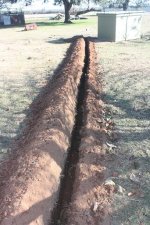
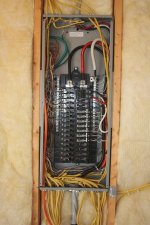
Thought I would throw in a few pictures to make it official. Added one for the electrical crowd also.
 

Attachments

  • IMG_0991.JPG
    IMG_0991.JPG
    70.6 KB · Views: 194
  • IMG_0992.JPG
    IMG_0992.JPG
    70.7 KB · Views: 185
  • IMG_0993.JPG
    IMG_0993.JPG
    62.7 KB · Views: 190
  • IMG_0932a.jpg
    IMG_0932a.jpg
    68 KB · Views: 175
/ Water supply from well to the house #23  
1" pvc is too small--1-1/4 or 1-1/2" is what you want.
Bury it at least 18" deep
If you're not running electric service in the same trench, then lay an insulated copper wire, 6ga or so, in the trench next to the water line and leave one end of the wire exposed above ground. That way you can locate that plastic line with an electric oscillator and simple detection equipment if you ever need to fix a problem.
If the well casing is steel, there should be ground wire back to the service entrance main switch or panel...
 
/ Water supply from well to the house #24  
If the well casing is steel, there should be ground wire back to the service entrance main switch or panel...

I know they use the water pipes to ground the system when you have city water. If you have plastic is it necessary to run wire back to the casing or can you just use a ground stake pounded into the ground? I THINK that's what my house has but can't swear to it.
 
/ Water supply from well to the house #25  
I know they use the water pipes to ground the system when you have city water. If you have plastic is it necessary to run wire back to the casing or can you just use a ground stake pounded into the ground? I THINK that's what my house has but can't swear to it.

Codes vary from place to place. It's best to get a trusted local answer to a question like that.
 
/ Water supply from well to the house #26  
This is what I did 10 years ago. I ran 3 pipes in the trench from the well to the house. The first is the pipe from the well pump to the tank, the second has 2 sets of electrical wires (1 set connected and the 2nd a spare set), and the third is a spare water line. My thinking is if I have a problem with either the well line or electric I can just connect the spare without digging. The first house we built I ran a single pipe and the electric wiring inside of 4" schedule 10 pipe (the thinking being I could pull new pipe or wire if need be. Hope this helps, Bill C
 
/ Water supply from well to the house
  • Thread Starter
#27  
The well is already fed power from an old house meter just opposite the new house. I do think I'll go ahead and lay a conduit for power if I decide to feed it off of my house when I tear down the old house. Either that or I will just have a meter at the pump house.

The new house will have automatic generator back-up so that would beat hauling the portable to the well after a hurricane and keeping gasoline in it. I would need a bigger home generator, though. Oh well, something else to think about.

Thanks again to all for sharing your perspective and knowledge.
 
/ Water supply from well to the house #28  
1" sch 40 PVC with belled ends. Use good quality glue and primer, you'll never have another problem.

Black poly pipe is terrible, I can't believe anybody would use that stuff for their main plumbing line. Dig up enough with splits and leaks and you'll see.

1" will be fine for what you're doing.
 
/ Water supply from well to the house #29  
The new house will have automatic generator back-up so that would beat hauling the portable to the well after a hurricane and keeping gasoline in it. I would need a bigger home generator, though. Oh well, something else to think about.

In emergency situations you do not have to run your well pump very often. Run the generator for 20-30 minutes or less to fill the pressure tank, and it can be a few days before you need to run the generator again if you practice a bit of water conservation.

Going down to the pump house and running the generator for a short while a few times a week beats the heck out of running the generator continuously.

For me, at least, the purpose of backup power is to preserve a reasonably comfortable life for a few days until normal power is restored, not to live without any changes at all.
 
/ Water supply from well to the house
  • Thread Starter
#30  


In emergency situations you do not have to run your well pump very often. Run the generator for 20-30 minutes or less to fill the pressure tank, and it can be a few days before you need to run the generator again if you practice a bit of water conservation.

Going down to the pump house and running the generator for a short while a few times a week beats the heck out of running the generator continuously.

For me, at least, the purpose of backup power is to preserve a reasonably comfortable life for a few days until normal power is restored, not to live without any changes at all.


I couldn't agree more if the well was only supplying the house, but this well also supplies water for livestock. After a few days without power I started thinking about the benefits of a direct-feed backup for the well. Three weeks without power and I was sold.

Totally agree with you on the purpose of backup power.
 
/ Water supply from well to the house
  • Thread Starter
#31  
1" sch 40 PVC with belled ends. Use good quality glue and primer, you'll never have another problem.

Black poly pipe is terrible, I can't believe anybody would use that stuff for their main plumbing line. Dig up enough with splits and leaks and you'll see.

1" will be fine for what you're doing.


I was told to stay away from the black poly also but after reading a couple of the replies here it seems that it has worked well for some. It looks like using the 200psi or better may be the key.

I am more comfortable with the sch 40 since most of my plumbing work has been with pvc. But again, I do like the idea of one continuous piece of pipe.

I'm going by Ace this afternoon to see what most people are using around here now.
 
/ Water supply from well to the house #32  
I use PVC for a living. Though it is true, it comes in sections that have to be glued together, that has never been a problem.

If you have an irrigation supply in your area, they should carry sch 40 PVC in 20' lengths with bells. These glue up nicely and don't need additional couplings.

Keep in mind that 1" sch 40 moves about 15 gals per minute. If you want more flow for that longer distance, you might consider 1-1/4" or 1-1/2" pipe. (again, an irrigation supply should have the 1-1/4" pipe and fittings - though most HD and Lowe's do not)

The fittings that glue on at both ends will be standard pipe thread so you can hook up to whatever is there.

I would agree with the post that said to put a check valve at the house. I would also put a shut-off. These two items could save a water heater element if the water fails for some reason by not allowing the water to drain from the house. I would also put pipe insulation on the exposed pipes.

BTW - I have nearly 1000' of water main supplying 3 houses on our land. The pump is 400' from my house and 600' from my brother's house. We have buried 1-1/2" PVC that has been down there for 30+ years and NO PROBLEMS. Just make sure to use cleaner and do not skimp on the glue.

Ours is buried about 2-3 feet deep.

Hope this helps.
 
/ Water supply from well to the house #33  
The new house is coming along nicely and I'm about ready to run the water supply line from my well to it, about 150 feet. I have been planning on using 1" pvc buried about 8-10 inches since there is no frost line to worry about. Does anyone recommend using anything other than pvc these days? I've heard from several people to stay away from the black flexible piping (can't think of the name).
Any other ideas/advice you may want to throw in on this will be appreciated.
You did not mention the size of your casing at the wellhead. I am sure it's not an issue but if you're going to use 1 1/4 supply line to the house, the wellhead casing should be at least that. On newer wells, I am sure this would not be an issue but I am using an 80 year old well that I reopened. It originally had 1 1/4'' gav'd casing the was a little rusty and I didn't trust it.

Wound up running schd 40 3/4'' pvc down the old casing with a foot valve. So, that limited me to a 3/4' supply line to the house since I can't push out more than I'm pumping in. The water pressure and volume tho is real good.

Someone mentioned a check valve at the house, I hadn't thought of that but it's an excellent idea. Gonna have to do that myself
 
/ Water supply from well to the house #34  
If you're getting a whole house generator you should be able to pick up the well without a problem. My well pump is 220v, 480 feet down, and I run it and the rest of my house with a 6500/8000 watt portable. Any whole house generator is probably going to be a minimum of 10,000 watts. The pump is only a big draw on start up, then it levels out a bit.

Re pipe size - what size is the pipe from the pump? Going a little bigger may help a LITTLE by reducing friction loss, but your limiting factor is going to be the pipe size from the pump and the pump output. 1 1/4 even seems like a pretty large pipe for a supply line. Of course bigger won't hurt anything, just cost a little more and not increase flow above the most limiting factor which is the pump capacity and pipe coming out of the pump. I just had my well casing replaced and I think they uses 1 inch pvc with brass screw connections at the joints but this was the actual well line, not the horizontal run to the house.
 
/ Water supply from well to the house #35  
i used 200# x 1 1/2" black buried between 6' -8' (frost)

i buried the tech cable about 2' above that.

i wouldn't go with less than 1 1/2", also, i wish now that i had also included some cat5 cable along side the tech. with the emergence of cat6, the cat5 is getting pretty cheap, and imho is a much better solution than wireless as far as video monitoring goes. i don't see any good reason not to have internet access in most if not all buildings on the property. my wellhouse is perfectly situated and provides a good place to mount cameras to monitor/photograph deer, bears, racoons, and owls grabbing rodents... as well as any two legged rodents that may venture where they shouldn't.

i guess the only thing better than a private grid that includes all of my infrastructure would be to have wind/water generation capacity of my own, able to feed my independent grid on a permanent basis.:)

btw, i think the notion of enron style bankrupting of people via electricity costs is not nearly as much a thing of the past as a lot of people seem to believe.
 
/ Water supply from well to the house
  • Thread Starter
#36  
It's a 4" well with 1 1/2" supply line that I'll connect to. It has a submersible 2hp pump about 135 ft down. Best I recall its capacity is about 27gpm.

I'll definitely have a check valve and shut-off at the house.
 
/ Water supply from well to the house #37  
You're good to go! I hope you enjoy your new house, that is always a special time!
 
/ Water supply from well to the house #38  
One other thought about burying your line. This is something I wish we had done when we put ours in. But then, 30 years ago I did not know then what I know now :)

You should think about burying a single run of insulated direct burial wire, a small gage is just fine (again, an irrigation supply would have this). When you bury it, leave a couple feet exposed at the well end and the house end.

What is this for? You may think you will remember just where the line is buried, but several years from now when things have grown in, it will be much more difficult to locate. With the wire running with the pipe, you can use a locator to find the path in the ground whenever you need to. (of course you will need someone with a locator to do this.)

Someone with the city or an irrigation company should have a locator. You may also be able to rent one, they are not that hard to use and they are quite accurate when operated properly. (you don't really want to buy one unless you really need one, they run $600 and up)
 
/ Water supply from well to the house #39  
If you haven't put a locator wire alongside the pipe, and need to find it, you may be able to insert an electrician's "fish tape" into the exposed end of the pipe and push it down the pipe.

Just as long as you don't have any ells or tees, you can push this stiff steel "wire" about 150' into a pipe. Use it to carry the locator signal. About $40 at Harbor Freight.

Just use a different fish tape for fresh water vs. sewer.
 
/ Water supply from well to the house #40  
If you haven't put a locator wire alongside the pipe, and need to find it, you may be able to insert an electrician's "fish tape" into the exposed end of the pipe and push it down the pipe.
A fish tape will work with a locator, but why not just use divining rods ????
 

Marketplace Items

UNUSED PAIR OF MINI RUBBER TRACKS (A52706)
UNUSED PAIR OF...
WOOD GRABBER FOR MINI EXCAVATOR (A58214)
WOOD GRABBER FOR...
2004 FORD F-350 SUPER DUTY (INOPERABLE) (A58214)
2004 FORD F-350...
UNUSED FUTURE FT-RR78 - 78" HYD ROCK RAKE (A52706)
UNUSED FUTURE...
2014 Timpte Hopper Bottom (A61307)
2014 Timpte Hopper...
2015 Ford F-350 4x4 Ext. Cab Pickup Truck (A59230)
2015 Ford F-350...
 
Top