Slopes and tractor tilt

   / Slopes and tractor tilt #121  
I was grinding some stumps for someone last week and at one point this thread came to mind.
I wasn't having a close call, but it just occurred to me that I was on compound slopes, I had a bucket on the front, I was in a very a "dippy" area and my mind was much more on what I was doing (lining up for the next stump) and where I was going. My mind was NOT on C of G and slope angles.

For MOST of this thread I have been thinking about mowing across a simple single plane, NOT backing around the sort of complex curves of the "dippy" area that I was working in with its stumps, surface roots and soft fill spots that I was in the process of creating.

It ain't text book geometry and applied math - well, it is, but the number of variables is LARGE and their values are essentially UNKNOWN ! so Ya just can't do the arithmetic.

It IS about watching where you are going (sometimes backwards and attempting precision), about feeling unstable and anticipating whether it will become more or less stable as you continue.

IOW it is a QUALitative thing more than a QUANTitative thing.
We probably DO the math, but it is a hugely analogue computation, not numeric.

BTW, diesel exhaust and 2 stroke chain saw exhaust does NOT chase away New Hampshire bugs (-:
 
   / Slopes and tractor tilt #122  
I have been reading different posts about slopes, stability and rollover for about 8 weeks now and have decided to experiment with my new tractor slashing on some steep slopes with FEL on front and 5t slasher (Brush Hog) on rear

First I have had it on narrowest setting and no loaded tyres; The tractor has been surprisingly much more stable than I expected. Even carrying bucket full of rock across slopes (slowly)

I then widened the rear tyres out and took it up same slopes. It has felt a little more stable but not as much as I expected.

Next I am going to load the rear tyres and and see if another 900lb (on top of the 650lb slasher at rear and 800lb or so Fel at front) really makes a significant difference.

What I still do not fully understand is that when you fully load tyres, half the weight is always above the axle and the COG.

Wouldn't it be better to half fill them and keep the weight below the axle.

I have been climbing and slashing these slopes for 15 years with fully loaded tyres but now have my doubts.

What I do know is to trust my backside.
 
   / Slopes and tractor tilt #123  
I have been reading different posts about slopes, stability and rollover for about 8 weeks now and have decided to experiment with my new tractor slashing on some steep slopes with FEL on front and 5t slasher (Brush Hog) on rear

First I have had it on narrowest setting and no loaded tyres; The tractor has been surprisingly much more stable than I expected. Even carrying bucket full of rock across slopes (slowly)

I then widened the rear tyres out and took it up same slopes. It has felt a little more stable but not as much as I expected.

Next I am going to load the rear tyres and and see if another 900lb (on top of the 650lb slasher at rear and 800lb or so Fel at front) really makes a significant difference.

What I still do not fully understand is that when you fully load tyres, half the weight is always above the axle and the COG.

Wouldn't it be better to half fill them and keep the weight below the axle.

I have been climbing and slashing these slopes for 15 years with fully loaded tyres but now have my doubts.

What I do know is to trust my backside.

As long as the C of G is high (and it is always ABOVE the axle center-line) adding ballast below it will lower it.
Yes, even adding ballast ABOVE the axle center-line, since that line is below (WELL below) the C of G.

Of course, adding ballast above the C of G will raise the C of G, but we would always try to not do that.
 
   / Slopes and tractor tilt #124  
As long as the C of G is high (and it is always ABOVE the axle center-line) adding ballast below it will lower it.
Yes, even adding ballast ABOVE the axle center-line, since that line is below (WELL below) the C of G.

Of course, adding ballast above the C of G will raise the C of G, but we would always try to not do that.

So where, generally speaking, would the COG line be on a CUT if it isn't the rear axle?
 
   / Slopes and tractor tilt #125  
So where, generally speaking, would the COG line be on a CUT if it isn't the rear axle?

It has to be higher. I see air below my axle and engine above - it's higher.

Loading the tires isn't just about raising or lowering cg, it's about adding weight far away from the rollover axis. When (if?) you roll, you're rolling about an axis that goes from the ground contact point of the downhill tire to the front axle pivot point. The loaded uphill tire is added weight about as far away from that axis as you can get - it raises your moment of inertia about that axis and makes it harder to roll. The downhill tire is very close to the axis and the weight doesn't affect the MoI much.

Try this thought experiment - park sideways on a slope. Think about rolling the tractor by lifting the uphill rear tire. Now fill both tires, to any level you want. Now think about lifting the uphill tire again. It just got harder, didn't it? Just because some of that liquid is above the axle doesn't mean it can't help prevent rollovers.
 
   / Slopes and tractor tilt #126  
So where, generally speaking, would the COG line be on a CUT if it isn't the rear axle?

Well,,,, above that (-:
There is a lot of STUFF above that center line, just about all the tractor is built above there.
At least in THEORY you could add mass below the axle center line, e.g. some sort of belly tanks or big slabs of lead hung underneath, but just about anything like that would reduce ground clearance, which is generally not a good thing.
It is true that more than 1/2 the fluid ballast in tires is below that line.

One theme here has been the loader and its sub frame have their centers of mass above the axle center line - and in all probability above the base tractor's center of mass, hence adding the loader raises the total mass and raises the center of gravity(/mass).

Think of this kinda/sorta like averages; anything added that is above the existing average will raise the average to a new average - anything below when added will lower the average.
In this case we are just totaling the weights and averaging their (weight times distance)s from the ground up.
(From the low side tire's contact point up.)

Fluid tire ballast in tires is not only LOW it is also about as far OUT from the tractor's front/rear center line as practical.
 
Last edited:
   / Slopes and tractor tilt #127  
Well,,,, above that (-:
There is a lot of STUFF above that center line, just about all the tractor is built above there.
At least in THEORY you could add mass below the axle center line, e.g. some sort of belly tanks or big slabs of lead hung underneath, but just about anything like that would reduce ground clearance, which is generally not a good thing.
It is true that more than 1/2 the fluid ballast in tires is below that line.

One theme here has been the loader and its sub frame have their centers of mass above the axle center line - and in all probability above the base tractor's center of mass, hence adding the loader raises the total mass and raises the center of gravity(/mass).

Think of this kinda/sorta like averages; anything added that is above the existing average will raise the average to a new average - anything below when added will lower the average.
In this case we are just totaling the weights and averaging their (weight times distance)s from the ground up.
(From the low side tire's contact point up.)

Fluid tire ballast in tires is not only LOW it is also about as far OUT from the tractor's front/rear center line as practical.

Thanks to Reg and North Country for providing me with the engineering explanations I've been after.

Just a final question: if the mass of the fel increases the COG of the tractor wouldn't a 650lb brush hog at the rear and carried 3" off the ground counteract the fel mass and lower the COG.

To me, my tractor feels nicely balanced and stable with both implements always on. I travel slow and am constantly adjusting height of both implements according to degree of incline I am traversing.
 
   / Slopes and tractor tilt #128  
Just a final question: if the mass of the fel increases the COG of the tractor wouldn't a 650lb brush hog at the rear and carried 3" off the ground counteract the fel mass and lower the COG.

More importantly, it moves it to the rear.

I think the most important point about FELs that most people miss is not how high or low it moves the cg - it's how far forward it moves the cg. Remember - you're driving a triangle. Your 3 points are the two rear tires and your front axle pivot. Putting that FEL on - and even worse, adding weight in the bucket - moves the cg forward towards the narrow "tippy" part of the triangle. Adding a rear mower moves it back towards the wider, stable part of the tractor.

If you mention "center of gravity" and "front end loader" in the same sentence, you should also mention "forward." If you're only talking about "higher" or "lower", you're missing the biggest reason* that a FEL makes a tractor more likely to roll.

It's a nice day - time to get outside and get a few sidehill pictures.


* I'm assuming that the operator is carrying the bucket low to the ground. Obviously, raising the bucket raises the CG significantly.
 
   / Slopes and tractor tilt #129  
Thanks to Reg and North Country for providing me with the engineering explanations I've been after.

Just a final question: if the mass of the fel increases the COG of the tractor wouldn't a 650lb brush hog at the rear and carried 3" off the ground counteract the fel mass and lower the COG.

To me, my tractor feels nicely balanced and stable with both implements always on. I travel slow and am constantly adjusting height of both implements according to degree of incline I am traversing.

Yes it would lower the CofG. As far as counteracting the weight of the FEL...depends.
The problem with the cutter on a slope is that it also has a tendency to move downslope (that tail wheel) and can make the tractor unstable too.
There's another current thread in which it seems the cutter may have caused the tractor (a Kubota BX series) to start a roll.

If you've ever felt that sudden lurch when the cutter tail wheel rolls a bit to the side, you'll know what I mean by instability.

The math and the theory make for nice and interesting discussions, but too often they don't really apply in a real word scenario as they don't take in account uneven topography and other variables (such as how much your cutter moves side to side (due to the uneven ground) as you traverse the slope.

North Country: Pretty day here in PA. I should get those pictures posted by this evening.
 
   / Slopes and tractor tilt #130  
Thanks to Reg and North Country for providing me with the engineering explanations I've been after.

Just a final question: if the mass of the fel increases the COG of the tractor wouldn't a 650lb brush hog at the rear and carried 3" off the ground counteract the fel mass and lower the COG.

To me, my tractor feels nicely balanced and stable with both implements always on. I travel slow and am constantly adjusting height of both implements according to degree of incline I am traversing.
A bushog does a real good job of partially or near fully counteracting the effect of the FEL as you say. Keeping it low [tailwheel just skimming] and well controlled so that it stays on tractor centerline are paramount. A bushog that can move very much off center can be pretty major in destabilizing a small tractor on a slope.

More importantly, it moves it to the rear.

I think the most important point about FELs that most people miss is not how high or low it moves the cg - it's how far forward it moves the cg. Remember - you're driving a triangle. Your 3 points are the two rear tires and your front axle pivot. Putting that FEL on - and even worse, adding weight in the bucket - moves the cg forward towards the narrow "tippy" part of the triangle. Adding a rear mower moves it back towards the wider, stable part of the tractor. ... :thumbsup:

If you mention "center of gravity" and "front end loader" in the same sentence, you should also mention "forward." If you're only talking about "higher" or "lower", you're missing the biggest reason* that a FEL makes a tractor more likely to roll. ... :thumbsup:

It's a nice day - time to get outside and get a few sidehill pictures.

* I'm assuming that the operator is carrying the bucket low to the ground. Obviously, raising the bucket raises the CG significantly.
Good asterisk.

I have heard that ballpark CG height is 10" below the seat ... we know that its forward of the rear axle as well ... and this, in particular, changes in composite with addition of end effectors/implements.
larry
 
   / Slopes and tractor tilt #131  
More importantly, it moves it to the rear.

I think the most important point about FELs that most people miss is not how high or low it moves the cg - it's how far forward it moves the cg. Remember - you're driving a triangle. Your 3 points are the two rear tires and your front axle pivot. Putting that FEL on - and even worse, adding weight in the bucket - moves the cg forward towards the narrow "tippy" part of the triangle. Adding a rear mower moves it back towards the wider, stable part of the tractor.

If you mention "center of gravity" and "front end loader" in the same sentence, you should also mention "forward." If you're only talking about "higher" or "lower", you're missing the biggest reason* that a FEL makes a tractor more likely to roll.

It's a nice day - time to get outside and get a few sidehill pictures.


* I'm assuming that the operator is carrying the bucket low to the ground. Obviously, raising the bucket raises the CG significantly.

Yahh but...
If you are including "triangle" you should include "rectangle", for when the bucket is EMERGENCY dropped (-:

Now, if you have several hundred pounds on the 3pt and it is LOW to the ground, but things are still getting tippy - you gotta SERIOUS PROBLEM happening.
I still want that 4 point landing and to get it I will take the pivoting front axle out of the equation.
 
   / Slopes and tractor tilt #132  
Yahh but...
If you are including "triangle" you should include "rectangle", for when the bucket is EMERGENCY dropped (-:

Now, if you have several hundred pounds on the 3pt and it is LOW to the ground, but things are still getting tippy - you gotta SERIOUS PROBLEM happening.
I still want that 4 point landing and to get it I will take the pivoting front axle out of the equation.

There's only so much you can do...and you already wrote two of them (bucket low and moving slow).
If your tractor has a ROPS, keep that seatbelt nice and tight and keep off that slope if it's the least bit wet.
That's about it, really...

Spyderlk wrote to have the tail wheel just skimming. I prefer to have it solidly on the ground and bearing part of the cutter's weight.
No matter what you do or how tight you adjust the anti-sway links, you'll still have some lateral movement of the cutter moving the rear of the tractor about. That's not theory and in all likelihood, you've already experienced that sway.
Going slow reduces the effect of the cutter sway. Worst thing I could imagine is getting into a "tail wagging the dog" situation.

Fortunately, the area I brush cut is very moderately sloped, but is very uneven (ruts and rises). I could definitely feel the effect the cutter was having on the rear of the tractor even with the tailwheel bearing some of the weight.

As far as the slopes North Country and I have written about...mine's on finished lawn and I'll have an RFM on the 3PH. As you know, RFM's aren't near as long as a cutter, so any sway is reduced (shorter "lever") plus there are 4 wheels on the ground rather then one.

BTW, this was brought up on an earlier post...if you haven't viewed those rollover vids in the Safety forum, they're definitely worth viewing:
http://www.tractorbynet.com/forums/safety/116448-tractor-rollover-demo-pictures-videos.html

(Edit: Unfortunately, it appear those videos are no longer linked. Shame...they were quite enlightening.)
 
Last edited:
   / Slopes and tractor tilt #133  
Yahh but...
If you are including "triangle" you should include "rectangle", for when the bucket is EMERGENCY dropped (-:

Now, if you have several hundred pounds on the 3pt and it is LOW to the ground, but things are still getting tippy - you gotta SERIOUS PROBLEM happening.
I still want that 4 point landing and to get it I will take the pivoting front axle out of the equation.

Of course. I think one of the earlier questions was about putting the FEL on when mowing - I thought they were talking about a MMM. Adding a FEL to a tractor with a MMM is adding instability.
 
   / Slopes and tractor tilt #134  
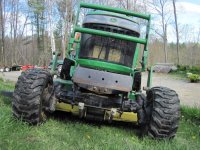
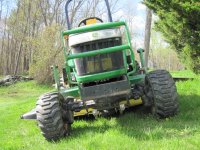
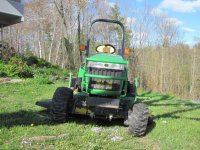
Pictures! I tried to hold the camera level, but you can see by the tree trunks in the background I tended to tilt it to make the slope look *less* than actual.

#1 is a 12 degree slope I have to drive any time I want to use the tractor.

#2 is an 18 degree slope. This is about where I start to "feel it" in the seat. I cross this regularly, but really get puckered with any load.

#3 is crossing a root I hate. I go over this very slowly with any load. The front axle is on the root and is pivoted away from it.

#4 is crossing the same root - the rear axle is on the root, and the front axle is pivoted the opposite direction.

Unless the ground is uneven, it doesn't look to me like the front axle pivots.
 

Attachments

  • IMG_0249.1024x768.jpg
    IMG_0249.1024x768.jpg
    756.4 KB · Views: 289
  • IMG_0251.1024x768.jpg
    IMG_0251.1024x768.jpg
    859.8 KB · Views: 264
  • IMG_0253.1024x768.jpg
    IMG_0253.1024x768.jpg
    887.3 KB · Views: 241
  • IMG_0254.1024x768.jpg
    IMG_0254.1024x768.jpg
    916.8 KB · Views: 257
   / Slopes and tractor tilt #135  
Of course. I think one of the earlier questions was about putting the FEL on when mowing - I thought they were talking about a MMM. Adding a FEL to a tractor with a MMM is adding instability.

North Country, how'd you make out with your pics?

Mine (taken with my cell phone) aren't viewable..too much contrast.
The 4400 is still outside as I have another task tomorrow so I'll try with my digital cam. A beautiful sunny day for mowing, but works against me for taking pictures under the tractor. I took the pics mid afternoon. A morning shot might work (I won't be shooting into the sun).
Anyway, the front axle stops are indented sections of the frame rails (don't try to visualize it...).
Although I could see a noticable angle between the front axle and frame rails, the front axle did not pivot to it's limits (that's the rear axle rigidity coming in to play). Not enough of a slope on my property, or at least where I'm willing to go...to get it to it's limits.

(EDITED: You must have been adding your pics as I was typing my post)
The sentence I bolded is most pertinent. My 4400 did lean...however, my ground is uneven. To me, that should be part of the test since flat ground isn't too common unless it's a golf course green.
Mine, on the slope, appears to be most comparable to your 4th pic (but no root...just the ground). I also notice that the 4400 is quite a bit taller then your 2305...more weight higher up. I also have my loader installed (sans bucket).
Anyway, my (crappy) pics were showing the axle position to the frame rails (basically, under the tractor). I'll take pictures similar to yours (from the front).
 
Last edited:
   / Slopes and tractor tilt #136  
I do like the 2305 for the low profile. It's quite a bit more stable than the others in the 2x20 series, and that's the primary reason it was my choice. The 3x20 and 4x00 were just too big for me. I have a fair amount of acreage but not much of it is maintained.

Uneven ground will make the front axle pivot. It's what it's there for. I tried to find some even ground for the non-pivoting front axle pics.

There's one other way you can get a pivoting front axle on even ground - look at the pics of these tires. Not too hard to guess which is uphill and which is downhill. This was on a 20 degree slope. The uphill tire barely has any tread grip at all.

On a related note, I was at a garden center watching a young guy load bulk compost into my truck the other day. He was using a older 4WD with a 1/2 yard FEL and NO rear ballast. What was amazing is that all the deep tracks in the muck were FRONT tire tracks - the rears were barely touching the ground at all. That's a rollover waiting to happen!
 
   / Slopes and tractor tilt #137  
OK, speaking from experience, which I will relate below, I will always have the FEL attached and don't hesitate to put stuff in it that I need to relocate.

Was planting native grass seeds on a dirt tank, going up and down the slope (not sideways) and turning around on the top of the tank to head back down. FEL inches off the ground(maybe 3 inches), loaded with about 300 lbs of rock.

A moment of inattention and I found myself doing a U turn a moment too late on the top of the dirt tank.... right front wheel went just a tad further down the opposite slope than on previous turns and in a flash the left rear loaded wheel was off the ground. I dropped the FEL further and stopped to survey the situation.

Turns out that the FEL was dug into the ground (the round part, not the teeth) and because of this it actually PREVENTED my rolling over. It provided a point of ground contact further in front of the tractor than the front wheel and with some DOWN FORCE. Thus, it PREVENTED the rear wheel from rising further, thus dramatically raising the COG and preventing allowing/initiating roll over.

Think about it.. for a rear wheel to rise, the tractor footprint rectangle must dip down on the opposing corner. A FEL out there extends that rectangle footprint beyond the front wheel. If close to the ground and dropped/driven into the ground when a roll starts, then it MUST assist in preventing the further rear tire elevation.

I was in 4wd low range, thus going very slow and momentum was not an issue, just balance.

I got out of it by strapping the tractor to my F350 to prevent actual roll over, getting additional help (my son), then SLOWLY turning front wheels downhill while AT THE SAME TIME keeping FEL in strong ground contact with hydraulic down force to maintain some modicum of stability. Ground was loose, thus slid under the FEL just enough...didn't "catch"....I also left the Brillion grass seeder pin hitch attached to the tractor...providing backdrag and some down force on the tow hitch.

Net, my experience leads me to conclude that in my case, with my tractor, in this instance, with me driving and taking the actions described, THE FEL PREVENTED A ROLL OVER.

I will tell you that I had to struggle mightily to dismount the tractor on the uphill side when the tractor was stopped. I have a cab. I truly don't believe there is any way I could have bailed out uphill from a moving non cab tractor. I would consider that move to be a suicide mission in the case I described.

Yes, my experience goes counter to what many have posted here. All I can tell you is that in my case, I WOULD have rolled over except for the FEL and the way I applied it when things went downhill (literally) very fast! Trust me, you DON'T have 1 to 2 actual seconds to take action. True time frame is about .5 second.

With my first hand experience, I will continue to keep FEL on and extremely low whenever I am on uncertain ground. You may decide that you wish to take a different approach.

Stay safe out there!
 
   / Slopes and tractor tilt #139  
I do like the 2305 for the low profile. It's quite a bit more stable than the others in the 2x20 series, and that's the primary reason it was my choice.

The 2305 also appears to have a wider (front axle) track relative to the height of the tractor's hood, although that might just be perspective (you apparently crouched down in front of the tractor).

My 4400's front axle track doesn't appear to be as wide (relative to the top of the hood).
 
   / Slopes and tractor tilt #140  
The FEL both caused you to start the roll and stopped it once it started. 300lbs of rock in the bucket moves the cg way out towards the skinny end of the triangle.
 

Tractor & Equipment Auctions

TANK MANIFOLD (A58214)
2004 MACK CV713 MIXER TRUCK (A55745)
2004 MACK CV713...
Honda EM3500S Portable Gasoline Generator (A59228)
Honda EM3500S...
International S1900 (A56438)
International...
2012 GENIE Z-45/25J ELECTRIC BOOM LIFT (A60429)
2012 GENIE...
2019 CHEVROLET SILVERADO 1500 CREW CAB TRUCK (A59823)
2019 CHEVROLET...
 
Top