You are using an out of date browser. It may not display this or other websites correctly.
You should upgrade or use an alternative browser.
You should upgrade or use an alternative browser.
question about using a disc
- Thread starter jr
- Start date
- Views: 5909
More options
Who Replied?
/ question about using a disc
#1
MMagis
Veteran Member
Sounds like you need a longer top link. To get mine to work the best, I set the top link so the rear disks are no more than 8" above the ground when I pick it up completely. It looks funny, but that's what works.
Western
Super Member
There will always be more force on the front disc in the direction of travel, try moving in reverse for about a foot and you usually will see the back disc dig in more.
As MMagis said, you may need a longer top link. Also you may double check the 2 bottom pins and see if there is some adjustment there. My tractor has telescoping lift arms, so bringing them in towards the tractor gives my top link more "play".
The front usually will do 60% or more of the digging in my experience, The one I have now is a 3 pnt, I had a 16' tandem with hydraulic lift wheels that was pulled by the pull bar. Did a much better job, but the front always had a little more "bite".
As MMagis said, you may need a longer top link. Also you may double check the 2 bottom pins and see if there is some adjustment there. My tractor has telescoping lift arms, so bringing them in towards the tractor gives my top link more "play".
The front usually will do 60% or more of the digging in my experience, The one I have now is a 3 pnt, I had a 16' tandem with hydraulic lift wheels that was pulled by the pull bar. Did a much better job, but the front always had a little more "bite".

Pooh_Bear
Platinum Member
- Joined
- Jan 2, 2005
- Messages
- 763
- Tractor
- Early 1949 Ford 8N
On my 8N I shorten the top link to use the disk.
I like the back disks to be about two to three
inches higher than the front. This puts all the
weight on the front disks and makes it dig
in really good. And the back disks cut up
what was just plowed up.
I have a real heavy 3 point disk.
Pooh Bear
I like the back disks to be about two to three
inches higher than the front. This puts all the
weight on the front disks and makes it dig
in really good. And the back disks cut up
what was just plowed up.
I have a real heavy 3 point disk.
Pooh Bear

atgreene
Platinum Member
- Joined
- Aug 10, 2007
- Messages
- 868
- Location
- Sebago, Maine
- Tractor
- 2005 TB135 Excavator with Thumb, Quick Attach System, Ripper tooth, 3' Hydrauic Tilt Clean-up Bucket, Skeleton Bucket, 1986 Kubota 4150 with Loader and Quick Attach with Woods Forks, JD B, 1963 IH 504
The front disk should do all the cutting, the rear should do much less of the work. If you are forcing the rear gang down you are out of adjustment and are not tilling the soil the way the harrow is designed to. That, and you will break disks.
Briar Hill Brittanys
Gold Member
i have a 8n ford and i am using a disc to plow my food plots
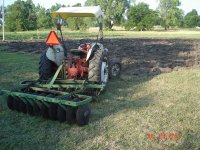
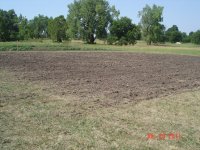
If your ground is like ours around here, it's mighty dry. The disc probably won't cut much or very deep. I plowed 2 days after 1.5" rain, disced the next day. Cut like butter, the wads and clods practically exploded. This was on sod that was sprayed with generic Round-up 2 weeks prior. Very little dust was kicked up. My disc is 1/2 of a JD KBA that's been channeled to about 6'. I can adjust the angles by pivoting one side of the 3 point to 3 different positions. Normally set so it's level front to back. When it's lifted, the front end is pretty light. Steering is done by brakes, mostly. You can see how good it worked the ground in the second picture. I was waiting for some rain to plow, and work up this plot. It's going to be another market patch for next year.
Attachments
MMagis
Veteran Member
The front disk should do all the cutting, the rear should do much less of the work. If you are forcing the rear gang down you are out of adjustment and are not tilling the soil the way the harrow is designed to. That, and you will break disks.
That simply is not true. If the front gangs are digging in and the rear are barely touching the dirt, it's not doing much good. A disk has to be set up to work properly whether it makes sense to you or not. I'm baffeled how you think having the rear gangs in the dirt will break disks? That's why they're there.

Farmwithjunk
Super Member
All but the really good 3-point disc's will tend to raise up in the rear as they try to rotate around the lower link pins.....It takes weight to hold 'em down. And there's the problem....Far too many "modern" 3-point disc's are just too light. The GOOD ones have enough built in weight to operate balanced front and rear. A well designed mounted disc will do an outstanding job. (provided the operator knows what he's doing....  )
)
A disc shares one characteristic with a plow....To do their job CORRECTLY, they need to run fairly level (front to rear)
Front gangs do the initial cut, rear gangs SHOULD cut too. Rear gangs are (should be) set a little less aggressive. The rear does the leveling. Having the FRONT gang set too aggressive will compound the problem where the disc tries to rotate around lower pins. (put top link in compression) Try setting front gang a notch LESS aggressive and see what becomes of that. (Provided yours has the adjustment capability to do so....)
) A disc shares one characteristic with a plow....To do their job CORRECTLY, they need to run fairly level (front to rear)
Front gangs do the initial cut, rear gangs SHOULD cut too. Rear gangs are (should be) set a little less aggressive. The rear does the leveling. Having the FRONT gang set too aggressive will compound the problem where the disc tries to rotate around lower pins. (put top link in compression) Try setting front gang a notch LESS aggressive and see what becomes of that. (Provided yours has the adjustment capability to do so....)

FredH
Platinum Member
I Agree with FWJ about the newer disk's needing weight . My KK 6.5' angle frame now has 5 100# weights on it . 4 on the front and 1 on the back with a piece of 4" x 10" "I" beam . Mine also cuts the Best when it is level front to back , that is , when it is just lifted barely above ground level . If I lift it all the way up , then obviously it is not level .
Disk type , Notched or smooth ? I won't go down that road , likely start another peeing match .
As Briar wrote , Moisture content in soil and soil type plays a huge roll in how the smaller disk's work .
Question : When You drop the disk all the way down and pull for say 50' , can you adjust or disconnect the top link or is it still tight . If no more adjustment can be made and it is still tight , then I would agree that you need a longer top link .
Fred H.
Disk type , Notched or smooth ? I won't go down that road , likely start another peeing match .
As Briar wrote , Moisture content in soil and soil type plays a huge roll in how the smaller disk's work .
Question : When You drop the disk all the way down and pull for say 50' , can you adjust or disconnect the top link or is it still tight . If no more adjustment can be made and it is still tight , then I would agree that you need a longer top link .
Fred H.

gwdixon
Elite Member
I agree with the folks that say the 3 PH disc should be level when being pulled.
The front gangs have a tendency to dig in and lift the rears just a bit so just a hair of compensation for that by lowering the rears an inch or two from level works for my application.
The lower pins on the 3PH are usually higher than the centerline of the disc's axles so the tractor is trying to pull the disc over. The top link prevents this. On a pull-type disc this is not an issue.
My experience is that if the rears are too high then you get a trenching effect since the rears (in a tandem setup) will not engage enough to throw the dirt back that the fronts have flipped out.
The front gangs have a tendency to dig in and lift the rears just a bit so just a hair of compensation for that by lowering the rears an inch or two from level works for my application.
The lower pins on the 3PH are usually higher than the centerline of the disc's axles so the tractor is trying to pull the disc over. The top link prevents this. On a pull-type disc this is not an issue.
My experience is that if the rears are too high then you get a trenching effect since the rears (in a tandem setup) will not engage enough to throw the dirt back that the fronts have flipped out.
jenkinsph
Super Star Member
I agree with the folks that say the 3 PH disc should be level when being pulled.
The front gangs have a tendency to dig in and lift the rears just a bit so just a hair of compensation for that by lowering the rears an inch or two from level works for my application.
The lower pins on the 3PH are usually higher than the centerline of the disc's axles so the tractor is trying to pull the disc over. The top link prevents this. On a pull-type disc this is not an issue.
My experience is that if the rears are too high then you get a trenching effect since the rears (in a tandem setup) will not engage enough to throw the dirt back that the fronts have flipped out.
^^^^^^ I agree with this 100%
jenkinsph
Super Star Member
A good disk should have enough built in weight in the structure that it will not need additional weight. Thicker blades, heavier spools, stronger frames are a better way to go than adding weights to a light disk.
Farmwithjunk
Super Member
Thicker blades, heavier spools, stronger frames are a better way to go than adding weights to a light disk.
Without a doubt....but....If you already have a disc that's just a bit too light, or certain conditions demand MORE weight, it sometimes becomes necessary to add a few more lbs.
The best 3-point disc I've ever had the pleasure of using is a model #25 Massey Ferguson. They had an optional "weight basket" where you could pile rocks, place a few suitcase weights, or whatever was heavy and laying around the barnyard. In all but the rarest of occasions, the #25 had PLENTY of weight without adding more. But it was nice to have provisions to add more. You don't ALWAYS need extra weight, and with any 3-point implements, too much weight can be a hinderence.
If you do not need to transport the disc over the road, I would recommend dumping the 3-point disc and getting a pull type. There is absolutely no comparison in effectiveness compared to a 3-point. The pull-type will almost always get the job done burning half or less the fuel. Most folks dont know this so you should have no trouble selling that near-useless 3-point disc on craigslist.
MMagis
Veteran Member
If you do not need to transport the disc over the road, I would recommend dumping the 3-point disc and getting a pull type. There is absolutely no comparison in effectiveness compared to a 3-point. The pull-type will almost always get the job done burning half or less the fuel. Most folks dont know this so you should have no trouble selling that near-useless 3-point disc on craigslist.
You just can't help yourself, can you.
Just so no one gets confused, this is absolutely false. wolc123 has been informed many times on multiple forums that his theories are completely wrong, but he continues to lead people astray. Nothing wrong with pull disks, but they absolutely do not do more work and use less fuel. He simply never understood how to properly set up a 3pt disk and refuses to admit it was his fault, not the equipments.
Farmwithjunk
Super Member
If you do not need to transport the disc over the road, I would recommend dumping the 3-point disc and getting a pull type. There is absolutely no comparison in effectiveness compared to a 3-point. The pull-type will almost always get the job done burning half or less the fuel. Most folks dont know this so you should have no trouble selling that near-useless 3-point disc on craigslist.
The idea that a drag type disc uses less fuel is a flippin JOKE. If you use less fuel, you're doing less work...That simple. Some whacko anecdotal "comparison" where you never really compared ANYTHING in a manner that would draw an ACCURATE conclusion doesn't prove squat. There's no comparison alright.....Using a clapped out, worn out antique piece of junk that works about 2" deep may impress you, but some of us actually like to do a good job when we do something.
If you like drag disc's, come here and load up a few. You'll find HUNDREDS of them sitting in fence rows around these parts. No one with a better alternative would consider using one. Too much trouble to load 'em up and haul 'em in for scrap. There's a long list of perfectly good reasons why no one has manufactured a new drag disc in 50 years.....
We used drag disc's way back when I was a youngin'. As soon as ANYTHING came along to allow us to park 'em, we did so. Way too slow and inefficient.... Gangs on a drag disc's tend to float up and down independently with every irregularity in the ground RATHER THAN leveling the seed bed like a rigid frame 3-point disc or a rigid frame transport disc will do. (and that cause and effect of using a drag disc is NOT a good thing if you know anything at all about preparing a seedbed) In order to get a field into decent shape to plant, they often required 4 or 5 trips over the field. When we got the first of our MF #25 disc's, that was cut to 1 or 2 trips....Saving a TON of fuel AND creating a MUCH better seed bed in the process.....So IN THE REAL WORLD, drag disc's result in the burning of substantially MORE fuel to get a seed bed to the same point.......and they waste a LOT of time. You should consider the FACT that NO ONE seems to agree with your ridiculous theory. The ONLY reason why anyone would use a drag disc over a good 3-point or wheel disc is they're cheaper....because there is virtually no demand for them, except for the folks at the smelter.
A nickel's worth of free advice....Give up on promoting your ridiculous theory. No one is buying it, and it destroys any shred of credability you may have in any other topic.
Last edited:
jenkinsph
Super Star Member
I prefer a pull type wheeled disk because it is usually can have more weight per blade and does a better job of leveling. I don't have one right now because I don't need it. I agree that the fuel consumption is based on the amount of work done and that the old drag disk which are easy to pull don't get much done.
I use tillers in my work because the spaces are generally small and tight quarters. But I should point out that tillers or disks will both do a similar job with similar fuel efficientcy for the same reason FWJ mentions. A disk may be slightly faster than a tiller but not by a wide margin for small plots.
I brought up tillers because the 3pt disk and tillers both share one problem and that is neither do as good a job of leveling as a good pull type disk with a rigid frame. For this reason I will generally till and area up and then run my landplane/grader with straight blades across it to level and smooth it out.
For large areas I would consider a chisel plow or ripper and pull type disks all of these need power to pull and diesel to get it done. This gets back to the fuel used is dependent on the amount of work done.
I use tillers in my work because the spaces are generally small and tight quarters. But I should point out that tillers or disks will both do a similar job with similar fuel efficientcy for the same reason FWJ mentions. A disk may be slightly faster than a tiller but not by a wide margin for small plots.
I brought up tillers because the 3pt disk and tillers both share one problem and that is neither do as good a job of leveling as a good pull type disk with a rigid frame. For this reason I will generally till and area up and then run my landplane/grader with straight blades across it to level and smooth it out.
For large areas I would consider a chisel plow or ripper and pull type disks all of these need power to pull and diesel to get it done. This gets back to the fuel used is dependent on the amount of work done.
MMagis
Veteran Member
Actually, I can get a perfectly smooth field with my 3pt disk, if it's set properly. I struggled for a long time, pulling drags and such, trying to get things smoothed out. Once I figured out how my disk needed set up, everything is perfectly smooth.I brought up tillers because the 3pt disk and tillers both share one problem and that is neither do as good a job of leveling as a good pull type disk with a rigid frame. For this reason I will generally till and area up and then run my landplane/grader with straight blades across it to level and smooth it out.
Farmwithjunk
Super Member
One of the perks of being a "horse trader" with regards to implements has been I got to try all sorts of "stuff" over the years. Enough so that I try NOT to lump ALL 3-point disc's, all wheel type disc's, ect, into the same catagories. All men may be created equal, but all disc's arent.....
With wheel disc's, it's my humble opinion that International Harvester knew something John Deere didn't (as an example) IH made several models from the mid 50's on through the late 80's that simply did a better job of stirring dirt and leaving it level. (Models #35/350, 37/370, 45/450/47/470/480/490) I had a few different models of Deere disc's that could take a nice level seed bed and wreck it. (RWA, KBA) For my buck, NO ONE built a wheel disc that was as capable as what IH produced, even to this day.
Same applies to 3-point disc's. And it doesn't take me long to point out that THE BEST mounted disc I've ever used is that MF #25 like the one I still use to this day. The WORST was a Birch brand I had back in the late 70's. It was an attemt to hang the workings of a drag disc under a 3-point mounted frame. Every clod in the field made the gangs rise and fall, leaving a roller coaster effect of a surface. Disc's of ANY sort will do a much better job of leveling with a RIGID FRAME. That concept SHOULD be easy for anyone to understand. (Obviously it isn't for some people....)
This is why I preface terms like "3-point disc" and "wheel disc/transport disc" with the word GOOD......When I'm making generalizations, I'm USUALLY talking about the good models/brands rather than ALL of one or the other.
THAT SAID, I've managed to make my "laundry list" of each type that is capable of doing a good job of building a seed bed. The ones that DON'T make my list, I tend to disregard the fact they ever existed....
And I also tend to think there is a "Darwinian theory" as far as farm equipment goes.....Many types of equipment simply fell into obscurity FOR A GOOD REASON (or reasonS) Drag disc's fit that catagory. They disappeared from manufacturers product lists around 50 years ago based on the FACT there are better choices. (ie, GOOD 3-point and GOOD wheel disc's...)
And now the part that some people will question, and those who understand WON'T question.....Discing is like so many chores we do in life. There's a LOT more to it than what meets the eye. Some people are just better at it than others. They can almost "read the dirt" and make certain adjustments or changes in technique as they go across a field to net better results. It's ALMOST a "black art"....And experience plays a HUGE part. Discing hundreds, if not thousands of acres over a lifetime helps with filling the "data bank". Growing up with a father who'd send me back out to the field to do it all over again if there was the SLIGHTEST problem (in his eyes) is another "learning tool"....
All that boils down to this end result....Some disc's are better than others, some operators are better at discing than others, some disc's put you at a disadvantage, and some people couldn't take ANY disc and do a decent job on a consistant basis.
Disc's are "old school"....They can (and usually do) cause a compaction layer similar to a plow. One of the WORST things you can do to soil is disc in wet conditions. (I wrote a paper on that subject while working on my soil science degree) Disc's have fallen out of favor as a primary OR secondary tillage tool on MOST modern farms. There are far better "tools" to work soil, releive compaction, level and prep a seed bed. Tillers are for the most part very IMpractical for doing so on a large scale. But....Disc's are still very popular for the low tech smaller farmers, food plotters, and a host of other end users.
Cost of implements, and limitations caused by size of tractors makes certain sizes and weights of disc's more popular than others....But there are still choices that fit budgets and fit small tractors that will get the job done and get it done RIGHT. (I never considered any job as done until it was done RIGHT.)
With wheel disc's, it's my humble opinion that International Harvester knew something John Deere didn't (as an example) IH made several models from the mid 50's on through the late 80's that simply did a better job of stirring dirt and leaving it level. (Models #35/350, 37/370, 45/450/47/470/480/490) I had a few different models of Deere disc's that could take a nice level seed bed and wreck it. (RWA, KBA) For my buck, NO ONE built a wheel disc that was as capable as what IH produced, even to this day.
Same applies to 3-point disc's. And it doesn't take me long to point out that THE BEST mounted disc I've ever used is that MF #25 like the one I still use to this day. The WORST was a Birch brand I had back in the late 70's. It was an attemt to hang the workings of a drag disc under a 3-point mounted frame. Every clod in the field made the gangs rise and fall, leaving a roller coaster effect of a surface. Disc's of ANY sort will do a much better job of leveling with a RIGID FRAME. That concept SHOULD be easy for anyone to understand. (Obviously it isn't for some people....)
This is why I preface terms like "3-point disc" and "wheel disc/transport disc" with the word GOOD......When I'm making generalizations, I'm USUALLY talking about the good models/brands rather than ALL of one or the other.
THAT SAID, I've managed to make my "laundry list" of each type that is capable of doing a good job of building a seed bed. The ones that DON'T make my list, I tend to disregard the fact they ever existed....
And I also tend to think there is a "Darwinian theory" as far as farm equipment goes.....Many types of equipment simply fell into obscurity FOR A GOOD REASON (or reasonS) Drag disc's fit that catagory. They disappeared from manufacturers product lists around 50 years ago based on the FACT there are better choices. (ie, GOOD 3-point and GOOD wheel disc's...)
And now the part that some people will question, and those who understand WON'T question.....Discing is like so many chores we do in life. There's a LOT more to it than what meets the eye. Some people are just better at it than others. They can almost "read the dirt" and make certain adjustments or changes in technique as they go across a field to net better results. It's ALMOST a "black art"....And experience plays a HUGE part. Discing hundreds, if not thousands of acres over a lifetime helps with filling the "data bank". Growing up with a father who'd send me back out to the field to do it all over again if there was the SLIGHTEST problem (in his eyes) is another "learning tool"....
All that boils down to this end result....Some disc's are better than others, some operators are better at discing than others, some disc's put you at a disadvantage, and some people couldn't take ANY disc and do a decent job on a consistant basis.
Disc's are "old school"....They can (and usually do) cause a compaction layer similar to a plow. One of the WORST things you can do to soil is disc in wet conditions. (I wrote a paper on that subject while working on my soil science degree) Disc's have fallen out of favor as a primary OR secondary tillage tool on MOST modern farms. There are far better "tools" to work soil, releive compaction, level and prep a seed bed. Tillers are for the most part very IMpractical for doing so on a large scale. But....Disc's are still very popular for the low tech smaller farmers, food plotters, and a host of other end users.
Cost of implements, and limitations caused by size of tractors makes certain sizes and weights of disc's more popular than others....But there are still choices that fit budgets and fit small tractors that will get the job done and get it done RIGHT. (I never considered any job as done until it was done RIGHT.)
Last edited:



