Tornado Shelter

   / Tornado Shelter #21  
As for being trapped in the shelter, don't worry about that. Disaster people, news media, neighbors, law enforcement and family will soon be there.

Maybe they will and maybe they won't.

We do not have any nearby family to check on us. If our place was hit it is very possible nobody would know it was hit. Most certainly the news media or law enforcement will not see our place. The neighbors would have to wonder about us and think to check on us. We could be in the storm shelter a very long time if cell service is out and we could not get out of the shelter.

Multiple entrances from a storm shelter are a requirement for us.

Later,
Dan
 
   / Tornado Shelter #22  
The words "storm shelter" and "wood" should NOT be in the same sentence. Wood is for making kitchen cabinets out of, NOT for stopping a tornado's deadly winds and debris.

Just look at the footage of every tornado that hits (F2- F5), all the wood homes looks like toothpicks scattered about, with F3+ tornado's wiping the wood homes off of their foundations.

Here in America we are still behind the times with our building techniques. In developed countries, masonry homes dominate the landscapes, not so in the USA. The lumber industry loves to see when a community gets wiped out by a tornado and then the homeowners go right back and build out of wood again. :confused2: The wood industry actually launched an attack on the concrete industry when they attempted to get the people of a community to rebuild out of concrete in tornado prone areas.

When you look at human history, the structures that stand the test of time are NOT made out of wood, those rot and fall. Concrete/masonry stands for hundreds and even thousands of years.

Military Blast Test - Amvic Insulated Concrete Forms (ICF) - YouTube

I guess a concrete 2,000 gallon septic tank would work but make sure that it is designed correctly. As some septic tanks require that their be water inside the tank to equalize the pressure the earth surrounding it that is pushing against the tank.
 
   / Tornado Shelter #23  
How are you going to dig the hole?

I've seen large culverts used for underground bunkers that had concrete on the back and a metal door on the front. It was put in on the side of a hill and if I remember correctly, it wasn't quite tall enough to stand up in, but there was bench seats on the sides with some shelves full of stuff.

Eddie

i've seen people do the same with square box culvert. we even use those to make small bridges here too.

soundguy
 
   / Tornado Shelter #24  
Pettrix said:
The words "storm shelter" and "wood" should NOT be in the same sentence. Wood is for making kitchen cabinets out of, NOT for stopping a tornado's deadly winds and debris.
.

While I will agree in principal to your statement, you are assuming above ground construction. One could make a below grade structure out of wood, with earthen backfill that would provide tornado protection.

Perfect - no, last forever -no. A resource that's readily and cheaply available - yes.

We (the good folks here on TBN) have a tendency to spend other people money like its going out of style.

The OP asked about using a resource he had available (wood). So I think we need to focus on ways he could use the wood to achieve his goal, which is why I suggested something similar to a root cellar which can and has been constructed from wood.

Or as I and others have suggested - contacting a maker of box culverts / concrete septic tanks, etc. I know they make mistakes (opening for a pipe inlet in the wrong location, etc), the one close to us has a yard full of rejects. One of these could be bought most likely for the cost of delivery. (a low cost alternative)9

You and I would prefer something more durable like engineered concrete full of rebar, anchored to bedrock - etc. I am sure that might be on the OP's wish list also. But that wasn't his question.

Ok - rant over.
 
   / Tornado Shelter #25  
We (the good folks here on TBN) have a tendency to spend other people money like its going out of style.
.

That's the common thing you hear when you talk to non tbn'ers about tbn.. etc.

I see / hear it on other boards often.

soundguy
 
   / Tornado Shelter #26  
There is a redi-mix company close by to me that sells concrete storm shelters. The look like a rectangular box with a wedge on one end. That end slopes down about 45 degrees and has Bilco like metal doors then the lower half slopes back towards the base and I would imagine has stairs. They have a roof vent for air intake I guess.

What with the 50/50 wedge shape, I guess the idea is to bury them half way in the ground to anchor them.

Google storm shelters and you will have enough leads to keep you busy for awhile. No shortage of info and adds for shelters.
 
   / Tornado Shelter #27  
Would a septic tank work? They are common and probably not very expensive.

Septic tank? Having been in 2 tornados and helped clean up in several others never seen a septic tank disturbed.
It would take a strong group of men to try to get me in one.
Having helped try to get elderly out of some of the shelters that used to be made with steep stairs and door that open outward Decided we would get a walk in type and there is now Gov. regulations on how there to be made.
They will not permit a shelter that is home made. But any contractor can build with same materials. Just follow the money trail.

There is a web site on tornado shelters. lots of pictures and construction tips.

Used to know of a mid 50's Chev. car that was buried in hill side 2 side doors exposed and comfortable seats to sit in until storm was over.
There is more storms reported in the past used to find out in the morning.

ken
 
   / Tornado Shelter #28  
That sounds like it would work. How would you enter? Cut a door on top?

Back in the old days, folks used to use root cellars...anything dug into the ground. It saved them...

Roy, either that or set it cantilevered in the ground. A hill side would work great.

If I used one I would likely cut a doorway on top as you mentioned. I believe I read on the FEMA site or maybe it was Texas A&M that those containers could work quite well.
 
   / Tornado Shelter #29  
I have designed and built three safe rooms that exceed FEMA plans. One easy way is to use knockout bond beam blocks. Dry stack them with no mortar but use little pebbles or sand to correct square and plumb. I use rebar in every cavity (8 inch centers) both horizontal and vertical. I use prebent 2x2 ft rebar corners to tie each vertical rebar to the floor slab rebar and the ceiling rebar. I use two mats in the ceiling which I made 14-16 inches thick. I use prebent corners to tie the rebar together around corners.

I use 2x4 lumber to make scaffolding to hold OSB to form the ceiling. I use OSB to cover the walls inside and out and brace against it to hold walls securely for the pour. I brace the heck out of the metal doorway (comes with matching HD steel door (3-0) cut for three deadbolts.

I auger piers at angles below the grade where pouring the slab. Tie the pier rebar to floor rebar using prenbent corners. Then pour the floor slab a few days ahead of the walls and ceiling.. Can mix with small electric mixer or whatever.

I hire a delivery truck and a concrete pumper to pour the ceiling and walls but you could do it yourself. (big job though) An alternative is to hire concrete deli]very and use FEL bucket to pour onto top of structure. This assumes you tractor reaches that high.

Pour the ceiling and walls in one monolithic pour. Pour the concrete onto the top of the ceiling forms and let it overflow into the wall cavities. This is a gentle way to deliver the crete to the walls. Rod the walls as they begin to fill to prevent air pockets and honeycomb.

The more water you add the runnier the concrete gets and the weaker it is. Have them mix it on the dry (stiff) side and add some water reducer plasticizer additive to the mix after the truck is on-site. The additive has relatively short life so don't have it added at the plant. IT will make the dry stiff mix (strongest) act like it has been thinned/tempered with lots of water I suggest half a dose and let it mix well. If still too stiff add the other half.

The additive makes the crete flow really well (too well if you over do it) but does not reduce the strength.

Wait a week before pulling any external braces and a wile more before taking out the shoring holding up the OSB ceiling forms.

A room constructed this way will laugh at a F-5 tornado.

Do not wire it for electricity or bring in antenna wires or coax to avoid lightning electrocution. When you occupy the shelter leave keys in the deadbolts on the outside for just in case.

Oh, I used 12 inch thick blocks. Maybe overkill but it inspires confidence. OH, you want in-swing door so it can't be blocked by debris. IF that bothers you add some easily closed and opened interior bracing for door.

You don't need to put this underground. most underground shelters are snake or bug infested moldy smelly damp mildewed places. My above ground shelter isn't. I built the one described for my mom.

My master suite is my safe room. ICF construction and HD steel doors. Also steel storm shutters on inside of room.

Pat
 
   / Tornado Shelter #30  
just watched on the weather channel a couple who own a trailer park in the south bought and buried a old school bus for the tenants of their trailer park. Hatch with a ladder entry ..Cheap enough...only need to be used in a real emergency.

I assume all fluids and tanks were removed..... had PVC air vent and a temp light. just a thought
 
   / Tornado Shelter #31  
The words "storm shelter" and "wood" should NOT be in the same sentence. Wood is for making kitchen cabinets out of, NOT for stopping a tornado's deadly winds and debris.

Safe above ground safe rooms can be built from wood. The designs are on the FEMA site.

Later,
Dan
 
   / Tornado Shelter #32  
Western, i have no idea if this is absolutely necessary...the way conex were explained to me, they have all their strength 'vertical' so as to be stacked. laterally, they have little strength....so, you might wanna think about this article before you go all the way:

SurvivalBlog.com
 
   / Tornado Shelter #33  
rebb said:
Western, i have no idea if this is absolutely necessary...the way conex were explained to me, they have all their strength 'vertical' so as to be stacked. laterally, they have little strength....so, you might wanna think about this article before you go all the way:

SurvivalBlog.com

The company I used to work for installed the FEMA trailer parks after Katrina and also Greensburg KS. Not positive about Katrina, but for Greensburg, we used CONEX boxes partially buried as tornado shelters - per FEMA spec, at the trailer park. FYI.
 
   / Tornado Shelter #34  
Rocket City Rednecks (great show) built an above ground cinder block shelter and shot 2x4's at it. Seemed like a good shelter.
 
   / Tornado Shelter #35  
just watched on the weather channel a couple who own a trailer park in the south bought and buried a old school bus for the tenants of their trailer park. Hatch with a ladder entry ..Cheap enough...only need to be used in a real emergency.

I assume all fluids and tanks were removed..... had PVC air vent and a temp light. just a thought
Here it is. I use to work with the owner. He had put a smaller version made from a van at his house .His wife told him that they could not use it unless he put something for the trailer court.
Underground school bus storm shelter - WSFA 12 News Montgomery, AL |
 
   / Tornado Shelter #36  
Western, i have no idea if this is absolutely necessary...the way conex were explained to me, they have all their strength 'vertical' so as to be stacked. laterally, they have little strength....so, you might wanna think about this article before you go all the way:

SurvivalBlog.com

Link didn't work for me, If the box is buried, I'm thinking there is little threat to the sides of the box, if the soil conditions are good, but even so, the sides should be strong enough since the PSI of the dirt would be slight and spread out. (just in theory in my head:D)

The company I used to work for installed the FEMA trailer parks after Katrina and also Greensburg KS. Not positive about Katrina, but for Greensburg, we used CONEX boxes partially buried as tornado shelters - per FEMA spec, at the trailer park. FYI.

Thanks Dean, I was almost certain I had read them as "recommended" by FEMA (properly installed) . The way I see it, much more square footage of storage for maybe less cost than a "store" bought or solid cement below grade shelter.

DId they do anything special? like treat the exterior? IE waterproofing?
 
   / Tornado Shelter #37  
Western said:
Link didn't work for me, If the box is buried, I'm thinking there is little threat to the sides of the box, if the soil conditions are good, but even so, the sides should be strong enough since the PSI of the dirt would be slight and spread out. (just in theory in my head:D)

Thanks Dean, I was almost certain I had read them as "recommended" by FEMA (properly installed) . The way I see it, much more square footage of storage for maybe less cost than a "store" bought or solid cement below grade shelter.

DId they do anything special? like treat the exterior? IE waterproofing?

Keep in mind these FEMA parks were "temporary housing", and normally would be dismantled after a couple of years, but to answer your question- no they did not weather proof these, probably because of its short term use.

On the "Green" channel, they had a program called Greensburg, which chronicled the town's recovery effort, and there desire to go green with their building efforts. One episode showed another tornado warning for the area, and the camera's were rolling as the park residents went into the buried CONEX box tornado shelter. I recall seeing the thing leaking like a sieve on television.

If I was going to use one, I definitely would tar coat and plastic the outside, if nothing else to keep it from rusting out.
 
   / Tornado Shelter #38  
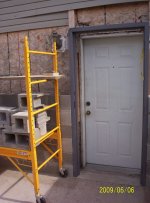
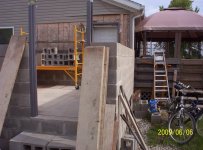
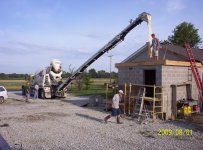
I built mine out of cement blocks filled with rebar and mortar and concrete roof. I went with above ground that was convenient to use. The breeze way approach is what I took. Some action photo's;

Dave
 

Attachments

  • Sx Picture 018.jpg
    Sx Picture 018.jpg
    234.6 KB · Views: 254
  • Sx Picture 022.jpg
    Sx Picture 022.jpg
    290.3 KB · Views: 233
  • xPicture 010.jpg
    xPicture 010.jpg
    351.6 KB · Views: 537
  • xPicture 012.jpg
    xPicture 012.jpg
    390.7 KB · Views: 596
   / Tornado Shelter #40  
We have a local septic tank co that builds storm shelters out of septic tanks

We do too they put a different roof on with a steel door but its just a tank. I think they are 3 grand installed and about $2000 out the door dig your own hole.

I built my shelter out of a water well house that needed rebuilt anyway I just dug it 5'x8'x5' bigger cinder blocked it and rebar and formed the top of the walls and filled the blocks with cement and put a roof over it probably spent $2000.

http://www.tractorbynet.com/forums/...ne-ever-use-cut-mounted-img_1088-640x480-.jpg

http://www.tractorbynet.com/forums/...ne-ever-use-cut-mounted-img_1072-640x480-.jpg

http://www.tractorbynet.com/forums/...42-newbie-can-i-dig-my-img_1037-1024x768-.jpg
 

Tractor & Equipment Auctions

2008 DOOSAN G25 GENERATOR (A55745)
2008 DOOSAN G25...
1996 FORD F-SERIES FLATBED TRUCK (A52706)
1996 FORD F-SERIES...
Honda EM3500S Portable Gasoline Generator (A59228)
Honda EM3500S...
16ft x 8ft Flat Bed (A57454)
16ft x 8ft Flat...
2001 CATERPILLAR 140H VHP MOTORGRADER (A59823)
2001 CATERPILLAR...
2016 Chevrolet Sonic LS Hatchback (A56859)
2016 Chevrolet...
 
Top