Trailer chain configuration

   / Trailer chain configuration #1  

FF117

Silver Member
Joined
Jan 7, 2010
Messages
141
Location
West Central Illinois
Tractor
Branson 4720h
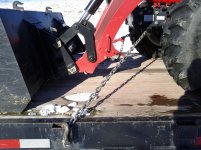
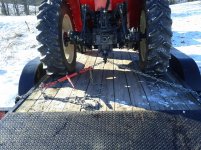
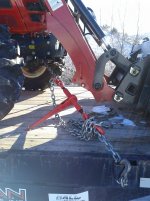
I recently purchased my first tractor hauling trailer and would like some help getting the tie-downs set up correctly. I've attached some pics of one possibility. I was thinking about changing the front so that the chains cross and are attached to the hooks using two binders instead of one. I assume these hooks on the tractor are made for transport?

I'm a little concerned how the rear is set up with the chain running though the clevis on the drawbar. I can't figure out another good way to attach it unless I wrap the chain around the axle.

Suggestions appreciated. Thanks

Note: The pics don't show the ratchet straps for the loader. Also, I didn't tow like this, just asking before I make a mistake.

IMG_20130102_144104.jpgIMG_20130102_144041.jpgIMG_20130102_144114.jpg
 
   / Trailer chain configuration #2  
I don't see any need for two chain binders on the front. I've used a clevis on the draw bar before but if you don't like it you can run the chain through the rear wheels.
 
   / Trailer chain configuration #3  
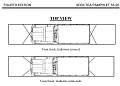
I prefer one of these configurations to keep the tractor centered after potholes or RR crossings. With a "sliding" attachment as shown it could move sideways from vibration.

Bruce
 

Attachments

  • Tiedown.jpg
    Tiedown.jpg
    25.9 KB · Views: 551
   / Trailer chain configuration #4  
Looks ok to me. You are anchored to the front where it looks like it is supposed to be and to what looks like is a hitch in the rear. Side to side, tight but not over tight is the way to do it. To speed up hooking up you can leave one side loose and tighten the other side down and get the slack out of the other side without having to spend time racheting.
 
   / Trailer chain configuration #5  
It appears from your pics you have 1 chain in front and one in rear. I never liked the one chain on each end tie down method due to the chance one might break allowing the other to go slack. Bruce's drawing shows two - 4 chain setups. Either one gives better holding strength.
 

Attachments

  • Tiedown.jpg
    Tiedown.jpg
    2.8 KB · Views: 974
   / Trailer chain configuration #6  
Yea, as far as DOT is concerned that is illegal. You need 4 seperate chains. What I do is chain the rear and then pull the tractor forward to draw the chains tight, then install the front chains and rachet them down.
 
   / Trailer chain configuration #7  
puckgrinder is right. however -- if you use a single chain for both fronts --- they need to be pulled on tractor from each side independently - not looped thru the holes. If you put binder on the tractor loops and one end of chain on trailer like you did, and repeat on the other side, you can use single chain without cutting it with extra wrapped around the binder to take up slack. You did the hook right on the trailer part .. put it thru thee stakes then up and on so if it falls off, the stake pocket prevent hook from whipping around which is what DOT wants to see. You should be tying down tractor in a X fashion whenever is possible. Also - just an fyi - if you get pulled over by a overezealous DOT cop - you might want a strap on your FEL too as dot rules states "all implements must be strapped down" and the FEL is an implement. I know, I know -- the FEL doesnt come off from tractor and its a sturdy piece on tractor, but what is an extra strap on the tractor? It just needs to be snug to satisfy DOT, not cranked down.
 
   / Trailer chain configuration
  • Thread Starter
#8  
puckgrinder is right. however -- if you use a single chain for both fronts --- they need to be pulled on tractor from each side independently - not looped thru the holes. If you put binder on the tractor loops and one end of chain on trailer like you did, and repeat on the other side, you can use single chain without cutting it with extra wrapped around the binder to take up slack. You did the hook right on the trailer part .. put it thru thee stakes then up and on so if it falls off, the stake pocket prevent hook from whipping around which is what DOT wants to see. You should be tying down tractor in a X fashion whenever is possible. Also - just an fyi - if you get pulled over by a overezealous DOT cop - you might want a strap on your FEL too as dot rules states "all implements must be strapped down" and the FEL is an implement. I know, I know -- the FEL doesnt come off from tractor and its a sturdy piece on tractor, but what is an extra strap on the tractor? It just needs to be snug to satisfy DOT, not cranked down.

Thanks for the suggestions. If I understand correctly, you are saying that I should attach the binder directly to the hooks on the tractor, but I'm not sure the hook would fit inside the binder ring.

I will make and X front and back next time and post more pics. I suppose attaching to the wheels would be best in the back, but I'm going to need some more chain and another binder (4 total).
 
   / Trailer chain configuration #9  
The idea behind having two chains not one at the front or rear is that if the chain fails or comes unhooked the other chain will still hold. If you have 1 chain long enough so you can have slack in the middle and a binder on each side that would work. You also have the option of connecting the chains up on one end and then tightening them up by moving the tractor and then using binders on the other end. DOT requires the operator of the transport vehicle be able to move the tractor to tighten up the chains as required. As long as you have the key and the tractor is operational you're fine.

In the bigger picture if your just moving your tractor for your personal use most states will not mess with you if you aren't up to DOT specs. But my motto is I would rather over do it right than get it wrong and see my tractor fall off the trailer and cause damage to something or worse hurt someone.
 
   / Trailer chain configuration #10  
Yea, as far as DOT is concerned that is illegal. You need 4 seperate chains. What I do is chain the rear and then pull the tractor forward to draw the chains tight, then install the front chains and rachet them down.

I chain down my tractor just like FF117 does. DOT calls for four separate chain contact points with the trailer if the equipment is over 10,000 lbs. At least thats what is required in Maryland.

Best to check with your State DOT if you are legal or not if that is a concern of yours.
 
   / Trailer chain configuration #11  
If you happen to be short of two binders, just hook chains in front and drive tractor backwards tighten chains and lock it worth parking brake.then use binders in rear.
 
   / Trailer chain configuration #12  
I chain down my tractor just like FF117 does. DOT calls for four separate chain contact points with the trailer if the equipment is over 10,000 lbs. At least thats what is required in Maryland.

Best to check with your State DOT if you are legal or not if that is a concern of yours.

Right. Federal regs call for 10,000 pound wheeled items to have 4 chains. Some states may spec that for under ...thats why you need to check.

I use 2 chains. At the rear i go through the rims. At the front through the FEL cross tube. yeah, paint it chipped. It gets hauled 10-15 times a year. If chips P you off, old fire hose around the chain is supposed to help.
 
   / Trailer chain configuration #14  
Care to post the regulation for this?

This 10K rule is what I have been told also by leo's here also. Below 10K straps are also ok for rolling loads as long as they are properly rated.

Chris
 
   / Trailer chain configuration #15  
Care to post the regulation for this?
Applicability. The rules in this section apply to the transportation of automobiles, light trucks, and vans which individually weigh 4,536 kg. (10,000 lbs) or less. Vehicles which individually are heavier than 4,536 kg (10,000 lbs) must be secured in accordance with the provisions of & sect;393.130 of this part.
b. Securement of automobiles, light trucks, and vans. 1. Automobiles, light trucks, and vans must be restrained at both the front and rear to prevent lateral, forward, rearward, and vertical movement using a minimum of two tiedowns.
2. Tiedowns that are designed to be affixed to the structure of the automobile, light truck, or van must use the mounting points on those vehicles that have been specifically designed for that purpose.
3. Tiedowns that are designed to fit over or around the wheels of an automobile, light truck, or van must provide restraint in the lateral, longitudinal and vertical directions.
4. Edge protectors are not required for synthetic webbing at points where the webbing comes in contact with the tires. & sect;393.130 What are the rules for securing heavy vehicles, equipment and machinery? a. Applicability. The rules in this section apply to the transportation of heavy vehicles, equipment and machinery which operate on wheels or tracks, such as front end loaders, bulldozers, tractors, and power shovels and which individually weigh 4,536 kg (10,000 lbs) or more. Vehicles, equipment and machinery which is lighter than 4,536 kg (10,000 lbs) may also be secured in accordance with the provisions of this section, with & sect;393.128, or in accordance with the provisions of & sect; & sect;393.100 through 393.114.
b. Preparation of equipment being transported. 1. Accessory equipment, such as hydraulic shovels, must be completely lowered and secured to the vehicle.
2. Articulated vehicles shall be restrained in a manner that prevents articulation while in transit.

c. Securement of heavy vehicles, equipment ormachinery with crawler tracks or wheels. 1. In addition to the requirements of paragraph (b) of this section, heavy equipment or machinery with crawler tracks or wheels must be restrained against movement in the lateral, forward, rearward, and vertical direction using a minimum of four tiedowns.
 
   / Trailer chain configuration #16  
If you happen to be short of two binders, just hook chains in front and drive tractor backwards tighten chains and lock it worth parking brake.then use binders in rear.

Exactly what I do, using 4 chains, 2 binders at the rear.
 
   / Trailer chain configuration #17  
This 10K rule is what I have been told also by leo's here also. Below 10K straps are also ok for rolling loads as long as they are properly rated.
I have yet to find a reg that specifies chains vs straps vs cable. Just what the WLL ratings have to be.

Aaron Z
 
   / Trailer chain configuration #19  
Right. Federal regs call for 10,000 pound wheeled items to have 4 chains. Some states may spec that for under ...thats why you need to check.

I use 2 chains. At the rear i go through the rims. At the front through the FEL cross tube. yeah, paint it chipped. It gets hauled 10-15 times a year. If chips P you off, old fire hose around the chain is supposed to help.

I used to run my chain thru the tube also but I found a place on the front of the tractor to secure a chain so I went that route.

I like the idea of the firehose to slip the chain thru. Are those available for sale for that purpose?
 
   / Trailer chain configuration #20  
If you happen to be short of two binders, just hook chains in front and drive tractor backwards tighten chains and lock it worth parking brake.then use binders in rear.

You'll get nailed by DOT everytime if you do it that way. Each chain has to have its own rachet binder.
 

Tractor & Equipment Auctions

2010 KMC 3376 Peanut Combine (A56438)
2010 KMC 3376...
ELECTRIC GOLF CART (A58214)
ELECTRIC GOLF CART...
John Deere 7410 (A53317)
John Deere 7410...
5th Wheel Hitch (A59230)
5th Wheel Hitch...
NIPPON HYD THUMB (A52706)
NIPPON HYD THUMB...
2018 GENIE GTH1056 TELESCOPIC FORKLIFT (A60429)
2018 GENIE GTH1056...
 
Top