Does ethanol blended gas gel?

/ Does ethanol blended gas gel? #21  
It really stinks that you can't find non-ethanol blended fuel around here (for a couple hundred miles anyway), at any price.

DEFPO
 
/ Does ethanol blended gas gel? #22  
that article was updated in 2008. Boy that is really current. Find something related that is more like in the last year?

I have been using 10% ethanol in everything that runs on gasoline from my chain saw to my portable generators to my vehicles since the late 70's / early 80's. Even ran a 30% blend in a 2002 Chevy Cavalier (non flex fuel) that the wife had and never had an issue. I have NEVER had a fuel related problem. Never added anything to the mix either. There are some things that get attributed to being caused by ethanol like the manufacturer used poor quality components, owner did not do regular maintenance issues like changing fuel filters, etc. Phase separation and such are over blown issues with no real merit. Some even claim that the standard aluminum tanker trucks need special tanks to haul ethanol. As a person who had tanked fuel, I can tell you that is absolute rubbish. The same aluminum tanker hauls, straight ethanol, blended, dino diesel, and bio diesel.

Anecdotal stories make for nice copy in the newsroom, but hardly pass for scientific analysis. Groups like the Technology and Maintenance Council, who is the de facto industry standard regarding fleet vehicle maintenance from small vehicles up thru class 8 trucks, has shown no real problem in their testing of ethanol fuels in vehicles which were built using industry standard components. Only when substandard components were used or improper maintenance performed did issues crop up.

But I am confident that I did not make a dent in anyone's perception who has a conspiracy theory type of mindset.

How's This?

The D.C. Circuit chastised the Environmental Protection Agency for favoring the biofuel industry instead of objectively projecting cellulosic ethanol production. You would think that the EPA would have been slightly cowed by the court, but they were not. Less than one week after the ruling, the agency has released new projections that are even more out of touch with reality than the projection that the court struck down. Sadly, the EPA's decision has consequences and in this case, it means higher gasoline prices at the pump.
In 2007, Congress and President Bush passed a law mandating fantastically large volumes of cellulosic ethanol. For example, for 2013 the law requires refiners to buy 1 billion gallons of cellulosic ethanol. But Congress understood that reality might not match their expectations and authorized the EPA to annually consult with the Energy Information Administration to project the amount of cellulosic ethanol that will be produced the next year. The EPA's projection would then be the mandated amount of cellulosic ethanol.
The EPA's projections have been out of whack with reality and because oil refineries are required to buy this phantom fuel or purchase credit (in effect a tax), the refiners took the EPA to court for skewing its projections in favor of cellulosic ethanol producers to the detriment of refineries and gasoline-buying Americans.
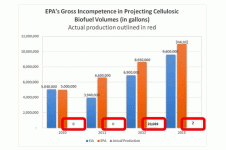
It is easy to see why the refiners were frustrated with the EPA's projections. In 2010, EPA projected that 5,000,000 gallons of ethanol would be produced, but not a drop was sold. In 2011, the EPA ignored the lack production.
In 2012, after two years of zero cellulosic ethanol production, the EPA's projection didn't return to reality, but further increased. At this point it became obvious that the EPA's projection was not an objective forecast, but an attempt to create a market for cellulosic ethanol. The refiners took agency to court and the court agreed.
The chart below shows the Energy Information Administration's forecast, the EPA's forecast, and actual cellulosic ethanol production. In 2012, it turns out that there was some cellulosic ethanol production?0,069 gallons. This was far short of the 8.65 million gallons the EPA mandated.


After being reprimanded by the court, one would think that the EPA's projections would be a bit more reasonable. But that would be incorrect. Less than a week after the court instructed the agency to be objective, the EPA released a new forecast that projects a whopping 14 million gallons of cellulosic ethanol to be produced in 2013.
The EPA argues that more companies are building cellulosic ethanol plants and that more of these plants will produce ethanol this year. This may be true, but it was also true in 2010, 2011, and 2012. In those years the EPA projected that 20,250,000 gallons would be produced, but only 20,069 gallons were actually produced. In fact, the closest the EPA has come to accurately project cellulosic ethanol production was in 2010勇PA's first and lowest projection. In its subsequent forecasts, the EPA apparently learned nothing from history.
 

Attachments

  • EPAChart.gif
    EPAChart.gif
    44.8 KB · Views: 140
/ Does ethanol blended gas gel? #23  
How's This?

The D.C. Circuit chastised the Environmental Protection Agency for favoring the biofuel industry instead of objectively projecting cellulosic ethanol production. You would think that the EPA would have been slightly cowed by the court, but they were not. Less than one week after the ruling, the agency has released new projections that are even more out of touch with reality than the projection that the court struck down. Sadly, the EPA's decision has consequences and in this case, it means higher gasoline prices at the pump.
In 2007, Congress and President Bush passed a law mandating fantastically large volumes of cellulosic ethanol. For example, for 2013 the law requires refiners to buy 1 billion gallons of cellulosic ethanol. But Congress understood that reality might not match their expectations and authorized the EPA to annually consult with the Energy Information Administration to project the amount of cellulosic ethanol that will be produced the next year. The EPA's projection would then be the mandated amount of cellulosic ethanol.
The EPA's projections have been out of whack with reality and because oil refineries are required to buy this phantom fuel or purchase credit (in effect a tax), the refiners took the EPA to court for skewing its projections in favor of cellulosic ethanol producers to the detriment of refineries and gasoline-buying Americans.
It is easy to see why the refiners were frustrated with the EPA's projections. In 2010, EPA projected that 5,000,000 gallons of ethanol would be produced, but not a drop was sold. In 2011, the EPA ignored the lack production.
In 2012, after two years of zero cellulosic ethanol production, the EPA's projection didn't return to reality, but further increased. At this point it became obvious that the EPA's projection was not an objective forecast, but an attempt to create a market for cellulosic ethanol. The refiners took agency to court and the court agreed.
The chart below shows the Energy Information Administration's forecast, the EPA's forecast, and actual cellulosic ethanol production. In 2012, it turns out that there was some cellulosic ethanol production?0,069 gallons. This was far short of the 8.65 million gallons the EPA mandated.


After being reprimanded by the court, one would think that the EPA's projections would be a bit more reasonable. But that would be incorrect. Less than a week after the court instructed the agency to be objective, the EPA released a new forecast that projects a whopping 14 million gallons of cellulosic ethanol to be produced in 2013.
The EPA argues that more companies are building cellulosic ethanol plants and that more of these plants will produce ethanol this year. This may be true, but it was also true in 2010, 2011, and 2012. In those years the EPA projected that 20,250,000 gallons would be produced, but only 20,069 gallons were actually produced. In fact, the closest the EPA has come to accurately project cellulosic ethanol production was in 2010勇PA's first and lowest projection. In its subsequent forecasts, the EPA apparently learned nothing from history.

How else would they prepare to ram E15 up our, er.....

I mean down our......

gasoline fill holes - yeah, that's it !

Rgds, D.
 
/ Does ethanol blended gas gel? #24  
Shell V-Power is straight gas....NO ETHONAL. you WILL pay a premium for it. It is they're high test/super.

Not true. My uncle owns a few Shell Stations and everything is 10% ethanol and has been for 3 or more years. This may be a regional thing but I know for a fact that all gas sold for on road use in Indiana must be E10

Chris
 
/ Does ethanol blended gas gel? #25  
Check the puregas.org website for dealers that have ethanol free fuel. Call before you drive to the station as this is a user updated website and the availability changes frequently.
 
/ Does ethanol blended gas gel? #26  
If I lived in Indiana,as my son and his family do,I would remove the ethanol for my small engine usage. I just told my daughter-in-law about this and my son will hear shortly. They have some large clear wine-making vessels which will be perfect for extracting and dumping the ethanol. Thanks,DIAMONDPILOT! don-ohio :)^)
 
/ Does ethanol blended gas gel? #27  
I assume a lot of you have had problems or you wouldn't be complaining. That said, I have run nothing but the readily available 10 % ethanol since it came into being with no problem - one exception - my snowmobiles. I paid the extra 50 cents per gallon to use our non-ethanol premium in them and had problems every few years with the fuel disintegrating the plastic hose Polaris uses inside its fuel tanks. Prior to ethanol fuel we put a bottle of Heet in with each tank - isopropyl alcohol, not ethyl alcohol, but does the same thing - attracts water so it doesn't settle out and freeze in the low points of the gas lines. Wonder what I am doing wrong to not have problems? Or is it I don't use them long enough? I usually want something new after about 10 years. Even my grandpa said a person needed ethyl alcohol to run. He drank a bottle of whiskey every day and lived to 93. My dad, however, has been a non-drinker and just celebrated his 99th this week so maybe the ethyl alcohol isn't the elixir grandpa said it was.
 
/ Does ethanol blended gas gel? #28  
I assume a lot of you have had problems or you wouldn't be complaining. That said, I have run nothing but the readily available 10 % ethanol since it came into being with no problem - one exception - my snowmobiles. I paid the extra 50 cents per gallon to use our non-ethanol premium in them and had problems every few years with the fuel disintegrating the plastic hose Polaris uses inside its fuel tanks. Prior to ethanol fuel we put a bottle of Heet in with each tank - isopropyl alcohol, not ethyl alcohol, but does the same thing - attracts water so it doesn't settle out and freeze in the low points of the gas lines. Wonder what I am doing wrong to not have problems? Or is it I don't use them long enough? I usually want something new after about 10 years. Even my grandpa said a person needed ethyl alcohol to run. He drank a bottle of whiskey every day and lived to 93. My dad, however, has been a non-drinker and just celebrated his 99th this week so maybe the ethyl alcohol isn't the elixir grandpa said it was.

Just like with humans, YMMV when using alcohol ! :D

Actually, I don't really mean mileage (altho that is a factor), but rather performance/problems.

One variable that can have a big factor is tank fill (or not) practices. Somebody that regularly fills up, then quickly burns through a tank is a lot less likely to have ethanol related problems. Some people literally never fill up their tank - IMO that is asking for (a lot of) trouble.

For the people that rarely fill up, and don't go through fuel quickly, I'd be interested to hear where they buy their Efuel (geographically speaking).

Rgds, D.
 
/ Does ethanol blended gas gel? #29  
I assume a lot of you have had problems or you wouldn't be complaining. That said, I have run nothing but the readily available 10 % ethanol since it came into being with no problem - one exception - my snowmobiles. I paid the extra 50 cents per gallon to use our non-ethanol premium in them and had problems every few years with the fuel disintegrating the plastic hose Polaris uses inside its fuel tanks. Prior to ethanol fuel we put a bottle of Heet in with each tank - isopropyl alcohol, not ethyl alcohol, but does the same thing - attracts water so it doesn't settle out and freeze in the low points of the gas lines. Wonder what I am doing wrong to not have problems? Or is it I don't use them long enough? I usually want something new after about 10 years. Even my grandpa said a person needed ethyl alcohol to run. He drank a bottle of whiskey every day and lived to 93. My dad, however, has been a non-drinker and just celebrated his 99th this week so maybe the ethyl alcohol isn't the elixir grandpa said it was.

What you are referencing as ethyl being an alcohol is like stating that if you drink alcohol you are an alcoholic. Ethyl in fuels prior to ethanol were Tetraethyllead (common name tetraethyl lead), abbreviated TEL, is an organolead compound with the formula (CH3CH2)4Pb. It was admixed with gasoline (petrol) beginning in the 1920s as an inexpensive octane booster which allowed engine compression to be raised substantially, which in turn increased vehicle performance and fuel economy. TEL was phased out starting in the US in the mid-1970s because of its neurotoxicity and its deleterious effect on catalytic converters. It is still used as an additive in aviation fuel for piston engine-powered aircraft, and also in high-octane automotive racing fuels. These additives did not bond with water as ethanol does and really did not have the solvent effect of ethanol. Ethanol blend petroleum fuels are banned in aircraft with a few exceptions mainly for this reason. It appears that the FAA concludes that ethanol fuel is too detrimental to use in aircraft. However, some aircraft with piston powered engines are authorized to use mogas (automotive gasoline) as low as 87 octane when it does not contain ethanol. Evening considering the positive side of ethanol for the sake of our environment. It still is questionable how effective it is as total fuel burned and energy produced. E15 has 40% less energy than straight gasoline, therefore, more fuel is required to produce the same amount of energy. More exhaust is created even though it may be more environmentally friendly exhaust. It will cost the consumer more as he/she will require more fuel to produce the same amount of work from the engine.
 
/ Does ethanol blended gas gel? #30  
Yes,quickly used ethanol won't cause a problem in cars,and larger engines,except if stored where air can enter to fuel. But it costs you gas mileage and as previous poster says,that makes for more,IF somewhat cleaner,emissions. I just informed my 33 yr.old son from Indiana how to purge ethanol from 5 gallons of gas at a time for mower gas and other small engines.Told him add 1/3 bottle of STP carb. cleaner to non-ethanol gas he'd created. I told him to test a small amount first,just to see if Marathon gas has it,like DiamondPIlot has said. don-ohio
 
/ Does ethanol blended gas gel? #31  
E15 has 40% less energy than straight gasoline,

I smell smoke......

How did you come up with this number?

Depending on the source of the data (in this particular case the US Gov. - Alternative Fuels Data Center), typically :
Neet (100%) gasoline has 116,900 btu's per gallon.
Neet (100%) ethanol has 76,330 btu's per gallon.

Therefore E15 (15% of the ethanol value = 11,450 btu's, PLUS 85% of the gasoline value = 99,365 btu's) equals 110,815 total for E15.

110,815 (E15) divided by 116,900 (E0) equals 94.8% of the btu content of neet (100% gasoline). So a loss of 5.2%, not 40%.

If my numbers are wrong, please correct me and show me the data.

DEWFPO
 
/ Does ethanol blended gas gel? #32  
I think its a bad waste of good drinking alcohol to take corn and make it into fuel ;-<()
 
/ Does ethanol blended gas gel? #33  
I smell smoke......

How did you come up with this number?

Depending on the source of the data (in this particular case the US Gov. - Alternative Fuels Data Center), typically :
Neet (100%) gasoline has 116,900 btu's per gallon.
Neet (100%) ethanol has 76,330 btu's per gallon.

Therefore E15 (15% of the ethanol value = 11,450 btu's, PLUS 85% of the gasoline value = 99,365 btu's) equals 110,815 total for E15.

110,815 (E15) divided by 116,900 (E0) equals 94.8% of the btu content of neet (100% gasoline). So a loss of 5.2%, not 40%.

If my numbers are wrong, please correct me and show me the data.

DEWFPO
Ethanol Alternative Fuel | E85 - Consumer Reports
 
/ Does ethanol blended gas gel? #34  
I smell smoke......

How did you come up with this number?

Depending on the source of the data (in this particular case the US Gov. - Alternative Fuels Data Center), typically :
Neet (100%) gasoline has 116,900 btu's per gallon.
Neet (100%) ethanol has 76,330 btu's per gallon.

Therefore E15 (15% of the ethanol value = 11,450 btu's, PLUS 85% of the gasoline value = 99,365 btu's) equals 110,815 total for E15.

110,815 (E15) divided by 116,900 (E0) equals 94.8% of the btu content of neet (100% gasoline). So a loss of 5.2%, not 40%.

If my numbers are wrong, please correct me and show me the data.

DEWFPO
Ethanol Alternative Fuel | E85 - Consumer Reports
 
/ Does ethanol blended gas gel? #35  
I smell smoke......

How did you come up with this number?

Depending on the source of the data (in this particular case the US Gov. - Alternative Fuels Data Center), typically :
Neet (100%) gasoline has 116,900 btu's per gallon.
Neet (100%) ethanol has 76,330 btu's per gallon.

Therefore E15 (15% of the ethanol value = 11,450 btu's, PLUS 85% of the gasoline value = 99,365 btu's) equals 110,815 total for E15.

110,815 (E15) divided by 116,900 (E0) equals 94.8% of the btu content of neet (100% gasoline). So a loss of 5.2%, not 40%.

If my numbers are wrong, please correct me and show me the data.

DEWFPO

I seem to recall E10 at about 6% less energy than pure gasoline. Wik listing seems to agree. The 40% comment may have been wrt. E85 ? Anyway, it is diminished for sure.... personally I'm less than thrilled about the 6% hit from E10.

Energy density - Wikipedia, the free encyclopedia

Rgds, D.
 
/ Does ethanol blended gas gel? #37  
I will stick with the Consumer Reports and the British Petroleum Institute numbers. They are less than the 40% that I picked up somewhere, I have not been able to relocate the source yet. My memory is good, just short. They show 27% on good proven, trustworthy data. Wikipedia is fine, but not always reliable. We choose to believe what we judge to be the best information available. Ethanol's lower fuel economy results from its lower energy content compared to gasoline. For example, E85 contains 75,670 British thermal units of energy per gallon instead of 115,400 for regular unleaded gasoline, according to the National Highway Traffic Safety Administration. So you have to burn more fuel to generate the same amount of energy. In addition, FFV engines are designed to run most efficiently on gasoline. Some engineers we interviewed say E85 fuel economy could approach that of gasoline if manufacturers optimized engines for that fuel, however. Quoting the Consumer Reports actual study Of the 13 billion gallons of ethanol expected to be produced in 2010 and 2011, less than 2 percent, or 260 million gallons, will be blended into E85. Because our tests show that E85 provides 27 percent lower fuel economy, those 260 million gallons are able to replace only a little more than 214 million gallons of gasoline—a tiny fraction of the 170 billion gallons consumed on American roads every year.
 
/ Does ethanol blended gas gel? #38  
My inner geek has a problem with all the teeny tiny fuel efficiency gains that the factory engineers blow their brains out designing getting wiped out by the stroke of some bureaucrats pen.

Except the corn States, I don't know anybody that is happy about this.

All the new vehicle mpg "official" ratings should be stated in more categories (Gas, E10, E15, E85) - I stand a better chance of winning a major lottery, than seeing that data published.

Rgds, D.
 

Marketplace Items

2025 GPS Trailers (A56857)
2025 GPS Trailers...
KMC 4 ROW BED SHAPER (A60430)
KMC 4 ROW BED...
2017 Kustom Signals Towable Solar Radar Speed Limit Trailer (A59228)
2017 Kustom...
JOHN DEERE 330G SKID LOADER (A58214)
JOHN DEERE 330G...
30 INCH TOOTHLESS BUCKET FOR MINI EXCAVATOR (A58214)
30 INCH TOOTHLESS...
CATERPILLAR CB24B DOUBLE DRUM ROLLER (A52707)
CATERPILLAR CB24B...
 
Top