jeff9366
Super Star Member
- Joined
- Jan 14, 2011
- Messages
- 12,787
- Tractor
- Kubota Tractor Loader L3560 HST+ ~~~~~~~~~~~~~ 3,700 pounds bare tractor, 5,400 pounds operating weight, 37 horsepower
Disc Harrows come in numerous types. However, for 18-45 horsepower tractors the three point hitch mounted, Tandem Disc Harrow, secondary tillage implement, is ubiquitous.
Tandem Disc Harrows are manufactured in two structural types: Angle Iron Frame and Box Frame. Box Frame Disc Harrows are stronger, heavier, have greater adjustability of the gang angles and, having welded frames, are not prone to working loose like Angle-Iron Frame Disc Harrows. If the budget allows, purchase a Box Frame Disc Harrow.
February 28, 2013 I took delivery of a Howse, box-frame, 3-Pt. Disc Harrow, Model DLHT16822B, from my local Kubota/Howse dealer. The dealer, from who I bought my tractor, recommended the Howse DLHT. At the time I was researching Disc Harrows from Land Pride, Everything Attachments (ETA), TSC/Countyline and Monroe Tufline
Howse describes the DLHT series as MEDIUM DUTY. Howse DLHT is a 16/18 Disc Harrow, meaning 16 discs, each 18" in diameter, spaced 9-1/2" apart. It cuts a swath nominally 5'-6" in width, adjustable by sliding the disc hangers in or out. The Howse DLHT16822B weighs 587 pounds. It has a 1" axle on sealed flange bearings. (There is a T-B-N consensus that to cut vegetation Disc Harrows should have 40+ pounds weighting each disc. My Howse has 37 pounds weight per disc; at times I wish for a bit more weight.)
( Howse sells Heavy-Duty DHT Series Disc Harrows, with 20" discs and 1-1/8" axles, in 16/20 {878 pounds / $1741 FOB Factory} and 20/20 {1,097 pounds / $2049 FOB factory} configurations. ) ((May be cheaper from a Howse dealer.))
My primary Disc Harrow objectives involve CUTTING; opening new game feed plots, maintaining vegetation free fire breaks and vegetation control along woodland trails. Harrow weight on 16 discs, rather than 20 discs, puts more cutting weight on each disc. Spacing between discs is 9". If you have rocky soil, 9" disc spacing may be advantageous.
Tractor users with SMOOTHING (plow furrows) as their priority may consider the 20/18 or 20/20 configuration. Both have 7-1/2" spacing between discs.
Disc Harrows are available with two types of discs: notched and smooth. Notched discs cut pasture grass and crop stubble better; in open soil notched blades jerk out trash, meaning vines and tree roots, which sporadically stick in the notches. Notched discs deform easier than solid/smooth discs working rocky soil. Thicker discs, if notched, are less prone to deform in rocky soil than thinner notched discs.
Smooth discs roll over some vegetation that notched discs will cut through.
Standard configuration for Howse Disc Harrows is notched discs front, notched discs rear.
((Synonyms for individual discs: wheels or pans.))
Discs for compact tractor harrows come in 16"-18"-20"-22 diameter. Generally speaking, sub-compact tractors will use 16" diameter notched discs, mid-size compacts 18" diameter notched discs. Thirty-five (plus) horsepower, heavy frame, utility tractors may opt for heavier 20" or 22 discs. Weight is your friend.
Four-wheel-drive tractors require 5-horsepower per foot of Disc width.
The three point hitch Top Link is used to adjust relative front/rear gang pressure on soil. Longer Top Link: more soil pressure on rear gang. Shorter Top Link, more soil pressure from front gang.
Some increase in pan penetration can be achieved by shortening the 3-Pt. Top Link until the rear gang is raised into the air, transferring rear gang weight to the front gang. This can sometimes be useful for penetrating vegetation on the first pass across a field.
Issues with disc diameter are concavity, wear, harrow weight and clearance lift. Smaller diameter discs generally have less concavity (less "float") than larger discs, so they theoretically penetrate easier; smaller discs are thinner/sharper than larger diameter discs. Larger diameter discs generally have greater concavity, so move more soil laterally. Larger diameter, thicker discs wear longer before requiring replacement. Larger diameter, thicker discs add to harrow weight, which offsets "float", improving penetration.
Replacement 18 inch discs are available in 3mm, 3.5mm, and 4mm thickness. Replacement 20 inch discs are available in 3.5mm, 4mm, 4.5mm, 4.76mm, 5mm and 6.35mm thickness. As shown, diameters and thickness overlap. Thicker discs are heavier. (Agri-Supply offers 516 individual disc types on its web site.)
Discs of larger diameter require more lift from the three point hitch. Clearance can be an issue when crossing ditches, rough ground and loading or unloading a tractor mounted Disc Harrow from a trailer.
My Howse has a dropped double clevis (two "ears") to receive draw pins. A dropped clevis is desirable on a Disc Harrow for an 18-45 horsepower tractor; it allows the 3-Pt. to lift the harrow earlier. Note Photo #6, showing my Howse in the air. Minimum disc height above ground is 14-1/2", greater than 14" ground clearance of my B3300SU tractor. This is ideal.
I prefer a wide double clevis, which accepts separate draw pins, to protruding, bolt-on "open" draw pins. The double clevis provides a stronger tractor/harrow connection, which distributes draft strain. TSC/Countyline by Tarter, 84 Disc Harrow, suitable for a tractor larger than mine, has "open" draw pins protruding from the harrow frame; in a "normal", undropped position. The Land Pride DH1560/60 has dropped "open" draw pins. Wider Land Pride Disc Harrows have preferred double clevis standard.
The Howse, with its 3" wide, dropped, double clevis is the easiest implement I own to mount on the three point hitch.
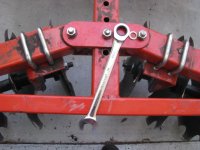
Most 5'-6'-7' Disc Harrows provide gang angle adjustment via clamp plates and adjustment holes in the frame. Clamp plate adjustment is simple, strong and inexpensive to manufacture but time consuming to adjust in the field. While the need to change gang angles will vary by user, adjustment is NOT an everyday event for me.
My Howse has five adjustment holes in the frame per gang, some brands have four.
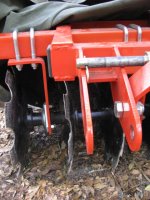
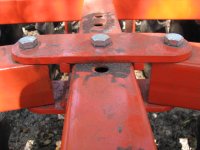
Clamp plate adjustment works via three through bolts/nuts per gang, clamping twinned upper and lower adjustment plates, which have a pair of rib guides on the top plate mirrored by a pair of rib guides on the bottom plate. To adjust one gang angle, the two outer bolts/nuts are loosened with a wrench, the center bolt, which passes through adjustment holes in the frame, is removed, then the gang is pulled and jiggled to line up holes in sliding adjustment plates with alternate holes in harrow frame, using gang length for leverage. The center bolt is replaced and all three bolts/nuts tightened with the wrench. Repeat for the second gang. {Loosening/replacing bolts/nuts is a 15 - 20 minute process.} I have applied wax lube to the harrow frame over which the adjustment plates slide. New, it adjusts easily. I understand with paint abrasion, rust, dust, deformity, etc., gang adjustment becomes harder. However, I will settle on a 'default' gang angle setting soon and only change gang angles occasionally thereafter.
Some TBN threads suggest substituting a 5" pin as a pivot, in lieu of the center bolt. With only a center pin, it seems possible the center support could "jump" the guides under load; stay with the center bolt and nut.
Three Disc Harrows could be accurately described as HEAVY DUTY, by design and by weight. All adjust gang angles more readily than the common friction plate arrangement but you pay for the convenience. If you will disc multiple soil conditions it will be worth paying the quick adjust premium.
Everything Attachment's ETA-XD-BF-DH-16-18 disc harrow weighs 686 pounds (43 pounds/disc) and is priced at $1554 delivered to Fanning Springs, North Florida. The ETA disc has two, long, gang adjustment screws, one adjusts each gang. I admired ETA screw-adjust disc at the 2012 Sunbelt Ag Expo in Georgia.
I have purchased several implements from ETA. I respect ETA's quality and excellent customer service.
Leinbach box-frame disc harrows use an identical screw adjustment.
Monroe Tufline's THE71618BF disc harrow (1-1/8" axle) weighs 670 pounds (42 pounds per disc) and was quoted at $2100, plus a local delivery charge. Tufline promotes lever adjustment of the gang angles. I researched the Tufline 'THE' discs on Tufline's very basic web site. I have not seen a Tufline with mine eyes but the Tufline brand enjoys an excellent reputation. Monroe Tufline makes a huge range of Harrows for CUTS through Big-Ag.
Brown Manufacturing Corp., Ozark, AL, produces the BDH-600-1620 Disc Harrow (1-1/8 axle), 6?4 width, 1095 pounds (68 pounds per disc!) with lever gang angle adjustment priced at $2535 FOB factory. I researched Brown's BDH Disc Harrow on Brown Manufacturing's web site.
Price is not the first priority when I purchase attachments. However, my Florida rock free, sandy-loam is not challenging to disc so I bought the Howse DLHT as adequate and a good value. I paid $950 delivered. (No sales tax in Florida on ag or forestry equipment.)
Pulling a Disc Harrow is high draft force work. Not only is the implement weight being pulled, but the discs are resisting passage through the soil, proportionate to gang angle adjustment. Box frame Disc Harrows require minimum five tractor horsepower per foot of width, plus four-wheel drive for traction. To optimize soil mixing a Disc Harrow must be pulled at a brisk pace.
I pull the Howse behind a Kubota B3300SU tractor/loader. ( 33-hp / 1,900 pounds / 4-WD / 58" tire width ) Tractor and Howse 587- pound Disc Harrow are well paired.
The B3300SU is in HST/MED range pulling the Howse. In repeatedly cut soil, in which the Disc Harrow will sink deep, additional throttle is required to keep the B3300SU from bogging down. Infrequently, I need to lift the Harrow just a tad. Adjusting gang angles to a less aggressive setting will reduce draft force.
Disc Harrows are frequently used to prepare game food plots. For food plot preparation, where you will maneuver between trees and boulders and work on slopes, buy a disc no wider than your tractor's rear tires. Any wider and the tractor will pass through gaps but the disc will "hang up" and you will waste time extricating tractor+harrow combination, possibly banging up your tractor in the process. It is important to buy a heavy enough Tandem Disc Harrow, which is really a secondary tillage implement; it is rarely practical to make a second pass over food plot ground. Fortunately, plot seeds are eager germinators.
It is important to tighten the four axle nuts regularly on a new disc harrow; they loosen. If the four axle nuts are tightened regularly the entire gang assembly will settle-in eventually and thereafter axle nuts require tightening infrequently. If axle bolts are not kept tight, disc hubs and axles will work each other, ruining one or both.
A test for tightness involves "ringing" the discs with a mallet when the harrow is elevated. A loose disc will give off a flat tone.
Howse offers its harrows in Kubota orange paint. Thank you, Howse. Standard Howse color is red.
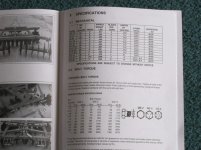
Two complaints: No operator's manual with the Howse. I like manuals. When adjusting the rear gang I found the left clamp bolt to be 4-1/2" long, instead of 5" like the other five clamp/adjusting bolts. Sloppy assembly. So I drove 20 miles/round trip to Tractor Supply for a $3.52, five inch replacement bolt. I have added upper/lower zinc chromate plated flat washers to six gang angle adjustment bolts to preserve the paint.
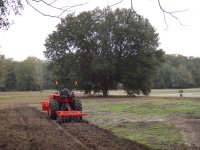
Photo #1 Howse DLHT 16822B
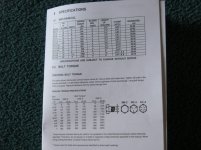
Photo #2,#3,#4 Clamp Plate adjustment of gang angles.
Photo #5 "Double Ear" dropped clevis.
Photo #6 Lift clearance.
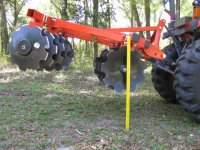
Photo #7 Short Top Link, rear gang lifted, transfers additional weight to front gang.
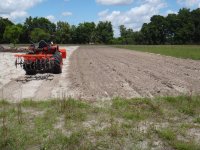
Photo #8 Howse behind Kubota B3300SU.
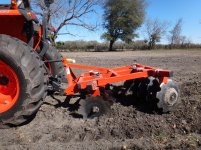
Photo #9 Howse behind Kubota L3560
Tandem Disc Harrows are manufactured in two structural types: Angle Iron Frame and Box Frame. Box Frame Disc Harrows are stronger, heavier, have greater adjustability of the gang angles and, having welded frames, are not prone to working loose like Angle-Iron Frame Disc Harrows. If the budget allows, purchase a Box Frame Disc Harrow.
February 28, 2013 I took delivery of a Howse, box-frame, 3-Pt. Disc Harrow, Model DLHT16822B, from my local Kubota/Howse dealer. The dealer, from who I bought my tractor, recommended the Howse DLHT. At the time I was researching Disc Harrows from Land Pride, Everything Attachments (ETA), TSC/Countyline and Monroe Tufline
Howse describes the DLHT series as MEDIUM DUTY. Howse DLHT is a 16/18 Disc Harrow, meaning 16 discs, each 18" in diameter, spaced 9-1/2" apart. It cuts a swath nominally 5'-6" in width, adjustable by sliding the disc hangers in or out. The Howse DLHT16822B weighs 587 pounds. It has a 1" axle on sealed flange bearings. (There is a T-B-N consensus that to cut vegetation Disc Harrows should have 40+ pounds weighting each disc. My Howse has 37 pounds weight per disc; at times I wish for a bit more weight.)
( Howse sells Heavy-Duty DHT Series Disc Harrows, with 20" discs and 1-1/8" axles, in 16/20 {878 pounds / $1741 FOB Factory} and 20/20 {1,097 pounds / $2049 FOB factory} configurations. ) ((May be cheaper from a Howse dealer.))
My primary Disc Harrow objectives involve CUTTING; opening new game feed plots, maintaining vegetation free fire breaks and vegetation control along woodland trails. Harrow weight on 16 discs, rather than 20 discs, puts more cutting weight on each disc. Spacing between discs is 9". If you have rocky soil, 9" disc spacing may be advantageous.
Tractor users with SMOOTHING (plow furrows) as their priority may consider the 20/18 or 20/20 configuration. Both have 7-1/2" spacing between discs.
Disc Harrows are available with two types of discs: notched and smooth. Notched discs cut pasture grass and crop stubble better; in open soil notched blades jerk out trash, meaning vines and tree roots, which sporadically stick in the notches. Notched discs deform easier than solid/smooth discs working rocky soil. Thicker discs, if notched, are less prone to deform in rocky soil than thinner notched discs.
Smooth discs roll over some vegetation that notched discs will cut through.
Standard configuration for Howse Disc Harrows is notched discs front, notched discs rear.
((Synonyms for individual discs: wheels or pans.))
Discs for compact tractor harrows come in 16"-18"-20"-22 diameter. Generally speaking, sub-compact tractors will use 16" diameter notched discs, mid-size compacts 18" diameter notched discs. Thirty-five (plus) horsepower, heavy frame, utility tractors may opt for heavier 20" or 22 discs. Weight is your friend.
Four-wheel-drive tractors require 5-horsepower per foot of Disc width.
The three point hitch Top Link is used to adjust relative front/rear gang pressure on soil. Longer Top Link: more soil pressure on rear gang. Shorter Top Link, more soil pressure from front gang.
Some increase in pan penetration can be achieved by shortening the 3-Pt. Top Link until the rear gang is raised into the air, transferring rear gang weight to the front gang. This can sometimes be useful for penetrating vegetation on the first pass across a field.
Issues with disc diameter are concavity, wear, harrow weight and clearance lift. Smaller diameter discs generally have less concavity (less "float") than larger discs, so they theoretically penetrate easier; smaller discs are thinner/sharper than larger diameter discs. Larger diameter discs generally have greater concavity, so move more soil laterally. Larger diameter, thicker discs wear longer before requiring replacement. Larger diameter, thicker discs add to harrow weight, which offsets "float", improving penetration.
Replacement 18 inch discs are available in 3mm, 3.5mm, and 4mm thickness. Replacement 20 inch discs are available in 3.5mm, 4mm, 4.5mm, 4.76mm, 5mm and 6.35mm thickness. As shown, diameters and thickness overlap. Thicker discs are heavier. (Agri-Supply offers 516 individual disc types on its web site.)
Discs of larger diameter require more lift from the three point hitch. Clearance can be an issue when crossing ditches, rough ground and loading or unloading a tractor mounted Disc Harrow from a trailer.
My Howse has a dropped double clevis (two "ears") to receive draw pins. A dropped clevis is desirable on a Disc Harrow for an 18-45 horsepower tractor; it allows the 3-Pt. to lift the harrow earlier. Note Photo #6, showing my Howse in the air. Minimum disc height above ground is 14-1/2", greater than 14" ground clearance of my B3300SU tractor. This is ideal.
I prefer a wide double clevis, which accepts separate draw pins, to protruding, bolt-on "open" draw pins. The double clevis provides a stronger tractor/harrow connection, which distributes draft strain. TSC/Countyline by Tarter, 84 Disc Harrow, suitable for a tractor larger than mine, has "open" draw pins protruding from the harrow frame; in a "normal", undropped position. The Land Pride DH1560/60 has dropped "open" draw pins. Wider Land Pride Disc Harrows have preferred double clevis standard.
The Howse, with its 3" wide, dropped, double clevis is the easiest implement I own to mount on the three point hitch.
Most 5'-6'-7' Disc Harrows provide gang angle adjustment via clamp plates and adjustment holes in the frame. Clamp plate adjustment is simple, strong and inexpensive to manufacture but time consuming to adjust in the field. While the need to change gang angles will vary by user, adjustment is NOT an everyday event for me.
My Howse has five adjustment holes in the frame per gang, some brands have four.
Clamp plate adjustment works via three through bolts/nuts per gang, clamping twinned upper and lower adjustment plates, which have a pair of rib guides on the top plate mirrored by a pair of rib guides on the bottom plate. To adjust one gang angle, the two outer bolts/nuts are loosened with a wrench, the center bolt, which passes through adjustment holes in the frame, is removed, then the gang is pulled and jiggled to line up holes in sliding adjustment plates with alternate holes in harrow frame, using gang length for leverage. The center bolt is replaced and all three bolts/nuts tightened with the wrench. Repeat for the second gang. {Loosening/replacing bolts/nuts is a 15 - 20 minute process.} I have applied wax lube to the harrow frame over which the adjustment plates slide. New, it adjusts easily. I understand with paint abrasion, rust, dust, deformity, etc., gang adjustment becomes harder. However, I will settle on a 'default' gang angle setting soon and only change gang angles occasionally thereafter.
Some TBN threads suggest substituting a 5" pin as a pivot, in lieu of the center bolt. With only a center pin, it seems possible the center support could "jump" the guides under load; stay with the center bolt and nut.
Three Disc Harrows could be accurately described as HEAVY DUTY, by design and by weight. All adjust gang angles more readily than the common friction plate arrangement but you pay for the convenience. If you will disc multiple soil conditions it will be worth paying the quick adjust premium.
Everything Attachment's ETA-XD-BF-DH-16-18 disc harrow weighs 686 pounds (43 pounds/disc) and is priced at $1554 delivered to Fanning Springs, North Florida. The ETA disc has two, long, gang adjustment screws, one adjusts each gang. I admired ETA screw-adjust disc at the 2012 Sunbelt Ag Expo in Georgia.
I have purchased several implements from ETA. I respect ETA's quality and excellent customer service.
Leinbach box-frame disc harrows use an identical screw adjustment.
Monroe Tufline's THE71618BF disc harrow (1-1/8" axle) weighs 670 pounds (42 pounds per disc) and was quoted at $2100, plus a local delivery charge. Tufline promotes lever adjustment of the gang angles. I researched the Tufline 'THE' discs on Tufline's very basic web site. I have not seen a Tufline with mine eyes but the Tufline brand enjoys an excellent reputation. Monroe Tufline makes a huge range of Harrows for CUTS through Big-Ag.
Brown Manufacturing Corp., Ozark, AL, produces the BDH-600-1620 Disc Harrow (1-1/8 axle), 6?4 width, 1095 pounds (68 pounds per disc!) with lever gang angle adjustment priced at $2535 FOB factory. I researched Brown's BDH Disc Harrow on Brown Manufacturing's web site.
Price is not the first priority when I purchase attachments. However, my Florida rock free, sandy-loam is not challenging to disc so I bought the Howse DLHT as adequate and a good value. I paid $950 delivered. (No sales tax in Florida on ag or forestry equipment.)
Pulling a Disc Harrow is high draft force work. Not only is the implement weight being pulled, but the discs are resisting passage through the soil, proportionate to gang angle adjustment. Box frame Disc Harrows require minimum five tractor horsepower per foot of width, plus four-wheel drive for traction. To optimize soil mixing a Disc Harrow must be pulled at a brisk pace.
I pull the Howse behind a Kubota B3300SU tractor/loader. ( 33-hp / 1,900 pounds / 4-WD / 58" tire width ) Tractor and Howse 587- pound Disc Harrow are well paired.
The B3300SU is in HST/MED range pulling the Howse. In repeatedly cut soil, in which the Disc Harrow will sink deep, additional throttle is required to keep the B3300SU from bogging down. Infrequently, I need to lift the Harrow just a tad. Adjusting gang angles to a less aggressive setting will reduce draft force.
Disc Harrows are frequently used to prepare game food plots. For food plot preparation, where you will maneuver between trees and boulders and work on slopes, buy a disc no wider than your tractor's rear tires. Any wider and the tractor will pass through gaps but the disc will "hang up" and you will waste time extricating tractor+harrow combination, possibly banging up your tractor in the process. It is important to buy a heavy enough Tandem Disc Harrow, which is really a secondary tillage implement; it is rarely practical to make a second pass over food plot ground. Fortunately, plot seeds are eager germinators.
It is important to tighten the four axle nuts regularly on a new disc harrow; they loosen. If the four axle nuts are tightened regularly the entire gang assembly will settle-in eventually and thereafter axle nuts require tightening infrequently. If axle bolts are not kept tight, disc hubs and axles will work each other, ruining one or both.
A test for tightness involves "ringing" the discs with a mallet when the harrow is elevated. A loose disc will give off a flat tone.
Howse offers its harrows in Kubota orange paint. Thank you, Howse. Standard Howse color is red.
Two complaints: No operator's manual with the Howse. I like manuals. When adjusting the rear gang I found the left clamp bolt to be 4-1/2" long, instead of 5" like the other five clamp/adjusting bolts. Sloppy assembly. So I drove 20 miles/round trip to Tractor Supply for a $3.52, five inch replacement bolt. I have added upper/lower zinc chromate plated flat washers to six gang angle adjustment bolts to preserve the paint.
Photo #1 Howse DLHT 16822B
Photo #2,#3,#4 Clamp Plate adjustment of gang angles.
Photo #5 "Double Ear" dropped clevis.
Photo #6 Lift clearance.
Photo #7 Short Top Link, rear gang lifted, transfers additional weight to front gang.
Photo #8 Howse behind Kubota B3300SU.
Photo #9 Howse behind Kubota L3560
Attachments
-
 DSC00147.jpg1.1 MB · Views: 2,744
 -
 IMG_0630.JPG80.6 KB · Views: 4,504
 -
 IMG_0629.JPG98.4 KB · Views: 26,890
 -
 IMG_0628.JPG57.9 KB · Views: 2,463
 -
 IMG_0597.jpg149.1 KB · Views: 2,476
 -
 IMG_0566.JPG57.5 KB · Views: 1,459
 -
 IMG_0589.JPG48 KB · Views: 1,468
 -
 IMG_0591.JPG106.1 KB · Views: 4,532
 -
 DSC00167.jpg1.1 MB · Views: 3,801
Last edited: