Pole barn versus Floating slab

   / Pole barn versus Floating slab #1  

BuilderML

Gold Member
Joined
Nov 22, 2012
Messages
484
Location
Tolland, CT
Tractor
CCY SX3100
After reading so many treads about people building a pole barn followed by pouring a slab after the pole barn is completed. It leaves me to ask WHY? Why not pour a floating slab and do regular stick framing? To me it just seems much easier to do stick framed walls and not trying to line up piers or holes perfectly and have post sticking up in the air having to line those up. I will be building a shed 16'x24' shortly for my father in law. Here is what i plan on doing.
Step 1- Prep site, removing organic material, Place 6"-12" of stone under slab.
Step 2- Form and pour 16'x24' slab, 10"x12" along perimeter (underneath exterior walls) and 5" slab remaining area, 2'X2' rebar grid for whole structure with 2 rows for perimeter. Lay 6 mil poly over stone prior to pour.
Step 3- Frame exterior walls 2x4 16" o.c, 7/16" osb sheathing, tyvek, smart side t-111 for exterior finish.
Step 4- 2x8 16"o.c ceiling joist spaning 16', 2x6 rafters 16"o.c, 7/16" osb roofing sheathing.
Step 5- roofing
Step 6- Kick back enjoy a beer
The whole cost for this i have at about $6000. which includes removing existing shed 18'x20' discarding into dumpster. 1- 9x7 overhead door, 2-windows, 1-6' door.
Reason for using osb is to try to cut cost.
The cost at 6k does not include labor. With what i have listed above i don't see how it can be cheaper or easier to build a pole barn. Those who have done pole barns please fill me in on how you figure it would be wiser to do a pole barn.
In my are one can go up to 24'x24' with a floating slab. (per inspector)
Thank you i look forward to seeing what others have to say about the cost and point of view of similar sized pole barns.
 
   / Pole barn versus Floating slab #2  
Building something that small I would not go the pole barn route either.
 
   / Pole barn versus Floating slab #3  
Reason A, that's a tiny building.
Reason B, in many locations, one cannot find suitable bearing soil immediately below turf. I suspect you don't have it either, and your otherwise unachored building is going to move at the whim of the seasons.
Reason C, in many locations, pole building are considered "temporary" and are not taxed (or taxes like residential structures), and are not governed by local building codes, thus saving time, money and aggravation to the power of infinity.

$0.02
 
   / Pole barn versus Floating slab #4  
About 10 years ago, I put up a one car garage on a slab foundation similar to what you describe, but it was smaller, 14x22 I think. I made the area under the walls thicker as you describe. The building code allowed for it for that size structure and specified the slab foundation about the same as you describe.

I sold the place shortly after, so I can't tell you much about the longevity but I have driven by it several times and it still looks square.
 
   / Pole barn versus Floating slab #5  
I have never done that except with small storage sheds. If there is to be an issue I would guess it would be with freeze/thaw cycles unless you go below freeze zone with footings. The other thing to be careful of is to make sure your slab has adequate drainage as you are going to have untreated lumber close to the ground. I would also use a six bag mix with fiber, and make sure you tie those bearing sections of the wall to the main floor with rebar. I am guessing there will be cracking where the floor transitions from thick to thin. A building is no better than its foundation. If it was me I would dig down to the freeze level and frame up a short wall getting the base of my wall off the ground ten inches or so. Will make a much better building. You will be able to wash the floors without soaking the mud sill, you will be able to pour the interior floor at a angle to aid washing the floor. The closer to the ground your framework is the better termites like it. The more I think about what your doing the less I like it actually. Take the extra step and be happy the rest of your life.
 
   / Pole barn versus Floating slab #6  
I just remembered that after I poured the slab, I put a row of blocks around the perimeter to keep the wood structure higher off the ground. You still use a treated sole plate but can then use regular 2x4's for the studs.
 
   / Pole barn versus Floating slab #7  
I don't understand it either, but I think it's because most people don't understand the basics of building and they think that a pole barn is better or cheaper. The only advantage to building a pole barn is when you are NOT going to pour a concrete floor. Once you decide to pour concrete, it is better to go with stick framing.

Eddie
 
   / Pole barn versus Floating slab #8  
That size pole barn would cost about $2-4K for materials, not counting the floor. The methods each have their pros and cons, so you really need to look at the job and site requirements. You can go to the diypolebarns.com site to price a kit.

Speed of construction is one benefit of pole barns, which can influence labor costs if you're paying someone else to do the work. If not, that factor goes away.

Setting poles and putting up wall girts goes fast once the holes are dug, so that's not a real issue to me. It's pretty easy if you have experience. No question it will go faster than stick building for sure.

In my case, not having time to do the whole project by myself, I compared sq ft costs for pole construction versus stick building for a 20x20, and the pole barn was significantly cheaper. The crew of 3 had the structure and roof up in one day, including a short delay waiting for a footing inspection. After that was siding and trim (board & batten) which went slower. Total was 2.5 days. It would have been 1.5 days if we had steel siding/roof.
 
   / Pole barn versus Floating slab #9  
By the way, if you don't need concrete floor slab for loads, going with a framed floor on blocks or piers is even cheaper. I used to build sheds like that many years ago as a summer job. Don't overlook that option if you can get by with framed floor and plywood deck. It is even more amenable to stick building than slab.
 
   / Pole barn versus Floating slab
  • Thread Starter
#10  
Before this goes off in the wrong direction. I will try to reword my question. Question being. Why one selects a pole type structure versus a slab from a cost stand point and as well as ease of building. Removing 1000 from the 6000 in the cost of the build due to old building disposal. So for about 5000 or $13 a square foot you get a storage shed. Maybe i should of asked what people have paid for a pole building with a slab poured after cost per sq ft. for a similar sized building.

To answer some of the previous responses.

1)The building longevity is not in question. Personally i would take a slab over a wood pole in the ground any day. Most buildings this size around here are p.t. 4x4 with 3/4" p.t. plywood floor over a stone bed.
2)Frost walls are not being poured due to added cost. Would that be ideal? yes. Its not my money to spend.
3)I am not concerned as the framing will be 8"-10" from the ground versus being set on a foundation wall. The wood portion of the building will not be in contact with "Grade".
4) Walls will be tied to slab with anchor bolts.
5) Fiber will not be added as i have a 2'x2' rebar grid for the whole structure. Fiber in my view would be useless in this case as rebar is far superior.
6) The building will be set on a stone bed about 12"(maybe more depending on how much organic matter is removed) with perf pipe draining to daylight. So drainage won't be an issue.
7)Not that he plans on taking a hose to clean off the floor. But how is getting the sill plate wet any different to getting the wood post wet or the exterior wall covering and or battens of the pole building wet?
I did not list all the steps that will be done for the build or all the details. I just wanted to give those who have a similar pole building an idea of what type of structure i wanted to compare to for pricing. I see most pole buildings have enclosed walls. For example i wouldn't be able to compare pricing to a pole building with just a roof.
Maybe as years go on i will keep updating this thread to keep people informed on how this method of building holds up over time.
Thanks for the replies.
 
   / Pole barn versus Floating slab #11  
I think a lot of it comes down to size of the building and code. A small shed would probably be fine with just building on top of a floating slab. A larger garage may by code require to be footed below the frost line, which here is 48". With that being said, the garage I am planning will be post frame construction with a slab poured inside after. Doing all the work myself a post frame will be much easier than stick building. I feel I can set the posts in concrete in the ground for a lot less money than it would cost to pour a 4' footer wall around the entire foundation. Again, it would all depend on local codes and the size of the building.
 
   / Pole barn versus Floating slab #12  
As long as the stone base is compacted I think it will be fine.

As to cost of a similar size structure, sorry can't help on that but you should be able to estimate it - 4 × 6 posts sunk 4 ft using either 12 or 14 footers depending on how tall you want the walls, 8 foot on center. 3 rows of 2 x 4 for purlins, sandwich the poles with 2 x 12 s at the top to carry your rafters. A bag of concrete in the bottom of each hole. I think the rest is the same construction you're planning except not thickening up the perimeter of the slab.

I agree the re rod eliminates the need for fiber.
 
   / Pole barn versus Floating slab #13  
It's a good question. :) Obviously the answer should be different in different climates, different soils, and for heated or unheated structures.
From what I have observed with my house, frost penetration is tied to drainage, and whether or not the area around the building is cleared of snow. The driveway leading to our garage completely reverses it's slope in a winter with lots of cold. It has two things against it: the snow is cleared allowing deeper frost penetration, and about 30-40 feet out from the house is the meeting point of two drainage slopes.

Once the ground freezes to any depth the water is no longer carried away by the french drain across that area, the water can't get to the drain. The ground water forms an ice lens that just keeps growing. It will penetrate below the 2" styrofoam 8' wide apron I have buried around the house. I have a frost wall on a footer, so that doesn't cause me any worries, but it is interesting to watch what happens, and what that would mean to a frost-protected shallow foundation that uses the same foam apron technique minus the footer and frost wall. Surface and below grade drainage really matters.

In a good drainage location--with additional foundation drainage installed in a good bed of gravel beneath the slab, I believe a frost-protected shallow foundation would work here with a perimeter depth of 24" or so. Styrofoam has become so expensive though that I don't think it saves much in material costs over a footer and frost wall. A footer and frost wall takes the guess work out of it as far as frost heaving is concerned.

For a simple two car garage I would be willing to try the slab, but for a larger building that has a lot more invested in it, I would bite the bullet and go with the tried and true footer and frost wall, and stick build on that in my location. Pole barns have their place for sure, but it depends on what the goal or use is.
 
   / Pole barn versus Floating slab #14  
Before this goes off in the wrong direction. I will try to reword my question. Question being. Why one selects a pole type structure versus a slab from a cost stand point and as well as ease of building. Removing 1000 from the 6000 in the cost of the build due to old building disposal. So for about 5000 or $13 a square foot you get a storage shed. Maybe i should of asked what people have paid for a pole building with a slab poured after cost per sq ft. for a similar sized building.

To answer some of the previous responses.

1)The building longevity is not in question. Personally i would take a slab over a wood pole in the ground any day. Most buildings this size around here are p.t. 4x4 with 3/4" p.t. plywood floor over a stone bed.
2)Frost walls are not being poured due to added cost. Would that be ideal? yes. Its not my money to spend.
3)I am not concerned as the framing will be 8"-10" from the ground versus being set on a foundation wall. The wood portion of the building will not be in contact with "Grade".
4) Walls will be tied to slab with anchor bolts.
5) Fiber will not be added as i have a 2'x2' rebar grid for the whole structure. Fiber in my view would be useless in this case as rebar is far superior.
6) The building will be set on a stone bed about 12"(maybe more depending on how much organic matter is removed) with perf pipe draining to daylight. So drainage won't be an issue.
7)Not that he plans on taking a hose to clean off the floor. But how is getting the sill plate wet any different to getting the wood post wet or the exterior wall covering and or battens of the pole building wet?
I did not list all the steps that will be done for the build or all the details. I just wanted to give those who have a similar pole building an idea of what type of structure i wanted to compare to for pricing. I see most pole buildings have enclosed walls. For example i wouldn't be able to compare pricing to a pole building with just a roof.
Maybe as years go on i will keep updating this thread to keep people informed on how this method of building holds up over time.
Thanks for the replies.

To answer some. I don't know why you would build and longevity not be an issue. Heaving of a floating slab over time will cause cracking and separation if you are in a climate that has deep freezing. if you can get the wood 8 to 10 inches off the ground water contact will not be an issue. I have seen poorly placed slab floors that would actually flood from run off. Fiber costs about 10 bucks extra per yard. It is not biodegradable like steel. I am not saying it is a substitute for rebar, but rather more insurance against problems. Once concrete is down its kind of hard to upgrade. If you are pouring a level slab, so your building is level you will not have a slope for drainage, however if you pour it in a two step pour (short wall for level and floor for slope) you will have drainage. A treated sill plate in a damp area will rot faster than tongue and groove treated lumber positioned vertically. If your sill plate does rot you are in major ****.

If I had to choose between a building with a short wall foundation having a slab floor inside vs. a pole building with a slab floor I would choose the foundation building. If I had to choose between a pole building vs. a stick building constructed over a floating slab I would choose the pole building. As I feel the later is destined for problems.

Over build and you will never be sorry, or as the old saying goes "The high cost of cheap construction".
 
   / Pole barn versus Floating slab
  • Thread Starter
#15  
When i say building longevity is not in question. I am saying that this WILL stand the test of time. I see how one could take what i said the wrong way. Sorry about that. "Pitching" a slab or creating slope in a garage is good when needed. In this case it won't be due to what is stored inside. There won't be a car pulling in with snow on top that will melt of inside or a car in from a rain storm that drips all over the floor. I will be pitching the door locations only to address rain issues but aside from that the whole slab doesn't need to be sloped. As far as frost depth goes. code is 42" around here, in reality the most i have ever come across would be 24". I agree that foundation walls would be best. I think someone in a previous post said the location does play a lot into why one would select different types off building methods. I completely agree. Thats why we have different codes for different areas and thats why this building is being built the way it is. Once this slab is set i would not be scared hooking up to it some how and take it for a spin in the woods with out it breaking up. First i would need something big enough for it and i can tell you the father in laws JD wouldn't be up for the task. I am not sure where you are from but for this area i am not using "cheap construction" in some areas i would not use the method i am using.
 
   / Pole barn versus Floating slab #16  
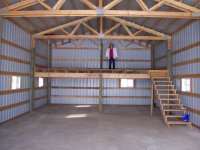
I had a local contractor do my 24x48 PB with a loft and concrete floor.
The concrete is insulated under the loft, which I've since enclosed as a office/man cave.


100_0468.jpg
 
   / Pole barn versus Floating slab #17  
I am from Illinois. 30 inches for frost depth here. It appears your mind is made up. Please do not take anything I say as an insult. I am just offering food for thought, and relating what has worked well for me. There are many ways to skin a cat. Whatever you do, do it as best you can, and good luck to you Sir.
Tim
 
   / Pole barn versus Floating slab #18  
1)The building longevity is not in question. Personally i would take a slab over a wood pole in the ground any day. Most buildings this size around here are p.t. 4x4 with 3/4" p.t. plywood floor over a stone bed.

Poles, fence posts, etc will rot at ground level if water is able to collect around the pole. This rather easy to prevent, either with plastic pole barriers, or simply by pitching the ground/concrete around the pole at ground level. The part of the pole in the ground is the part you have to worry least about!


2)Frost walls are not being poured due to added cost. Would that be ideal? yes. Its not my money to spend.

Big mistake, and that is artificially making your numbers look better because you're skipping a big requirement. Not sure how you could honestly compare to a pole building that would have footings below the frost line.

5) Fiber will not be added as i have a 2'x2' rebar grid for the whole structure. Fiber in my view would be useless in this case as rebar is far superior.

Fiber and re-bar are not interchangeable concepts. Re-bar (or wire) is intended to reinforce the tension side of concrete (since concrete has no strength in tension). It has no real benefit for any other purpose. Fiber, on the other hand, can both reinforce the tension side and prevent general cracking. If you have ever done demolition on fiber-reinforced concrete, it's a huge difference. Hit regular concrete with a jackhammer and you send long cracks off in multiple directions. With fiber-reinforced concrete, the jackhammer only punches a hole and you will have to keep moving to create a long crack. So I think fiber is well worth the small cost, and it certainly does not preclude the use of re-bar. Use re-bar to reinforce the concrete for tension loads. Use fiber to provide homogeneous reinforcement of tension and compression loads and prevent general cracking.

7)Not that he plans on taking a hose to clean off the floor. But how is getting the sill plate wet any different to getting the wood post wet or the exterior wall covering and or battens of the pole building wet?

That is exactly the scenario I described above that can rot poles. Letting water wick in between a concrete slab and a bottom plate will rot that bottom plate in no time.

As far as pricing, basic pole barns with metal siding/roof run about $7-9 per square foot for materials, and $5-6 per square foot for labor. Figure another $3-4 per square foot for a concrete floor slab (materials and labor). So total is $15-18 per square foot materials+labor. With a proper foundation/footer stick-built construction, I was seeing materials+labor costs at least 2-3X that.
 
   / Pole barn versus Floating slab #19  
Look up rubble trench foundation. I've done this on 3 buildings in central PA and they've been just fine.
 
   / Pole barn versus Floating slab #20  
I paid $19,86 sq ft for my PB, including the loft and stairs...no taxes and cheaper labor in Oregon.

Posts set on a poured pad, 48" down.
 

Tractor & Equipment Auctions

2004 Toyota Camry Sedan (A59231)
2004 Toyota Camry...
PALLET OF SCRUBBER PODS (A58214)
PALLET OF SCRUBBER...
Honda EM3500S Portable Gasoline Generator (A59228)
Honda EM3500S...
1979 Ford F-100 Ranger Pickup Truck (A59230)
1979 Ford F-100...
John Deere Gator (A53317)
John Deere Gator...
2018 INTERNATIONAL 4300 26FT NON CDL BOX TRUCK (A58017)
2018 INTERNATIONAL...
 
Top