Grade of steel used for implements?

/ Grade of steel used for implements? #1  

Gus Osmium

Member
Joined
Jul 27, 2015
Messages
26
Location
Wandandian, NSW
Tractor
Eastwind DFS 65 hp
Hello tractor people,
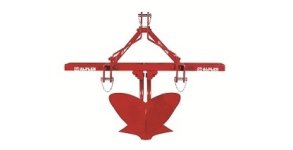
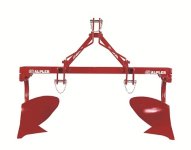
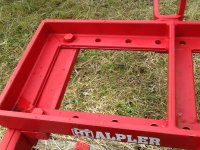
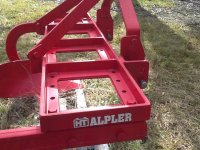
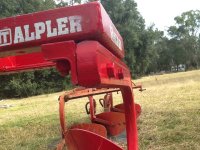
I have a plough and want to extend the width of the rectangular top frame to allow the moldboards to be set wider.

I'm a little wary of just welding on additional mild steel to each end of the frame as the supplier claims the plough is heat treated (but can't tell me what grade of steel it is fabricated from or which parts have been heat treated).

Can anyone provide advice on what grade of steel are likely to be used for fabrication of a plough like this, and which parts are likely to have been heat treated?

Thanks,
Gus
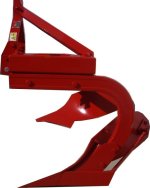
image.jpgimage.jpg
 
/ Grade of steel used for implements? #2  
For myself : get comparable sised square tubing, 3/8 plate for fillet supports and do it. Due to extra width there may be a need for fillet plates on parts of the original frame.
 
/ Grade of steel used for implements? #3  
I'd be amazed if any of that upper frame was other than mild steel, or heat treated. The arms holding the mouldboards are probably alloy, and heat treated for spring temper, but aside from that the rest of the frame is likely made rigid through geometry and wall thickness.

Rather than fish plates, I'd put a heavy wall tube gusset inside the butt joint and plug weld it in a few places on the original frame and the extensions.
 
/ Grade of steel used for implements?
  • Thread Starter
#4  
Thanks Jim,
I've reinforced/repaired implements, minor stuff, but never just whacked additional steel on the end of a frame to extend it and my concern is that it is the extremities of the frame.
My guess is that the tip/toe of the mouldboard plough and the curved section are heat treated but I've never seen implements manufactured and never spoken to anyone directly involved in manufacture so I am only guessing.
 
Last edited:
/ Grade of steel used for implements? #5  
Hello tractor people,
I have a plough and want to extend the width of the rectangular top frame to allow the moldboards to be set wider.

I'm a little wary of just welding on additional mild steel to each end of the frame as the supplier claims the plough is heat treated (but can't tell me what grade of steel it is fabricated from or which parts have been heat treated).

Can anyone provide advice on what grade of steel are likely to be used for fabrication of a plough like this, and which parts are likely to have been heat treated?

Thanks,
Gus
<img src="http://www.tractorbynet.com/forums/files/build-yourself/434510-grade-steel-used-implements-image-jpg"/><img src="http://www.tractorbynet.com/forums/files/build-yourself/434509-grade-steel-used-implements-image-jpg"/>

How do you use that may i ask??
 
/ Grade of steel used for implements? #6  
Just use tubing same as on the implement and brace similar to what the plow has now. I wouldn't think any of the frame is more than mild steel so weld with 7018 electrode would be good. If any part is heat treated it would be the cast steel curved shanks for the plow.
 
/ Grade of steel used for implements? #7  
I bet the supplier knows nothing. The plowshares, cutting edges, spring supports etc are very likely heat treated (as said above by several). Doubt that the SQ tube is heat treated (or even heat treatable). It is "possible" that the SQ tube is made of a heat treatable material but unlikely.

Take a coarse hand file (a new, sharp one) and file off a corner of rect tube you want to evaluate. Find a comparable mild steel rect tube and do the same test. If the effort/result "feel" the same then it's normal mild steel (A500). There's also the "spark test" (better done in the evening!) but 1010 and 1040 can look about the same. I would try it though.

How much are you extending it? I bet you can get away with 25% extension. A couple considerations, fishplates or doublers on the outside will protect your weld joint but will create hard points, and your extensions will be very "visible". If you don't have the doublers (inside or outside), your welds will need to be very well done ,,,,, consider to make your cuts at 45degrees. What size is this SQ tube?
 
/ Grade of steel used for implements?
  • Thread Starter
#8  
It's not tube, it's angle 19mm thick angle. I'll clean the paint from one of the edges in a non-critical area and butt weld a piece of mild steel to test.
 
/ Grade of steel used for implements?
  • Thread Starter
#10  
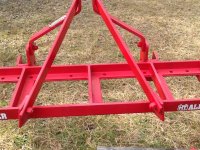
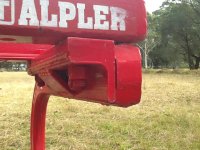
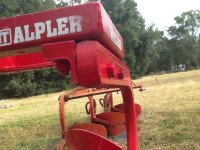
I'll post a close up picture tomorrow, the frame is 110x110x19mm equal angle. 19mm is the thickness.
Butt welding a piece of mild steel bar onto a non-critical area won't test the type of steel, it will just give me comfort that my electrodes and settings are suitable before I start working anywhere near the corners of the frame.
Thanks, Gus.
 
Last edited:
/ Grade of steel used for implements?
  • Thread Starter
#11  
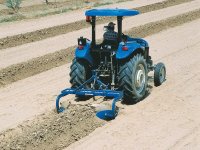
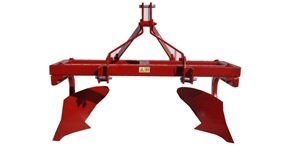
How is this plough used? Here is a pic of the plough in use.
It is pretty versatile, the ploughs can be set to face/turn soil inwards or outwards with a range of spacing widths between. Setting the frame with a single plough on the very edge of the frame facing/turning outwards (one side only) is a really efficient way to dig a contour drain across the slope with the upturned sod forming a mound below the spoon drain, and you can even do this closely along a fence line.
I have heavy subsoils and need to form raised beds for my orchard rows for improved drainage, but the frame is a bit too narrow for that so I want to widen it by 250mm (10") at each end. This will enable me to form up wider beds more effectively and with the minimum number of passes. One pass down the midrow with both ploughs set to turn soil from my rear wheel track to the outside (on each side). Importantly for my heavier soils the wider frame will allow me to then re-set the width so tips of each plough are set on the outside width of my rear wheel track (still facing/turning soil outwards) so I can make a second pass directly down the same midrow to turn the soil and the same already turned sods outwards again without having to drive directly over the already turned sod or the planting bed. The result being an elevated, un-compacted planting bed and lowered wheel tracks in my midrow for improved drainage, onto which I can broadcast the same tall fescues and phalaris grasses (both of which tolerate heavy soils and wet feet), lucerne and sub clovers that collectively make up my pasture.
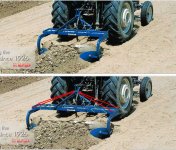
The plough is made for bed forming for row crops in cultivated soils as shown in the picture below, which I assume is why there is no cutting wheel in front of each plough like you find on many moldboard ploughs - but that is not what I use it for.
Thanks, Gus
image.jpg
image.jpg
image.jpg
 
Last edited:
/ Grade of steel used for implements? #12  
If you extend that you could add a diagonal brace from the 3-pt attach corner to the rear corner. Those plough shares will twist pretty hard on that rectangular frame.
 
/ Grade of steel used for implements? #13  
What do you call that implement? I would like to have one like it... Where did you buy it?
 
/ Grade of steel used for implements?
  • Thread Starter
#14  
Sodo,
Now that you've put it in writing is is so obvious. I feel like a clown. Thank you.
DJ,
it's sold as a "Ditcher Plough", manufactured by Alpler in Turkey. I sent an enquiry to them directly but have not had any reply. The model I have is SKP16, sold locally as being 2,000mm wide, the local distributor assured me that this was the width of the frame but it's not. Distributor is full of it, the frame width is only 1,600mm
See: Ditcher Plough
 
Last edited:
/ Grade of steel used for implements? #15  
Gus a different look is sometimes all it takes. I extended your ditcher appx 10" with photoshop. I like projects.

If you want to hide your 10" extensions ( grind off the welds ) maybe cut the 110mm angle at 45 degrees to make a much longer weld. Or if git'er done then just put 1/4" doublers over the welds on the inside of the angles. I drew the yellow lines both ways. The fishplate style (a diamond shaped doubler) has its merits too. Diagonal welds can confuse cracks, they don't know where to start. :D Theres more to it than that but that's the simplest I can explain it.
For the red links I'd make SQ tube links, like 2 x 2 x 3/16", with one pretty big bolt on each end. You can tab them onto the structure. The twisting force is the SAME whether it's original or 10" extension. The red links only need to make up for the defficiency of the extended rectangular frame.

434825d1438269687-grade-steel-used-implements-ditcherext10in-jpg


I'd certainly test it carefully (in increments of depth/speed/soil hardness etc) and watch it like a hawk how it flexes. And brace it up accordingly if it seems to have problems. You could send this pic to the MFR, and ask for their thoughts. They may have already thought of this, and upon seeing your interest and commitment to the wider size may offer assistance.

Engineers aren't going to like your plan, they have to consider the forces on your 3-point if it hits a rock on one side while the other side is in soft soil. Maybe you should too but I understand getting your farming done has its benefits too.
 

Attachments

  • ditcherext10in.jpg
    ditcherext10in.jpg
    86.4 KB · Views: 450
Last edited:
/ Grade of steel used for implements?
  • Thread Starter
#16  
Sodo,
Wow. That is so generous of you.
Thank you so much.
The last time I used photoshop was version 2 back in the Quark Express vs Pagemaker DTP era before the Adobe ascendency, when 32MB of RAM was high end... but by the time it got to v5 it had got away from me completely and I'd struggle to even open the application now.
I'm tied up today but will post the close up pics of the frame tomorrow.
Thanks, Gus
 
/ Grade of steel used for implements?
  • Thread Starter
#17  
Here's the close up pics of the frame

Thanks,
Gus
image.jpg
image.jpg
image.jpg
image.jpg
image.jpg
 

Attachments

  • image.jpg
    image.jpg
    303.4 KB · Views: 128
Last edited:
/ Grade of steel used for implements? #18  
Gus that is a stout frame.

Maybe it can be done entirely bolt-on. Build a square unit of similar construction that bolts onto the end of that frame, moving your plowshares 10 inches outboard. And picks up some of the bolt holes below too. And then add the red links as I drew earlier. Then you don't have to cut into that new unit just drill some holes.
 
Last edited:
/ Grade of steel used for implements?
  • Thread Starter
#19  
Yes, I am pretty happy with the robust construction. The limitation is that there are no shear bolts, which may be fine for frequently cultivated soil but a bit of risk for my use. My thinking, and the only option I can spot is to replace these two horizontal bolts with shear bolts.

Thanks, Gus
image.jpg
 
Last edited:
/ Grade of steel used for implements? #20  
I think Sodo has the right idea, looks like you might be able to bolt into at least four of the existing holes with a welded up assembly. Looks like a neat tool
 

Marketplace Items

2017 Ford F-250 4x4 Crew Cab Pickup Truck (A64556)
2017 Ford F-250...
2019 Allmand Night-Lite V-Series S/A Towable Light Tower (A64194)
2019 Allmand...
Case Axial-Flow Combine Wheels NO RESERVE (A63118)
Case Axial-Flow...
New 5400LB, Rachet Binders and G70 Chains (A62679)
New 5400LB, Rachet...
2003 MAC TRAILERS 45' WALKING BOTTOM TRAILER (A60430)
2003 MAC TRAILERS...
Wolverine TCR-12-48H Skid Steer Trencher  (A62679)
Wolverine...
 
Top