Considering a smaller tractor to avoid Tier 4 emissions difficulties

/ Considering a smaller tractor to avoid Tier 4 emissions difficulties #1  

Freep

Silver Member
Joined
Apr 12, 2018
Messages
110
Location
Duvall, WA
Tractor
Kioti CK3510SE TLB, BCS 852
Greetings, All,

As the title suggests, I am leery of government mandated emissions equipment. It isn't an ideological thing: I just remember the 70s. I worry that the Tier 4 engines will potentially require significant expense over time due to emissions equipment. I find myself leaning toward a smaller tractor simply to avoid potential Tier 4 issues. Am I being silly?

My goal is to purchase a tractor that will last forever if I take care of it and require as few additional expenditures and/or trips to the dealer as possible.

The tractor will be a CK series Kioti, so the actual size and weight will be nearly identical. And I frankly am not sure I need more than 25HP, but when I look at the cost of a CK2610 and then consider the relatively small increase in price to the CK3510SE, I start rationalizing: They are the same size and one wouldn't take up more space than the other... and so forth. Plus, everyone keeps telling me to buy a bigger tractor than I need. (Note: I probably only need a little sub-compact, so the 2610 is already an upgrade in that sense). I suspect y'all know this phenomenon very well. The only thing keeping me away from the 3510 is the Tier 4 engine, and I wonder if I'm making too big a deal of it. What do you think?
 
/ Considering a smaller tractor to avoid Tier 4 emissions difficulties #2  
You designate Seattle as your location. One of West Coast cities with highest land prices. How much land will you operate your tractor on?

Is your land flat or hilly? Could be either in Seattle. More power is needed to power up hills with heavy implements attached.

Need your tractor fit in a residential garage?

The average residential tractor owner clocks eighty engine hours per year, according to the last industry data I saw here. My Kubota regenerates once every sixty engine hours for sixteen minutes @ 2,200. Diesel cost for regeneration $1. Forget Tier IV as a problem. Your immediate problem will be object collisions as you begin operating a tractor. Some object collisions will damage your tractor, some the object, some both. I hope concomitant damage to your corpus will not occur.

Battery powered tractors may be ten years in the future.

Are you a residential tractor candidate, with lawn mowing and landscape work, maybe a kitchen garden, most of what you anticipate? Blackberries? Twenty-four horsepower MAY be ample for your needs. Tractor weight is more important than tractor engine horsepower.


jeff9366
Roosevelt HS Class Of 1965
Still a Roughrider.
 
Last edited:
/ Considering a smaller tractor to avoid Tier 4 emissions difficulties #3  
I personally would not buy a tractor based on avoiding the emissions. That's just plain silly. The tractor is a tool. If you're buying a tool that doesn't meet your demands for workload, then you're better off not buying at all. Just my opinion, and some folks seem paralyzed by fear of tractor emissions. Most important thing to think through is what are your wants, needs, demands for whatever tractor you buy? What are your horse power demands going to be? What is the biggest pto driven tool you need/want to drive off of your tractor? Then buy one that meets or exceeds that hp requirement and hang the notion that you need to avoid going over 25 hp.

Not all manufacturers "meet" the emission standards in the same way. Some systems are relatively easy to bypass or delete, and some are rather difficult to impossible. Depends on how the manufacturer decided to engineer their system. Some have complicated computer controls that monitor and change fuel delivery, or control active regeneration, and some systems are entirely passive in design.

Mine, for example, can be ENTIRELY defeated (deleted if you will?) by just removing the soot cooker, piping in a replacement muffler, and unplugging the "data logger" device. That's it. No other mods or changes, nothing needs to be "hacked" or reprogrammed. That is my long term "fix" for my tractor if the exhaust filter system becomes a problem. I'll just take it off, and have a true "70's" tech tractor.
 
/ Considering a smaller tractor to avoid Tier 4 emissions difficulties #4  
Many people worry over the Tier 4 emissions due to experiences with emissions equipment in the automotive world. I had a similar concern as i own a pre SCR diesel truck which had an oxidation catalyst and DPF similar to the Tier 4 system. In the on road application the engine control unit "managed" the regen process, which was not good. It produced poor milege, used excessive EGR, and had regens which would not complete (therefore being rerun) along with a long history of emission equipment failure. The Tier 4 system is similar to the pre-SCR diesel trucks, with the important exception that the tractor allows you to manage the regen. On my tractor it alerts when the regen is needed, but i have the control of triggering the regen which let's me perform the regen when i know i'll have time for it to complete. Granted if i ignore the regen alert for too long it will go into limp mode, but so far that has not been an issue and i've been able to complete my tasks and give it 20m or so to regen. I don't believe the Tier 4 equipment will be as problematic in tractor applications since the operator can manage the process ensure the regen runs to completion.
...that being said, as Slowpoke Slim mentioned, there are opportunities to work around emission equipment (especially once it is out of warranty)
 
/ Considering a smaller tractor to avoid Tier 4 emissions difficulties #5  
Tier IV on sub 75 hp tractors is simpler than your diesel truck's emission system because the requirements are less stringent. That's why there's no DEF. Branson uses old fashioned mechanical injection along with a low temp continual regen DPF. The data logger is there to tell you if the DPF is clogged. It seems to work well unless the operator does not run the tractor hard enough often enough to get the DPF hot. All DPF tractors will put more soot in the DPF when you do that, so all of them benefit from not being idled and being used hard periodically. The usual discrete regen system will just need regens more often if you don't.

Mahindra meets emissions by using sophisicated electronic fuel injection and combustion chamber shape... no DPF. Is that going to be more reliable than the typical system? It could be as there's one less thing (the DPF) but in practice it's hard to tell just from the design. It comes down to the actual components.

Everyone else meets Tier IV using both electronic fuel injection and a DPF. They all use high temp regens. It seems like the higher hp engines have less trouble with the regens, probably because they make more heat so the DPF can get up to the high temps needed. Smaller engines, especially turbos, have more of a problem. With many of the higher hp models people report little or no change in engine performance during a regen, and if it happens while they're working they just keep working.

Having gone from a non emissions tractor to a Tier IV Branson I have to say that the lack of soot and stink from the exhaust is greatly appreciated. If I have a problem with the DPF I can just take it off (something that can't be done on most tractors without hacking the ECU) but I'd hate having to breathe that junk again.

You haven't mentioned anything about your needs. If a 25hp tractor will meet your needs there's no reason to go bigger. But if you need a bigger tractor there's no reason to fear the DPF. Just do your research so you know what kind of system it is, how often it regens and how disruptive it is, and if owners are having problems.
 
/ Considering a smaller tractor to avoid Tier 4 emissions difficulties #6  
So I am probably a bit "odd" on this forum in that I do not think more HP is always the answer. I bought a 24 horse power New Holland because that is what I could afford reasonably at the time I bought. I fully expected in a few years when I could afford more I would buy more. Now I am not so sure that is the case.

I run an 18 acre horse farm in my spare time. The wife does day to day work of training, managing people who clean stalls and the like.

Our tractor hits more than the 80 hrs/yr stated above. But that may well be because we are not a typical home owner.

I have done some tasks with it where more HP would have been nice. I tilled about 10 acres with it last fall. That took a couple days. With a 50 HP tractor I am sure that time would have been measured in hours. I have also moved many yards of dirt. Again more HP would have done that more quickly.

So the question becomes the trade off between $$ and time. My big tasks are some of these one time things that needed to get done as a start up portion of our operation. Now that those are done the day to day mowing, moving small hay bales, loading manure into the bin can all easily be accomplished with my "little" tractor.

So I would not worry so much about Tier IV. Buy the tractor that will get done the jobs you want done in the time you need them done in. Also need to consider budget. It is easy to say "oh buy a bigger tractor", but if you don't have the money for a bigger tractor you may have to make some trade off choices.
 
/ Considering a smaller tractor to avoid Tier 4 emissions difficulties #7  
Greetings, All,

As the title suggests, I am leery of government mandated emissions equipment. It isn't an ideological thing: I just remember the 70s. I worry that the Tier 4 engines will potentially require significant expense over time due to emissions equipment. I find myself leaning toward a smaller tractor simply to avoid potential Tier 4 issues. Am I being silly?

My goal is to purchase a tractor that will last forever if I take care of it and require as few additional expenditures and/or trips to the dealer as possible.

The tractor will be a CK series Kioti, so the actual size and weight will be nearly identical. And I frankly am not sure I need more than 25HP, but when I look at the cost of a CK2610 and then consider the relatively small increase in price to the CK3510SE, I start rationalizing: They are the same size and one wouldn't take up more space than the other... and so forth. Plus, everyone keeps telling me to buy a bigger tractor than I need. (Note: I probably only need a little sub-compact, so the 2610 is already an upgrade in that sense). I suspect y'all know this phenomenon very well. The only thing keeping me away from the 3510 is the Tier 4 engine, and I wonder if I'm making too big a deal of it. What do you think?

If you don't need the bump in pto hp now or in the future, the CK2610 should serve you fine from what you wrote. Does the 2610 offer anything else than the "e" economy series 3510 to make it worth it? Other than pto, it appears most of other specs are pretty close, so I think your initial thought is pretty good on what you really require (sans pto hp requirement).
 
/ Considering a smaller tractor to avoid Tier 4 emissions difficulties #8  
Funny what some call silly, I call very wise. And why should we have complicated, expensive crap, that the manufacturers have no handle on and feel no obligation for, rammed down our throats?

Why not simply a nice, low hour tier zero tractor?

I predict that in the no so far distant future, these computer tractors will become a GIANT headache. Look at the myriad of threads about all the tractor problems with non electronic issues. What is going to happen when the connectors, wiring and sensors start giving trouble, particularly those that were not made with the absolute highest quality materials. Certain brands, yet to be determined will become worthless except for scrap and parts.
 
Last edited:
/ Considering a smaller tractor to avoid Tier 4 emissions difficulties
  • Thread Starter
#9  
This discussion is very helpful - many thanks to all for the valuable contributions. Some answers to questions and/or ideas and comments:

I have 10 acres of mildly sloped but fairly bumpy land - not enough, I think, to worry about going uphill. Currently about half of it is wooded and half has been cleared. I intend to re-forest at least a couple of acres over time. Once I fill in the various holes it will be less bumpy. There do seem to be some rocks scattered in with the soil, so there may be cases in which a little extra power is helpful to dig/drag out an inconvenient rock or etc. I think the most intensive operation will be skidding the occasional log. I can imagine doing some niche farming on a small scale, but I suspect the most stressful activity I'll be engaged in is lifting stuff. The Man's experience with having a lot of stuff needing to be done up front is probably similar to my situation. I don't mind it taking a little longer, because as Jeff notes I probably need to take it slow to avoid destroying things.

As I noted, I suspect that a SCUT would be ideal in many ways, but I want to have a bit more capability than I have current plans for given the advice I have received on this board. I also feel that SCUTs seem a little tippy, especially given the bumpiness of my land and my o bwn inexperience with tractor usage.

I will probably use a rotary cutter to some extent, but the tractor will primarily be for general utility. The reason I like the CK2610 is the weight and the fact that it has a larger engine in it, which should in (my) theory suggest more headroom. I have storage available. Probably, I will start out using the tractor as would a residential user, but I am generally ambitious with regard to tool usage. I'll find more ways to use it, I'm sure. I am generally uninterested in a used tractor due to my own inability to evaluate it, because I would like a warranty, and because used tractors cost so much relative to new ones. For this first tractor, I want it to work properly, or if not to be my dealer's problem to fix rather than mine.

Re: the Tier 4 engines, I am less concerned with regen (which I think I understand, and does not seem problematic to me) or cost thereof. I think I can manage to work the tractor hard enough once in a while to burn stuff off. :) I am concerned with potential equipment upkeep or replacement costs over time. I love the idea of aftermarket mods as Slowpoke Slim suggests, but I don't know the extent to which the Kioti CK series would permit that. (I am sort of locked into Kioti, as it is the best tractor for me that I can tell with a dealer nearby.) If I were to go bigger than the CK2610, it would be a CK3510SE or CK4010 SE. They are all the same size and near the same weight, and relatively close in price.
 
/ Considering a smaller tractor to avoid Tier 4 emissions difficulties #10  
1) I have 10 acres of mildly sloped but fairly bumpy land - not enough, I think, to worry about going uphill. About half is wooded and half has been cleared. I intend to re-forest at least a couple of acres over time. Once I fill in the various holes it will be less bumpy. There do seem to be some rocks scattered in with the soil, so there may be cases in which a little extra power is helpful to dig/drag out an inconvenient rock or etc.

2) I think the most intensive operation will be skidding the occasional log. I can imagine doing some niche farming on a small scale, but I suspect the most stressful activity I'll be engaged in is lifting stuff.

3) I suspect a SCUT would be ideal in many ways, but I want to have a bit more capability than I have current plans for given the advice I have received on this board. I also feel that SCUTs seem a little tippy, especially given the bumpiness of my land and my o bwn inexperience with tractor usage.

4) I will probably use a rotary cutter to some extent, but the tractor will primarily be for general utility. The reason I like the CK2610 is its weight and its larger displacement engine, which should generate greater engine torque, more of the time. I will start using the tractor as a residential user, but I am generally ambitious with regard to tool usage. I'll find more ways to use it, I'm sure.

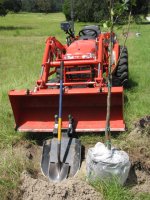
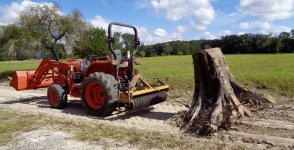
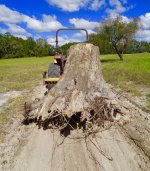
1) For removing rocks and other ground contact work, tractor weight is more important than tractor horsepower. You may wish to consider a Bucket Spade attachment. Photo #1, #2

Consider Dunstan Chestnuts for forest restoration. Mature Chestnuts are large trees.
ChestnutHillTreeFarm

2) Tractors are pulling machines. Tractors are geared low and those large rear wheels are further gearing down.
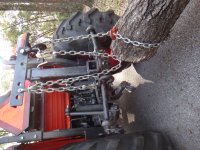
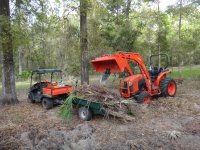
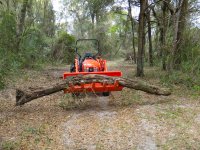
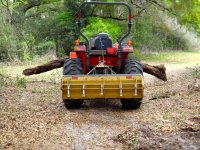
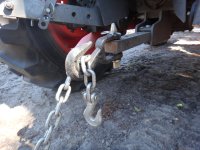
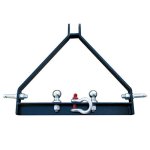
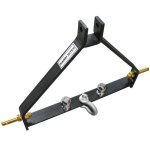
Even a 1,700 pound tractor can tow 8" diameter timbers. If you will tow timbers on hard surfaces roads, you will need a cross-drawbar to elevate timbers a few inches to prevent abrasion of your tow chain and decrease timber friction against the road. Photos #3 - #6


1) & 3) SCUTS have 7" to 9" ground clearance due to small front wheels.

Heavier tractors are built on larger frames with larger wheels/tires. Heavier tractors with large diameter tires have more tractive power pulling ground contact implements, pushing a loader bucket into dirt and pushing snow. Larger wheels and tires mean more ground clearance, enabling a heavier tractor to bridge holes, ruts and downed tree limbs with less bucking, yielding a less disturbing passage over rough pastures and woodlands.

4) http://www.lsuagcenter.com/~/media/...aa214276e14dacb/pub2917tractorimplements1.pdf

Buckeye Tractor Co -- Online
 

Attachments

  • 86545.jpg
    86545.jpg
    18.2 KB · Views: 444
  • 61559.jpg
    61559.jpg
    19.9 KB · Views: 460
  • DSC00670.JPG
    DSC00670.JPG
    3 MB · Views: 673
  • DSC00671.JPG
    DSC00671.JPG
    3.9 MB · Views: 597
  • DSC00692.JPG
    DSC00692.JPG
    4.7 MB · Views: 970
  • IMG_0428.jpg
    IMG_0428.jpg
    189.6 KB · Views: 715
Last edited:
/ Considering a smaller tractor to avoid Tier 4 emissions difficulties #11  
I had a Kubota B7100, which is a little larger than a SCUT. The Branson I have now is so much more capable there's no comparison. It pulls more, lifts more and carries more. A lot more.

Most tractors have their rated HP in the 2500-3000 rpm range. The rated rpm is usually the same or close to the PTO rpm, the rpm where the PTO is turning 540 rpm. HP being a function of torque and RPM, tractors that have the same HP at the same RPM make the same torque. When the rated HP is at different rpms, the gearing for the drive and PTO generally are changed to match that rpm, so the torque to the PTO and the wheels is still about the same.

An engine that's larger and making the same power might last longer. But as residential/hobby users we're not putting enough hours on our tractors to wear out even the most high strung tractor engine (if properly cared for) in our lifetimes.
 
/ Considering a smaller tractor to avoid Tier 4 emissions difficulties #12  
My 2011 BX25 SCUT is rated at 24 HP. I now have 1500 hours +/- on it. Until last year I used it on our 21 AC forested land doing a lot of improvements. It did all I needed and then some albeit slower. I am retired so time is not an enemy. It made hard work easy and fun. Drug around 10-12" firs and alders often. Dug a lot of ditches and dry wells, leveled ground, terraced hill sides, moved a lot of stuff around with the FEL forks. Pushed over small trees and dug up stumps of those 10-12" trees.

For what you are describing I believe a SCUT will fill your bill. Just get the proper implements to do the jobs you want to tackle. If you are handy with tools and can weld you can make and/or modify a lot of implements. A good dealer salesman can be a lot of help. Better yet ask us!

Ron
 
/ Considering a smaller tractor to avoid Tier 4 emissions difficulties
  • Thread Starter
#13  
Thanks again for all the input!

Really manhandling the trees I have some trees in the 30+" area that I would like to drag in fairly lengthy pieces. I'll also want to lift the near end as Jeff suggests (never seen that drawbar - will check it out; was considering a heavy duty boom). How long of a 30" bigleaf maple log do those of you with tree-dragging experience reckon I can pull? I'd like to cut some beams to use in timber framing or post and beam construction. I can quarter them as they get longer if I cannot pull them whole. This use (and pushing logs around with the loader or grapple) are one of the primary reasons I am looking beyond the SCUTs into the CUTs.
 
/ Considering a smaller tractor to avoid Tier 4 emissions difficulties #15  
I have trees in the 30+" area that I would like to drag in fairly lengthy pieces. I'll also want to lift the near end as Jeff suggests (never seen that drawbar - will check it out; was considering a heavy duty boom).

How long of a 30" bigleaf maple log do those of you with tree-dragging experience reckon I can pull? I'd like to cut some beams to use in timber framing or post and beam construction. I can quarter them as they get longer if I cannot pull them whole.

This use (and pushing logs around with the loader or grapple) are one of the primary reasons I am looking beyond the SCUTs into the CUTs.

My experience is with Oak. I guesstimate that 30" diameter green Maple might limit you to six feet or so. You will pull in HST/LOW RANGE, so speed maybe 1-1/2 mph? With smaller diameter sections the tractor can pull longer pieces. This could be an instance where more than 25-horsepower would be useful. BUY ENOUGH TRACTOR.

I pulled a hurricane downed 40" Oak section about 12' long the other day. I got it out of the woods and moving over the hard road fine. I stalled out when I reach a short 5 degree dirt slope at the burn pile. I halved trunk there with my Stihl MS461. I did not have my camera, unfortunately, as it was my max timber pull to date. My tractor is heavier than what you are considering and has 37-horsepower. Power to weight ratio probably similar.

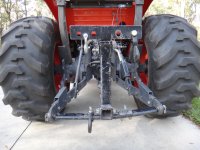
Tractor rear/center drawbar is directly attached to tractor. Rear/center drawbar withstand heavier loads than a cross-drawbar, but is fixed. Photo #1 - #3, Post 7, Photo #6
http://www.tractorbynet.com/forums/...ar-center-tractor-drawbar-use.html?highlight=

Few would use a boom to pull timber. You have to pull heavy loads low, or the tractor will roll. Nothing with weight center above rear axle. Also, bouncing over rough ground can produce huge transient loads which could bend or break a boom. With a boom, your load elongates due to boom length when load is low. When operating any tractor close to max, hazard quotient escalates.

With a heavier tractor with more FEL capacity you can move timber in front, keeping it dirt free for the sawmill. In Photos #4 - #5 I had a 630 pound Rollover Box Blade as Three Point Hitch ballast, even so the rear wheels were dancing light. Approximate FEL lift 1,700 pounds.


TRANSFORMER Quick Hitch Compatible Platform - OMNI Mfg LLC
 

Attachments

  • DSC00025.jpg
    DSC00025.jpg
    5.1 MB · Views: 294
  • DSC00026.jpg
    DSC00026.jpg
    6.5 MB · Views: 254
  • DSC00177.jpg
    DSC00177.jpg
    1.2 MB · Views: 285
  • DSC00178.jpg
    DSC00178.jpg
    1.1 MB · Views: 295
  • DSC00514.JPG
    DSC00514.JPG
    3.1 MB · Views: 234
  • DSC00061.jpg
    DSC00061.jpg
    5.9 MB · Views: 289
Last edited:
/ Considering a smaller tractor to avoid Tier 4 emissions difficulties #16  
This discussion is very helpful - many thanks to all for the valuable contributions. Some answers to questions and/or ideas and comments:

I have 10 acres of mildly sloped but fairly bumpy land - not enough, I think, to worry about going uphill. Currently about half of it is wooded and half has been cleared. I intend to re-forest at least a couple of acres over time. Once I fill in the various holes it will be less bumpy. There do seem to be some rocks scattered in with the soil, so there may be cases in which a little extra power is helpful to dig/drag out an inconvenient rock or etc. I think the most intensive operation will be skidding the occasional log. I can imagine doing some niche farming on a small scale, but I suspect the most stressful activity I'll be engaged in is lifting stuff. The Man's experience with having a lot of stuff needing to be done up front is probably similar to my situation. I don't mind it taking a little longer, because as Jeff notes I probably need to take it slow to avoid destroying things.

As I noted, I suspect that a SCUT would be ideal in many ways, but I want to have a bit more capability than I have current plans for given the advice I have received on this board. I also feel that SCUTs seem a little tippy, especially given the bumpiness of my land and my o bwn inexperience with tractor usage.

I will probably use a rotary cutter to some extent, but the tractor will primarily be for general utility. The reason I like the CK2610 is the weight and the fact that it has a larger engine in it, which should in (my) theory suggest more headroom. I have storage available. Probably, I will start out using the tractor as would a residential user, but I am generally ambitious with regard to tool usage. I'll find more ways to use it, I'm sure. I am generally uninterested in a used tractor due to my own inability to evaluate it, because I would like a warranty, and because used tractors cost so much relative to new ones. For this first tractor, I want it to work properly, or if not to be my dealer's problem to fix rather than mine.

Re: the Tier 4 engines, I am less concerned with regen (which I think I understand, and does not seem problematic to me) or cost thereof. I think I can manage to work the tractor hard enough once in a while to burn stuff off. :) I am concerned with potential equipment upkeep or replacement costs over time. I love the idea of aftermarket mods as Slowpoke Slim suggests, but I don't know the extent to which the Kioti CK series would permit that. (I am sort of locked into Kioti, as it is the best tractor for me that I can tell with a dealer nearby.) If I were to go bigger than the CK2610, it would be a CK3510SE or CK4010 SE. They are all the same size and near the same weight, and relatively close in price.

So far, the only pto driven attachment you've listed has been a rotary cutter? Are you thinking a finish mower for established yards around the house, or more like a brush hog to clear fields of tall standing grass and brush? The type of cutter (finish-vs.-brush hog) will change your hp demand, as will size of cutter and how often (as in how tall the field gets, and what is in it) you plan on cutting it. Are you seeing any other pto driven tools in your future use? Tiller, splitter, chipper/shredder? Depending on the size and type of pto attachment, will steer you towards how much hp you will need. Thinking this through now may save you a ton of money later (if you pick too small and have to rebuy another tractor later).

Tractor weight will help with stability over uneven ground, stability lifting objects with FEL, and also help (along with hp) with any ground engaging attachments like plows, discs, middle busters, cultivators, etc. Filling the rear tires will also help with stability and ballast for FEL lifting, along with keeping a heavy attachment on your 3 pt hitch.
 
/ Considering a smaller tractor to avoid Tier 4 emissions difficulties #17  
Not that I like the idea of it, but I wouldn't allow Tier 4 emissions systems limit my tractor choices. I always prefer more tractor than I need so as I am not constantly working it to it's maximum capacity. Just like the front wheel drive. I never engage it unless I really need it.
 
/ Considering a smaller tractor to avoid Tier 4 emissions difficulties #18  
Look into logging arches for pulling trees. If you're going to be picking up trees with the loader and a grapple or forks you will want a large tractor, good loader capacity, ballast weight, filled tires, etc. Wood gets heavy when it's a decent diameter. The other day I picked up a length of madrone that was only a little over 2' or so diameter and about 8' long. It was close to my loader's capacity- I had to rev the engine up and it felt like it was straining. That tree is 4.5' at the base. The grapple couldn't even fit around the lowest 8'. I had to section that into rounds and then rip into quarters. Ok for firewood but obviously not for lumber.
 
/ Considering a smaller tractor to avoid Tier 4 emissions difficulties #19  
that's why I bought a low hr (300) used large tractor to avoid the government mandated crap !
 
/ Considering a smaller tractor to avoid Tier 4 emissions difficulties #20  
The CK2610hst mentioned sure hits most of your important wishes. Works for me very well and I downsized getting there. Big little tractor. Heavy and handles all the 5 foot mowing stuff I throw at it pretty darn well. And does all the bucket and grapple stuff I need it to do. And its a big motor for its HP at 1.6 liter and is just under Tier 4 as well. Everything is a trade off no matter what you do. This ones a great compromise and a capable tractor in a good size. Avoiding tier 4 was indeed one of my wish list items and this one pegged almost all the other things on the list as well.
 

Marketplace Items

Year: 2012 Make: Ford Model: F-250 Vehicle Type: Pickup Truck Mileage: Plate: Body Type: 2 Door C... (A59230)
Year: 2012 Make...
1999 GMC C7500 S/A Dump Truck (A59230)
1999 GMC C7500 S/A...
UNUSED RAYTREE RMPP680 HYD POST POUNDER (A60432)
UNUSED RAYTREE...
(3) DRIVE WHEELS (A60430)
(3) DRIVE WHEELS...
Toro z turn (A56859)
2018 Komatsu D61PX Crawler Tractor Dozer (A59228)
2018 Komatsu D61PX...
 
Top