How can I test a loader for cylinder vs control valve leakage??

/ How can I test a loader for cylinder vs control valve leakage?? #1  

4lane

Bronze Member
Joined
Jun 6, 2015
Messages
70
Location
Warren, CT
Tractor
2008 Kioti CK30
I have a Kioti CK30 with a KL130 loader. My loader is leaking down pretty rapidly. When I raise the loader it sinks down over the course of a couple hours. The FEL will raise the front tires slowly and the tractor immediately (slowly) returns back to the ground within a minute. I'd like to determine whether the issue is a leaky cylinder or the control valve.

  • Can I raise the loader, turn off the tractor, and disconnect the couplers nearest the loader joystick? I'm thinking if the loader drops it's the cylinders and if not it's the valve??
  • If it is the valve, could I then swap the up/down couplers and see if it doesn't drop to ID which spool needs replacing?

Any other suggestions/ideas? Thanks!
 
/ How can I test a loader for cylinder vs control valve leakage?? #2  
That's exactly what you should do to diagnose the problem.

Since you said it drops down quite fast, I would go with leaky cylinders. But test it out and let us know.
 
/ How can I test a loader for cylinder vs control valve leakage??
  • Thread Starter
#3  
That's exactly what you should do to diagnose the problem.

Since you said it drops down quite fast, I would go with leaky cylinders. But test it out and let us know.

Great thanks. Are there any precautions I should take when disconnecting and reconnecting (considering hydraulic fluid under pressure)? If I disconnect under pressure, should I expect fluid to come out of the coupler(s) if it leaks past the cylinder? And reconnection is simple?
 
/ How can I test a loader for cylinder vs control valve leakage?? #4  
Just don't lift the loader too high. Just enough to check if it will drop or not. You don't want it to just fall on the ground if the problem is in the cylinders.

Also, wrap a rag around the coupler while disconnecting, it will disperse any pressure plus it will catch most of the oil that will come out.

If the problem is the cylinders, it will leak internally, so you won't much more oil in the coupler than you do while removing the loader from the tractor.
 
/ How can I test a loader for cylinder vs control valve leakage??
  • Thread Starter
#5  
Thanks much. It will take me some time to get to this but once I do, I'll give it a try and will report back.
 
/ How can I test a loader for cylinder vs control valve leakage?? #6  
I presume you are talking about the loader lift cylinders and not curl cylinders.

For the loader cylinders to drift down or retract their is either an external leak or the directional valve is leaking.

Bad piston seals can contribute to the valve leakage since you now have both sides of the cylinder under pressure from the load so you now have two leak paths through the valve Vs the normal one path.

Do you have some way of supporting the loader a ways off the ground? If yes raise the loader, support it, unplug quick disconnect in the cap end of the cylinders. Remove the support, does the loader drift down? If yes you have bad seals on one or both of lift cylinders.

If no your valve is the source of the leak.
 
/ How can I test a loader for cylinder vs control valve leakage?? #7  
If there is pressure on the system you can not hook or unhook them. Use a floor jack to hold loader up then you can get the pressure off then unhook, then let jack down. Use the jack to hook back up.
 
/ How can I test a loader for cylinder vs control valve leakage??
  • Thread Starter
#8  
I presume you are talking about the loader lift cylinders and not curl cylinders.

For the loader cylinders to drift down or retract their is either an external leak or the directional valve is leaking.

Bad piston seals can contribute to the valve leakage since you now have both sides of the cylinder under pressure from the load so you now have two leak paths through the valve Vs the normal one path.

Do you have some way of supporting the loader a ways off the ground? If yes raise the loader, support it, unplug quick disconnect in the cap end of the cylinders. Remove the support, does the loader drift down? If yes you have bad seals on one or both of lift cylinders.

If no your valve is the source of the leak.

Yes, I can support the FEL with a jack, then remove it.

What do mean by ç*¥nplug quick disconnect in the cap end of the cylinders?
 
/ How can I test a loader for cylinder vs control valve leakage?? #9  
Many owners with cylinder issues have found this test procedure very helpful.

awQ8qMT.jpg


Dave M7040
 
/ How can I test a loader for cylinder vs control valve leakage?? #10  
If the valve did not leak a drop, you could drill holes in the piston, and the FEL wouldn't drop. Total cylinder volume changes when the cylinder moves. The valve is leaking.
 
/ How can I test a loader for cylinder vs control valve leakage?? #11  
Yes, I can support the FEL with a jack, then remove it.

What do mean by ç*¥nplug quick disconnect in the cap end of the cylinders?

I meant that you need to determine which hose connects to the cap or (lift end) of the cylinder and then unhook or unplug that quick disconnect. This will isolate the cap end of the cylinder from the valve. By leaving the rod end hose connected you have a path for the oil to return to tank IF the piston seals are leaking.
 
/ How can I test a loader for cylinder vs control valve leakage??
  • Thread Starter
#13  
I meant that you need to determine which hose connects to the cap or (lift end) of the cylinder and then unhook or unplug that quick disconnect. This will isolate the cap end of the cylinder from the valve. By leaving the rod end hose connected you have a path for the oil to return to tank IF the piston seals are leaking.

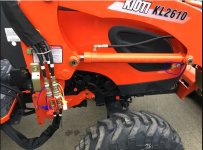
I see. I believe you're describing DL Meisen's test: Bypass testing a hydraulic cylinder - YouTube, by unplugging the disconnect circled here in blue, correct?

Capture.JPG
 
/ How can I test a loader for cylinder vs control valve leakage?? #15  
I see. I believe you're describing DL Meisen's test: Bypass testing a hydraulic cylinder - YouTube, by unplugging the disconnect circled here in blue, correct?

View attachment 558172

4 lane,
What I suggested is a very similar concept except you will be using the weight of the loader to create the pressure & not using the tractor hydraulics.

The line circled in blue in the line that you need to trace back to one of the quick disconnects located by the loader mounting frame. Unplugging the quick disconnect should be easier that removing and then plugging the fittings at the cylinder.
 
/ How can I test a loader for cylinder vs control valve leakage??
  • Thread Starter
#16  
4 lane,
What I suggested is a very similar concept except you will be using the weight of the loader to create the pressure & not using the tractor hydraulics.

The line circled in blue in the line that you need to trace back to one of the quick disconnects located by the loader mounting frame. Unplugging the quick disconnect should be easier that removing and then plugging the fittings at the cylinder.

Understood, thank you.
 
/ How can I test a loader for cylinder vs control valve leakage?? #17  
You’re making this too hard. It’s impossible to push the rod into the cylinder without leaking oil past the valve or leaking externally.
 
/ How can I test a loader for cylinder vs control valve leakage?? #18  
Youæ±*e making this too hard. Itç—´ impossible to push the rod into the cylinder without leaking oil past the valve or leaking externally.

By doing this test You are using the loader and valve to determine what if anything is leaking. If the loader drifts down the seals on the piston and the valve are leaking. By fixing the seals on the cylinder you have eliminated one leak path. The unknown is still the valve leakage on the blind or cap end of the cylinder. Trying to eliminate one leak point using the loader which is something I know 4lane has.

Sorry if this seems to complicated.
 
/ How can I test a loader for cylinder vs control valve leakage?? #19  
It’s impossible for the cylinder to retract without the valve leaking or external leakage. There’s no need to suffer through trying to get the quick connects re connected under pressure. It doesn’t prove anything that’s not already proven. It’s still possible for the cylinder to extend with the quick connects undone. If the cylinder seals are bad it’s going to pass oil past the seals into the other end. Since the cylinder volume is getting larger no oil needs to move out of the cylinder. Again it’s impossible for the rod to retract without pushing oil out of the cylinder rather it goes out the end or out the valve. Since it’s apparently not leaking out the end that means the valve is leaking. I’d bet money that the loader stays up indefinitely with the quick connects unplugged assuming no oil leaks out.
 
/ How can I test a loader for cylinder vs control valve leakage?? #20  
I'm with 4570Man

Simple "volume issue" You can NOT put a liter of oil plus 1/2 liter volume of steel shafting into a 1 liter volume cylinder.

The oil must go somewhere!
 
Last edited:

Marketplace Items

7 Barrel Masport Vac Pump (A62679)
7 Barrel Masport...
(1) HD 24ft Free Standing Corral Panel (A65579)
(1) HD 24ft Free...
New/Unused ATS 13000 Pound Electric Winch (A65583)
New/Unused ATS...
6' 3-Pt Disk (A66285)
ATS Mini Excavator (A66408)
ATS Mini Excavator...
Cattle Feeder (A65640)
 
Top