Servicing a Deep Well

   / Servicing a Deep Well #1  

MMalabama

Bronze Member
Joined
Jul 11, 2017
Messages
53
Location
Thomasville, Alabama
Tractor
Mahindra 4540
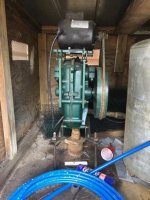
I have an old deep well on my property that isn't working. The pump works fine, just no water. From what i understand there are leather cups at the bottom that may have worn out causing a bad seal so no water can be pulled up to the surface. The pipe inside the casing is 3/4" iron pipe. Thought Id check to see if anyone on TBN had ever serviced one like this before. I've tried to call a few professionals within a 100 mile radius and I cant get anyone to either return my calls or show up for an estimate. Seems like that's the norm for customer service these days.
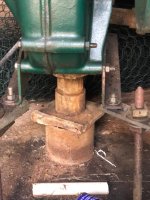
 

Attachments

  • Pump 2.jpg
    Pump 2.jpg
    83 KB · Views: 320
  • Pump 1.jpg
    Pump 1.jpg
    78.2 KB · Views: 319
   / Servicing a Deep Well #2  
What is that thing? Does it need to be primed?
I don't know, but I do know the maximum you can only pull/lift water up is about 34 feet. (laws of physics).
How deep is the well?

Is that some type of "jet pump" or something similar that you have to fill/prime, that pushes a small amount of water down an inner tube that pushes (more) water up from the bottom in another pipe (i.e. 2 pipes go into well)? These require a foot valve or check valve at the bottom of the well.
 
   / Servicing a Deep Well #3  
I'm not familiar with your exact pump, but;
if it is a mechanic rod pump yes it will have cups and seals and the seals do wear,
it usually will also have a foot valve (check valve) to hold the water as the cup brings it in.
I wouldn't be surprised if most of the well services are only or much more familiar with submersible pumps.
One other problem could be a rusted thru or broken pipe.
Depending on the depth it could be quite a few joints of pipe to unscrew while pulling it up.
The last time I worked on a plunger, cup or sucker rod pump was close to thirty years ago, the
intent was to pull the rod and cup up thru the pipe replace the leather seal and reinstall.
It didn't work as planed the pipe had corroded so much that the cup got stuck right after the pump barrel.
The "new" one was not designed to be repaired with out pulling the whole thing out of the well.
 
   / Servicing a Deep Well #4  
To my knowledge there are three types of well pumps commonly used:

Submersible pumps that sit in the water in the well and can be at any depth.

Shallow well pumps that sit on the surface and can pull water up using suction but are limited in how high they can lift due to atmospheric pressure, about 32 feet, but really about 25 feet in practice.

Deep well jet pumps sit on the surface and shoot a stream of water down into the well to drive water up from greater depths than can be pulled.

To my uneducated eye it looks like there is just a single pipe going into the casing, which would indicate a shallow pump.

Is there a nameplate on the pump? Maybe googling will give you more info.

The two most common problems with shallow pumps are that the pump isn't primed, or that the water level in the well is too low.
 
   / Servicing a Deep Well
  • Thread Starter
#6  
I think you are right on with what I have LouNY. So, im thinking i can use the tractor loader with a winch to pull this thing up one section at a time, and if its repairable i will repair it. If not then I will replace it with a submersible perhaps?
 
   / Servicing a Deep Well #7  
You can only "suck" water up about 30 feet (pitcher pump with leathers inside) basically works on vacuum created above the static water level.

You can pump water from a 500+ deep well using a cylinder that sits at the bottom of the borehole with sucker rod to the surface with a windmill, pump jack or suitable hand operated pump stand. This arrangement "pushes" water up the drop pipe.

Oil wells use the same technology and can pump from even greater depths.
 
   / Servicing a Deep Well #8  
I think you are right on with what I have LouNY. So, im thinking i can use the tractor loader with a winch to pull this thing up one section at a time, and if its repairable i will repair it. If not then I will replace it with a submersible perhaps?

The worst part of pulling a pump for me has been securing the pipe at the casing level while unscrewing the joints, having the right wedges or clamps makes the job much easier and safer. depending on the manufacture and installer most pipe joints and rods are 20 footers a few have been done with 10 footers lot more joints and sections to unscrew but easier to work with.
Having to lift 20 feet , then secure the remaining pipe, unscrewing the pulled joint, lifting it a bit to expose the pump rod, disconnecting and then standing that section in a rack or laying it down and repeating can get old in a hurry.
Good Luck with it.
 
   / Servicing a Deep Well
  • Thread Starter
#9  
One more question Lou. I get all the steps you are mentioning except where you say "lifting it a bit to expose the pump rod". Are you saying there is a rod inside the pipe? If so is it also in 20ft sections. Please explain this a little more if you could.
 
   / Servicing a Deep Well #10  
How do you know it's a deep well? Do you know if there's water?
 
   / Servicing a Deep Well
  • Thread Starter
#11  
How do you know it's a deep well? Do you know if there's water?

This used to be my grandparents place. I remember it working prob 8 yrs ago and cant be certain but I think he said it was 400ft.
 
   / Servicing a Deep Well #12  
One more question Lou. I get all the steps you are mentioning except where you say "lifting it a bit to expose the pump rod". Are you saying there is a rod inside the pipe? If so is it also in 20ft sections. Please explain this a little more if you could.

This is interesting. So many questions:

Looking at the diagram Lou posted the link to, it looks like there is a rod inside of the pipe; but is the "drop pipe" inside the well casing, or is it the well casing itself? I'm thinking it's separate from the well casing, otherwise how would you pull up the foot valve?
Does one pull the rod and piston first, then pull up the "drop pipe" with the foot valve?

What's the purpose of the bottom check valve (foot valve) if the piston is above it? Wouldn't water still pass through to the high side of the piston on the down-stroke if the foot valve wasn't there? And then get lifted on the upstroke?
 
   / Servicing a Deep Well #13  
One more question Lou. I get all the steps you are mentioning except where you say "lifting it a bit to expose the pump rod". Are you saying there is a rod inside the pipe? If so is it also in 20ft sections. Please explain this a little more if you could.

If that has a pump chamber at the end of the pipe with a mechanical piston type of pump yes there will be a pump rod inside the water pipe.
That style works by lifting a bit of water with every stroke till the pipe is full and you have water flowing.
Some times the rod are threaded, some will have a twist lock connection, pined type also.
If its a shallow well as the others have mentioned under 30 feet to the water level the pistons/ pump chamber can be located in the pump.
 
   / Servicing a Deep Well #14  
This is interesting. So many questions:

Looking at the diagram Lou posted the link to, it looks like there is a rod inside of the pipe; but is the "drop pipe" inside the well casing, or is it the well casing itself? I'm thinking it's separate from the well casing, otherwise how would you pull up the foot valve?
Does one pull the rod and piston first, then pull up the "drop pipe" with the foot valve?

What's the purpose of the bottom check valve (foot valve) if the piston is above it? Wouldn't water still pass through to the high side of the piston on the down-stroke if the foot valve wasn't there? And then get lifted on the upstroke?

The lower check/foot valve makes them much more efficient especially when the water level is close to the chamber level, it stops any slosh or wave action from emptying water from the chamber.
Yes you will normally have a smaller line inside the well casing to hang the chamber from and direct the pump water up with the pump rod inside that pipe, there have been designs that ran the pump rod separate from the piping with a packing at the chamber, those required guides to keep the pump rod stable.
 
   / Servicing a Deep Well #15  
   / Servicing a Deep Well
  • Thread Starter
#16  
Here are some links to new ones, most are hand pumps some can have motors added;
Deep Well Hand Pumps 3 Foot Static


– SunshineWorks

Hand Water Pump, Well Hand Water Pump By Bison Pumps
This one discuss the different styles
Hand Water Pumps Operation and Classification

Most of the ones that we see in our area are the "pitcher" pumps on shallow wells, if you see one on a windmill its usually a deep one.

Interesting read. I dont think it would work for me since like I was saying I think i remember him saying it was 400ft well. But i feel confident now that if i figure out a good method to pull up that weight of all the sucker rod and a good method for holding it in place while disconnecting the joints at each 20ft interval that i can just replace or repair the piston assembly. Or look into dropping in a submersible if the casing is 3" or more.
 
   / Servicing a Deep Well #17  
A 400 ft well could still have a high static level. If I had to guess I'd say what you have is a shallow well suction pump. It may work if primed.
 
   / Servicing a Deep Well #18  
Some of the pump guys have a special plate/dog/wedge that catches on the pipe couplings as you pull up the pipe sections. I wouldn't think of attempting this without having something like that to keep from losing the whole string of pipe down the hole, more than just a pipe wrench.
 
   / Servicing a Deep Well #19  
Tools;
Well Pipe Clamps

And this place has most everything for a well;
the rancher holder sounds reasonable, they also have pump cylinders and leathers
Well Pipe Clamps
 
   / Servicing a Deep Well #20  
What's the purpose of the bottom check valve (foot valve) if the piston is above it? Wouldn't water still pass through to the high side of the piston on the down-stroke if the foot valve wasn't there? And then get lifted on the upstroke?

The bottom foot valve serves two purposes. On the down-stroke of the piston it keeps the water from flowing back into the ground. In order for the valve on the piston to open on the down-stroke, the pressure on the bottom side of the valve has to be equal to or greater than the pressure on the top side. When the column of water is full there is about 400 feet of water riding on the piston, or about 150 PSI. Pushing down on the piston, the water is essentially incompressible and if there is something to keep the water in place it will reach that pressure and the top valve will open. But without a bottom valve the pressure would just push water back into the earth.

The other purpose is that once you've pumped the well full with a column of water you want to keep it from leaking back down.
 

Tractor & Equipment Auctions

2003 International 7400 T/A Heil 12 CuYd Dump Truck (A55853)
2003 International...
2015 Freightliner M2 106 AWD Altec DM478BTR Insulated Digger Derrick Truck (A60460)
2015 Freightliner...
2012 JOHN DEERE 13-INCH REAR WHEEL SPACER FOR 10 BOLT HUB (A55315)
2012 JOHN DEERE...
2020 PRINOTH PANTHER T14R ROTATING CRAWLER DUMPER (A60429)
2020 PRINOTH...
John Deere 1025R (A53317)
John Deere 1025R...
2018 Honda Rubicon TRX500FA5 4X4 ATV (A59231)
2018 Honda Rubicon...
 
Top