Explain battery voltage?

   / Explain battery voltage? #21  
Not a tear in space-time, but the quantum behavior of a semi-conductor.

I think you are seeing forward bias voltages on a diode(s) somewhere. The are not linear, but rather constant, typically in the .5 to .7 range, and are seen with very small current . You will see the drop with very small amounts of current flowing. Standard demo in electronics class from long ago.

Diodes - learn.sparkfun.com
 
   / Explain battery voltage?
  • Thread Starter
#22  
But you are bridging that open circuit with the meter. Similar to you bridging the open circuit between the posts with the meter.

Yes.
I bridge open circuit between battery posts and get 12.6V
I bridge open circuit between disconnected battery neg(-) post and disconnected neg(-) cable and get 11.7V.
(Same as across the OPEN disconnect switch when I connected into the neg(-) cable and battery.)
 
   / Explain battery voltage? #23  
A volt meter only measures voltage potential. An ammeter measures current flow. If you wire an appropriate ammeter between the negative cable and battery post, you will read the current flow in amps from your circuit leak.
 
   / Explain battery voltage? #24  
But you are bridging that open circuit with the meter. Similar to you bridging the open circuit between the posts with the meter.

To clarify, by bridging, what you are actually doing is completing the circuit across the open switch. You cannot measure the voltage across the open switch. If you measure across you need to be measuring Current/AMPS.

If you want to measure the voltage drop of the system, place your voltage meter on the battery terminals. Then measure the battery voltage with the disconnect switch open and then closed.

To be able to find the device that is drawing power when the key is off you want to measure the current across the open switch. If something is drawing current (i.e. draining the battery) you will measure some amount of AMPS. If you get a reading then just start disconnecting thing until the current reading is Zero.

The Battery supplies Voltage - Devices consume Current.
 
   / Explain battery voltage?
  • Thread Starter
#25  
Yes.
I bridge open circuit between battery posts and get 12.6V
I bridge open circuit between disconnected battery neg(-) post and disconnected neg(-) cable and get 11.7V.
(Same as across the OPEN disconnect switch when I connected into the neg(-) cable and battery.)

I misused the term “bridge” to mean measured.

I know what the leakage current is when an ammeter completes the loop from the battery’s positive post to the negative post through the atv’s leak. It’s:
30mA (30 milliamperes, .03 of an amp)

When I disconnect the negative cable from the negative post, leakage current should be: 0 amps (Zero) (but we have no way to directly measure. We can only observe it is disconnected.)

We can only measure the voltage. Which suggests there’s current flowing (and a voltage drop occurring).
But this suggests the current is flowing through the volt meter when you complete the circuit.
But this suggests meter is very low resistance.
...or as was mentioned, it could be diodes.

Ahh, now I get it. The 30mA leakage is a moot point, insignificant when measuring the open cable voltage to battery post.

That reading is a simple voltage divider across ATV circuits and meter. Doesn’t mean meter is low resistance. It’s the ratio of those resistances.
Something like 11.7v/12.6v= Rmeter/(Rmeter+Ratv)
Solve for ratio that gives 11.7 volts across cable and terminal when battery is 12.6V.
 
   / Explain battery voltage? #26  
Maybe the second black hole discovered.

It might be easier to understand by taking some measurements of a good system. Then maybe add a resisor to ground somewhere and see what kind of readings you get.

In many instances over the years, I don't like using a Digital meter. One electrician was dumb founded that he still had "Voltage" on disconnected conductors. I had to explain to him that the voltage was being induced into those conductors by other conductors present in the same conduit drawing current. He never would have seen that voltage with an analogue meter.

Anyway, thats AC, Different ball game, but just speaking of meters.
 
   / Explain battery voltage? #27  
Not a tear in space-time, but the quantum behavior of a semi-conductor.

I think you are seeing forward bias voltages on a diode(s) somewhere. The are not linear, but rather constant, typically in the .5 to .7 range, and are seen with very small current . You will see the drop with very small amounts of current flowing. Standard demo in electronics class from long ago.

Diodes - learn.sparkfun.com

Yup, sounds like diode voltage drop or reverse biased FET. Not really a big deal and pretty normal.
 
   / Explain battery voltage? #28  
It is a big deal if it discharges your battery in an untimely manner. Anything, should be able to sit at least a few months with a healthy battery and still start.
 
   / Explain battery voltage? #29  
Added a master disconnect to my Ford Ranger on the negative side also due to a parasitic draw. New battery will still go dead in a little over a month of sitting. No clue why this is still happening.
 
   / Explain battery voltage?
  • Thread Starter
#30  
Added a master disconnect to my Ford Ranger on the negative side also due to a parasitic draw. New battery will still go dead in a little over a month of sitting. No clue why this is still happening.

Is the "battery side" of the master disconnect switch somehow touching the frame? That is, is the leakage current bypassing the open switch by using the frame?

I've "heard" (take w/ grain of salt) that batteries can discharge by using the dust on their cover as a path. That's hard to believe, but the smallest of current when given enough time is equivalent (energy) to any other amount of current.
 
Last edited:
   / Explain battery voltage? #31  
Maybe this will help.
As an electronic technician I have lots of meters, including Dad's Simpson 230.
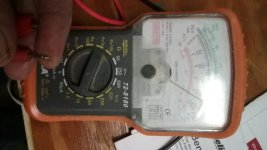
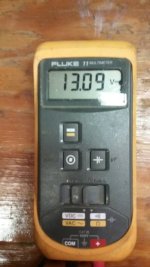
All voltmeters draw current called input impedance (resistance) measured in ohms per volt. The Simpson meter in 1K (1000) ohms per volt. The other extreme is this Fluke 11, input impedance is 10M (10,000,000) ohms/volt.
The cornerstone of electricity/electronics is ohms law. E=IR, E (voltage)=I (current) times resistance.
If you know two things you can figure out the third. A 24 ohm resistance across a 12 volt battery = 1/2 amp (500mA). As resistance increases, current drops.
The higher the voltage the thicker insulation needs to be like spark plug wires.
Strange things happen in the area between a good/poor conductor and proper insulation. A good new battery can drain if there is moisture or conductivity post to post. Stray or ghost voltages and current drains can occur with even a slight imperfection, moisture, poor connection, corrosion or poor insulation.
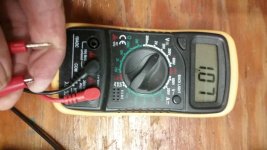
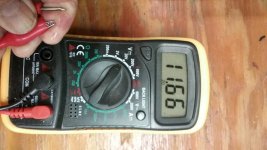
In pictures you see a few analog and digital meters all with the same 13.09 VDC source and effect of measuring across my finger (skin resistance) dry and wet with water.
The Fluke meter voltmeter reads the same voltage even with one lead measuring across my finger because it's input impedance is so high.
You can disconnect a battery lead, put an ammeter in series to measure a current draw, then watch the reading change if you spray water around different areas. 12 volts is not high enough to shock you with clean dry hands, it will shock if you've ever had one wet hand on a good ground, the other in a wet wash mitt on positive terminal. 20190415_210124.jpeg20190415_210300.jpeg20190415_210336.jpeg20190415_210412.jpeg20190415_210637.jpeg20190415_212047.jpeg20190415_211203.jpeg
 
   / Explain battery voltage? #32  
Tired of messing with it so now I keep a 1 amp trickle charger on it. Think I will be switching to a smart maintainer type unit this summer.

I do live in a cold, frosty place, so possibly the combination has some bearing on battery drain.
 
   / Explain battery voltage? #33  
I had this thought in the shower a while ago. Yes, strange. I would never measure a circuit as you did. I would measure resistance (+ feed) to ground with the battery out of circuit. Measuring voltage with the battery circuit broken but volt meter in there would give you difficult and impossible to interpret results.
 
   / Explain battery voltage?
  • Thread Starter
#34  
Measured results:
Battery (post to post): 12.6V
Break neg(-) leg and insert ammeter between cable and battery post : 30mA leakage
Measure voltage across "broken leg" from cable to neg(-) battery post: 11.7 Volts (one would expect 12.6V, with 0 mA leaking (assuming voltmeter doesn't pass current through it when measuring)

Calculated results:
30mA leaking when 12.6 vdc is applied means "leaking device" on ATV has a resistance of 420 Ohms

11.7V measure across open leg compared to 12.6V battery source, means the meter has a resistance of 13 times the "leaking device" (using voltage divider method).

From above, we calculated the "leaking device" resistance as 420 Ohms, so this gives us a meter resistance of 5460 OHms (and a calculated current of 2.14286 mA going through the voltmeter when we measured).

Here, ALL the math makes sense (where 2.14286mA current flowing through 5460 Ohm meter gives 11.7V measured across meter; and same 2.14286mA flowing though 420 Ohm "leaking device" gives .9 V;
and this 11.7V + .9V adds up to the 12.6V measured at the battery. Check. Life is good, the world makes sense.

Except that it doesn't make sense that both meters I used would have only 5460 Ohm input resistance!

KYGunGeek, probably has it right when he mentions diodes.
Diodes on ATV is the only thing that makes sense. Perhaps when the 12.6 battery "loop" is connected and we measure leakage current at 30mA, and calculate ATV's "leakage device" resistance of 420 Ohms, that's only the resistance with 12.6V connected.

Perhaps it's the nature of these diodes, that when we break the loop (disconnect the 12.6 volt "bias" across them), those diodes resistance go from 420 ohms to (let's say) 5000 ohms. Thus if the meter's input resistance is still 13 times that (=65,000 OHMs, more realistic) we will still measure 11.7V across the open leg from our 12.6V battery. (and the 0.9V difference is still across "leaking device")
...with the leakage current through the meter now (a more realistic) 0.18mA (much smaller than the 30mA previously measured).

I'll buy that for a nickel!
 
Last edited:
   / Explain battery voltage? #35  
I thought I was being helpful...maybe not.
This is my wife's 55 Chevy with battery disconnect switch.
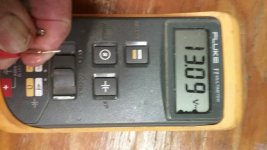
First picture, engine running...13.95volts
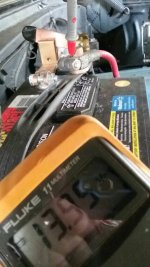
Second, off switch open 12.41 volts. That's impossible measuring from battery negative not to batt + but just the cable!!!!!
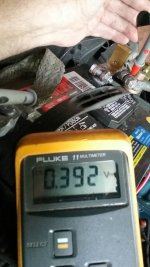
Third, same scenario, this time it's .392 volts...still impossible! Measuring from battery-- negative ground, open switch to a cable going to starter. Battery is disconnected!
Ghost voltages. Car is original, generator, no diodes anywhere (no radio).
With 10 Megohms/volt it's highly sensitive.20190416_191842.jpeg20190416_191927.jpeg20190416_192102.jpeg
 
   / Explain battery voltage? #36  
I see a lot of strange answers explaining why you should have voltage, but I do not see the one that should say, you should not have voltage. If one post is completely isolated from the machine you are measuring, then the machine has nothing to do with any odd ball measurements. Full stop. Don't complicate it.

It is possible to measure voltage all over the world, hold the probes in the air, place one in a puddle and the other on your tongue, measure across a flower, and on and on, but as soon as you attempt to draw a current, poof away that voltage goes.

In your case, likely the 11.7 is not real and any load will knock it to zero. Or, which happens all the time, someone is holding the probes and using their fingers, or spare tire (love handles), to complete a path.

The ATV drain is likely in the soild state ignition. I have a Kaw and Yamaha that do exactly the same thing. In my case, I went a bit ADD and added a relay. Moved all grounds to the relay output. Seems strange to have 2 kill switches, but one I know for sure causes death, the other has a zombie load.
 
   / Explain battery voltage? #37  
I thought I was being helpful...maybe not.
This is my wife's 55 Chevy with battery disconnect switch.
First picture, engine running...13.95volts
Second, off switch open 12.41 volts. That's impossible measuring from battery negative not to batt + but just the cable!!!!!
Third, same scenario, this time it's .392 volts...still impossible! Measuring from battery-- negative ground, open switch to a cable going to starter. Battery is disconnected!
Ghost voltages. Car is original, generator, no diodes anywhere (no radio).
With 10 Megohms/volt it's highly sensitive.View attachment 600623View attachment 600624View attachment 600625

Do I see your fingers touching metal bits? :D
 
   / Explain battery voltage? #38  
Measured results:
Battery (post to post): 12.6V
Break neg(-) leg and insert ammeter between cable and battery post : 30mA leakage
Measure voltage across "broken leg" from cable to neg(-) battery post: 11.7 Volts (one would expect 12.6V, with 0 mA leaking (assuming voltmeter doesn't pass current through it when measuring)

Calculated results:
30mA leaking when 12.6 vdc is applied means "leaking device" on ATV has a resistance of 420 Ohms

11.7V measure across open leg compared to 12.6V battery source, means the meter has a resistance of 13 times the "leaking device" (using voltage divider method).

From above, we calculated the "leaking device" resistance as 420 Ohms, so this gives us a meter resistance of 5460 OHms (and a calculated current of 2.14286 mA going through the voltmeter when we measured).

Here, ALL the math makes sense (where 2.14286mA current flowing through 5460 Ohm meter gives 11.7V measured across meter; and same 2.14286mA flowing though 420 Ohm "leaking device" gives .9 V;
and this 11.7V + .9V adds up to the 12.6V measured at the battery. Check. Life is good, the world makes sense.

Except that it doesn't make sense that both meters I used would have only 5460 Ohm input resistance!

KYGunGeek, probably has it right when he mentions diodes.
Diodes on ATV is the only thing that makes sense. Perhaps when the 12.6 battery "loop" is connected and we measure leakage current at 30mA, and calculate ATV's "leakage device" resistance of 420 Ohms, that's only the resistance with 12.6V connected.

Perhaps it's the nature of these diodes, that when we break the loop (disconnect the 12.6 volt "bias" across them), those diodes resistance go from 420 ohms to (let's say) 5000 ohms. Thus if the meter's input resistance is still 13 times that (=65,000 OHMs, more realistic) we will still measure 11.7V across the open leg from our 12.6V battery. (and the 0.9V difference is still across "leaking device")
...with the leakage current through the meter now (a more realistic) 0.18mA (much smaller than the 30mA previously measured).

I'll buy that for a nickel!
Yes, you have been correct in your analyses. The meter completes the open circuit and voltage should divide proportionally between the resistance of the meter and whatever allows current to flow in your OFF ATV circuitry. ... Except, in the range of near Zero current flow allowed by the voltmeter only forward biased junction losses of a diode would be active to any notable amount. There are surely some K Ohm resistors in series that limit flow thru those diode(s) in normal circumstances, but the flow V loss thru the resistors is nothing at the tiny current allowed by the meter.

Im betting that "lost" V is across diode/semiconductor junctions at some ~ microamp circuit current.
 
   / Explain battery voltage? #39  
That was my point. The one picture you see .392 volts. No magic, deception, etc.
I'm measuring ground to a cable, the battery just happens to me close by. There's no path, water, etc., but it's there. There isn't another battery hidden anywhere.
The 12.41 volt picture...yes, my dry hand is touching battery, but that's enough to complete the circuit.
After trade schools and college there's real world experience and I had 43 years of it before retiring 5 years ago.
That's why different meters are useful, the ones with a lower input impedance can be better since it loads the circuit under test more.
Original query "But from the unconnected negative cable (which is connected to the frame, etc..) I measure around 11.7 volts from the cable to negative battery post."
The answer is because if you disconnect the battery cable, there is no current flow Unless! the battery needs cleaning (baking soda, soap,water,dry).
When you use the meter, Now! battery is not disconnected, meter completes the circuit.
To find a small (30mA) current drain you'd have to disconnect things one at a time.
If everything works ok I wouldn't worry about it. If I could see a schematic I could tell, but nothing wrong with a disconnect switch and trickle charging battery as needed.
 

Tractor & Equipment Auctions

2018 John Deere 245G LC Excavator - Hydraulic Thumb, Tooth Bucket, 56K LB Class (A56438)
2018 John Deere...
2015 Acura ILX Sedan (A59231)
2015 Acura ILX...
500 BBL FRAC TANK (A58214)
500 BBL FRAC TANK...
2020 MACK GRANITE (A58214)
2020 MACK GRANITE...
2015 Toro Sand Pro 5040 Bunker Rake (A59228)
2015 Toro Sand Pro...
2022 FREIGHTLINER CASCADIA SLEEPER (A56129)
2022 FREIGHTLINER...
 
Top