generic externally regulated alternator connection

   / generic externally regulated alternator connection #1  

fitterski

Gold Member
Joined
Oct 20, 2016
Messages
377
Location
Nouvelle, QC
Tractor
1987 Cat-426, 1991 Deutz-Dx-6.05, 2019 Husqvarna 2xHP
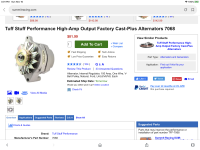
I bought this alternator for my snow-blower's cummins 5.9 12-valve (no internal wiring diagram).

DB Electrical AND71 Alternator (For 94 95 96 97 98 1332), Alternators - Amazon Canada

Not knowing any better (to research and do it myself) I farmed out the hookup to a retired technical school teacher. He tapped out a stator pigtail for a tach signal which subsequently worked (for a while).

Next he piggybacked an unidentifiable electronic external regulator that has 2 wires on it and a grounding tab. He connected battery positive to one of the regulator wires and the one of the alternator field tabs to the other regulator wire. The remaining field tab on the alternator was connected to ground.
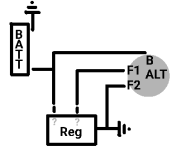
genwire1.png

The tach quit working so I provisionally bypassed the regulator and connected live battery + to the alternator field tab. The tach now works, I haven't yet checked charging.

I also ordered a new Tru-Tech VR166T regulator (no internal wiring diagram).

While trying to get myself spooled up on the topic I stumbled upon this blurb which seems to contradict all of the above.

https://dodgeforum.com/forum/1st-gen-ram-tech/303000-diy-external-voltage-regulator-conversion.html

If I read this correctly the BATT should connect to the batt tab of the regulator AND to one field tab on the alternator while the other field tab on the alternator should connect to the F tab on the regulator. This suggests that the one filed tab on the alternator receives battery power which then exits via the other field tab to ultimately ground out in the regulator tab.

Can anyone chime in on this? TIA
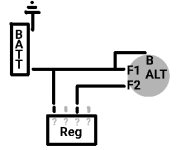
 

Attachments

  • genwire2.png
    genwire2.png
    1.8 KB · Views: 271
   / generic externally regulated alternator connection #2  
I bought this alternator for my snow-blower's cummins 5.9 12-valve (no internal wiring diagram).

DB Electrical AND71 Alternator (For 94 95 96 97 98 1332), Alternators - Amazon Canada

Not knowing any better (to research and do it myself) I farmed out the hookup to a retired technical school teacher. He tapped out a stator pigtail for a tach signal which subsequently worked (for a while).

Next he piggybacked an unidentifiable electronic external regulator that has 2 wires on it and a grounding tab. He connected battery positive to one of the regulator wires and the one of the alternator field tabs to the other regulator wire. The remaining field tab on the alternator was connected to ground.

View attachment 627993

The tach quit working so I provisionally bypassed the regulator and connected live battery + to the alternator field tab. The tach now works, I haven't yet checked charging.

I also ordered a new Tru-Tech VR166T regulator (no internal wiring diagram).

While trying to get myself spooled up on the topic I stumbled upon this blurb which seems to contradict all of the above.

https://dodgeforum.com/forum/1st-gen-ram-tech/303000-diy-external-voltage-regulator-conversion.html

If I read this correctly the BATT should connect to the batt tab of the regulator AND to one field tab on the alternator while the other field tab on the alternator should connect to the F tab on the regulator. This suggests that the one filed tab on the alternator receives battery power which then exits via the other field tab to ultimately ground out in the regulator tab.

Can anyone chime in on this? TIA

I have a Delco Remy service bulletin attached. This is a very common alternator on older equipment, and easy to work on. The regulator is inside this alternator but the bulletin shows you the principle.
The right charging voltage is important. We had a tractor with a bad regulator at work. The gauge showed max voltage. The boss said we look at it when we have finished. Not long after, the operator walked of the field. 2 batteries had exploded and the battery parts had damaged the radiator. Battery acid all over!
 
   / generic externally regulated alternator connection
  • Thread Starter
#3  
I have a Delco Remy service bulletin attached. This is a very common alternator on older equipment, and easy to work on. The regulator is inside this alternator but the bulletin shows you the principle.
The right charging voltage is important. We had a tractor with a bad regulator at work. The gauge showed max voltage. The boss said we look at it when we have finished. Not long after, the operator walked of the field. 2 batteries had exploded and the battery parts had damaged the radiator. Battery acid all over!

Weird, I AGAIN did not get an email thread alert.

Thanks, that's a so called 3-wire alternator. I was advised to buy one with an external regulator because the new electronic ones (internal or external) are easy to blow. Mine probably blew when a battery terminal got unscrewed with the alternator charging, something I had been warned about. I tested it today with no regulator and just unregulated battery powering the field and an unregulated 17vdc charge was the result, which I of course did not leave on :))

I'll have to wait to see what kind of docs I get with the new regulator, it's evident now that the 2 field tabs on the alternator are just that, the 2 ends of the field coil, one of which has to be grounded the other powered. What I do not know at this point is if the regulator (presumably F) tab provides modulated output power to one of he field tabs in which case the other tab would only need to be grounded, or if full BATT power goes to one one the field tabs on the alternator and the modulation is still done by the regulator but on the line grounding the field via the other alternator field tab connected to the F tab on the regulator? Also need to know if polarity is important.

Any mechanic used to working with charging systems would know this blindfolded but I only share the latter attribute :)

Speaking of exploding batteries, did that a while back while welding with 3 in series. The one that blew (it's side, 20 feet away) was fortunately totally dry.
 
   / generic externally regulated alternator connection #4  
Internal regulated alternator are no less reliable than external regulated ones...

Internal regulated alternators have been around for years, almost every vehicle manufactured today has internal regulated alternator ..Internal regulated alternators are basically one wire hookup from B+ post to battery... By using external regulated alternator and not knowing how to hook it up just makes life difficult for you....

IF external regulated alternator is off Dodge Ram, just pull appropriate Dodge wiring diagram and wire per diagram, IF you have matching regulator... Not all regulators are created equal........

Dale
 
   / generic externally regulated alternator connection #5  
Internal regulated alternator are no less reliable than external regulated ones...

Internal regulated alternators have been around for years, almost every vehicle manufactured today has internal regulated alternator ..Internal regulated alternators are basically one wire hookup from B+ post to battery... By using external regulated alternator and not knowing how to hook it up just makes life difficult for you....

IF external regulated alternator is off Dodge Ram, just pull appropriate Dodge wiring diagram and wire per diagram, IF you have matching regulator... Not all regulators are created equal........

Dale
I agree with all this except for the claim that internally regulated alternators are one wire hookups. The vast majority of alternators whether internally regulated or not require an excitation circuit usually controlled in some form or fashion by the ignition switch.
All one wire alternators are internally regulated but not all internally regulated alternators are one wire.
 
   / generic externally regulated alternator connection #6  
I agree with all this except for the claim that internally regulated alternators are one wire hookups. The vast majority of alternators whether internally regulated or not require an excitation circuit usually controlled in some form or fashion by the ignition switch.
All one wire alternators are internally regulated but not all internally regulated alternators are one wire.
I agree, I just put a "3 wire" internally regulated GM 10si alternator in out 1965 David Brown project. 2 wires to the battery connection on the starter and 1 wire to the key switch.

Aaron Z
 
   / generic externally regulated alternator connection #7  
I put this 100 amp one wire on a old ford last year.
F614740E-EED0-4F35-89A3-32321682C701.png
 
   / generic externally regulated alternator connection
  • Thread Starter
#8  
Again several replies, I have checked 'subscribe' to be emailed but got none.

I understand that internal/external reliability is similar but if an external one blows you don't need to replace the alternator. Meanwhile I presume that mechanical ones are more reliable. There is a warning (below) to "never disconnect a battery terminal with engine running'. Remember when this WAS the standard way to test an alternator? We probably still doe not need this warning with mechanical ones(?).

I went to the local supplier and the only alternator with a tach-tab he has in stock is 3-wire one for $400cdn (not ready to buy one of those!).

Meanwhile I received the external regulator I ordered. It's electronic and compatible with ford (mechanical or electronic) which I guess is generic enough. Unfortunately ABSOLUTELY NO DOCUMENTATION, it has 4 tabs: I, A, S, F plus a warning note and that is it.
 
   / generic externally regulated alternator connection #9  
Again several replies, I have checked 'subscribe' to be emailed but got none.

I understand that internal/external reliability is similar but if an external one blows you don't need to replace the alternator. Meanwhile I presume that mechanical ones are more reliable. There is a warning (below) to "never disconnect a battery terminal with engine running'. Remember when this WAS the standard way to test an alternator? We probably still doe not need this warning with mechanical ones(?).

I went to the local supplier and the only alternator with a tach-tab he has in stock is 3-wire one for $400cdn (not ready to buy one of those!).

Meanwhile I received the external regulator I ordered. It's electronic and compatible with ford (mechanical or electronic) which I guess is generic enough. Unfortunately ABSOLUTELY NO DOCUMENTATION, it has 4 tabs: I, A, S, F plus a warning note and that is it.

I payd CAD $7 for a new internal regulator for a Delco 10 SI at the local automotive store. The Delco 10SI is probably the easiest alternator to work on! No soldering at all.
A tach tab is that not just a connection to one of the stator windings?

The Delco is also available as one wire alternator.
 
   / generic externally regulated alternator connection
  • Thread Starter
#10  
I payd CAD $7 for a new internal regulator for a Delco 10 SI at the local automotive store. The Delco 10SI is probably the easiest alternator to work on! No soldering at all.
A tach tab is that not just a connection to one of the stator windings?
The Delco is also available as one wire alternator.

I had no idea you could just replace an internal regulator as well, that's good to know. Yes, the tach tab would be a connection to the stator pole, that's what's on the existing alternator which right now is neither charging nor driving the tach. Alternators that come with it have a terminal usually labeled "R" (for rpm?). I'll try the new regulator but for now i have more pressing issues.
 
   / generic externally regulated alternator connection
  • Thread Starter
#11  
I need to rephrase my original question. The alternator I have is an externally regulated model suitable for a 1995 Ram diesel pickup (the engine it's going to). It has 2 unmarked field terminals. In the case of that truck I /think/ the external regulator is actually he external vehicle PCM module so that one field terminal on the alternator gets full 12 volts from the system and the other one goes to the PCM where it is then reduced if needed and then grounded (regulated).

I don't have a PCM, I have a generic ford-compatible electronic 4-terminal (I-A-S-F) external regulator.

"I" normally goes to ignition which I do not have, it could be a light which I do not need, ergo "unused"
"A" is where regulator gets 12v, connect to batter or BAT terminal of alternator
"S" supposedly goes to STATOR, not sure about purpose/use of this one
"F" what is the exact function of the F terminal?

Case-1: my 4-terminal external regulator acts like the external PCM so one of the 2 alternator field terminals gets battery 12v (from any source) and the other goes to the regulator F terminal inside which the voltage subsequently gets reduced if required before being grounded (regulated). In this case the F terminal does NOT SUPPLY.

Case-2: the 4-terminal external regulator F terminal PROVIDES already regulated voltage in which case it gets connected to one of the 2 alternator field terminals (same as above) but then the other alternator field terminal must be just grounded to alt-regltr-frame.

I don't wanna blow the regulator with a + to + connection as soon as powered, nor blow up the battery because all it really gets is 16-17v which result from continuous un-reduced 12v going the the alternator F terminal all he time.
 
   / generic externally regulated alternator connection #12  
Again several replies, I have checked 'subscribe' to be emailed but got none.

I understand that internal/external reliability is similar but if an external one blows you don't need to replace the alternator. Meanwhile I presume that mechanical ones are more reliable. There is a warning (below) to "never disconnect a battery terminal with engine running'. Remember when this WAS the standard way to test an alternator? We probably still doe not need this warning with mechanical ones(?).

I went to the local supplier and the only alternator with a tach-tab he has in stock is 3-wire one for $400cdn (not ready to buy one of those!).

Meanwhile I received the external regulator I ordered. It's electronic and compatible with ford (mechanical or electronic) which I guess is generic enough. Unfortunately ABSOLUTELY NO DOCUMENTATION, it has 4 tabs: I, A, S, F plus a warning note and that is it.
To run an alternator and then disconnect the battery has never been a test method, and you are not taking out the regulator but are risking to kill the rectifier diodes.
 
   / generic externally regulated alternator connection
  • Thread Starter
#13  
To run an alternator and then disconnect the battery has never been a test method, and you are not taking out the regulator but are risking to kill the rectifier diodes.

My mistake, I should have said generators, Alternators began showing up in the 60's, generators had no diodes
 
   / generic externally regulated alternator connection
  • Thread Starter
#14  
   / generic externally regulated alternator connection #15  
Here’s a little more information if you want it.

MAD enterprise has been gurus in automotive electrics for years.
They have quite a bit of information to share on their web site.
Specifically, read the 3 wire or one wire articles.
Catalog

I’m interested in this thread as I am just finishing up converting my 64 Ford 2000 gasser to 12 volt.
After researching quite a bit, I found it easier to buy a “kit”. Mine came from Yesterday’s Tractor.

Here’s an old thread that I hope is allowed here with some useful information.

Yesterday's Tractors - Step by Step 12-Volt Conversion

Though mine is installed as a one wire from the kit, I’m going to wire in the indicator light.
When I tested it though, it did immediately start charging at 14.4 volts at idle. I was worried about that having to rev it up to start charging. That’s a half assed way to do things.
 
   / generic externally regulated alternator connection
  • Thread Starter
#16  
When I tested it though, it did immediately start charging at 14.4 volts at idle. I was worried about that having to rev it up to start charging. That’s a half assed way to do things.

from what i understand the new alternators' charge voltage depends on the battery condition, around 14 being the minimum and it climbs for a more discharged battery
 
   / generic externally regulated alternator connection #17  
I payd CAD $7 for a new internal regulator for a Delco 10 SI at the local automotive store. The Delco 10SI is probably the easiest alternator to work on! No soldering at all.

Yes and you can usually buy new brushes too. And bearings.
 
   / generic externally regulated alternator connection
  • Thread Starter
#18  
..I went to the local supplier and the only alternator with a tach-tab he has in stock is 3-wire one for $400cdn (not ready to buy one of those!)..

I showed him the 1-wire chinese knockoff with an R teminal on amazon for $116cdn and he immediately found a real ACDelco available for $10 more. It should be here in 4 days or so:cool2:
 

Tractor & Equipment Auctions

3410 (A47477)
3410 (A47477)
2006 Ford F-750 Fuel and Lube Truck (A59230)
2006 Ford F-750...
2018 Nissan Versa Sedan (A59231)
2018 Nissan Versa...
500BBL WHEELED FRAC TANK (A58214)
500BBL WHEELED...
2008 Godwin Dri-Prime CD103M Towable Trash Pump (A59228)
2008 Godwin...
2010 CATERPILLAR 303.5C CR EXCAVATOR (A60429)
2010 CATERPILLAR...
 
Top