Fixing and caulking rotting joints on exterior wood stairs

/ Fixing and caulking rotting joints on exterior wood stairs #21  
I'll have to see if I can find a tag to know what the treatment level was, but it was basic off-the-shelf 2-by lumber from Lowes. It ain't doing great!

For those asking, there are regular stringers hidden out of sight, sistered to the inside of the outer 2x12 board. In retrospect, I don't think this is a good design for dealing with moisture, although I have used the same design on three other sets of stairs on my property that have zero issues. And the rot is just on about 10 steps out of the 45 going down to the pier. So I either think those steps get wetter and get less light/air, or it's just crappy treated lumber.

Thanks for all the responses so far guys, it helps! I plan to pull off a couple treads/risers this weekend and see how bad it looks underneath.

OK... If it was from Lowes you got .25, the .40 is rated for ground contact. The .40 will be more in price but worth it.
 
/ Fixing and caulking rotting joints on exterior wood stairs #22  
I'm going to skip my usual procedure and not read all the responses. I'm going to posit that the original builder of this deck - you or otherwise - just cut the boards and installed them. That is likely the root failure. The treatment does not typically soak the entire thickness of a board as the manufacturers do not/cannot allow enough time in the treatment process for this to occur. Thus any cut ends expose what is essentially untreated wood in the center. And it rots. Go figger. You can go to any paint type store and get a gallon of the treatment chemical. It is nasty stuff. Only use it outside with gloves, and a face shield to avoid any splashes in your eyes is a wise move too. Slop it on any and all cut faces/ends/etc, and anyplace else it looks like the treatment did not get to.

Yes, you will also want to do things to avoid any puddling of water so they deck/stairs can drain, but if you do not treat the cut ends, you have started the clock ticking much faster than it should.
 
/ Fixing and caulking rotting joints on exterior wood stairs #23  
any lumber from blows home cheapo is crap . Find yourself a good lumber yard where you could drive up to a pile hand pick the best boards nice and straight tight knots. You will see the price difference is minimal and the product is far superior . When the say built to home cheapo standards they don't tell you it'slower standard than everybody else. Any calk rot fill sealer is a bandaid. It will just start again in a few years. bite the bullet and replace it you will have peace of mind for the next 20 years instead of a on going head ache.:drink:
 
/ Fixing and caulking rotting joints on exterior wood stairs
  • Thread Starter
#24  
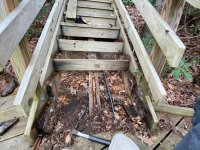
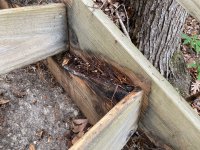
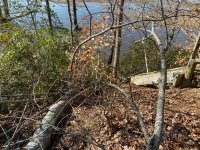
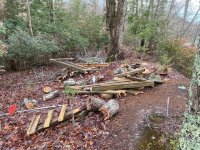
Wanted to bump this thread with some pictures. I had started pulling apart some steps to repair rotted areas, then we had a bad storm last weekend and a tree came down on the middle section of steps. So I am basically rebuilding one flight of the steps now.

PRIOR TO TREE FALLING:

IMG_3444.jpg

IMG_3446.jpg

IMG_3451 (1).jpg

AFTER (not many pics, I was busy with chainsaw and tractor on the side of a hill):

IMG_3456.jpg

IMG_3462.jpg

IMG_3459.jpg

I think what exacerbated the rot problem was the stair design I used, which sistered a 2x10 stringer against a 2x12 for stiffness. It let water collect and soak into all the cut ends of the stringers, and trapped water between the boards. But in looking at the labels on the old lumber, it was a lower treatement level than I can buy today, so the treatment wasn't great. On top of that, some critter (possibly a fox) had made a den under the bottom 3-4 steps and that most certainly accelerated the rot in that area, and on the deck where the steps rested. To add insult to injury, looks like a mouse chewed on my electrical wire, so that needs replacing too.

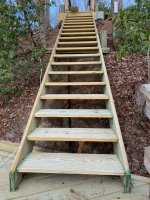
For the new steps, I am using only 2x12 sides and using galvanized angle brackets to hold the treads, which will be a single 2x12 36" wide. No stringers. There will also be no risers. I prefer risers for the finished look, but that's just more wood and joints to trap water and rot.

The middle deck is being rebuilt today. I am using marine lumber for the beams and ground-contact 2x8 for the joists and deck boards. I have a bottle of copper treatment to paint on all cut ends.

I have mixed emotions about this rebuild. On the one hand, I want to do it right and avoid rotting so that the steps last longer. On the other hand, a tree could fall in a future storm or hurricane and take them out again. Just have to accept the risk I guess.

I'll post more pics as I make progress. Working on a hill sucks. I lost the 3/4" socket off my wrench yesterday when I accidentally hit the button on the wrench. The socket made a bunch of bounces on the way down the hill before it launched into the water.
 
/ Fixing and caulking rotting joints on exterior wood stairs #25  
any lumber from blows home cheapo is crap . Find yourself a good lumber yard where you could drive up to a pile hand pick the best boards nice and straight tight knots. You will see the price difference is minimal and the product is far superior .

This assumes you have a "good" lumberyard nearby. I don't know of any near me. The wood at the independent home centers doesn't seem to be any better than what Lowes, HD, etc. have, and it's more expensive.
The only difference is that it's easier to find someone to help you load/pick if you need it.
 
/ Fixing and caulking rotting joints on exterior wood stairs #26  
Sure looks like a steep hill from the pictures. Do you use a safety rope? I've found that having a rope on a roof makes a huge difference for me in dealing with slipping. I can quickly hold onto the rope when I start to slide and keep on going without missing a beat. Without something to grab onto, nothing else gets done until I'm safe again.

From your pictures, it sounds like you figured out the problem. I'm not a fan of bracket to support steps because then tend to loosen up over time. For me, I want a stringer every foot to 16 inches. I think 18 inches between steps is pushing it. Once I figure out the math to cut the first stringer, the others are easy.

I also try real hard to have my stringers sitting on concrete.
 
/ Fixing and caulking rotting joints on exterior wood stairs #27  
Wanted to bump this thread with some pictures. I had started pulling apart some steps to repair rotted areas, then we had a bad storm last weekend and a tree came down on the middle section of steps. So I am basically rebuilding one flight of the steps now.

PRIOR TO TREE FALLING:

View attachment 641567

Just curious...Is that a Craftsman hammer?...I seem to remember having one just like it...I think I wore it out...
 
/ Fixing and caulking rotting joints on exterior wood stairs #28  
Although it may be harder this looks like a good place to dry lay stone stairs. Wood that close to the ground always rots away. At least stone wouldn't care or can be reused if a tree falls.
 
/ Fixing and caulking rotting joints on exterior wood stairs #29  
Any closed stringer is going to promote rot no where for moisture to escape . Can't tell from pictures but it looks like stringers are sitting on ground . The higher you can get them off the ground to facilate air circulation and the ability to remove leaves keeps critters from building homes in the nooks and crannies. My grand mother made me make a set of stairs like that closed stringer [riser boards] because she was afraid to look through open risers:confused2: I told her there was no place for leaves and snow to go but she wanted it. After a few years it was a yearly project replaceing boards that rotted out. After 10 years so much was replaced had to rip it out and start over again. Pt lumber sucks.:drink:
 
/ Fixing and caulking rotting joints on exterior wood stairs #30  
Its been banned for members of the public this side of the pond, but the original old fashion creosote is still about, I find it a good preventer of rot with the advantage that not many creatures like to chew it.
 
/ Fixing and caulking rotting joints on exterior wood stairs
  • Thread Starter
#31  
This assumes you have a "good" lumberyard nearby. I don't know of any near me. The wood at the independent home centers doesn't seem to be any better than what Lowes, HD, etc. have, and it's more expensive.
The only difference is that it's easier to find someone to help you load/pick if you need it.

I was at a builder supply last week ordering pine siding for my barn and asked about their pricing on treated lumber. They wanted $24 for a #1 grade 2x12-12' ground-contact and it's from a treating company about 50 miles away that has a good reputation. Free delivery. We had used them when building out house and all that lumber is still holding up well (even stairs made with this same exact design). Lowes wants $20 for a #2 board of the same size, from who knows where and I can vouch that the treatment isn't always consistent. For an extra $4 it was a no brainer to order from the builder supply and get a better grade board and free delivery. Hopefully the treatment quality is as good as their past product. So far it looks good when I saw into it.
 
/ Fixing and caulking rotting joints on exterior wood stairs
  • Thread Starter
#32  
Sure looks like a steep hill from the pictures. Do you use a safety rope? I've found that having a rope on a roof makes a huge difference for me in dealing with slipping. I can quickly hold onto the rope when I start to slide and keep on going without missing a beat. Without something to grab onto, nothing else gets done until I'm safe again.

From your pictures, it sounds like you figured out the problem. I'm not a fan of bracket to support steps because then tend to loosen up over time. For me, I want a stringer every foot to 16 inches. I think 18 inches between steps is pushing it. Once I figure out the math to cut the first stringer, the others are easy.

I also try real hard to have my stringers sitting on concrete.

It's a 30-35 degree slope, so about the same as a 8/12 roof. Not as scary as a roof but slippery in some spots. I still have the old center stringer attached at the top to help me move up and down. Once that comes out I will put in a rope for sure. I remember when building the stairs the first time, going down that rope with sacks of concrete, posts, etc on my shoulder, and it was crazy. I am not young enough to do that anymore.

I agree on the spacing -- I plan to install a couple test treads and see how they feel. A 2x12 is pretty stiff over 36" but we'll see. If there is any flex (which would be bad for the brackets) I will either add a stiffener under the tread or add a center stringer of some sort.
 
/ Fixing and caulking rotting joints on exterior wood stairs
  • Thread Starter
#33  
Just curious...Is that a Craftsman hammer?...I seem to remember having one just like it...I think I wore it out...

You know, I found it in the road one day and it has no markings. It's a lighter hammer but I figured since I might lose it down the hill it was the best option for this project!
 
/ Fixing and caulking rotting joints on exterior wood stairs
  • Thread Starter
#34  
Any closed stringer is going to promote rot no where for moisture to escape . Can't tell from pictures but it looks like stringers are sitting on ground . The higher you can get them off the ground to facilate air circulation and the ability to remove leaves keeps critters from building homes in the nooks and crannies. My grand mother made me make a set of stairs like that closed stringer [riser boards] because she was afraid to look through open risers:confused2: I told her there was no place for leaves and snow to go but she wanted it. After a few years it was a yearly project replaceing boards that rotted out. After 10 years so much was replaced had to rip it out and start over again. Pt lumber sucks.:drink:

The closest these come to the ground is about 4". But pack leaves and a critter nest in there and it may as well be on the ground. The bizarre thing is that the boards did not rot on the bottom where they were close to the ground. They mainly up above rotted where the stringer and outer 2x12 came together, and where the treads and risers touched the stringers. There were other scrap boards used to prop up the stringers 6 years ago in full ground contact, and those looked fine! So I think the main issue here was trapping water and having no air circulation. Hopefully the new design will improve that.

I know my wife won't like walking up the stairs when she can see through below, but it's obvious to me that a closed design isn't a good idea in this spot. There is another long flight below that is 6-8' off the ground (and over water) and those are still in good shape so I will leave them alone. They get sunlight and that probably avoided problems. But eventually they will need replacing and I would go with open treads there too, so everything looks the same.

If I had the money and access, I would get steel/glavanized steps made up with grating for treads. Those would probably last forever, pending trees coming down.
 
/ Fixing and caulking rotting joints on exterior wood stairs
  • Thread Starter
#35  
Although it may be harder this looks like a good place to dry lay stone stairs. Wood that close to the ground always rots away. At least stone wouldn't care or can be reused if a tree falls.

I gave that some serious thought, but the hill is almost all sand and I wasn't confident I could get stone steps to stay put. To be honest, I am surprised that the wood posts haven't shifted over 6 years, but they seem to be stable. They go 4-6' down into the hill.
 
/ Fixing and caulking rotting joints on exterior wood stairs #36  
You know, I found it in the road one day and it has no markings. It's a lighter hammer but I figured since I might lose it down the hill it was the best option for this project!

Thanks for the reply...I'm basically going by the fiberglass handle...I had a 16 oz. straight claw that was very similar...
One thing exclusive to Craftsman was what they called "a third claw"...the edge of one of the claws would have a 'V' cut out so it could grab smaller headed nails etc...not sure if they came on curved claws...
 
/ Fixing and caulking rotting joints on exterior wood stairs #37  
Thanks for the reply...I'm basically going by the fiberglass handle...I had a 16 oz. straight claw that was very similar...
One thing exclusive to Craftsman was what they called "a third claw"...the edge of one of the claws would have a 'V' cut out so it could grab smaller headed nails etc...not sure if they came on curved claws...

I still have 2 Craftsman hammers with the 3rd claw. Very beat up because they are so old but I still would rather grab one of them than the dozen or so other hammers I have laying around.
 
/ Fixing and caulking rotting joints on exterior wood stairs
  • Thread Starter
#38  
Working from home gives me a couple extra hours every day, so I have been able to get a move on the new stairs and knock them out quickly. Thankfully I had bought materials and hardware weeks ago.

IMG_3565.jpg

(Note top step isn't installed yet, since I need to access the area for electrical).

I am surprised how solid the stairs feel -- this design uses about half the lumber as before, and there is no center stringer. Despite that, they are very solid and there is no bounce when walking.

Since there are no risers to brace the stringers cross-wise, I think the stringers might want to twist or "rack" if anyone leans on the hand rails (when they get added later). So I might put cross braces between stringers next to each pair of hand rails to tie everything together cross-wise.

For railings, I can salvage the previous 4x4 posts. I'll do a 2x6 and 2x4 along the top for a handrail. Instead of side rails, I might try something using thin cable. Sort of like those expensive cable rails you see on modern decks, but maybe done on a budget.
 
/ Fixing and caulking rotting joints on exterior wood stairs #39  
Looks good lots of room for air circulation to keep stringers dry .:thumbsup::drink:
 
/ Fixing and caulking rotting joints on exterior wood stairs #40  
Random thoughts ....

I have an HF hammer or two that look like that. I also have a very old Sears or Craftsman hammer that looks like an Estwing that I believe has the extra 'v'.

PVC boards for the stringers would add considerable cost, but be certain not to wet rot. Can't swear if they're UV stable or not though. PVC conduit (grey) is Sunlight rated and 4 or 6" could be used for the railing posts.

Risers could be set back a half inch from the treads to provide that 'finished' look, but still allow drainage. If sized an inch or more larger than the stair rise (ie. 2 x 10 for 8 inch step rise), they could also take a center support bolt or two for the treads to be more stable.
 

Marketplace Items

2008 Dynapac CA150D (A60462)
2008 Dynapac...
2007 Avanti 36 Boat with Tri-Axle Boat Trailer (A59231)
2007 Avanti 36...
Kubota ZG222 (A60462)
2012 JACK COUNTY 130 BBL STEEL (A58214)
2012 JACK COUNTY...
2001 Chevrolet Suburban SUV (A59231)
2001 Chevrolet...
2013 PETERBILT 389 (INOPERABLE) (A55745)
2013 PETERBILT 389...
 
Top