Tiller Anybody use a disc harrow AND a tiller

   / Anybody use a disc harrow AND a tiller #1  

Indian Territory

Silver Member
Joined
Feb 23, 2020
Messages
107
Tractor
New Holland PowerStar 75
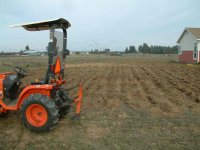
We are turning over acreage that has grown nothing but hay for the last 30 years. Our intention it to plant a 1-2 acre vegetable garden, out of which we may sell some produce for supplemental income. The field is very flat and even, with a slight south facing slope and few to no rocks.

While I know everyone has their own opinion on the matter (to the point that the conversation has taken on a near political/religious fervor), I have determined to first turn the sod using a moldboard plow. The ground is simply too compacted without this step. After this my question begins. I have a small tractor (after all this is horticulture we're doing, not agriculture), so any disc harrow i could pull would be comparatively light when stacked up against the big boys. I'm talking a 5-foot harrow at about 500 pounds, used to beat the furrows and clods into shape after the turned vegetation has dried.

So here goes: Is there anyone out there who both disc harrows AND tills (3-point PTO tiller) their large gardens before transplanting?

Thanks. Looking forward to a few perspectives.
 
   / Anybody use a disc harrow AND a tiller #2  
I'm talking a 5-foot harrow at about 500 pounds, used to beat the furrows and clods into shape after the turned vegetation has dried.

So here goes: Is there anyone out there who both disc harrows AND tills (3-point PTO tiller) their large gardens before transplanting?

The first effective "size" of Disc Harrow has 18" diameter pans. A box-frame Disc Harrow with 18" diameter pans applies less than forty pounds pressure to each pan, requiring multiple passes over the field to smooth plow furrows. If you invert soil with a 12" moldboard plow, Disc Harrow with 18" diameter pans could require four to six passes to smooth. An angle-iron frame Disc Harrow is lighter than a box-frame Disc Harrow, requiring more passes.


A PTO powered, forward rotation roto-tiller is the right choice for smoothing plow furrows using an 1,800 pound bare weight tractor.
 
Last edited:
   / Anybody use a disc harrow AND a tiller #3  
I have 80 acres. Very little of it has ever been "turned" with anything. It's all virgin grass land. I tried tilling about an acre or two with a disk harrow. It was a joke. My disk harrow is a light Land Pride type. I considered borrowing a heavy disk harrow from my neighbor. His were all designed to be pulled by a 350 hp or bigger tractor. Another joke.

In the end I borrowed a very large - 108" wide - 3-point, PTO driven, rototiller. It got the job done in just two passed over the acreage. I now have a very nice patch of clover. All the wild animals seem to enjoy my efforts.
 
   / Anybody use a disc harrow AND a tiller #4  
Let's think/talk about the future years of your gardening. After the 1st year of ground breaking the tiller is the better choice for working the ground to 7-8" depth. A light disc will not get that deep. Otherwise you are approaching a no-till approach to gardening. BTW, after the 1st year ground breaking a tiller can be used in one pass thereafter unless the weeds have gotten totally out of control.

If you live in deer country a tiller is better for working the ground in smaller deer fence enclosed gardens. I can till my 50X50 garden by taking down the two opposing sides of the deer fence alternating directions annually. A tiller also better incorporates organic matter into the soil than a disc.

Also don't forget to have a soil test done. For an acre you can mix samples different areas for a single test, or mix samples from smaller areas if you suspect there are different conditions for several tests. I use AgroLab and their $10 basic test for gardens. Home | AgroLab Order their free bags and establish an account. I send in ~5-6 ounces of soil in a bag for $1.60 postal charges and get a test response in ~3-4 work days after they receive.

Just my opinion after using both light discs and tillers for decades in gardens and food plots of your size.
 
   / Anybody use a disc harrow AND a tiller #5  
+1 on the tiller choice. I've been able to use my 3 pt disc in Indiana for my food plots, where the soil is loose and sandy. In Iowa where the soil is more loamy (is that a word?), I'm also going to have buy (or rent) a tiller.
 
   / Anybody use a disc harrow AND a tiller #6  
We are turning over acreage that has grown nothing but hay for the last 30 years. Our intention it to plant a 1-2 acre vegetable garden, out of which we may sell some produce for supplemental income. The field is very flat and even, with a slight south facing slope and few to no rocks.

While I know everyone has their own opinion on the matter (to the point that the conversation has taken on a near political/religious fervor), I have determined to first turn the sod using a moldboard plow. The ground is simply too compacted without this step. After this my question begins. I have a small tractor (after all this is horticulture we're doing, not agriculture), so any disc harrow i could pull would be comparatively light when stacked up against the big boys. I'm talking a 5-foot harrow at about 500 pounds, used to beat the furrows and clods into shape after the turned vegetation has dried.

So here goes: Is there anyone out there who both disc harrows AND tills (3-point PTO tiller) their large gardens before transplanting?

Thanks. Looking forward to a few perspectives.
I kill all the weeds with roundup, wait a couple or three weeks to decompose, disc once and tiller over it once.
 
   / Anybody use a disc harrow AND a tiller #7  
Rototiller should do it all. First pass on sod might require the removal of some tines. The first pass is slow going. The rest get easier with each pass.

For first discing sod it requires much larger tractors and heavier discs. Say real farm size.
 
   / Anybody use a disc harrow AND a tiller
  • Thread Starter
#8  
Thanks. You guys are fast. I already own the tiller. A Titan 4'. Pretty happy with it. (Wish it wasn't offset; my tractor's not wide enough to need it.)

Anyway, the reason for my question about disc harrows is time. While I'm not campaigning to spend another ~$1K of my own money, I do worry about having to roto-till 2 acres of ground at 1mph. Is there any logic to plowing then disking the area, and only after that tilling the rows as they become ready to be planted (a kind of seedbed preparation). I don't want to add more expense or time to my process, but neither do I want to do things the slow (i.e. harder) way.

Thoughts?

Postscript: I wish I could depend on something as simple as Roundup, but we are an aspiring organic spot in the much larger field.
 
   / Anybody use a disc harrow AND a tiller #9  
You can till with a tiller faster than you would be able to turn it with a single bottom plow. Then it will take multiple disk passes with a disk after plowing. You will have a much nicer seed bed with the tiller.

If it were me, I would be looking for a larger tiller. A 5' tiller should not be an issue for your tractor. JMO
 
   / Anybody use a disc harrow AND a tiller #10  
+1 for the tiller. As said before, first pass slower, then one or two more to reach the desired result.
 
   / Anybody use a disc harrow AND a tiller #11  
i use a 3 point mounted single shank sub soiler attachment i bought from tractor supply. i pull it with my john deere 870. it can go down to about 16 inches in the soil.does a good job of breaking up the soil. then the tiller or disc can do a much better job of preparing the site for planting.
 
   / Anybody use a disc harrow AND a tiller #12  
I have determined to first turn the sod using a moldboard plow. The ground is simply too compacted without this step.

So here goes: Is there anyone out there who both disc harrows AND tills (3-point PTO tiller) their large gardens before transplanting?

Because you are first turning it with a moldboard plow, and you already own a tiller, I don't think you need to spend money buying a disc. The moldboard will start the process, and the tiller will finish it.
 
   / Anybody use a disc harrow AND a tiller #13  
I use all of the combinations above, but only started with the tiller last year, only for a biofumagation experiment. I didn't get good results with the biofumagation experiment, due to wet weather, and early frost, so I'll try again this Fall.

I'm gardening in the same spot, my family has gardened in since 1953. This has always been moldboard plowed, and disked. I have a loamy clay here, so the key is, to not plow it when it's too wet. A simple test is to take a shovel, and dig up a shovel full of dirt. Pick up a handful, and if it form a ball in your hand, it's too wet. If it some what crumbles in your hand, you're good to go. Plowing down last years residue, gets it far enough down under the surface to break it down, adding organic matter. It also gets most residue down below the level, of where my cultivator's won't grub it back to the surface. I only cultivate to a depth of about 2", to battle the weed seed bank in that layer. Weed seeds below that level have less chance of germinating. What does germinate, will be taken out the next time I cultivate.

If you have a few days ahead of dry weather, let the plowed ground dry out. Then till, or disk it up. Just don't over till. It will ruin the soil structure, and it will compact. I have a buddy who has been doing the market garden thing for 10 years, and it has taken me 8 years, to convince him NOT to over till. He has some very high organic matter black bottom ground, and in the past, has tilled it to the consistency of flour. Then complained it was hard, and would take until mid, to late summer to mellow back out. 2 years ago, I convinced him to do an experiment to moldboard and disk a section, and till the other as normal, so as to see for himself. Some people have to pee on the electric fence, to see for themselves. He was amazed at the difference. Very friable dirt where it was plowed/disked, hard crust where he tilled as normal.

When I work the plowed ground down, I pretty much just make 2-3 passes with the disk, whether mounted, or pull type. With this finish, I can plant early crops. I leave the rest of the area alone, until it's time to plant whatever comes next, whether it's days, or weeks later, I'll only disk up the next area to be planted, unless there is some heavy weed growth, then I'll disk the whole area outside what I'm planting a time or two, to kill weeds in their infancy. That's the easiest way to reduce the seed bank, in the top 2"-3" surface. That's literally millions of weeds you won't have to deal with later. You're loosening the soil, and getting the thread like roots exposed to the sun, and air to kill them. I call weeds that size, in the "button" stage, others call it in the "thread" stage. That's when weeds are in the tiny 2 leaf stage, just barely emerged. If you use a cultivator for weed control, at the end of the row, when you pick it up to turn around, you'll see hundreds, if not thousands of thread like roots hanging off the shovels/shanks of the cultivator.

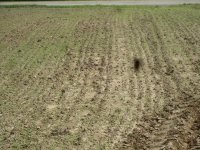
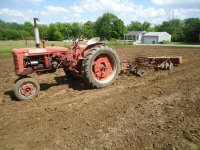
Instead of a 3 pt. disk, you may want to consider a pull type. It will give you a better finish. I pull mine, with either my Farmall A, or the Super C. pictured below. This is a prime example of what I mentioned above, of killing/reducing weeds/weeds in the top seed bank. This was 2 years ago, and I disked it when it was a lot damper than I like to, and not the finish I like to see. They were calling for a couple inches of rain over the next 2-3 days, and it was dry enough to get in, and disk it up. With the hot sun, and wind that day, I probably got an 80% kill on those weeds.

If you have any Spring consignment auctions in your area, that could be a good place to find one. Craigslist, or FaceBook Marketplace is also another good source to find one. I've seen many listed for around $100.00. This one has adjusting levers to set the amount of cut. I set it to full cut for the initial pass to work it down, then set it to a medium cut to plant in. Some years when I put a cover crop on, I'll use my tractor mounted Cyclone seeder to spread the cover crop seed, then go over it with the disk, set on a light cut to cover the seed, and the home made cultipacker Dad built back in the mid 60's firms the surface up.

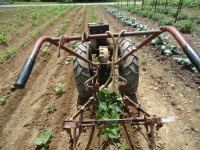
I know you're question was about disking, or tilling, but thought I'd add the last picture, for how I battle weeds. I have 5 similar tractors like the one pictured, with various setups of cultivators, for various stages of plant growth. This is a David Bradley, and the largest in hp I have. It is a 5 hp one, but others have mostly 3 hp engines. I have the hilling shovels on it, to hill up around the corn and beans. This particular year was dry, so I set the hiller's to leave that "V", to hold any rainwater, that we were to receive. It worked well that year, as it stayed pretty dry the rest of the summer.

Again, I have no idea what your plans are for weed suppression, but no matter what you use, I'd suggest to NOT till/cultivate more than 2"-3" deep. All you'll be doing is bring more weed seed to the surface, to easily germinate, and to battle. Anything below that level will have a tough time coming up, but you can take out if they do come up, with a pass of cultivating/tilling. Leave the rest for Mother Nature to do her magic on them.

I don't know if you are a fan of FaceBook, but there are a number of Market Garden pages, and also some 2 wheel garden tractor pages, that many of these Market Gardener's use, to keep their crops clean. One particular fellow out in Washington state uses one (Planet Junior brand from the 40's) to cultivate his 5 acres. Many others are doing 1-2 acre plots like you will be doing. These small 2-wheel tractors will allow you to grow more produce on a smaller footprint, due to average row width of 30" or less, depending on what you plan to plant. Some are planting onions & such in 15" row width's with the Planet Juniors.

I prefer the David Bradley's for several reasons. #1. They can be bought pretty cheap at auctions. The last 4 I bought at auction, were $80-$100, and would run with some minor work. Carb. cleaning, new spark plug, etc. All had an attachment, or attachments with them. #2. Easy to re-power. A 3 hp Briggs, or Tecumseh engine will bolt right on, and you're good to go. I'm hearing the Harbor Freight engines bolt right on too. For the last 2 years, I've been buying what appear to be low hour lawn edger's, with the 3 hp engines, for $35 - $40 for replacement engines, for just in case. The Planet Juniors need to have a similar hp engine, but with a 6:1 reduction, and those can be costly. #3. Attachments can be less expensive. I bought one about a year ago, with 5 attachments, for $100. It was in decent original condition for it's age, but a non-runner. I set it off to the side in the shop for a winter project, and just last week got it running. I cleaned the carb., and spark plug, lubed up the throttle cable. After 4 pulls of the starter rope it was up and running. This is a 1952 model, with the original B&S model 8 engine. There were no signs of smoke from the exhaust, so this one will be used this summer in the garden. I'm thinking the hp rating is 2-1/2 hp, but plenty of power to pull a cultivator. I can cultivate my 1/4 acre garden, sometimes running through twice if the weeds got away from me, due to rain 2-3 times, on less than a gallon of gas. Here is a video clip shortly after I got it started. MAH00371 - YouTube

These small tractors are making a serious come back, on the Market Garden scene. From planting, to weed slayer's, many are amazed at the work they can do with them. Pretty much old hat to me, as we've been using the David Bradley's here, since 1953. Glad to see they are making a come back.
 

Attachments

  • DSC02129.JPG
    DSC02129.JPG
    3.5 MB · Views: 136
  • DSC02130.JPG
    DSC02130.JPG
    3.4 MB · Views: 146
  • Hilling Corn & Beans 002 (1).jpg
    Hilling Corn & Beans 002 (1).jpg
    3.5 MB · Views: 161
   / Anybody use a disc harrow AND a tiller #14  
I'd use a middle buster to break up the compacted soil down to 6-8 inches. It will be slow going with that little 24 hp Boomer. But it's only 2 acres so you'll get the job done eventually.

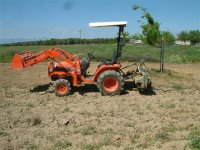
Here's how I did soil prep for the landscaping around my new house in 2005. Used a Kubota B7510 HST with a $125 middle buster and the rototilled with a 48" wide Yanmar tiller $200.

Kubota rototill-1.JPGB7510HST middlebuster.JPG

Good luck


Marketplace Items

2019 CHEVROLET SILVERADO 1500 CREW CAB TRUCK (A59823)
2019 CHEVROLET...
GIYI BF47-47" (2) PRONG BALE FORK (A60430)
GIYI BF47-47" (2)...
2018 PRINOTH PANTHER T14R ROTATING CRAWLER DUMPER (A60429)
2018 PRINOTH...
2009 Sterling Acterra Altec DM47TR Insulated Digger Derrick Truck (A60460)
2009 Sterling...
UNUSED FUTURE FT-180H HYD ROTARY TILLER (A52706)
UNUSED FUTURE...
2007 BOBCAT S250 SKID STEER (A60429)
2007 BOBCAT S250...
 
Top