How Does This Work? Voodoo Engineering?

   / How Does This Work? Voodoo Engineering? #1  

Cahaba Valley Farm

Veteran Member
Joined
Jan 13, 2020
Messages
1,726
Location
Somewhere Alabama
Tractor
1980 Ford 3600
I was comparing the specs between a John Deere 3038E and a Kubota LX3310 and I'm not understanding how these numbers work. If anybody has any ideas please share them.

John Deere 3038E:
Engine Torque at rated speed: 77.2 ft-lbs
Rated Speed/RPM: 2500
Engine horsepower: 37.2
PTO horsepower: 30
Weight: 2,222 lbs

Kubota LX3310:
Engine Torque at rated speed: 77.7 ft-lbs
Rated Speed/RPM: 2500
Engine horsepower: 30.8
PTO horsepower: 27
Weight: 1,918 lbs
 
Last edited:
   / How Does This Work? Voodoo Engineering? #2  
I was comparing the specs between a John Deere 3038E and a Kubota LX3310 and I'm not understanding how these numbers work. If anybody has any ideas please share them.

John Deere 3038E:
Engine Torque at rated speed: 77.2 ft-lbs
Engine horsepower: 37.2
PTO horsepower: 30
Weight: 2,222 lbs

Kubota LX3310:
Engine Torque at rated speed: 77.7 ft-lbs
Engine horsepower: 30.8
PTO horsepower: 27
Weight: 1,918 lbs
The JD's torque is 88.5lb-ft according to Tractor Data


But 77.2 according to JD themselves, so... 🤷
 
   / How Does This Work? Voodoo Engineering? #4  
You need rpm and torque to establish HP. More RPM at the same torque equals more hp.
 
   / How Does This Work? Voodoo Engineering? #5  
the formula is:

HP = Torque x RPM / 5252

For torque in lbf-ft. So you can have torque and hp peaks at different engine rpm depending on specs snd tuning.

why are you looking at sub 2000 pound tractors now? After all that ranting in your other thread, lol.
 
   / How Does This Work? Voodoo Engineering? #6  
HP = Torque x RPM / 5252

Here is the derivation of this formula.

LINK
 
   / How Does This Work? Voodoo Engineering? #7  
I was comparing the specs between a John Deere 3038E and a Kubota LX3310 and I'm not understanding how these numbers work. If anybody has any ideas please share them.

John Deere 3038E:
Engine Torque at rated speed: 77.2 ft-lbs
Engine horsepower: 37.2
PTO horsepower: 30
Weight: 2,222 lbs

Kubota LX3310:
Engine Torque at rated speed: 77.7 ft-lbs
Engine horsepower: 30.8
PTO horsepower: 27
Weight: 1,918 lbs
How they work? What do u mean?
Ideas? About what

Your signature phrase there suggest you know what torque is. So what are you asking?
 
  • Good Post
Reactions: JWR
   / How Does This Work? Voodoo Engineering? #8  
If “rated speed” is engine rpms when the PTO is turning at a standardized 540 rpm that most attachments operate at, it means the Deere’s engine is turning at a faster rpm to get the 540 rpm at the PTO.

Like others say:
(Horse) power = Torque x RPM
(don’t worry about the other numbers in the formula. They’re just conversion factors for keeping the units (Hp, foot-pounds, minutes, seconds, etc..) straight.

So if 2 tractors have the same torque, but one outputs more horsepower, it’s engine rpms must be higher at “rated speed”.

“Rated speed” is the undefined, confusing term in the above info.

Example your weedwacker turning at 12,000 rpm may have the same horsepower rating as an electric motor turning 1200 rpms, but it’s going to have 1/10th the torque.
 
Last edited:
   / How Does This Work? Voodoo Engineering? #9  
What part of it are you having problems with?
 
   / How Does This Work? Voodoo Engineering? #10  
I was comparing the specs between a John Deere 3038E and a Kubota LX3310 and I'm not understanding how these numbers work. If anybody has any ideas please share them.

John Deere 3038E:
Engine Torque at rated speed: 77.2 ft-lbs
Engine horsepower: 37.2
PTO horsepower: 30
Weight: 2,222 lbs

Kubota LX3310:
Engine Torque at rated speed: 77.7 ft-lbs
Engine horsepower: 30.8
PTO horsepower: 27
Weight: 1,918 lbs

I think the problem is that you may be expecting that JD's "rated speed" is the same as Kubota's. It may be that both use the same RPM for rated speed, but it doesn't have to be the same and if it was it would be a coincidence.
In this case it looks to me like JD's engine is set up to produce their torque figure at a rated speed that is slightly higher than the Kubota's. There could be as much as a couple hundred RPMs difference.

If so, and the torque is the same, then when we calculate HP using HP = torque times RPM we get different HP.

Does that help?
rScotty
 
   / How Does This Work? Voodoo Engineering?
  • Thread Starter
#11  
One very important figure is left;
what rpm did they get these numbers at.
Good point LouNY, I can't believe I left that out 🤦‍♂️

*Update: Ok I have updated the first post to show those numbers.
 
Last edited:
   / How Does This Work? Voodoo Engineering?
  • Thread Starter
#12  
the formula is:

HP = Torque x RPM / 5252

For torque in lbf-ft. So you can have torque and hp peaks at different engine rpm depending on specs snd tuning.

why are you looking at sub 2000 pound tractors now? After all that ranting in your other thread, lol.
I always was looking at tractors in that category. If you go back and read my first post on that thread you will see where I highlighted the word medium frame size which is what I was referring to.
 
   / How Does This Work? Voodoo Engineering?
  • Thread Starter
#13  
If “rated speed” is engine rpms when the PTO is turning at a standardized 540 rpm that most attachments operate at, it means the Deere’s engine is turning at a faster rpm to get the 540 rpm at the PTO.

Like others say:
(Horse) power = Torque x RPM
(don’t worry about the other numbers in the formula. They’re just conversion factors for keeping the units (Hp, foot-pounds, minutes, seconds, etc..) straight.

So if 2 tractors have the same torque, but one outputs more horsepower, it’s engine rpms must be higher at “rated speed”.

“Rated speed” is the undefined, confusing term in the above info.

Example your weedwacker turning at 12,000 rpm may have the same horsepower rating as an electric motor turning 1200 rpms, but it’s going to have 1/10th the torque.
"So if 2 tractors have the same torque, but one outputs more horsepower, it’s engine rpms must be higher at “rated speed”.

Haha so what sense do you make of this now? 😁
 
   / How Does This Work? Voodoo Engineering?
  • Thread Starter
#15  
I think the problem is that you may be expecting that JD's "rated speed" is the same as Kubota's. It may be that both use the same RPM for rated speed, but it doesn't have to be the same and if it was it would be a coincidence.
In this case it looks to me like JD's engine is set up to produce their torque figure at a rated speed that is slightly higher than the Kubota's. There could be as much as a couple hundred RPMs difference.

If so, and the torque is the same, then when we calculate HP using HP = torque times RPM we get different HP.

Does that help?
rScotty
Then according to those calculations the Kubota should have 36.98 horsepower.
 
   / How Does This Work? Voodoo Engineering? #16  
I was comparing the specs between a John Deere 3038E and a Kubota LX3310 and I'm not understanding how these numbers work. If anybody has any ideas please share them.

John Deere 3038E:
Engine Torque at rated speed: 77.2 ft-lbs
Rated Speed/RPM: 2500
Engine horsepower: 37.2
PTO horsepower: 30
Weight: 2,222 lbs

Kubota LX3310:
Engine Torque at rated speed: 77.7 ft-lbs
Rated Speed/RPM: 2500
Engine horsepower: 30.8
PTO horsepower: 27
Weight: 1,918 lbs
If you look up the engine specs the v1505 kubota max torque is 77 ft lbs @ 2000 rpm . The jd engine max torque is 88 ft lbs at only 1680 rpm and drops to 77 at its hp rated 2500 rpm. By doing the math for the kubota 30.8hp x 5252 =16176 divided by 2500 rpm =64.7 ft lbs torque at 2500rpm. So in a nutshell the Kubotas torque 77.7 @ 2500 is wrong.
 
   / How Does This Work? Voodoo Engineering? #17  
Its called voodoo marketing. They are posting the rated engine speed, not the rpm at which the HP was calculated. The peak torque likely isn't occurring at max rated rpm.
 
   / How Does This Work? Voodoo Engineering? #18  
If you look up the engine specs the v1505 kubota max torque is 77 ft lbs @ 2000 rpm . The jd engine max torque is 88 ft lbs at only 1680 rpm and drops to 77 at its hp rated 2500 rpm. By doing the math for the kubota 30.8hp x 5252 =16176 divided by 2500 rpm =64.7 ft lbs torque at 2500rpm. So in a nutshell the Kubotas torque 77.7 @ 2500 is wrong.
Is that for the the V1505 naturally aspirated or the common rail turbocharged version used in the LX3310? I thought the max tq was about 87ftlbs for the cr turbo version.
 
   / How Does This Work? Voodoo Engineering? #19  
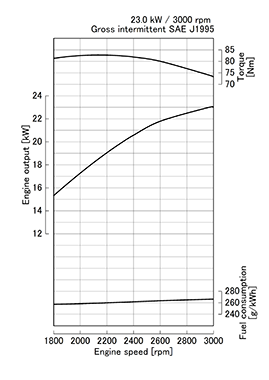
There's no voodoo engineering going on, you guys just don't have your facts straight. Absolutely zero chance that Kubota is going to lie about their engine performance.

(there are several different versions of their v1505 engine, but it should be this 30.8 HP one in the LX3310)

30_performance_curve_1.png
 
   / How Does This Work? Voodoo Engineering? #20  
Well thats odd. On the Kubota spec sheet, they list the engine as the V1505-CR-TE5-D36R1, which is the turbocharged version that makes 44 HP. But the lx3310 should only has 30.8 HP. Maybe they did confuse something after all.

Does the LX3310 have a turbo?


Tractor & Equipment Auctions

UNUSED RAYSKY RMS7-96 MOBILE TOILET (A60432)
UNUSED RAYSKY...
2025 Kivel Hitch Mini Skid Steer Attachment (A59228)
2025 Kivel Hitch...
2021 CATERPILLAR 299D3 SKID STEER (A60429)
2021 CATERPILLAR...
Ford F450 Bucket Truck with Altec AT200A Boom (A56435)
Ford F450 Bucket...
EZ-GO Utility Cart (A55851)
EZ-GO Utility Cart...
4 Unused Montreal ST205/75R15 Trailer Tires (A55788)
4 Unused Montreal...
 
Top