My Industrial Cabin Build

   / My Industrial Cabin Build #2,681  
I believe it’s 20 amp circuit, but outlets themselves can be 15A rated if multiple, unless a dedicated 20A load. For my fridge, I had to put in a single outlet, not a duplex. I haven’t looked at a code book in several years.

It looks nice recessed in a wall, but it’s hell trying to add circuits later. I have moved circuits many times in my panel since I built.
And the heavy circuits are closer to the main.
I cringe just thinking of the work to install the service entrance wiring to that panel.

Laying out the wires neatly into the panel in an art. Mine looks crappy.
 
Last edited:
   / My Industrial Cabin Build #2,682  
I'm not 100% sure, but in residential work, isn't it code for ALL outlets to be only 15 amps now? Or maybe that is just bedrooms, etc?
I won't pretend to have kept current with the code since it became less important to me (in other words - my house is done!) but I have not heard of that limit. Residential has been allowed 15A rated devices (receptacles, GFCI's etc) on a 120V 20A circuit for a long time. A lot also depends on what version your state or locality has adopted. Few places seem to jump on the new code the minute it comes out so most places are behind at least one version, and new ones come out every 3 years. My first question when starting my permit was what version of NEC are we using now? I think it was 2 or 3 behind.

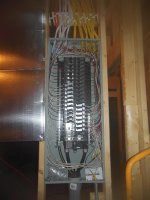
Just for giggles here was my panel when I was done with it. 200A 40 space. Actually I see there are a couple spaces there. It was all full when I was totally done, but I must have been waiting for a couple things when I got to this point. Mains fed from bottom, so I flipped it.
 

Attachments

  • Panel Complete (Medium).JPG
    Panel Complete (Medium).JPG
    421.3 KB · Views: 184
Last edited:
   / My Industrial Cabin Build
  • Thread Starter
#2,683  
Dstig, that panel is impressive.
I am supposed to have an electrician at the house tomorrow. If he wants me to, I’ll cut a piece of osb, cover the hole and surface mount it. Wont take long.
 
   / My Industrial Cabin Build #2,684  
I called the folks at Aqua sciences today. She priced out the stuff I need.
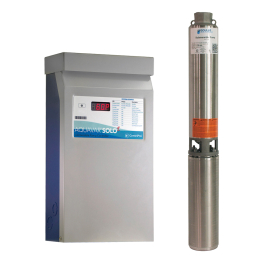
She priced a goulds pump that should give me 15 gallons a minute at 40 psi. At about 2950 and a goulds constant pressure system that would give me 15 gallons per minute up to 70 psi at 2750.
The constant pressure is appealing because there is no well tank involved. The downside is there is no reserved water if you lose power.

Anybody have experience wit this kind of system?

Yes I have lots of experience with pump controls of all kinds. Constant pressure is s good thing. But how you get it is important. The variable speed type pumps may seem to cost less up front because of the smaller wire, but that is just to entice you into purchasing the tar baby and get stuck with replacing it several times for several times the cost over the next few years. The Cycle Stop Valve is s simple mechanical and long lasting way to get good strong constant pressure. The CSV makes pumps last longer, uses smaller tanks, and is considered a disruptive product to the pump industry because it saves you so much money over the years.
 
   / My Industrial Cabin Build #2,685  
Dstig, that panel is impressive.
I am supposed to have an electrician at the house tomorrow. If he wants me to, I’ll cut a piece of osb, cover the hole and surface mount it. Wont take long.
Use a nice sheet of plywood instead of OSB. Make it big enough so you can staple the wires to the plywood.
 
   / My Industrial Cabin Build #2,686  
Yes I have lots of experience with pump controls of all kinds. Constant pressure is s good thing. But how you get it is important. The variable speed type pumps may seem to cost less up front because of the smaller wire, but that is just to entice you into purchasing the tar baby and get stuck with replacing it several times for several times the cost over the next few years. The Cycle Stop Valve is s simple mechanical and long lasting way to get good strong constant pressure. The CSV makes pumps last longer, uses smaller tanks, and is considered a disruptive product to the pump industry because it saves you so much money over the years.
Hi David,

Can you post the pump details from Aqua Science 15 GPM setup quoted as your well/pump will be at 190', 20 GPM output, and water averages around 70' as I recall?

The Goulds 7GS 3/4HP will easily pump 8-10 GPM, and the 10 GS 3/4HP will average around 10-12 GPM at the depth you are running.

You should look at the pump flow charts and for your application I would not get more than a 3/4 HP 10 GPM (10 GS series).

Definitely get the Cycle Stop Valve to prevent pump cycling and then a 8-12 Gal drawdown bladder tank, otherwise each time you run a faucet or use any water the pump will run - and the start/stops is what kills pump life.

I would keep the system simple and not get into the variable speed pumps.

Carl
 

Attachments

  • Goulds 10GS15 Pump Chart.pdf
    336.2 KB · Views: 170
   / My Industrial Cabin Build
  • Thread Starter
#2,687  
The pump quoted was 10gpm. It would produce 15gallins per mijute. I am definately houng to avoid the computerized drive. I am at the end of the line for power here. It isnpretty stable most of the time but we have som big storms and wind and lots of people lose power. Spikes are not uncommon.

 
   / My Industrial Cabin Build
  • Thread Starter
#2,688  
The electrician came to look things over this morning. He will be back friday to do some install work to bring the power into the house. The disconnect and transfer switch.
I have to re run some of my wiring. I have too much for the boxes I am using. Some of it he wants me to redo in 14 instead of 12.
I am pulling the box back out and surface mounting it. Always so fun to redo stuff. It’s the Inexperienced builder tax.
 
   / My Industrial Cabin Build
  • Thread Starter
#2,689  
Yes I have lots of experience with pump controls of all kinds. Constant pressure is s good thing. But how you get it is important. The variable speed type pumps may seem to cost less up front because of the smaller wire, but that is just to entice you into purchasing the tar baby and get stuck with replacing it several times for several times the cost over the next few years. The Cycle Stop Valve is s simple mechanical and long lasting way to get good strong constant pressure. The CSV makes pumps last longer, uses smaller tanks, and is considered a disruptive product to the pump industry because it saves you so much money over the years.

I appreciate you weighing in. Since you are here, what pump would you recommend? Provided, that I could find it with the way supplies are going these days. Any particular vendor you would recommend?
 
   / My Industrial Cabin Build #2,690  
... Some of it he wants me to redo in 14 instead of 12.
...
Why would anybody want you to remove a bigger wire that's already in place for a smaller wire that cannot handle as much power?

You can never go wrong with a bigger wire, it's just more expensive, but if it's already in place, you can easily run a 15 amp breaker on 12 gauge wire.
 
   / My Industrial Cabin Build #2,691  
My guess is that the electrician doesn't want to deal with a lot of stiff wire in a box.
 
   / My Industrial Cabin Build #2,692  
Why would anybody want you to remove a bigger wire that's already in place for a smaller wire that cannot handle as much power?

You can never go wrong with a bigger wire, it's just more expensive, but if it's already in place, you can easily run a 15 amp breaker on 12 gauge wire.
Agreed. I'd have a serious conversation with your electrician before replacing any #12 with #14. I can't think of any valid reason to do so.
 
   / My Industrial Cabin Build #2,694  
Why would anybody want you to remove a bigger wire that's already in place for a smaller wire that cannot handle as much power?

You can never go wrong with a bigger wire, it's just more expensive, but if it's already in place, you can easily run a 15 amp breaker on 12 gauge wire.

Fill ratio is one reason, can put more #14 than #12 in the box. Or, put in larger box. I would not change wiring down unless absolutely necessary.

I use #12 for receptacle circuits, #14 for lighting. And I don’t mix them. I also put in more than code requires. I also don’t use switched receptacles for lights, I have ceiling fans in almost every room.
 
   / My Industrial Cabin Build #2,696  
I haven’t had time to digest all the pump talk, like csv, but find it interesting. Thanks for the input. I want to learn some more for the next time.
 
   / My Industrial Cabin Build #2,697  
Why would anybody want you to remove a bigger wire that's already in place for a smaller wire that cannot handle as much power?

You can never go wrong with a bigger wire, it's just more expensive, but if it's already in place, you can easily run a 15 amp breaker on 12 gauge wire.
Likely because working with 12 in a box is more difficult.

I always try to get the widest and deepest box I can make work for the application because I hate trying to nicely stash 12ga wire into them.
 
   / My Industrial Cabin Build #2,698  
I agree that 12 gauge wire is harder to work with, but it's not really that much harder. Can an electrician really be so lazy that he refuses to work with 12 gauge wire?
 
   / My Industrial Cabin Build #2,700  
And if you want to use some of the new WiFi electrical switches, you need the neutral in the switch box. Sometimes they will only bring the hot wire to the switch box. Not all white wires will be neutral.
 

Tractor & Equipment Auctions

2018 NEW HOLLAND C232 SKID STEER (A60429)
2018 NEW HOLLAND...
2017 Toyota Camry Hybrid Sedan (A59231)
2017 Toyota Camry...
2019 GALYEAN EQUIPMENT CO. 150BBL STEEL (A58214)
2019 GALYEAN...
2022 Caterpillar 906M Compact Articulated Wheel Loader (A56857)
2022 Caterpillar...
Kubota M4700 4WD 51HP Utility Loader Tractor (A56857)
Kubota M4700 4WD...
2020 CATERPILLAR 299D3 SKID STEER (A60429)
2020 CATERPILLAR...
 
Top