How to find a suction leak

   / How to find a suction leak #1  

BeezFun

Veteran Member
Joined
Jul 1, 2009
Messages
2,493
Location
IL
Tractor
Kubota B2710
Is it possible to pressurize a hydraulic system to some low value to help locate a leak in the suction lines? I was thinking of fabricating a cap for the oil reservoir that will have a shrader valve in it so I can hook a compressor to it and put some low pressure (5-10psi?) in the system to find a leak. The reason I want to do this is in the next paragraph.

I've got an aerial lift, hydraulic circuit attached. The problem symptom is that the cage constantly goes out of level, and also moves out of level on it's own even when the system isn't running. In the circuit diagram the cage leveling cylinders are in the lower center area of the drawing, there is a cage cylinder and a knuckle cylinder. The bleed procedure given in manual is to cycle the cage cylinder fully in both directions, holding it at each extreme position for 20 seconds before releasing pressure. That works, the cage leveling operates properly for some time, generally an hour or two. But then the problem recurs. So I assume it's sucking air in the suction lines. I've tightened the fittings, the hoses are relatively new. I'm trying to figure out how to diagnose the problem before I just start replacing hoses and fittings with no idea what the problem is.
 

Attachments

  • Hydraulic Circuit.pdf
    247.8 KB · Views: 301
   / How to find a suction leak #2  
When was the last time the cylinders were rebuilt?
 
   / How to find a suction leak #3  
if i goes down with it not running then it is an internal leak, not vacuum leak. hydraulics are a pressurized system . suction side is a relative term. its still has pressure in my opinion. cap off the the cylinders and the one capped and still leaks down is the bad one. is usually a cylinder internal on the side going down. i have always rebuilt them in pairs but only me. most people don't
 
   / How to find a suction leak #4  
if i goes down with it not running then it is an internal leak, not vacuum leak. hydraulics are a pressurized system . suction side is a relative term. its still has pressure in my opinion. cap off the the cylinders and the one capped and still leaks down is the bad one. is usually a cylinder internal on the side going down. i have always rebuilt them in pairs but only me. most people don't
Pairs is the way to go.
 
   / How to find a suction leak
  • Thread Starter
#5  
if i goes down with it not running then it is an internal leak, not vacuum leak. hydraulics are a pressurized system . suction side is a relative term. its still has pressure in my opinion. cap off the the cylinders and the one capped and still leaks down is the bad one. is usually a cylinder internal on the side going down. i have always rebuilt them in pairs but only me. most people don't
These aren't lift cylinders, there is no up or down and there's almost no loading. If you read this article , it does a nice job explaining how leveling cylinders work. Also a leaking seal is not consistent with the symptoms I described. Bleeding the air out of the cylinder would not correct the problem if the problem was a leaking seal. I think the reason it moves when the system is not running is because the air is either expanding due to temperature change, or the air is migrating to the highest point in the system, which happens to be the cage leveling cylinder, so the air gets compressed and the cage moves.

Also, as an aside, leaking seals can't cause cylinders to drift in the direction of retraction. You could remove the seals and the cylinder still wouldn't drift retract because of the difference in volumes of fluid on the two sides of the piston. If it drifts in that direction it's either a hose/fitting or the valve leaking.
 
   / How to find a suction leak #6  
Beezfun,
I presume the knuckle cylinder is attached directly to the mast linkage and is mechanically pulled or pushed to drive the cage cylinder as a master slave system. Is this a correct assumption?

Which cylinder is moving in which direction?

I also item 19 a check and item an over center or counterbalance valve in the system. Depending on how these cylinders are attached to frame you could possibly have an internal circuit leak that would allow these two cylinders to move in unison causing the basket to tip or the directional control valve connected to the knuckle cylinder could also allow that cylinder to drift again depending on how the cylinder is connected. The check and over center valve should prevent the cage cylinder from moving if they are working properly.

I would be very surprised if a pump suction leak would only effect this one function and none of the others.
 
   / How to find a suction leak
  • Thread Starter
#7  
Beezfun,
I presume the knuckle cylinder is attached directly to the mast linkage and is mechanically pulled or pushed to drive the cage cylinder as a master slave system. Is this a correct assumption?
Yes
Which cylinder is moving in which direction?
When the knuckle extends the cage retracts.

I also item 19 a check and item an over center or counterbalance valve in the system. Depending on how these cylinders are attached to frame you could possibly have an internal circuit leak that would allow these two cylinders to move in unison causing the basket to tip or the directional control valve connected to the knuckle cylinder could also allow that cylinder to drift again depending on how the cylinder is connected. The check and over center valve should prevent the cage cylinder from moving if they are working properly.
Ok, thanks, that's on the edge of my hydraulic understanding, let me research that a bit to see if I understand it.

I would be very surprised if a pump suction leak would only effect this one function and none of the others.
The only reason I made that guess is because the manual says that the way to purge air from the system is to cycle the cage cylinder. So I assume it's designed for any air in the system to end up at the cage cylinder. In addition to the motion I describe, I also get slight shuddering of the cage when the leveling system is operating, which is another sign of air in the cage cylinder. After I bleed it, that shuddering goes away for awhile.
 
Last edited:
   / How to find a suction leak
  • Thread Starter
#8  
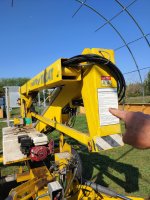
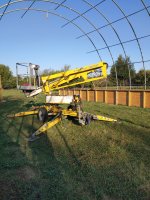
To help visualize things, here's the lift:

0927210813.jpg

The knuckle cylinder is behind where my finger is pointing:

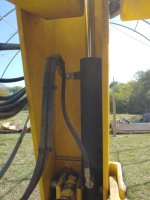
0927211031.jpg

Here's the knuckle cylinder:

0927211031a.jpg

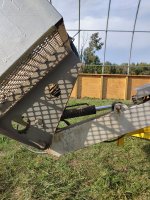
And here's the cage cylinder, I manually rolled the cage forward to make it more visible:

0926211641_HDR.jpg
 
   / How to find a suction leak #9  
Beez
Great job on the pictures they certainly do help.

Can the knuckle cylinder move without the main lift mast moving. Suspect no from pictures but would appreciate confirmation on this concept.
In looking at cage cylinder it could drift or extend if seals were bad but looks like load would trying to retract cylinder. Is this also correct?

does the cage feel spongy or bouncy after drifting out of position? If yes this would point towards air in the cage cylinder

shuddering can also be caused by the PO check and or the over center valve which could be another symptom or side effect of air somehow getting into the system
 
   / How to find a suction leak #10  
Didn't you post this exact same thread a few months (or more) back? It sure sounds familiar to me. Not that I have anything helpful to add, just wondering why it wasn't resolved last time or what has changed.
 
   / How to find a suction leak
  • Thread Starter
#11  
Can the knuckle cylinder move without the main lift mast moving. Suspect no from pictures but would appreciate confirmation on this concept.
No
In looking at cage cylinder it could drift or extend if seals were bad but looks like load would trying to retract cylinder. Is this also correct?
I think that's always true. I suppose if the lift were raised to it's highest vertical position so that the cage cylinder were fully extended and I leaned out the front of the basket, the load might be trying to make the cylinder extend, but 99% of the time the load is trying to retract it.

However it is true that when it drifts, it always drifts in the direction of the cage cylinder extending, and when it gets out of level it's always in the direction of the cage cylinder being too far extended. So it's always "drifting" in the opposite direction of the load.

does the cage feel spongy or bouncy after drifting out of position? If yes this would point towards air in the cage cylinder
No, not spongy at all.
shuddering can also be caused by the PO check and or the over center valve which could be another symptom or side effect of air somehow getting into the system
The shuddering has been going on a lot longer than the other symptoms. So whatever is happening is getting worse, and it's progressed from just shuddering to also getting out of level and drifting when the pump is off.
 
   / How to find a suction leak
  • Thread Starter
#12  
Didn't you post this exact same thread a few months (or more) back? It sure sounds familiar to me. Not that I have anything helpful to add, just wondering why it wasn't resolved last time or what has changed.
Yes, good memory, the last thread was asking for help understanding how the leveling system worked because I had no clue where to even start working on it. It also gave me more time to experiment and make sure I understood what was really happening. Now it's cold outside, so I've got it in the shop and I'd like to get it fixed.
 
   / How to find a suction leak #13  
Beez,
This is definitely a puzzler since what you are describing points towards the cage cylinder being under pressure to move even with the pump off.

Any way to install a pressure gauge in the cap end of the cage cylinder? What does it read when sitting stationary? Can you also get a reading while moving just as a comparison on what pressure it takes to tilt the basket.

Reason for asking is the the over center valve requires some pilot pressure to open would like to see if we can attempt to establish what that pressure is. My guess the over center valve is an Eaton Integrated brand valve since they are one company that I know of that calls there valves over center valves and also based in England.

I see the word manometer in a couple of different locations on the schematic. are these pressure gauges? With pump off I presume they drop to zero PSI or Bar.
 
   / How to find a suction leak #14  
An interesting problem. Thanks for including that excellent hydraulic schematic and also the tutorial on hydraulic leveling.

Yes, I agree with oldnslo that it might be a British design - based on some of the terms being not being the same as we use in the US. Understandable, though.

I'll have to let the whole schematic perculate for awhile. Oldnslo is way ahead in visualizing how it works. His questions help.

I'm not convinced yet whether the problem is air or something else i.e. an internal leak in the leveling system when it should be closed.

But right now you are looking for diagnostics. We ought to be able to come up with something. I suggest that we look first to see if it is air or not just because that might be easier.
The fact that the problem is at the highest point in the system sure points to entrained air exiting the fluid and accumulating at the high point. I suppose temperature change could account for the tilt. Do we have any numbers on normal temperature range?

ASIDE: Diagnosing internal hydraulic leakage is tougher for me because we know that ALL hydraulics have some inevitable internal fluid leakage; we just don't know how much is too much in this case. How do you feel about doing air first?

There aren't many places where air can enter. It has to be somewhere below atmospheric pressure when running - which means somewhere between the sump (2) and pump (3). And all you have for air introduction Tbetween the two are the fluid level in the sump, the shut-off (24) and the crud filter with bowl (14) plus the connections between them....Oh, AND the seal between the motor and pump. Lets not forget that.
Is that filter bowl glass? Can you see the fluid? What does it look like? BTW, the sump capacity seems low. Could it be that the fluid is simply too low?

Eventually we might think about introducing air into the system
deliberately as a diagnostic....to see if we can create the same problem..
rScotty
 
   / How to find a suction leak
  • Thread Starter
#15  
Beez,
This is definitely a puzzler since what you are describing points towards the cage cylinder being under pressure to move even with the pump off.
Yes, seems like that's what has to be happening.

Any way to install a pressure gauge in the cap end of the cage cylinder? What does it read when sitting stationary? Can you also get a reading while moving just as a comparison on what pressure it takes to tilt the basket.
I'll look at that today. I live right in the middle of a triangle of hydraulic shops, so I should be able to find some way to get a gauge on it.

Reason for asking is the the over center valve requires some pilot pressure to open would like to see if we can attempt to establish what that pressure is. My guess the over center valve is an Eaton Integrated brand valve since they are one company that I know of that calls there valves over center valves and also based in England.

I see the word manometer in a couple of different locations on the schematic. are these pressure gauges? With pump off I presume they drop to zero PSI or Bar.
I never noticed the manometer. Maybe there's a fitting to connect a guage, there's no guages on it. I know where those lines are that show the manometer, I'll look closely and see if there's a fitting that I can connect to.

That thing that's still perplexing is that following the air bleeding procedure resolves the problems for a short time, then it starts coming back. That points so strongly to the problem having something to do with air, but I can't imagine if it's sucking that much air I wouldn't see foam in the oil or some other evidence of air in other cylinders.
 
   / How to find a suction leak #16  
Beez,
When you manually operate the tilt or leveling system the only cylinder that moves is the cage cylinder correct. Based on this logic could there be a air pocket in the knuckle cylinder that you partially displace when manually cycling the tilt feature??

I can't determine exactly how the knuckle cylinder is mounted but the only logical way is that as the bucket mast lifts, the knuckle cylinder is being retracted which would then extend the cage cylinder keeping it level while raising the mast. Opposite is true while lowering the mast.

Since the cage never feels spongy or bouncy I doubt air is getting into the cage cylinder cap end but how about the rod end? Is it possible that there is an air pocket in the rod ends of the cylinders that you reduce the volume of when manually operating but never 110% purge. Then the question becomes how would this volume effect leveling operation?

Raising I would expect little to know effect on leveling operation since that end is full of oil (in theory)..

Lowering: I could foresee some shuddering since air is compressible and you have to keep pilot pressure on the PO check to hold it open while lowering. Pilot pressure builds, check opens air volume decompresses, check closes, pressure builds and cycle repeats.

Now I am trying to determine how having an air pocket in the rod end could allow cylinder drift with system off and what could we do to try and test this theory? I am not a big fan of opening systems just for something to do since once you introduce air into these master slave circuits in can be a challenge to get it bled so they function properly. Note: this is also a concern that I should have mentioned in my previous post while attempting to install a gauge in the system. Sorry for omitting that important bit of information.

Possibly crazy thought but is there any way you can manually try lifting the cage forcing the cage cylinder to extend to see if it is spongy in that direction. That would then support the theory of air in the system. easy for me to type potentially challenging for you to accomplish ;-)
 
   / How to find a suction leak
  • Thread Starter
#17  
Yes, I agree with oldnslo that it might be a British design - based on some of the terms being not being the same as we use in the US. Understandable, though.
It is British, the company is in the UK but sold all over the world. They're popular because there's no electronics, everything is hydraulic.

But right now you are looking for diagnostics. We ought to be able to come up with something. I suggest that we look first to see if it is air or not just because that might be easier.
The fact that the problem is at the highest point in the system sure points to entrained air exiting the fluid and accumulating at the high point. I suppose temperature change could account for the tilt. Do we have any numbers on normal temperature range?
Yes, I thought about temp change of the air causing the tilt. I normally use it when the temps are pretty moderate, generally 40-80F. The oil I have in it is rated for use below freezing, can't remember the exact rating but it's colder than I'm willing to be up in the air.

ASIDE: Diagnosing internal hydraulic leakage is tougher for me because we know that ALL hydraulics have some inevitable internal fluid leakage; we just don't know how much is too much in this case. How do you feel about doing air first?

There aren't many places where air can enter. It has to be somewhere below atmospheric pressure when running - which means somewhere between the sump (2) and pump (3). And all you have for air introduction Tbetween the two are the fluid level in the sump, the shut-off (24) and the crud filter with bowl (14) plus the connections between them....Oh, AND the seal between the motor and pump. Lets not forget that.
Is that filter bowl glass? Can you see the fluid? What does it look like? BTW, the sump capacity seems low. Could it be that the fluid is simply too low?

Eventually we might think about introducing air into the system
deliberately as a diagnostic....to see if we can create the same problem..
rScotty
Here's a picture of the suction area:

Suction Line Routing.jpg
There are two motors that can drive a hydraulic pump, the gas engine and it's pump are on the left, the electric motor is attached to the right side of that black cylindrical reservoir tank. The electric pump is inside the reservoir so it's not visible. Yellow arrow shows where suction line enters gas driven pump. Green arrow shows where suction line enters hydraulic filter base, red arrow shows the suction line that comes out the right side of the hydraulic filter base but is very hard to see because it makes a sharp turn to go under the electric motor. So there is a fair bit of suction plumbing that could be leaking. I've checked in the tank frequently and never see any evidence of foaming or entrained air. The tank is the only place in the system where the fluid is visible. The fluid level is correct, also note the only double acting cylinders are the stabilizers (and the leveling system), the lift cylinders are all single acting. I don't think that matters with respect to this problem. There is also a hydraulic motor that rotates the lift. If even a hint of air entered that motor it would be easy to feel a stutter in the rotation, and I've never felt anything.

The other part of this that makes it feel like an air problem is that I've had the lift for 8 years. When I got it, it displayed very slight shuddering in the cage leveling circuit, and when I bled the air it stayed good for a long time (days). Over time the problem has progressively gotten worse to the point where this year it also started this drifting behavior when the pump is off. So it really feels like a small air leak which has gotten progressively worse with time. But it could also be some other hydraulic component that has gotten progressively worse with time.
 
   / How to find a suction leak
  • Thread Starter
#18  
Beez,
When you manually operate the tilt or leveling system the only cylinder that moves is the cage cylinder correct. Based on this logic could there be a air pocket in the knuckle cylinder that you partially displace when manually cycling the tilt feature??
Yes, only the cage cylinder moves, the manual circuit has no effect on the knuckle cylinder. And yes, it's possible there's an air pocket in the knuckle cylinder that is only partially being displaced.

I can't determine exactly how the knuckle cylinder is mounted but the only logical way is that as the bucket mast lifts, the knuckle cylinder is being retracted which would then extend the cage cylinder keeping it level while raising the mast. Opposite is true while lowering the mast.
Yes, that's correct. You can confirm that in the photo I posted of the knuckle cylinder. That photo shows the lift
in the completely lowered position and the knuckle is fully extended. That cage cylinder is fully retracted.

Since the cage never feels spongy or bouncy I doubt air is getting into the cage cylinder cap end but how about the rod end? Is it possible that there is an air pocket in the rod ends of the cylinders that you reduce the volume of when manually operating but never 110% purge. Then the question becomes how would this volume effect leveling operation?
Yes, I see your thinking.

Raising I would expect little to know effect on leveling operation since that end is full of oil (in theory)..
Correct, there is either no or much less out of level problem when raising.
Lowering: I could foresee some shuddering since air is compressible and you have to keep pilot pressure on the PO check to hold it open while lowering. Pilot pressure builds, check opens air volume decompresses, check closes, pressure builds and cycle repeats.
Yes, shuddering only occurs when lowering, never when raising. Also, the out of level problem is worse when lowering than when raising. And as I mentioned earlier, the drifting with pump off only occurs in the extension direction of cage cylinder.
I think you're on to something.
Now I am trying to determine how having an air pocket in the rod end could allow cylinder drift with system off and what could we do to try and test this theory? I am not a big fan of opening systems just for something to do since once you introduce air into these master slave circuits in can be a challenge to get it bled so they function properly. Note: this is also a concern that I should have mentioned in my previous post while attempting to install a gauge in the system. Sorry for omitting that important bit of information.

Possibly crazy thought but is there any way you can manually try lifting the cage forcing the cage cylinder to extend to see if it is spongy in that direction. That would then support the theory of air in the system. easy for me to type potentially challenging for you to accomplish ;-)
Actually it's not that hard to test that. With the lift on the ground I can manually operate the leveling system so the cage rotates far forward, then I can hang on it like a monkey and see what it feels like. If you look at the photo I posted earlier showing the cage cylinder, that's the position I'll get the cage in and then hang on it from the outside.
 
   / How to find a suction leak #19  
Beez
Any way you can try an extend the cage cylinder without hydraulicly tilting the cage? By tilting the cage you have reduced the rod end volume which may or may not have some effect on indicating an air entrapment issue.
 
   / How to find a suction leak #20  
It is British, the company is in the UK but sold all over the world. They're popular because there's no electronics, everything is hydraulic.


Yes, I thought about temp change of the air causing the tilt. I normally use it when the temps are pretty moderate, generally 40-80F. The oil I have in it is rated for use below freezing, can't remember the exact rating but it's colder than I'm willing to be up in the air.


Here's a picture of the suction area:

View attachment 725600
There are two motors that can drive a hydraulic pump, the gas engine and it's pump are on the left, the electric motor is attached to the right side of that black cylindrical reservoir tank. The electric pump is inside the reservoir so it's not visible. Yellow arrow shows where suction line enters gas driven pump. Green arrow shows where suction line enters hydraulic filter base, red arrow shows the suction line that comes out the right side of the hydraulic filter base but is very hard to see because it makes a sharp turn to go under the electric motor. So there is a fair bit of suction plumbing that could be leaking. I've checked in the tank frequently and never see any evidence of foaming or entrained air. The tank is the only place in the system where the fluid is visible. The fluid level is correct, also note the only double acting cylinders are the stabilizers (and the leveling system), the lift cylinders are all single acting. I don't think that matters with respect to this problem. There is also a hydraulic motor that rotates the lift. If even a hint of air entered that motor it would be easy to feel a stutter in the rotation, and I've never felt anything.

The other part of this that makes it feel like an air problem is that I've had the lift for 8 years. When I got it, it displayed very slight shuddering in the cage leveling circuit, and when I bled the air it stayed good for a long time (days). Over time the problem has progressively gotten worse to the point where this year it also started this drifting behavior when the pump is off. So it really feels like a small air leak which has gotten progressively worse with time. But it could also be some other hydraulic component that has gotten progressively worse with time.
Interesting thread. Oldnslo is giving great advise. That is one seriously ugly suction plumbing. Upside down filter? Suction line with a loop higher than both the pump and tank? Surely the factory didn't do that. May not have anything to do with your problem, but how do you ever get all the air out of that?
 

Tractor & Equipment Auctions

2023 CATERPILLAR D6 LGP HIGH TRACK CRAWLER DOZER (A60429)
2023 CATERPILLAR...
207279 (A52708)
207279 (A52708)
2001 Dorsey 48ft Flatbed T/A Trailer (A56857)
2001 Dorsey 48ft...
2021 KENWORTH T680 TANDEM AXLE SLEEPER (A59575)
2021 KENWORTH T680...
2007 MACK CTP713 TRI AXLE DUMP TRUCK (A59575)
2007 MACK CTP713...
2019 CATERPILLAR  XQ60 GENERATOR (A58214)
2019 CATERPILLAR...
 
Top