jonsstihl
Veteran Member
here are images of both types attachment side. definitely not compatible with each other
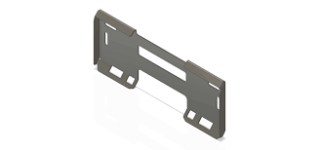
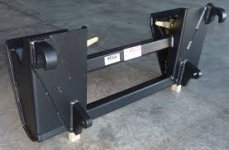

Kind of looks like that loader was actually built for a 4WD tractor.I see a lot more 2wd right now. Seems like 4WD is super expensive. If 2wd were even an option something like this would probably be good.
JD 5420 for $23,500. Doesn't list hours though.

John Deere 5420, 2wd with loader - farm & garden - by dealer - sale
Nice John Deere 5420 (81 Eng HP) 2wd tractor, has syncro shuttle 9X3, canopy, Ind PTO, joystick front valve with extensions to hook up for dual rear remote hyd. Comes with John Deere 542 Quick...fayar.craigslist.org

Th 4707 is 70 hp. It's right under the limit for Tier4 emissions. Massey did something kind of unique, they made the 4708, 4709 and 4710 with the exact same engine, except they are 80 hp, 90 hp and 100 hp. The 4707 is the only one under the limit, so it doesn't have DEF, and it doesn't Regenerate. The others all do.How
How can a new tractor in that hp range be sold without emissions? I don’t think that’s legal. Please explain what the situation is, because your description doesn’t make sense to me.


I tend to agree, but the more I read these forums and listen to people, I think Kubota may be one of the few who put a loader on that is rightly sized for the tractor and weight. The problem I see is that everyone just looks at specs and goes, ooh, that lifts more so it is better. The problem is they have a 3000# lift capacity on a 5000lb tractor and then a front axle breaks (or worse the tractor splits in half) and it's the tractors fault, not theirs for doing something they probably shouldn't have.
I guess what I am saying is most should go up a size in tractor, but of course they can't afford to or just don't want to. There will always be fringe cases, but if you are looking at max loader capacity and expecting to always need it, one should be buying a bigger tractor.

I don’t know. Safer? Considering most users have no concept of balance or ballast. More honest? More accurate? Better match to the tractor’s weight?But they do it anyway. What does that tell you?
rScotty

All of the aboveI don’t know. Safer? Considering most users have no concept of balance or ballast. More honest? More accurate? Better match to the tractor’s weight?
My opinion, is it tells me they don't believe it is costing them enough sales to matter. Or they simply believe in their design and specs for what they want to offer.I've had similar thoughts about different brands and their loader ratings. It's not like it is difficult or expensive to make a loader lift more weight. Any mechanic can do that quickly & for not much money. For a manufacturer to increase lift is no cost at all.
And Kubota has to know that their loaders are rated to lift less than others, just like they have to be aware that their lower loader lift spec is costing them sales.
But they do it anyway. What does that tell you?
rScotty
I have been looking for a larger tractor to replace or go with my Kubota L4400 4wd. The L4400 is 45 hp and is a good machine but it is very light weight. I need something heavier and with substantially more loader capacity. I'm looking for a used pre-emissions tractor with no computer. I'm looking in the 60-70 hp range. My ideal machine is a Kubota M6040 or M7040. Needs to be 4wd. But these are hard to find and as everyone knows these pre-emissions tractors are EXPENSIVE right now. I looked at a M7040 with 1800 hours on it. Beat up. Bent exhaust pipe. One of the front wheels and tires was new which makes me wonder what happened to it. Otherwise it was solid. Drove and functioned well. No obvious leaks etc. $28,500! And searching the web that's consistent with what else is out there. I've made a casual offer of $22,000 but haven't heard back. Can't imagine he'll get anywhere close. But it has been sitting there a while.
So, I need to broaden my horizons. That would primarily mean John Deere or other popular brand with good local dealer support. But I don't know anything about brands other than Kubota. I would prefer a mechanical shuttle shift. Would consider hydraulic shuttle shift. No hydro. What would the JD equivalent of a Kubota M6040 or M7040 be? Any thoughts or recommendations appreciated.
New tractors are generally in short supply and thus used ones have become pricey as well.
Deere's pre-emissions tractors in the 60-70 HP range would be certain 5000 series machines up until 2013, and before that, the smaller members of the 2x40/2x50/2x55 series as they introduced MFWD on the 40 series units in this HP range. I will say that MFWD was pretty uncommon until roughly the late 1990s, so it would be pretty uncommon to find a 40/50/55 series unit with it and it wasn't even that common on the first 5x00 units. The units you would want to look for are the 5300 and 5400, 5310, 5320, 5303, 5325, 5403, and 2008-2013 5065E and 5075E as well as 5065M and 5075M. Do note that the 5065E, 5075E, and 5075M are still made and you would need to narrow your search to 2013 and older units in order to not turn up 2014-up Tier 4 units if you want a pre-emissions tractor. These tractors depending on year and model series could have an unsynchronized 3-range/3-speed Collar Shift transmission, a 3-range/3-speed synchronized SyncShuttle (also called the TSS or "top shaft synchronized") transmission which does NOT have a shuttle lever, or one of a few different hydraulic reverser (PowrReverser) transmissions with the shuttle lever, most commonly a three-range/four-speed unit. Deere never made a mechanical shuttle transmission for these tractors with a shuttle lever like you would see on a New Holland Workmaster 60 or 70 aka the CaseIH Farmall 60A and 70A. They also never made a hydrostatic transmission for this size of tractor either.
The Deere 5000 series are a nice tractor, the same basic design has been made since the early 1990s and the basic 3 cylinder 179 CID/2.9 L engine in nearly all of those has been made since the 1970s. The exception here is the 5325 and Tier 2 5065M/5075M. They used a five-cylinder skid loader engine and the 5M used/uses a new, different, larger frame than the other tractors in this list. I have run several three and four-cylinder versions in the 5000 line over a couple of decades, both cabbed and open station, 2WD and MFWD, and with the TSS as well as 12-speed PowrReverser transmissions. They all worked well, I personally prefer the TSS transmission despite there being no reverser lever, but that is personal preference.
Deere's comparable models to the M6040 and M7040 would have been the 2008-2013 5055E and 5065E/5065M.
Regarding loader carriers, the "ALO" type above is called Global and is an ISO spec. CaseIH/New Holland as well as John Deere give it as an option on some loaders. The other carrier CaseIH/New Holland uses is the skid loader QA, which is an option if not the only setup offered on loaders on <75 HP tractors. Deere offers their own hook-and-linch pin JD 500 QA on all of their 500 series loaders, and on some loaders they offer Global and on some new ones, skid loader QA. Kubota appears to only use the skid loader QA on tractors of this size. I personally like the JD QA as it's the easiest and most foolproof of the three mentioned above, and it is not proprietary. Most 500 series Deere loaders made before about 2010 or so are going to be Deere QA.
I will also say to not rule out a 2WD utility tractor unless you have actually used a 2WD utility tractor on your property and had issues with it. A utility tractor has a lot more weight than a compact, and particularly with the fluid-filled ag (R1) tires that generally come on them, a 2WD utility tractor will get a lot more traction than compact tractor with MFWD disengaged will get. They work just fine with a loader, you just need to have appropriate ballast, which you are supposed to have on any tractor with a loader. With the exception of the smaller Kubota M series units with their bevel gear MFWD as you see in a compact tractor, the 2WD tractors have a much smaller turning radius than a regular planetary-hub MFWD utility tractor as well, which is why they are popular for haying operations around here.
Thanks for that real complete synopsis on the larger JD utility tractors & loaders. BTW, wasn't there a high quality loader made a few decades back by the ALO company? Maybe in Canada? I remember something of that.
You changed my mind on on thing, which is I have long been in favor of the SSQA just because it opens up a whole world of rental options. But I am realizing I haven't taken advantage of those rentals myself, and I have several times now mis-mated my SSQA with the few front attachments I have... and then worrried about someday tweaking the SSQA. All that adds up to my beginning to look around just to see if there really are better QAs out there. I'm probably not going to change, but I would like to know.
I hear you on the 2WD. I suspect that a 2wd is going to be the cost-wise sweet spot right now in used pre-emission tractors. Once you get over 70 hp, the 2WD machines have a lot of traction, they are real reliable, and they steer nicely. They just aren't popular against the same machine in 4wd and that might be the one way to save serious money. Now if you have hills, snow, and ice, then best stay with 4wd. But consider it. When I buy used, I worry about the 4wd. It's the one mechanical system difficult to evaluate.
rScotty

Thank you. I get a little confused on all the smog systems out there. Kubota M4 and 7060 uses DPF, EGR and Regen.Kubota doesn't use DEF on either the M7060 or M4 which are both over 70HP. Not sure about Deere.
2wd is simply not an option. Too many hills. Too much slick mud. With Kubota 4wds I don't think there is a big compromise in turning radius due to the bevel gear design. I could be wrong.
Thank you. I get a little confused on all the smog systems out there. Kubota M4 and 7060 uses DPF, EGR and Regen.