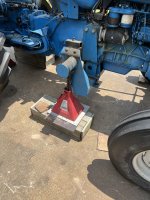
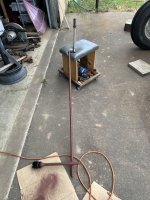
First time jacking tractor rear end.

   / First time jacking tractor rear end. #1  

ETpilot

Gold Member
Joined
Mar 3, 2010
Messages
282
Location
East Texas
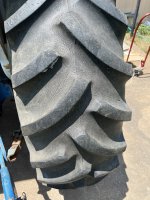
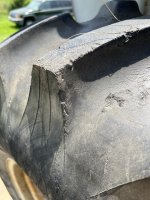
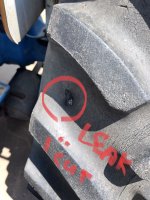
This is my first time jacking the tractor rear end. Tractor is a Ford 4610 purchased new in 1992. Rear tires are original, not filled, and I believe in need of replacement. I was mowing the backside on my property and parked the tractor behind the shop so as to finish the next day.

Next day I found the left tire was going flat. I was able to air the tire up so I was able to remove the mower and FEL. I parked the tractor with a jack stand to support the left side. I decided new tires are in order. The problem is I have to take the wheels to town for the replacement. I no longer have a service that comes to me.

First battle was getting the lug nuts loose. They are 1 ½” and we’re on super tight. Either over torqued or corrosion. I made a couple of new tools. Once I had then loose I was on to the next problem; how to lift the rear end?

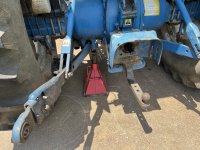
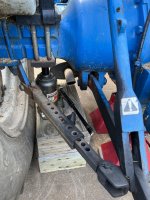
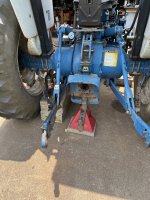
Searching how to do it, I decided to use a 20 ton bottle jack with 2 jack stands for support, one being a close standby. The pictures show how I have this set up. I have the tractor just about level left to right. So I would just raise the left side, remove the wheel and then lower to the jack stands. Do the same on the right side. Doing one wheel at a time.

Just looking for feedback or suggestions if my plan is good. Anything to look out for. Any idea on the weight of the wheel. Thanks.
BBC9C13A-B03C-4D7B-8EDF-11CAE016F036.jpeg5DD1806A-4FD4-4294-80F2-9EF39770E09A.jpeg9DA5C02C-A8A1-49BA-B33B-8E9C772DD7A8.jpegC7AA9BA1-4A27-4D7A-A609-B2249429225C.jpeg1CF5875C-9A39-4757-A3E9-0300C47CEA9D.jpegA7A11794-0A22-4D69-8275-E05117B5CEFD.jpeg
 
   / First time jacking tractor rear end. #2  
Weight of wheel is = heavy.
y not just plug that leak? Does it have a tube?
 
  • Good Post
Reactions: JJT
   / First time jacking tractor rear end. #3  
I don't think I would support the tractor under those lower arm brackets. I'm a little gun shy though... Last summer I snapped one off on my Kubota. Totally different circumstances however.

I would also plug that tire and get another 20 years out of it.
 
   / First time jacking tractor rear end. #4  
When I swapped my tires around for more space for chains I did very similar;
getting ready to jack.jpg


both rears off.jpg
 
   / First time jacking tractor rear end. #5  
Typical safety hints... Chock the front tires since the brakes are on the rears. Break loose wheel bolts while on the ground. Then jack and block. I like wood cribbing rather than jack stands. Metal to metal is slippery unless the tractor rests in the jack stand cup. There's only flat surfaces under my tractor. I also leave the jack under the tractor with a preload on. Sort of a belt and suspenders approach if one were to slip or fail.
 
   / First time jacking tractor rear end. #6  
Any idea on the weight of the wheel.

You really need to tell us the size of your tires. I run a Kubota B7610 and an M4700. One is easy, the other heavier.

I did similar on my M4700 w/14.9-28's FILLED (to swap my wheels to decrease the width). On the first tire I had 2 strapping 6' plus 20 yr olds to help. On the second tire I only had one of the helpers but I used a HiLift jack under the rim to help lift the tire off & on the studs. That almost made it a 1 man job. But the tires still weigh about 700lbs apiece IIRC.
Also do it on a hard surface.
 
   / First time jacking tractor rear end. #7  
I would plug that tire and go on about my business. You can get many more years out of those tires.
Elevate the "offending" tire and plug it. No need to even remove the tire/wheel.
 
   / First time jacking tractor rear end. #8  
I want them old bad tires. I'd get another 30-40 years out of them. Just fixed a flat on my neighbors. He knows that tire hadn't been off since he bought the tractor used in 1968.
 
   / First time jacking tractor rear end.
  • Thread Starter
#9  
Thanks for all the replies. The tires are 16.9-30 tube type, not filled. The tractor sits on a concrete pad. I initially placed the jack stand under the lower arm bracket as it was easiest at the time. After reading it was not a good location, I moved it to the drawbar support bracket. It is now in a C channel cross member. Jack will also provide support. Finding a good flat spot is a problem. All 3 wheels will be chocked.

Jacking will be on the axle under a flat plate where the ROPS is bolted. I made a bracket for the jack so it cannot move left to right nor forward and aft. Using the bottle jack will make aligning the wheel with the lug bolts easier. I think.

Plugging or replacing I still have to take it to town. I will look into plugging. I may get a helper. Plan is to remove the wheel and roll it onto a flatbed trailer. Easy writing about it. I may be a bit nervous actually doing it.

I’m going to try, one last time, to see if I can find a service that will come to me for this repair.

LouNY, I’m not that knowledgeable about these tires. Mine has an arrow indicating direction of rotation. The lugs on both tires face forward. In your second picture the right tire appears to be on in reverse. Something you may want to check as I could be wrong. Thanks for the pics.
 
   / First time jacking tractor rear end. #10  
You can fix a tube tire while they are still mounted on the tractor, we never take a rim off to work on a rear tractor tire.
If you are running a tube plugging will not work, it will need to be broken down and the tube patched or replaced.
It something poked through the tire or the tire has been penetrated it should have a boot installed in the tire.
A boot is similar to a tube patch but much heavier and is designed to function much like the carcass of the tire.
Those are the rear tires that had been rolled up to lean on the fronts while I was getting ready to swap them side to side
to get a bit more clearance inside the tires for tire chains.
Yes the treads are facing the correct direction when I finished.

Rolling a 16.9-30 tire is not difficult just take it slow and easy keeping the tire balanced in the upright position.
The difficulty is going to be trying to safely lay it down on the trailer,
as soon as the top goes past center it is going to become heavy very fast.
A safer way will be some manner to suspend in the air and back the trailer under and lower it down.

If your tractor has a loader, after the tire is off carefully and securely support the corner of the tractor and use your
own loader to lift the tire and rim up and lower it into a trailer, then lift and set it down upright when done.

Or an engine hoist or even a tree and a come along.
Laying that tire down will be the most hazardous part of the job and standing it back up the hardest physically.
 
   / First time jacking tractor rear end. #11  
Pick up the rear with a floor Jack. Place Jack stand under axle and lower it down being sure to get the axle into the u on the stand.
I use my 3 ton floor Jack.
 
   / First time jacking tractor rear end. #12  
I would plug that tire and go on about my business. You can get many more years out of those tires.
Elevate the "offending" tire and plug it. No need to even remove the tire/wheel.
Ditto those rear tires would work for me. My Ford 6700 has raked many 100 acres pulling my 14 wheel rake with rear tires than the cleats were almost worn off with tire carcass for many years.
 
   / First time jacking tractor rear end. #13  
I like floor jacksless chance something going wrong.
 
   / First time jacking tractor rear end. #14  
Important to know, very important, that lifting tractors is completely different than cars or pickups.
The front is not supported by the front wheels at the corners, its supported by the front axle pivot bolt at the center.
If the whole rear is lifted at the center, you've got the whole thing balanced on the jack and the front axle pivot bolt.
If it starts leaning to one side, you're in big trouble in a hurry.
And obviously, the bigger tractor the bigger challenge.

If at all possible, only jack up the rear on one side at a time and leave the other side wheel in place for stability
If the whole rear lift is necessary, two jacks, one on each axle is best.
The challenge there is that you may not have enough room for a jack and a jack stand on each axle.

I have used a single jack at the center with stands at the axles, but it gets tricky.
A helper, or two are needed to keep raising the stands or adding dunnage.
And filling in a 1/2" of space or less.
If the tractor starts to lean over to the right, the jack and stands will get spit out to the left.
 
   / First time jacking tractor rear end. #15  
A round point shovel is your friend with big tires. Use as a huck bar.
 
   / First time jacking tractor rear end.
  • Thread Starter
#16  
Well I could not find a tire service that will come to me. I spoke to my tire man in town and the plan is to keep the tire. He will put a boot and use a new tube. So I will have to remove this wheel and take it to town.

I'm certainly learning a lot regarding lifting this tractor. I’ve given thought to many of the points made here. I’m not in favor of lifting from the center due to the instability I will face. So I favor lifting the axle on left side while keeping 3 wheels on the ground. I will have a helper while doing the work. I will definitely go slow and study the lift as I progress. It going to be interesting.

Today I wil place the trailer for the transport and hope to do the lift tomorrow. Thanks all for all the help.
 
   / First time jacking tractor rear end. #17  
I don't think I would support the tractor under those lower arm brackets. I'm a little gun shy though... Last summer I snapped one off on my Kubota. Totally different circumstances however.

I would also plug that tire and get another 20 years out of it.
+1
 
   / First time jacking tractor rear end.
  • Thread Starter
#18  
Well success!!

This morning as I walked to the tractor and looked at it, I had one of those “ why didn’t I think of that before moments” What I saw is that my tractor has a FEL support that sticks out and is even with the inside sidewall of the front tire. A jack stand under that support would stop the leaning concern that I had.

So I just moved one jack stand to the FEL support and made a test lift of about 2 inches on the jack piston. Sure enough the jack stand was supporting the tractor right side. The real surprise was that I found the left wheel was clear of the ground. Hooray!

I called a friend to come to help with getting the wheel off. The lift only required a piston extension of just 1 inch for the wheel to clear the ground. We rolled it on the trailer and it does get heavy once it leans off of vertical.

I’m sure with the tire repaired and full of air I may have to lift the tractor a bit more. I also believe what really helped was my placing the tractor almost level left to right. Right side was just 1 inch higher than the left side. That was my starting point.

It sure will be great getting my tractor running again. Again thanks to all. It was good information and a good learning experience for me. Plus you all saved me a ton of money.

2C331C0B-1C6D-46A7-A922-807B3EB0CF3D.jpegAC35822B-2B23-483F-97EF-9E64B74B75C9.jpeg
 
   / First time jacking tractor rear end.
  • Thread Starter
#19  
My tire trouble didn’t end with the tractor tire. This morning I went to take the tractor tire to town and my RR tire on my trailer was flat. The tire was good but the valve stem failed. Another tire for the work order.

The tire service man and my friend from yesterday are both super strong. They both handled that wheel as if it were an auto wheel. I tried lifting that wheel today and I could not move it an inch. A sign I have a young mind but an old body.

Here is a picture of my torque wrench extension I made to torque the lug nuts. A bit heavy but it worked. I set the wrench to 95 ft. Lbs. and it torqued the lug nuts at 350 ft. Lbs.

59F63BA3-B98B-4F7B-A645-DDEF0D4F82F0.jpeg
 
   / First time jacking tractor rear end. #20  
My tire trouble didn’t end with the tractor tire. This morning I went to take the tractor tire to town and my RR tire on my trailer was flat. The tire was good but the valve stem failed. Another tire for the work order.

The tire service man and my friend from yesterday are both super strong. They both handled that wheel as if it were an auto wheel. I tried lifting that wheel today and I could not move it an inch. A sign I have a young mind but an old body.

Here is a picture of my torque wrench extension I made to torque the lug nuts. A bit heavy but it worked. I set the wrench to 95 ft. Lbs. and it torqued the lug nuts at 350 ft. Lbs.

View attachment 746336
How did you calculate that out?
I made a extension to get 300 ft/lb off a 150 wrench.
It was 14.something inches@ something less than 150 setting (closer to 130 maybe?)
That picture just seems like its way out of whack.
 

Tractor & Equipment Auctions

2019 CHEVROLET SILVERADO 1500 CREW CAB TRUCK (A59823)
2019 CHEVROLET...
2023 CATERPILLAR D3 LGP CRAWLER DOZER (A60429)
2023 CATERPILLAR...
2025 Ligchine Spiderscreed Concrete Screed (A59228)
2025 Ligchine...
2018 Chevrolet Tahoe SUV (A59231)
2018 Chevrolet...
2012 HYUNDAI  HL740-9 WHEEL LOADER (A58214)
2012 HYUNDAI...
2001 Chevrolet Suburban SUV (A59231)
2001 Chevrolet...
 
Top