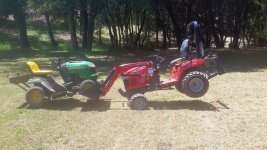
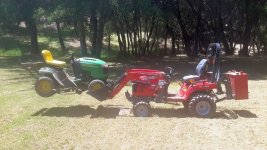
tractor tipping question

   / tractor tipping question #21  
I bought some pallets of precast modular retaining wall from a guy down the road. The manufacturer says the pallets are 1850 lbs. Talk about pucker factor trying to load these pallets on my trailer to get them home. The sketchiest tractor work I have ever done. I had a 1200 lb. ballast on the back and QA pallet forks. Unloading them was even worse. Sometimes it is just not worth it. As much as I am dreading it I will be loading the remaining 3 pallets on the trailer by hand. Be careful out there folks!View attachment 840460
I would guess that the load you have pictured may be overloading that trailer…..
 
   / tractor tipping question #22  
I would guess that the load you have pictured may be overloading that trailer…..
It is quite possible. I towed it with the tractor a little over a mile down the road, all uphill. The tractor was working for sure. Possibly not the best idea, it was one of those times where I was very happy to get off the tractor once I got to the property.
 
   / tractor tipping question #23  
I would guess that the load you have pictured may be overloading that trailer…..

Mobile home axles are designed to take a lot of weight.

If the 3 pallets weigh less than 6,000 lbs, then it may be within what that trailer can carry. It really depends on how the trailer was made. Does it have springs? Were they bottomed out?

I know my little Ford doesn't like heavy loads. And, while I like my bucket forks, it means they stick out quite a bit, and I've got the weight of the bucket + the weight of the forks.
 
   / tractor tipping question #24  
Ok, a while ago I made these little axle blocks for my little Ford.
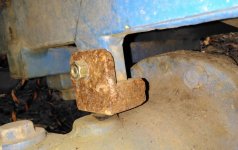
AxleBlocks.jpg

The blocks helps the axle resist rolling, going between the factory stop and the axle. Pretty simple to make. Quick weld, and then drilling both the block and the axle stop on the tractor.

A month or so I changed from my tiller which I was using as ballast to the drawbar for towing, then didn't think about it.

unloadinglift-jpg.839410


drawbar-jpg.839306


If I do it right, I can get both rear wheels off of the ground without the tractor tipping to the side.

I don't know how dangerous it is when the tractor rolls over to the factory blocks, but it is very uncomfortable. Plus, I can now get 2 wheels off the ground, rather than just one.

My biggest issue is driving in certain areas such as climbing up away from my driveway where I can actually get the tractor driving on 2 wheels (one front, one rear). I have a wheel locker and need to use it from time to time.

I can't say if every tractor would work well with these blocks, but it is good for mine.

Old forklift forks have been bolted to my bucket. Top 2 bolts on each fork are visible. Then a piece of angle iron is welded near the front of the bucket with 4 more bolts. Unfortunately the configuration is mighty heavy.
 
   / tractor tipping question #27  
Is it similar to Cow Tipping?
 
   / tractor tipping question #30  
I’m not quite sure of the purpose of the blocks, and especially not sure why you want to be on two tires…
😳
The blocks decrease the distance that the front axle can pivot, which allows him to more easily overload the front axle, loader, tires, wheels etc. with less risk of tipping. It significantly increases the chances of breaking something, since the "clue" of the rear getting light and the tractor pivoting on the front axle is less noticeable.
 
   / tractor tipping question #31  
I have a sub-compact, emax 20s with a bucket and backhoe. A couple of times with a heavy load on the front (clamp on forks) I've felt a rear wheel lift off the ground. Lowered the bucket, inched forward, and lowered the backhoe outriggers to help keep from tipping. Is that a stupid think to do? Does it help?
Using the backhoe outriggers can help to keep you from going all the way over. Obviously you won't be able to move with them all the way down and if you "hover" them a few inches off the ground, you run the risk of bending them if you hit a bump or hole. As has been pointed out, if you get to the point where you're using your outriggers that way, or swinging the backhoe around for counterweight, you've overloaded your machine. You can decide what to do from there. I've overloaded plenty of loaders of varying kinds and made it work, but that doesn't mean it's a good idea, especially for someone who doesn't understand the forces that are being exerted and where.
 
   / tractor tipping question #32  
The blocks decrease the distance that the front axle can pivot, which allows him to more easily overload the front axle, loader, tires, wheels etc. with less risk of tipping. It significantly increases the chances of breaking something, since the "clue" of the rear getting light and the tractor pivoting on the front axle is less noticeable.
Sorry, but I don't see how having limited articulation would make it easier to overload anything up front. To me, adding weight to the rear does.

Also, it's very easy to tell when the rear is getting light (well. for me it is) regardless of articulation abilities. I've lifted both rears evenly a few times when underestimating the weight on the pallet forks, and with unaltered pivot travel in the front.
 
   / tractor tipping question #34  
As has been pointed out, if you get to the point where you're using your outriggers that way, or swinging the backhoe around for counterweight, you've overloaded your machine.
More that I don't understand. I use the backhoe as a counterweight with no loads whatsoever, either on side hills or when crossing ditches. Certainly shouldn't be an overload situation.
but that doesn't mean it's a good idea, especially for someone who doesn't understand the forces that are being exerted and where.
I though I knew the forces involved, after all it's simple physics, but I guess I have a lot to learn yet.
 
   / tractor tipping question #35  
Sorry, but I don't see how having limited articulation would make it easier to overload anything up front. To me, adding weight to the rear does.

Also, it's very easy to tell when the rear is getting light (well. for me it is) regardless of articulation abilities. I've lifted both rears evenly a few times when underestimating the weight on the pallet forks, and with unaltered pivot travel in the front.
It makes it easier to overload without pivoting as much. If you're on perfectly flat ground, with tires that are at exactly the same pressure, lifting a load that is perfectly centered and the rear of the tractor has the center of gravity exactly balanced between the wheels and the operator stays exactly in the center and doesn't lean one way or the other, at all, then the rear wheels will lift evenly and stay that way. Otherwise, they may lift at the same time, but as soon as there is the slightest shift in anything being exactly balanced in the middle, the tractor will pivot on the front axle. Adding weight to the rear will also allow more overloading, since it makes the machine more stable and less prone to the rear end lifting.
 
   / tractor tipping question #36  
More that I don't understand. I use the backhoe as a counterweight with no loads whatsoever, either on side hills or when crossing ditches. Certainly shouldn't be an overload situation.
I didn't say that using the backhoe as a counterweight caused overloading, I said it made it easier to overload. Anything that makes a machine harder to tip makes it easier to overload it, obviously.
I though I knew the forces involved, after all it's simple physics, but I guess I have a lot to learn yet.
I have no idea what you do or don't know.
 
   / tractor tipping question #37  
If you're on perfectly flat ground, with tires that are at exactly the same pressure, lifting a load that is perfectly centered and the rear of the tractor has the center of gravity exactly balanced between the wheels and the operator stays exactly in the center and doesn't lean one way or the other, at all, then the rear wheels will lift evenly and stay that way.
As in the photo in post number 33?

I think it's highly unlikely that WranglerX got off of the tractor, and back on, while staying exactly in the center.

It really is a matter of understanding the "forces that are being exerted and where".
 
   / tractor tipping question #38  
May I say that as far as I’m concerned, this topic is a strange topic……
 
   / tractor tipping question #39  
As in the photo in post number 33?

I think it's highly unlikely that WranglerX got off of the tractor, and back on, while staying exactly in the center.

It really is a matter of understanding the "forces that are being exerted and where".
I'm not sure if you're disagreeing with me or what? If all the tractor's weight is on the front axle and the weight is not perfectly centered, it will tilt towards the heavier or downhill side. That isn't my opinion, that's a fact.
 
   / tractor tipping question #40  
I think I’ve tried to think too hard on this thread, I’m gonna go take a nap
 

Tractor & Equipment Auctions

2010 CATERPILLAR 345DL EXCAVATOR (A60429)
2010 CATERPILLAR...
2015 Ford F-250 Crew Cab Pickup Truck (A59230)
2015 Ford F-250...
2008 MOTIV ALUMINUM TRAILER CO. 32 TRI AXLE GOOSENECK ENCLOSED TRAILER (A58214)
2008 MOTIV...
MARATHON 20KW GENERATOR (A58214)
MARATHON 20KW...
20FT X 30FT STEEL CARPORT (A58214)
20FT X 30FT STEEL...
CHALLENGER MT525B TRACTOR (A59823)
CHALLENGER MT525B...
 
Top