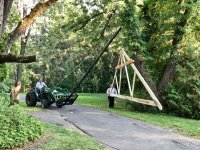
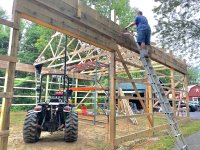
truss boom design

   / truss boom design #1  

ironman1952

Silver Member
Joined
Dec 7, 2023
Messages
118
Tractor
2023 Kioti RX7320pccb
The cost of a truss boom is pretty high for what is involved.
Here is my design what does everyone think?

Critique :) Please as I am certainly not an engineer. Regards, Joe
 

Attachments

  • Joes truss boom design.pdf
    599.9 KB · Views: 309
   / truss boom design #2  
How much weight are you expecting?
What about adding a wire stay to the top to give support?
You could add an upright at the end of the 120" piece. Cable could have a turnbuckle to adjust tension.
 
   / truss boom design #3  
Why make it mount to pallet forks rather than direct? What are you intending to lift?
 
   / truss boom design #4  
Here is my design what does everyone think?
Here it is in case it doesn't download on your device:

Screenshot 2024-01-11 14.57.12.png

Screenshot 2024-01-11 14.58.08.png
 
   / truss boom design #5  
I'm not seeing much of a truss design in your drawing, unless I'm missing something.

If these are pallet forks on a tractor then do the forks tilt upwards a lot? In that case you can run your boom flat with the pallet fork tines, rather than at some kind of an angle.

Also, the strongest point of your pallet forks is near the back, closet to the tractor. So, unless you need to attach something at the tip, attach it at the back instead.

Looking at forklift forks, definitely they're not all the same. Different widths and thicknesses from 4", 5", 6", and 8" wide, and 2" to 2 1/2", or perhaps even thicker at the base. It will really make a difference with the amount you'll be able to lift out in the distance. If your tractor forks were made by a reputable manufacturer, you should have weight ratings, perhaps at different points on the forks.

Also the tractor weight, design, and ballast will make a difference.

If you know the weight on the rear wheels, and the distance between the front and rear wheels as a pivot, and the distance from the front wheels to the load. And the center mass location and weight on your truss. And, of course the actual desired load. Then you would be able to calculate whether your tractor could handle it.
 
   / truss boom design
  • Thread Starter
#6  
Truss boom has become a name for all boom types. More of a modified jib crane +-
The weight this will lift will be 400 or less as I would only be lifting 24'trusses
weighing about 120-150 lbs

SO no not really truss by design. :)

My back tires have about 625lbs times 2 so about 1250 lbs of counterweight.

I am tossing around the idea of building the boom to attach to my pallet forks or possibly purchasing a quick attach plate setup and welding to that.

Thanks, Joe
 
   / truss boom design #7  
Here's mine. 3x3 square steel tube mounted to fork lift plate (forks removed). Harbor Freight winch added to make final placement raising and lowering easy. Chain added to support top of boom. We easily put our 32' trusses on the 12' walls. Cost us $100 for the steel and $100 for the winch. We bolted it to the fork back plate so we can remove it easily and re-attach it if we ever build another building.
Truss Boom 4.jpeg
 

Attachments

  • Truss Boom 1.jpeg
    Truss Boom 1.jpeg
    2.6 MB · Views: 312
  • Truss Boom 3.jpeg
    Truss Boom 3.jpeg
    2.9 MB · Views: 394
Last edited:
   / truss boom design #8  
Why not just rent one of these ? I bought one to service my windmills, trees & gutters, but for just a short time, rent one and see if you really need that capability all the time. I can take the bucket off and put on a homemade jib crane arm, all controlled from the ground.
SAM_0050.JPG
 
   / truss boom design #9  
The cost of a truss boom is pretty high for what is involved.
Here is my design what does everyone think?

Critique :) Please as I am certainly not an engineer. Regards, Joe
You are paying for the skills of an engineer to design it so people don't get injured and or die. You are also paying to cover the cost of that engineers insurance until the day they die because stupid people do stupid things and lawyers are greedy.
 
   / truss boom design #10  
I wouldn't over think it... I bolted a long enough 2 by 6 to the bucket of my little CK20 and used that to raise the trusses. Did the job no problem, I was working by myself so didn't have to worry about killing anyone. (that's a joke btw...)
Really the main considerations are how high you'll have to raise, and weight/counter-weight. Trusses aren't heavy but you're lifting something way in front of you so that compounds things.
I could have made something fancy but I've never needed it since.

E.
 
   / truss boom design
  • Thread Starter
#11  
Thanks for all the great comments.
I basically have plagiarized the approximate length of the boom with what the main manufacturers have engineered and are already selling with what the weight limits that are from fully contracted to fully extended.
I am still working on the materials I will use. I would like to use a rectangular box beam that is about 3X6 for the largest size. Putting the 6", outer tube vertically.
I have been talking with one of the guys at a local steel vendor and he said getting the inner piece to not be sloppy is the issue. I was thinking with 1/4" wall tube I could drill and tap lets say 1/2" bolts on all 4 sides, strategically placed to adjust the slop out of it.

I still can decide If I should build to go over pallet forks or purchase a 1/2" quick attach plate, they are only about $180

I also am going to put the boom at about 18 degrees to the plate or forks.

A work in progress :cool:
 
   / truss boom design #12  
Thanks for all the great comments.
I basically have plagiarized the approximate length of the boom with what the main manufacturers have engineered and are already selling with what the weight limits that are from fully contracted to fully extended.
I am still working on the materials I will use. I would like to use a rectangular box beam that is about 3X6 for the largest size. Putting the 6", outer tube vertically.
I have been talking with one of the guys at a local steel vendor and he said getting the inner piece to not be sloppy is the issue. I was thinking with 1/4" wall tube I could drill and tap lets say 1/2" bolts on all 4 sides, strategically placed to adjust the slop out of it.

I still can decide If I should build to go over pallet forks or purchase a 1/2" quick attach plate, they are only about $180

I also am going to put the boom at about 18 degrees to the plate or forks.

A work in progress :cool:
I would definitely go QA mount. It's gonna be a lot less sloppy and more secure. I would also make the boom come up off the mount at a much steeper angle. Gives better lift angles, IMO. I've got the materials sitting outside to build mine, just haven't got around to it yet.
 
   / truss boom design #13  
I'm not seeing much of a truss design in your drawing, unless I'm missing something.
The name comes from what they're designed to lift, not how it's built.
 
   / truss boom design #14  
   / truss boom design #15  
Thanks for all the great comments.
I basically have plagiarized the approximate length of the boom with what the main manufacturers have engineered and are already selling with what the weight limits that are from fully contracted to fully extended.
I am still working on the materials I will use. I would like to use a rectangular box beam that is about 3X6 for the largest size. Putting the 6", outer tube vertically.
I have been talking with one of the guys at a local steel vendor and he said getting the inner piece to not be sloppy is the issue. I was thinking with 1/4" wall tube I could drill and tap lets say 1/2" bolts on all 4 sides, strategically placed to adjust the slop out of it.

I still can decide If I should build to go over pallet forks or purchase a 1/2" quick attach plate, they are only about $180

I also am going to put the boom at about 18 degrees to the plate or forks.

A work in progress :cool:
Also, I don't think you want the inside boom to be bearing on bolts. Should be bearing on a flat surface. What I'm going to do with mine to take up the slop is to make a bearing surface on the ends of the interior and exterior tubes to change the dimensions on the ends slightly. Basically just weld together a square out of 1/2"x1 1/2" flat stock that's closeler to the size tube that it's fitting. Weld that to the end of the machine end of the interior tube and another to the hook end of the main tube. There will need to be a groove in the interior one to swallow the weld seam on the main tube. Hope that makes sense. Maybe I'll try to draw it up later so you can see what I'm talking about.
 
   / truss boom design #16  
When I set my assembled grain tanks, I borrowed a buddy's big JD FWA tractor with an FEL on it and strapped on a telephone pole and set them with that. Problem was, unhooking it from the top of the grain bins.
 
   / truss boom design #17  
What thickness Tube wall are you using. You are making a boom pole and forces are rather simple to determine
 
   / truss boom design
  • Thread Starter
#18  
Still in research mode thought about .25 wall thickness on outer tube or maybe .375
Still have to find the right vendor to purchase the materials.
Farwest only sells full 2' lengths.

The idea of welding on a spacer to the outside of the interior tube makes all the sense in the world.
Thats why in the multitude of counselors there is success ! :)
 
   / truss boom design #19  
Why not just rent one of these ? I bought one to service my windmills, trees & gutters, but for just a short time, rent one and see if you really need that capability all the time. I can take the bucket off and put on a homemade jib crane arm, all controlled from the ground. View attachment 846205
I've thought about using a boom lift as a crane or telehandler. Every once in a while a used one shows up pretty cheap. However, they are often limited to 500 or 1000 lbs lifting. Probably OK for lifting wood, but it could be problematic for steel. It isn't clear how easy it is to move the controls from the bucket to the body, or perhaps many have dual controls already.

Someone mentioned removing the truss or load. One could design a method that attaches that can be released from the ground. For example using a rope that goes from the end of the boom, through the load, then back to a pulley, and back down to the ground. So, simply release the rope from the ground and pull it through.
 
   / truss boom design #20  
Farwest only sells full 2' lengths.
I think you missed a digit. 20' to 24' for full lengths. Many other vendors will cut to length. I think your diagram is showing about 18 feet, so you're pretty close. Do you have a fairly longer trailer to haul it? I usually load a stick of steel forward most of the length of the tongue nearly to the hitch. Keep it narrow and you will be able to turn fine. Tie it down and toss a flag on the rear.

If you bought something like 2" x 5" or 2" x 6" steel tubing or whatever would slide onto your fork flat, you would have a pretty sweet fork extension. However, at 20 feet you'd get a bit of flex.

You'd probably do better with say a short piece of rectangular steel tubing that would slide onto the fork, then weld a long piece of vertical I-Beam onto it. Say 3"x6" I-Beam for the extension.

You'd still get a fair amount of weight sticking out 20 feet in front of the tractor, and may benefit from trying to keep a lightweight design.


Marketplace Items

2017 Toro Sand Pro 5040 Bunker Rake (A59228)
2017 Toro Sand Pro...
2020 GENIE GTH-5519 TELESCOPIC FORKLIFT (A59823)
2020 GENIE...
2019 Chevrolet AWD Equinox SUV (A59231)
2019 Chevrolet AWD...
2007 Ford F-550 Crew Cab 11ft Flatbed Truck (A55852)
2007 Ford F-550...
HYDRAULIC THUMB CLAMP FOR MINI EXCAVATOR (A58214)
HYDRAULIC THUMB...
2008 MACK CHU613 DAYCAB (INOPERABLE) (A58214)
2008 MACK CHU613...
 
Top